
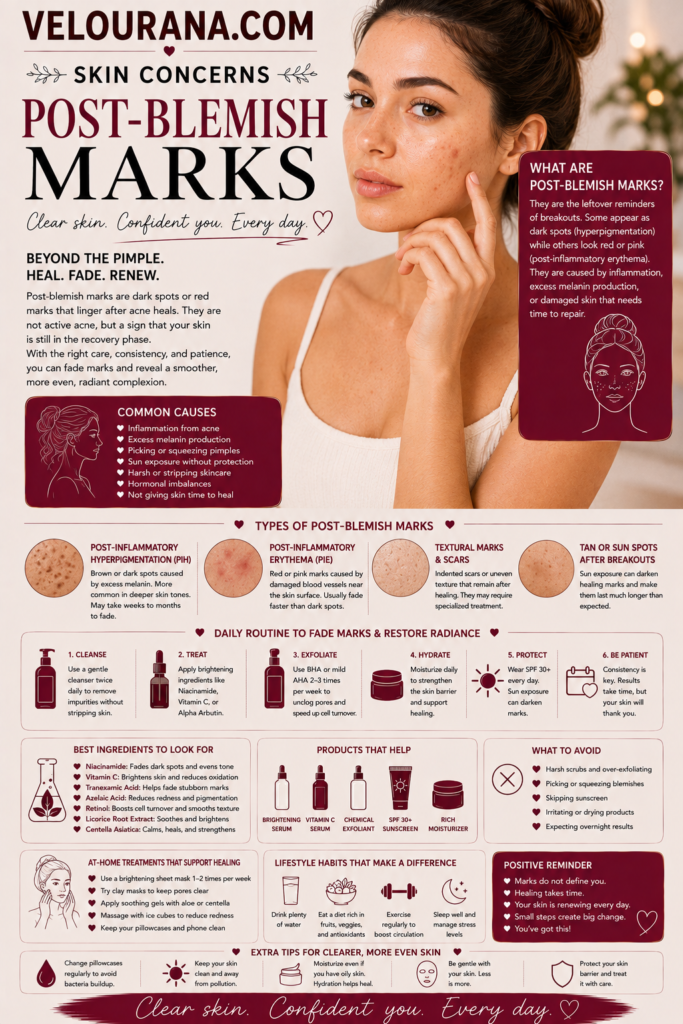
CATEGORY: Post-Blemish Marks
There is a peculiar moment in the life of a blemish when the problem appears to be over, yet its presence has not entirely disappeared. The swelling subsides. Tenderness fades. The raised lesion flattens and the skin closes. But in precisely the place where the blemish once commanded attention, a red, pink, brown, purple, or greyish mark remains.
For many people, this aftermath becomes as frustrating as the acne itself. A breakout may last days, while the evidence it leaves behind can remain visible for weeks or months. When new blemishes continue to appear while older marks are still fading, the complexion can seem permanently affected even when the number of active lesions is relatively small.
Yet the term post-blemish mark describes several different biological processes, and understanding those differences changes the way they should be approached. Most flat marks left after acne are not true scars. The American Academy of Dermatology distinguishes these areas of lingering discoloration from permanent acne scarring: flat pigmented spots following acne are generally post-inflammatory changes and can fade with time, whereas scars involve structural alterations to the skin.
That distinction is more than reassuring terminology. It explains why patience matters, why preventing new inflammation is as important as treating existing discoloration, why aggressive attempts to erase marks can sometimes make them worse, and why successful skincare must work with the skin's recovery process rather than constantly provoking it.
Post-blemish care is therefore not simply about removing a spot. It is about understanding what the spot represents.
The Blemish May Be Gone, but the Inflammatory Story Continues
Acne is an inflammatory disorder. Even a relatively ordinary pimple represents a complicated sequence involving the follicle, sebum, accumulated cells, microorganisms, immune activity and inflammatory signalling. What is visible on the surface is only part of that process.
When the active lesion resolves, the skin does not instantly return to its previous state. Repair continues beneath the surface. Blood vessels that became more prominent during inflammation may remain visible for a period. Pigment-producing cells may have responded to inflammatory signals by increasing melanin production. In more severe lesions, collagen architecture may have been altered as tissue was damaged and rebuilt.
This is why two blemishes that initially looked similar can leave entirely different traces.
One may disappear almost completely within a few days. Another may leave a pink area. Another may produce a dark brown mark. A deeper inflammatory lesion may eventually leave an indentation. Skin tone, inflammation intensity, depth of the lesion, manipulation of the blemish, sun exposure and individual biological tendencies can all influence what remains.
Research increasingly treats acne-associated pigmentation as a significant part of acne itself rather than an insignificant cosmetic afterthought. A 2026 review describes both acne-induced hyperpigmentation and acne-related macular erythema as common consequences of acne inflammation and notes that these changes can persist for months or even years in some people.
The first principle of post-blemish care follows naturally: before trying to fade what remains, identify what actually remains.
Red, Pink and Purple Marks Are Not Necessarily Pigment
A flat red or pink mark following a blemish is frequently described casually as hyperpigmentation, but redness and pigmentation are not always the same phenomenon.
After inflammatory acne, vascular changes can remain visible even after the raised lesion has disappeared. This persistent redness is commonly referred to as post-acne erythema or post-inflammatory erythema. It can appear pink, red, reddish-purple or deeper purple depending on skin tone, the intensity of the original inflammation and the vascular response of the skin.
A systematic review of post-acne erythema describes it as persistent erythematous change following acne inflammation and notes that while some lesions improve naturally, persistent cases may require different therapeutic approaches from those used primarily for pigment.
This distinction matters because melanin-targeting ingredients are designed primarily to influence pigmentation pathways. They cannot be expected to address every form of redness through exactly the same mechanism.
The appearance of post-acne erythema can also fluctuate. Heat, exercise, hot showers or anything that temporarily increases blood flow may make a mark look stronger. On another day, under different conditions, the same area may appear calmer. That variability can be confusing when someone is attempting to judge whether a skincare routine is working.
Redness also illustrates why skincare escalation can become counterproductive. A person notices a stubborn red mark, assumes stronger exfoliation will remove it faster, increases the frequency of acids or retinoids, irritates the surrounding skin and consequently creates more visible redness. The treatment then begins producing part of the problem it was intended to solve.
Effective post-blemish care requires enough restraint to distinguish persistent evidence of previous inflammation from new inflammation caused by the routine itself.
Brown and Grey Marks Tell a Different Story
When inflammation stimulates pigment production, the result can be post-inflammatory hyperpigmentation, often abbreviated as PIH.
Melanocytes—the cells responsible for producing melanin—can respond to inflammatory signalling by increasing pigment production or altering pigment distribution. After the blemish resolves, excess pigment remains visible where the inflammation occurred.
The result may appear tan, brown, dark brown, purple-brown, blue-grey or greyish depending partly on natural skin tone and the depth at which pigment is located.
Post-inflammatory hyperpigmentation can occur across skin tones, but it is particularly prominent and persistent in darker phototypes. A recent review reported that acne-induced hyperpigmentation is especially common among Fitzpatrick phototypes IV–VI. This helps explain why acne management cannot be separated from pigmentation management for many people: preventing inflammatory lesions also means preventing the marks those lesions are likely to leave.
PIH can also develop after surprisingly modest acne. Severe cystic acne is not required. Research has noted that acne-induced PIH may occur even when obvious clinical inflammation seems relatively limited.
This can create the impression that the skin marks extremely easily. In reality, the visible blemish may simply underestimate the inflammatory activity occurring within the skin.
Once pigment has been produced, fading is usually gradual. Epidermal pigment can diminish as normal cellular turnover redistributes and removes melanin-containing cells. Deeper pigment may take considerably longer.
This is why photographs taken several months apart can reveal improvement that seemed almost invisible from one morning to the next. Skin recovery rarely follows the dramatic timetable promised by aggressive beauty marketing. It tends to be incremental.
A Mark and a Scar Are Fundamentally Different
One of the most useful distinctions in acne care is also one of the most frequently misunderstood: discoloration is not necessarily scarring.
Run a clean fingertip gently across a flat post-blemish mark and the skin may feel essentially normal. Its colour has changed, but its architecture has not necessarily been permanently altered.
A scar is different.
True acne scarring involves structural changes in the skin. When inflammation damages deeper tissue, collagen repair may produce too little tissue, creating depressed scars, or excessive tissue, creating raised scars. These changes alter texture rather than merely colour.
Indented acne scars may appear as narrow, deep pits, broader depressions or rolling irregularities. Raised scars may become firm or thickened. Such structural changes behave differently from flat pigmentation and generally require different therapeutic strategies.
The American Academy of Dermatology specifically notes that flat areas of pigmentation after acne are usually not scars and that these spots tend to fade, although the process can take time.
The difference can be particularly important psychologically.
Someone looking in the mirror at dozens of dark marks may believe that their skin has become permanently scarred. If those marks are predominantly flat PIH, the long-term outlook may be very different. Conversely, someone repeatedly purchasing brightening products for deep textural scars may become frustrated because pigmentation products cannot rebuild significant structural depressions.
Some people have both.
A single area can contain residual pigment and an underlying scar, while different lesions across the face may leave different types of aftermath. Once this is recognised, treatment becomes less about finding one miracle ingredient and more about matching strategies to the biological problem.
The Most Effective Strategy Begins Before the Mark Exists
There is an obvious temptation to divide acne care into two phases: first eliminate the blemish, then treat the mark.
Biology does not divide itself quite so neatly.
Every new inflammatory lesion creates another opportunity for persistent discoloration. If five old marks fade while five new blemishes create five new marks, the complexion can appear unchanged despite genuine improvement in individual spots.
For this reason, successful management of post-blemish marks usually requires simultaneous attention to active acne.
A 2023 dermatologist consensus on acne-associated hyperpigmentation emphasized three interconnected objectives: controlling existing acne, preventing new acne and reducing existing pigmentation while avoiding irritation that might create additional pigmentation.
This concept transforms the treatment strategy.
Imagine a bathtub with the drain open while the tap continues running. Trying to empty it exclusively by enlarging the drain is inefficient if water continues pouring in. Treating pigmentation without reducing the formation of inflammatory acne follows the same logic.
The skin needs fewer inflammatory events.
This also means resisting behaviours that intensify those events. Squeezing, digging, scratching and repeatedly touching blemishes can increase trauma and prolong inflammation. The momentary satisfaction of extracting a lesion can exchange a temporary bump for a longer-lasting mark.
Picking can also create wounds that extend beyond the original acne lesion. The resulting mark may therefore reflect not merely the acne but the additional mechanical injury inflicted upon it.
A calmer relationship with active blemishes is one of the least glamorous but most valuable elements of post-blemish prevention.
Why Sunlight Changes the Equation
A fading routine that ignores sun protection is working against one of the most important external influences on pigmentation.
Ultraviolet radiation stimulates melanogenesis—the biological process through which melanin is produced. For skin already prone to post-inflammatory pigmentation, repeated exposure can contribute to persistence or darkening of marks.
This does not mean that a person must fear daylight or attempt to live permanently indoors. It means that photoprotection belongs inside the pigmentation strategy rather than being treated as an unrelated anti-ageing step.
A broad-spectrum sunscreen appropriate for the individual's skin and environment can help reduce the influence of UV exposure while other parts of the routine address acne and discoloration.
Consistency matters more than theatrical application followed by neglect. Sunscreen that feels intolerably heavy, causes stinging, pills under makeup or contributes to breakouts is unlikely to become a sustainable daily habit. Finding a formulation compatible with acne-prone skin can therefore be as important as selecting a theoretically ideal ingredient.
Visible light may also be relevant to hyperpigmentation, particularly in darker skin tones, which is one reason tinted sunscreens containing iron oxides are sometimes incorporated into pigmentation-focused dermatological strategies.
Sun protection does not erase existing marks overnight. Its role is more subtle and arguably more important: it creates a more favourable environment in which fading can occur without repeatedly adding a pigmentation stimulus.
In other words, treatment encourages the skin to move forward while photoprotection helps prevent it from being pulled backward.
Brightening Is Not the Same as Bleaching
The language surrounding pigmentation has historically encouraged an unnecessarily aggressive mentality. Words such as erase, strip, bleach and remove suggest that healthy skin must somehow be forced into submission.
Modern pigmentation care is better understood as regulation.
Different topical ingredients influence different stages of pigmentation, inflammation and epidermal renewal. Some interfere with enzymes involved in melanin production. Some influence the transfer or distribution of pigment. Some accelerate cellular turnover. Others reduce inflammation while simultaneously affecting pigmentation pathways.
Azelaic acid is particularly interesting in acne-prone skin because it occupies several of these territories at once. It can be useful in acne management while also influencing pigmentation and inflammation. Retinoids likewise have an established role in acne treatment and can contribute to gradual improvement in uneven pigmentation through their effects on cell turnover and other skin processes.
Other commonly used pigmentation-supporting ingredients include niacinamide, vitamin C derivatives, alpha hydroxy acids and, in appropriately supervised contexts, stronger depigmenting agents.
But the longest ingredient list does not necessarily produce the fastest result.
A routine containing a retinoid, strong exfoliating acid, concentrated vitamin C, multiple brightening serums and frequent peeling treatments may look sophisticated on paper. On reactive acne-prone skin, however, it can become an irritation machine.
The paradox is important: inflammation contributes to post-inflammatory pigmentation, so an excessively irritating pigmentation routine can create conditions that encourage further discoloration.
More treatment is not automatically more progress.
The Skin Barrier Is Part of the Fading Strategy
The skin barrier is sometimes discussed as though it were a fashionable skincare concept rather than a fundamental biological structure. In reality, an intact stratum corneum helps regulate water loss and protects the living layers beneath it from environmental exposure.
When a post-blemish routine becomes too aggressive, barrier disruption can manifest as tightness, burning, peeling, persistent redness, unusual sensitivity or discomfort from products that previously felt harmless.
This matters particularly when active acne treatments are already present. Benzoyl peroxide, retinoids, salicylic acid and other effective acne ingredients can be drying or irritating depending on formulation, concentration, frequency and individual tolerance. Adding several pigmentation treatments simultaneously may push the skin beyond what it can comfortably accommodate.
A thoughtful routine therefore includes apparently ordinary products for strategic reasons.
Gentle cleansing limits unnecessary stripping. Moisturizer supports hydration and barrier function. Sunscreen reduces an important pigmentation stimulus. Active ingredients are then introduced within this stable framework rather than replacing it.
This architecture may seem less exciting than an overflowing shelf of treatment serums, but it creates something more valuable: consistency.
A moderate treatment used reliably for six months can accomplish far more than an extreme routine repeatedly abandoned because the skin becomes irritated.
Barrier care is not a pause from treating post-blemish marks. It is part of treating them intelligently.
The Search for Speed Can Become the Greatest Obstacle
Post-blemish marks are especially vulnerable to impatience because their progress is difficult to perceive.
A blemish changes visibly from day to day. It becomes swollen, develops, resolves and flattens. Pigmentation behaves differently. A dark mark may look almost identical for weeks before gradually becoming lighter.
That slow visual feedback encourages escalation.
Someone uses a product for ten days, sees no dramatic transformation and adds another. Two weeks later, another acid enters the routine. Soon exfoliation happens daily, the skin becomes irritated and the original problem is obscured by redness, dryness and new blemishes.
This cycle is one reason realistic expectations matter.
Clinical reviews of PIH treatments show that improvement is possible but complete clearance is far from guaranteed with any single modality. A systematic review covering 41 studies and 877 patients found considerably more partial responses than complete responses across commonly studied topical, combination and procedural treatments.
That does not mean treatment is ineffective. It means pigmentation biology is gradual and variable.
The better question is not, Why hasn't this disappeared yet?
It is, Is the overall direction improving?
Monthly photographs taken in similar lighting can sometimes answer that question better than daily inspection. The human eye adapts rapidly to familiar features, and staring at the same mark every morning makes incremental change extraordinarily difficult to notice.
Progress may be occurring long before it feels dramatic.
When Professional Treatments Enter the Conversation
Some post-blemish concerns eventually exceed what a home routine can reasonably address.
Dermatologists may use prescription medications, chemical peels, microneedling, vascular lasers, pigment-targeting lasers and other energy-based procedures depending on whether the primary concern is active acne, erythema, pigmentation, texture or a combination of these.
The correct treatment depends heavily on diagnosis.
Persistent redness is not identical to epidermal hyperpigmentation. Deep pigment is not identical to superficial pigment. An atrophic scar is not a dark mark. A raised scar is not treated like either.
This is particularly important with procedural treatments because greater intensity does not guarantee a better result. Lasers and peels intentionally interact with skin tissue, and inappropriate treatment parameters can provoke inflammation and, in susceptible skin, additional post-inflammatory pigmentation. The dermatologist consensus literature specifically recognises the possibility that procedures themselves can aggravate pigmentation, particularly in skin of colour.
A systematic review of PIH treatments likewise found that while laser and energy-based treatments produced improvement for many participants, worsening of PIH occurred in a small proportion of treated patients.
Professional treatment should therefore not be imagined simply as a stronger version of skincare.
It is a different level of intervention requiring diagnosis, appropriate device or treatment selection, consideration of skin phototype, understanding of risks and careful adjustment of treatment intensity.
For persistent post-acne erythema, vascular-focused devices have been among the most studied procedural approaches, although the evidence base remains imperfect and there is no universal gold-standard treatment.
For textural acne scars, still other procedures may be appropriate.
The essential principle remains the same throughout: treat what is actually present rather than what it resembles in the bathroom mirror.
A Sustainable Routine Has a Clear Hierarchy
Post-blemish skincare becomes easier when every product has a defined purpose.
The foundation is uncomplicated: cleanse without unnecessarily irritating the skin, maintain adequate moisturization and use appropriate daily photoprotection.
Above that foundation sits acne control. Depending on the person's acne type and tolerance, this may involve ingredients such as salicylic acid, benzoyl peroxide, azelaic acid or a retinoid, with prescription treatment appropriate for some cases.
Pigmentation-focused treatment can then be incorporated according to the nature of the marks and the tolerance of the skin.
The order matters conceptually even when the exact products vary.
If active acne remains uncontrolled, pigmentation treatment is continually chasing new damage. If the barrier is chronically irritated, treatment becomes difficult to tolerate. If sun exposure is ignored, pigmentation receives an additional stimulus. If every active ingredient is introduced simultaneously, it becomes almost impossible to identify which product is helping and which is causing trouble.
Simplicity therefore does not mean doing nothing.
It means creating enough structure that each intervention can actually perform its job.
A person might use only a few carefully selected products and have a more sophisticated routine than someone using fifteen. Sophistication in skincare is not measured by the number of bottles. It is measured by how accurately the routine corresponds to the biology of the skin.
The Emotional Weight of Marks Deserves Recognition
Post-blemish marks occupy a strange psychological territory. The acne appears to have ended, so other people may assume the problem has ended too. Yet the person experiencing it continues seeing evidence of every previous breakout.
This can alter behaviour.
Some people become reluctant to leave home without foundation. Others repeatedly inspect their skin in magnifying mirrors or photograph it under harsh lighting. A single new blemish can feel disproportionately upsetting because it represents not only several days of acne but potentially months of discoloration afterward.
Research on acne-associated pigmentation acknowledges that its effect on quality of life can be substantial, and recent reviews note that residual pigmentation may sometimes trouble patients as much as, or even more than, active acne.
That concern should not be dismissed as vanity.
The face is central to social interaction and self-perception. Persistent visible changes can affect confidence even when they are medically harmless.
At the same time, post-blemish care becomes healthier when the skin is viewed across longer periods rather than evaluated blemish by blemish.
The complexion seen today is not a permanent photograph. It is tissue in motion.
Inflammation resolves. Pigment is processed. Epidermal cells turn over. Vascular responses settle. Treatments gradually influence these processes. New lesions can be prevented. Professional interventions exist when home care reaches its limits.
The marks visible now are part of the skin's recent history, not necessarily its permanent future.
Learning to Read What the Skin Is Leaving Behind
The most important shift in approaching post-blemish marks is moving away from the idea that every trace of acne is the same problem.
A flat brown area may represent post-inflammatory hyperpigmentation. A persistent pink or red area may reflect post-inflammatory erythema. An indentation represents structural tissue change. A raised area may represent another form of scarring. Several of these can coexist.
Once these differences are understood, the strategy becomes more coherent.
Prevent unnecessary inflammation. Control ongoing acne. Avoid picking. Protect the skin from excessive ultraviolet exposure. Introduce targeted ingredients according to tolerance rather than attempting to overwhelm pigmentation with every active available. Preserve the barrier. Give biological processes enough time to respond. Seek dermatological assessment when marks are persistent, diagnosis is uncertain, acne remains difficult to control or structural scarring is present.
Perhaps most importantly, recognise that fading is rarely an event.
It is a direction.
One morning does not usually reveal the moment a post-blemish mark disappeared. Instead, the border becomes less distinct. The colour loses intensity. Makeup covers it more easily. Photographs show that an area that once dominated the complexion has become quieter. Eventually, a mark that received daily attention is no longer the first thing the eye notices.
That gradual disappearance reflects what the skin has been doing all along: recovering.
The best post-blemish routine respects that recovery. It does not demand that the skin repair itself overnight, nor does it confuse irritation with effectiveness. It reduces the causes of new marks while creating favourable conditions for old ones to fade.
Acne may leave a visible memory behind, but a mark is not always a scar, and today's discoloration is not necessarily tomorrow's complexion.
The End Velourana
 Discover More From Our Family of Websites
 ZodiacBearing (Astrology, Tarot, Numerology, Angel Numbers & Spiritual Guidance)
 Velourana (Beauty, Makeup, Hair Care, Skincare & Beauty Tips)
 HavenBearing (Home, Living, Organization, Décor & Everyday Inspiration)
 PawBearing (Pet Care, Dog Breeds, Animal Health, Training & Pet Products)
 PsyCatherine (Notes From the Journal of a Psychologist on Real Life)

