
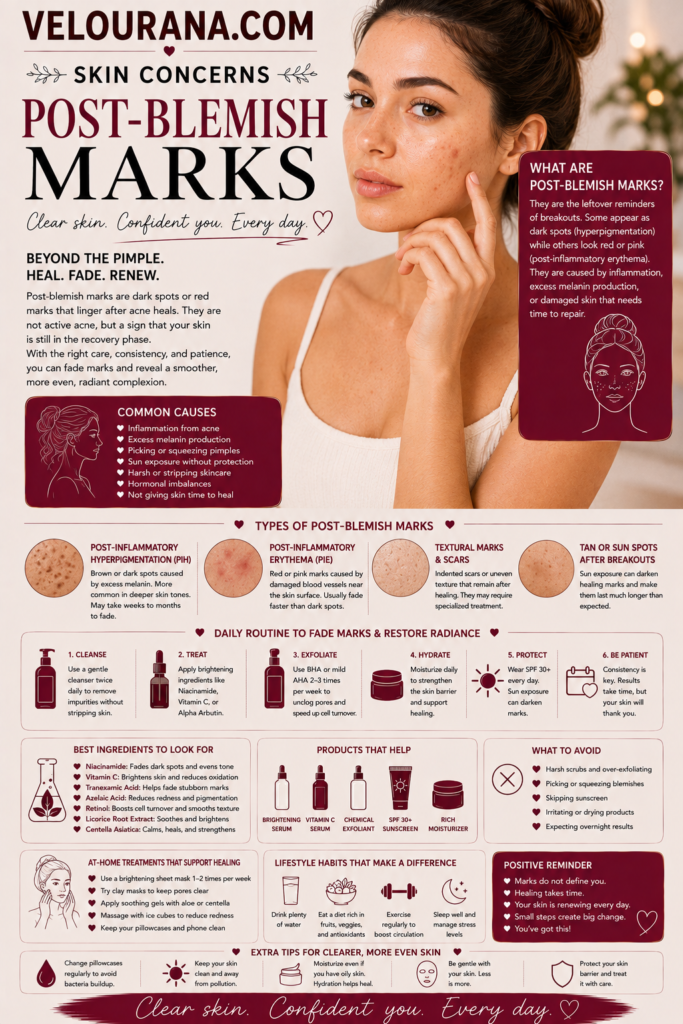
CATEGORY: Post-Blemish Marks
Post-blemish marks are often described as though they were a single, predictable consequence of acne. A blemish appears, inflammation settles, and a dark spot remains. But that simplified story misses one of the most important realities of post-acne skin: the aftermath can look, behave, and persist very differently depending on the complexion in which it develops.
On fair skin, a recent blemish may leave behind a pink or red area that remains visible long after the bump itself has disappeared. On medium and olive complexions, the same type of inflammatory event may produce a mixture of redness and brown discoloration. On deeper skin tones, lingering marks can appear brown, deep brown, violet, slate, or greyish and may remain more conspicuous for longer periods.
These differences do not mean that one skin tone heals and another does not. They reflect differences in how inflammation, blood vessels, melanocytes, and visible colour interact.
Understanding that interaction matters because post-blemish care cannot be reduced to one universal approach. A routine that makes sense for persistent redness may be poorly matched to predominantly melanin-driven discoloration. An aggressive treatment tolerated by one complexion may trigger additional pigmentation in another. A mark that looks dark may be superficial pigment, deeper pigment, vascular change, or a combination of several processes.
The central challenge is therefore not simply to make a mark lighter.
It is to understand what kind of mark the skin is producing and why.
The Same Blemish Can Leave a Different Visual Memory
Acne begins with broadly similar mechanisms across skin tones: changes within the follicle, sebum production, keratinisation, microbial activity, and inflammation. Yet the visible aftermath of that inflammation is influenced heavily by the skin's baseline pigment biology.
Melanin is produced by melanocytes and transferred to surrounding keratinocytes. People of different skin tones do not necessarily differ dramatically in the number of melanocytes they possess; much of the visible variation in complexion is related instead to melanosome size, distribution, activity, and the way melanin is produced and retained.
Inflammation can disturb this system.
When acne triggers inflammatory signalling, melanocytes may increase pigment production. In a complexion with more active baseline melanogenesis, the resulting post-inflammatory pigmentation can be particularly noticeable.
This is one reason acne can feel like a two-stage condition in darker skin tones.
The first stage is the active blemish.
The second is the mark that remains after it.
For some people, that second stage lasts considerably longer than the first and may become the dominant cosmetic concern even when active acne itself is relatively mild.
This experience can be confusing if skincare advice focuses almost entirely on clearing pimples. A treatment may successfully reduce the number of inflammatory lesions while the complexion still appears uneven because older pigmentation remains visible.
The acne may be improving faster than the skin's colour is returning to baseline.
Why Deeper Skin Tones Can Be More Prone to Persistent Pigment
Post-inflammatory hyperpigmentation occurs when inflammation stimulates excess melanin production or changes the distribution of pigment within the skin.
This process can occur in any complexion, but darker phototypes generally have a greater tendency to develop noticeable and persistent PIH.
The reason is not that darker skin is somehow more fragile.
In many respects, it may be remarkably resilient. The difference lies in pigment responsiveness.
Melanocytes in highly pigmented skin are capable of producing substantial amounts of melanin. When inflammatory mediators activate these cells, the pigmentary response can therefore be visually prominent.
The original acne lesion does not always need to be severe.
A small inflammatory papule may leave a mark disproportionately darker than the blemish seemed to justify. Repeated mild acne can consequently create a complexion covered in residual pigmentation even when severe cystic disease is absent.
This has an important therapeutic implication.
Reducing inflammation early matters.
The longer a lesion remains inflamed, the more opportunity there may be for pigmentary disturbance. Picking, squeezing, scrubbing, and irritating a lesion can therefore be particularly costly for someone whose skin readily responds to inflammation with pigment.
The objective is not merely to clear acne.
It is to clear acne while disturbing the skin as little as possible.
Redness Is Easier to See in Some Skin and Easier to Miss in Others
Post-inflammatory erythema is often discussed in relation to lighter complexions because vascular redness is more visually obvious when there is less overlying melanin.
A fair complexion may show a vivid pink or red mark after almost every inflammatory lesion.
In deeper skin tones, vascular change can still occur, but it may not appear bright red. It may instead look burgundy, violet, dusky, or simply darker than the surrounding skin.
This creates a diagnostic challenge.
A mark can be assumed to be purely hyperpigmented when a vascular component is also present.
That matters because pigment-targeting ingredients and vascular-targeting treatments do not work through identical pathways.
The complexity increases further because some marks genuinely contain both components.
Inflammation may stimulate melanin production while also leaving persistent vascular dilation. The resulting area can therefore contain overlapping brown, red, or purple tones.
A person may notice that the mark becomes more visible after exercise, during hot weather, or following a hot shower. That temporary intensification may suggest a vascular contribution because increased blood flow can amplify redness.
The lesson is not that people should diagnose themselves by colour alone.
It is that "dark mark" is an imprecise description.
Skin colour contains information, but it requires interpretation.
Olive and Medium Complexions Often Sit Between Two Patterns
Medium and olive skin tones can experience a particularly mixed form of post-blemish aftermath.
A fresh lesion may initially leave pinkness or muted redness. As that vascular component fades, brown or tan pigmentation may become more obvious. In some cases, both remain visible together for a period.
This can create the impression that the mark is changing colour over time.
It often is.
Early inflammation can be dominated visually by vascular activity. Later, residual pigment becomes the more noticeable component.
That transition can influence how treatment is perceived.
A person may believe a product is making the mark darker when in reality the bright red phase is settling and revealing underlying brown pigmentation that had already been present.
Conversely, a brown mark can appear less intense while subtle redness remains.
This is one reason post-blemish marks are best evaluated over longer periods rather than judged from daily visual fluctuations.
Lighting matters enormously as well.
Warm indoor light can reduce the apparent intensity of redness while making brown pigmentation more prominent. Cool daylight can do the opposite. Phone cameras apply automatic processing that can exaggerate or suppress both.
The skin may not be changing as dramatically as the photograph suggests.
Consistent conditions are therefore essential when monitoring progress.
Melanin Is Protective, but the Same System Can Create Unevenness
Melanin is sometimes treated in pigmentation discussions as though it were a problem to be removed.
That framing is biologically misleading.
Melanin is part of the skin's protective response to radiation and contributes to the extraordinary range of natural human skin colours.
The difficulty in post-inflammatory hyperpigmentation is not the presence of melanin itself.
It is its uneven distribution and overproduction in response to inflammation.
This distinction matters philosophically as well as practically.
A good pigmentation routine should aim to reduce abnormal contrast between the mark and surrounding skin, not to suppress healthy natural complexion.
This is why aggressive "bleaching" language is increasingly inappropriate.
Modern brightening strategies focus more intelligently on regulating excessive pigment production, reducing inflammatory triggers, supporting turnover, and protecting the skin from stimuli that can perpetuate discoloration.
The goal is equilibrium.
Not erasure of natural colour.
Why Irritation Can Be More Expensive in Pigment-Prone Skin
One of the most important principles in treating post-blemish marks across darker complexions is that irritation can create exactly the problem treatment is attempting to solve.
Strong acids, harsh scrubs, aggressive peels, excessive retinoid use, and incompatible ingredient combinations can all provoke inflammation.
In a skin type prone to post-inflammatory hyperpigmentation, that inflammation may produce new pigmentation.
This creates a frustrating paradox.
The person increases treatment intensity because the mark is persistent.
The skin becomes irritated.
The irritation stimulates additional pigment.
The mark appears darker or new discoloration develops.
Treatment is intensified again.
At that point, the skincare routine has become an inflammatory cycle.
Breaking that cycle often requires reducing complexity rather than adding strength.
A calmer routine does not mean abandoning effective ingredients.
It means using them in a way the skin can tolerate consistently.
Tolerance is not a secondary concern.
It is part of treatment efficacy.
Stronger Is Not Always Better
Skincare culture often rewards intensity.
High percentages sound more advanced. Peeling feels active. Tingling is interpreted as proof that something is happening.
But pigment biology does not reward theatrical discomfort.
A lower-strength formulation used consistently may produce a better long-term outcome than a stronger product that repeatedly causes dermatitis or inflammation.
This is particularly relevant with exfoliating acids and retinoids.
Both can be useful in acne and pigmentation care. Both can also irritate the skin when introduced too quickly or used too often.
The appropriate frequency is individual.
Some skin tolerates nightly retinoid use after an adaptation period. Other skin performs better with several applications per week. Some people use acids comfortably alongside retinoids. Others need to separate them.
There is no prestige attached to using the highest tolerated dose.
The only meaningful question is whether the routine improves the skin without creating unnecessary injury.
Post-Blemish Marks Can Appear Deeper Than They Are
Colour perception on darker skin can be deceptive because contrast behaves differently.
A brown mark on fair skin may look clearly superficial. The same degree of excess pigment on deep skin may appear visually denser because of the way colour interacts with the surrounding complexion.
This can lead people to assume that a mark is permanent or "deep" when it may still be predominantly epidermal.
At the same time, truly deeper pigment can appear grey, blue-grey, or slate-like, particularly when melanin or pigment-laden cells are located in the dermis.
The distinction matters because deeper pigment generally fades more slowly.
A superficial epidermal mark may respond gradually to turnover and topical treatment.
A deeper dermal component may be more persistent and sometimes requires professional assessment.
Trying to judge depth purely from colour at home is difficult.
This is one of the situations in which dermatological evaluation can prevent months of misplaced treatment.
The Role of Sunlight Is Not Equal Across All Skin Tones
There is a persistent misconception that naturally deeper skin requires little or no sun protection because melanin provides some inherent photoprotection.
Melanin does provide meaningful natural protection.
It does not make skin immune to ultraviolet damage or pigmentation changes.
For someone managing post-inflammatory hyperpigmentation, repeated UV exposure can contribute to persistence of discoloration.
Visible light may also play an important role in pigmentation, particularly in darker skin tones.
This is why tinted sunscreens containing iron oxides are sometimes recommended in pigmentation-focused dermatology. Iron oxides can help attenuate portions of visible light that conventional untinted sunscreens may not address as effectively.
That does not mean every person with post-blemish marks must use a tinted product.
Cosmetic acceptability matters.
A sunscreen that leaves a grey cast, looks unnatural on deeper skin, or feels unpleasant will probably not be used consistently.
Modern sunscreen selection therefore becomes both a biological and aesthetic problem.
Protection must be effective.
The finish must also respect the complexion.
White Cast Is More Than a Cosmetic Irritation
Traditional mineral sunscreens can leave a visible white film because zinc oxide and titanium dioxide scatter light.
On very fair skin, this may be barely noticeable.
On medium and deeper complexions, the same residue can appear chalky, ashy, lavender, or grey.
This matters because adherence is central to photoprotection.
If sunscreen visibly distorts someone's complexion, they are less likely to use enough of it or reapply it.
A technically excellent formulation can therefore fail in practice.
Tinted mineral sunscreens, micronised formulations, hybrid filters, and modern organic filters have expanded the range of cosmetically acceptable options.
The objective should be to find a product that does not make daily use feel like a compromise.
Photoprotection only works when it is actually worn.
Acne Treatment Must Be Chosen With Pigmentation Risk in Mind
The ideal acne treatment is not simply the one that clears lesions fastest.
It is the one that clears them effectively while minimising secondary damage.
This is particularly important in pigmentation-prone skin.
A highly irritating acne regimen may reduce comedones but produce persistent inflammation, dryness, and PIH. A more balanced regimen may achieve a slower initial change while delivering a better overall complexion several months later.
This is where ingredients with overlapping benefits become useful.
Azelaic acid can help address acne, inflammation, and pigmentation.
Retinoids can prevent follicular blockage and improve cell turnover.
Salicylic acid can assist with comedonal congestion and exfoliation.
Benzoyl peroxide can be highly effective against inflammatory acne but requires careful use because dryness and irritation may occur.
The exact combination should depend on the acne pattern, skin tolerance, existing pigmentation, and whether prescription treatment is needed.
The broader principle is simple.
Acne control and mark prevention should be planned together.
Why Picking Can Leave a Stronger Signature on Deeper Skin
Squeezing a blemish creates extra trauma regardless of skin tone.
But the cosmetic consequence can be particularly striking in pigment-responsive skin.
Mechanical pressure can rupture the follicle, damage surrounding tissue, and prolong inflammation. Fingernails can injure the epidermis and create wounds beyond the boundaries of the original lesion.
The skin then repairs both acne inflammation and physical trauma.
For someone prone to PIH, that added inflammatory burden may produce a darker, larger, or longer-lasting mark.
A lesion that might have resolved with minimal residual colour can become a conspicuous brown or purple spot.
This is why repeated picking often creates a misleading impression that the acne itself is unusually severe.
The residual marks may reflect both the disease and the response to it.
Reducing manipulation can substantially improve the long-term appearance of acne even before the number of breakouts changes.
Makeup Can Help Without Interfering With Recovery
Post-blemish marks can remain visible long enough that waiting for biological fading alone may not satisfy someone's immediate cosmetic needs.
Makeup provides a practical bridge.
A concealer matched carefully to skin tone can reduce the contrast of individual marks without affecting the recovery process beneath.
Colour-correcting techniques may also help.
Peach or orange tones can counteract blue-grey or deep brown discoloration in some complexions. Green correction may reduce the appearance of prominent redness in lighter skin, although the technique must be subtle to avoid creating unnatural tones.
The objective is not to hide the skin because it is unacceptable.
It is to provide control over appearance while treatment takes time.
That psychological benefit matters.
A person who knows they can cover a mark effectively may feel less pressure to attack it aggressively with skincare.
Sometimes cosmetic camouflage indirectly protects the skin by reducing impatience.
Foundation Matching Becomes More Complex With Uneven Pigment
Persistent post-blemish marks can complicate foundation selection because the face may no longer appear uniformly toned.
Matching foundation directly to the darkest marks can make the overall complexion look too deep.
Matching only to the lightest areas can leave the pigmentation looking even more conspicuous.
A better approach is usually to match the general surrounding skin tone and use targeted concealer on areas requiring extra coverage.
This preserves dimension and prevents the entire face from being overcorrected.
Undertone also matters.
Olive, golden, neutral, red, and cool undertones can all influence how pigmentation reads through makeup.
The same brown mark may appear more purple against one undertone and more grey against another.
Cosmetic correction is therefore not separate from understanding skin tone.
It is another expression of it.
Professional Treatments Require Particular Care in Skin of Colour
Chemical peels, lasers, microneedling, and other procedures can improve post-acne pigmentation and scarring.
But in darker skin tones, procedural treatment requires especially careful calibration because excessive inflammation can trigger new PIH.
This does not mean people with deeper skin should avoid procedures.
It means provider experience matters.
Laser wavelength, energy settings, pulse duration, peel strength, pretreatment, aftercare, and the individual's history of pigmentation all influence risk.
A practitioner who regularly treats a broad range of skin tones is more likely to appreciate these variables.
The wrong procedure performed too aggressively can exchange one mark for another.
The right procedure, selected carefully, can produce meaningful improvement.
Technique matters as much as technology.
Skin Tone Also Influences How Progress Is Perceived
The contrast between a post-blemish mark and surrounding skin determines how noticeable it appears.
A small absolute change in pigment may produce a dramatic visual improvement in one complexion and a subtle improvement in another.
This means progress cannot always be measured by asking whether the mark has disappeared.
A mark may remain visible but become substantially less contrasting.
Its edges may soften.
Its colour may shift closer to the surrounding skin.
Its appearance under natural daylight may improve even if it remains detectable under harsh overhead lighting.
These are real changes.
Demanding complete invisibility as the only definition of success can make meaningful progress feel inadequate.
The Skin Around the Mark Matters Too
It is easy to focus exclusively on the discoloured area.
But the surrounding skin strongly influences how visible the mark appears.
Dryness can make pigmentation look duller and more pronounced.
Redness around the mark can increase contrast.
Uneven texture can cast small shadows that exaggerate colour differences.
Improving overall skin health can therefore make post-blemish marks appear less prominent even before the pigment itself has completely faded.
Hydration, barrier support, controlled acne, and smoother texture all contribute to a more even visual field.
This is another reason post-blemish care should not become a spot-treatment obsession.
The complexion is an ecosystem.
Treating the surrounding skin well changes how the mark is perceived.
Patience Does Not Mean Passive Waiting
The advice to "be patient" can sound dismissive when someone has been looking at the same dark mark for months.
Patience should not mean doing nothing.
It means choosing interventions whose timelines respect biology.
Photoprotection can be used daily.
Acne can be actively treated.
Pigmentation-focused ingredients can be introduced.
Barrier health can be maintained.
Professional advice can be sought when needed.
What patience rejects is the expectation that intensity can compress every biological process into a few days.
The skin does not work on demand.
It responds progressively.
A Better Strategy Starts With the Complexion in Front of You
The most effective approach to post-blemish marks begins by abandoning the idea that all skin should be treated identically.
Fair skin may reveal vascular redness dramatically.
Deeper skin may show pigmentation more strongly.
Medium and olive complexions may move between both patterns.
Individual biology creates even more variation within these broad groups.
This means that skincare must be responsive rather than rigid.
A person whose primary issue is persistent redness may need a different emphasis from someone whose primary issue is deep brown PIH.
Someone with highly pigment-responsive skin may need to prioritise irritation control more aggressively.
Someone with stubborn recurrent acne may gain more from better acne management than from adding another brightening product.
Someone with mixed scarring and discoloration may need professional procedures alongside topical treatment.
The complexion itself should guide the strategy.
Every Skin Tone Can Recover, but Not on the Same Timeline
One of the most damaging myths surrounding post-blemish marks is the belief that darker pigmentation automatically means permanent damage.
It does not.
Many marks fade substantially.
They may simply require more time.
This is especially true when pigment is pronounced, inflammation was significant, or the skin continues experiencing new acne.
The objective is to reduce the forces that keep generating discoloration while supporting the processes that gradually remove it.
That means fewer inflammatory lesions.
Less picking.
More controlled use of active ingredients.
Reliable photoprotection.
A stable barrier.
Appropriate pigment-directed treatment.
And professional intervention when home care reaches its limits.
The skin may not return to perfect uniformity overnight, but uniformity is not the only measure of recovery.
A mark that becomes lighter, softer, less contrasting, and easier to conceal is already changing.
The complexion is moving.
That movement matters.
Post-Blemish Care Works Best When It Respects Individual Biology
Post-blemish marks expose a fundamental truth about skincare: the same condition does not look identical on every face.
Inflammation interacts with pigment.
Pigment interacts with vascular colour.
Both interact with baseline complexion.
This is why a red mark on fair skin and a deep brown mark on richly pigmented skin may share the same origin yet demand different emphases in care.
The most effective routines do not attempt to force every complexion into one standard response.
They work with the skin's natural tendencies.
They recognise that melanin is not the enemy.
Inflammation is the event that disrupts its distribution.
They recognise that irritation can perpetuate discoloration.
They recognise that sun and visible light can influence pigment persistence.
They recognise that treating active acne is essential to preventing new marks.
And they recognise that time remains part of the process.
Post-blemish skin is not failing to heal because it does not fade quickly.
It is healing according to its own biology.
Understanding that biology is what turns post-acne treatment from a battle against colour into a strategy for restoring balance.
The End Velourana
 Discover More From Our Family of Websites
 ZodiacBearing (Astrology, Tarot, Numerology, Angel Numbers & Spiritual Guidance)
 Velourana (Beauty, Makeup, Hair Care, Skincare & Beauty Tips)
 HavenBearing (Home, Living, Organization, Décor & Everyday Inspiration)
 PawBearing (Pet Care, Dog Breeds, Animal Health, Training & Pet Products)
 PsyCatherine (Notes From the Journal of a Psychologist on Real Life)

