
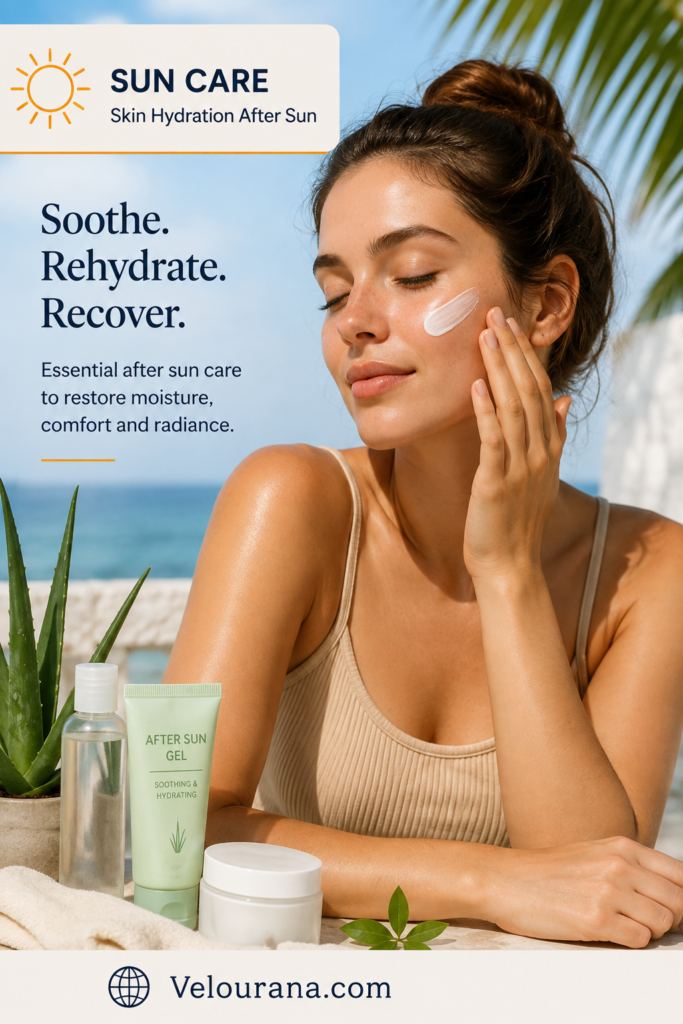
CATEGORY: Skin Hydration After Sun
The hours after sunset provide an ideal opportunity to restore comfort to skin that has spent the day dealing with heat, sunlight, perspiration, sunscreen, wind, salt water, chlorine, and changing humidity.
By evening, the complexion may feel tight even when it looks shiny. The shoulders may feel dry after swimming. The legs may seem rougher than they did in the morning. Air conditioning can add another layer of dryness just as the body begins to cool.
An overnight hydration routine can help.
This does not mean that nighttime skincare can reverse ultraviolet exposure. Moisturizers, serums, masks, and after-sun gels cannot undo UV damage. Their role is to support hydration, moisturization, and comfort after an environmentally demanding day.
The most effective evening routine is often surprisingly simple.
Cleanse carefully.
Cool the skin comfortably.
Provide water-rich hydration.
Add enough moisturizer for the skin type.
Treat exposed body areas with the same attention.
Then allow the skin to rest.
Why Evening Is Ideal for After-Sun Hydration
During the day, skincare has to coexist with sunscreen, perspiration, makeup, swimming, outdoor activities, and repeated reapplication of sun protection.
At night, those demands disappear.
Sunscreen can be removed completely.
The face can remain free of makeup.
A moisturizer can stay undisturbed for several hours.
This makes evening a convenient time to concentrate on comfort and hydration.
Start by Leaving the Heat Behind
If you have just returned from the beach, pool, garden, or another outdoor activity, do not immediately begin layering skincare onto hot, perspiring skin.
Move into a comfortable environment.
Allow the body to cool naturally.
Drink fluids as appropriate for your general hydration needs.
Then begin the skincare routine.
The transition from heat to comfort is part of after-sun care.
Take a Comfortably Cool Shower
A shower can remove the physical residue of the day.
Perspiration, sunscreen, salt, chlorine, sand, body products, and environmental particles can all remain on the skin.
Use comfortably cool or lukewarm water.
Extremely hot water may feel unpleasant when the skin already feels dry or warm.
There is also no need for an icy shower.
Gentle cooling is sufficient.
Rinse Salt Water Away
After swimming in the sea, salt can remain on the skin as water evaporates.
Some people find that this contributes to tightness.
Rinse thoroughly with fresh water.
There is no need to scrub aggressively.
Allow water and a gentle cleanser to do the work.
Rinse After the Swimming Pool
Pool water should also be rinsed from the skin.
Frequent swimmers may notice that their face and body become progressively drier when they repeatedly swim without following with moisturization.
A consistent post-swim routine can make a significant difference to comfort.
Remove Sunscreen Thoroughly
The face may have accumulated several applications of sunscreen during the day.
Water-resistant products in particular may require deliberate removal.
A cleansing oil, balm, micellar product, or other appropriate first cleanser may help dissolve sunscreen and makeup.
Follow with a gentle facial cleanser when necessary.
The objective is clean skin without excessive stripping.
Double Cleansing Is Not About Washing Harder
When double cleansing is appropriate, each step should remain gentle.
The first cleanser loosens oil-soluble residue such as makeup and sunscreen.
The second cleanses the remaining surface.
There is no advantage in rubbing aggressively.
Gentle technique is particularly important when the skin already feels sensitive after environmental exposure.
Do Not Chase a Squeaky-Clean Finish
Skin does not need to feel tight after cleansing to be clean.
If your face consistently feels uncomfortable immediately after washing, reconsider the cleanser, water temperature, or cleansing technique.
An overnight hydration routine works better when it begins with comfortable skin rather than skin that has been unnecessarily stripped.
Pat the Face Dry
Use a soft towel.
Pat rather than rub.
You can leave the skin slightly damp before applying the first hydrating product.
This can make a water-rich serum or essence feel particularly pleasant.
Begin With a Hydrating Mist if You Enjoy One
A facial mist is an optional first step.
A slightly cool mist can feel refreshing after cleansing.
Spray lightly and allow it to settle.
Do not assume that a mist alone provides enough lasting hydration for dry or dehydrated skin.
It is usually a preparatory or refreshing step.
Hydrating Toners Can Provide the First Layer
A hydrating toner can replace the mist.
Choose a formula intended primarily for hydration rather than aggressive exfoliation if the skin feels stressed.
Apply gently with clean hands or according to the product instructions.
One comfortable layer may be enough.
Essences Offer Another Lightweight Option
Essences can provide a slightly more substantial hydrating layer while remaining lighter than many serums and creams.
They are particularly useful for people who enjoy very lightweight summer skincare.
There is no need to use toner, essence, and mist together unless there is a specific reason.
Choose the format you prefer.
A Hydrating Serum Can Become the Core Treatment
For many people, one good hydrating serum is all that is needed between cleansing and moisturizer.
Look for a formula appropriate to the skin type.
Glycerin, hyaluronic acid, panthenol, beta-glucan, and similar ingredients are commonly used in hydrating products.
The complete formulation matters more than collecting every individual ingredient.
Glycerin Works Well Overnight
Glycerin is widely used because it can be incorporated into almost every skincare texture.
A lightweight glycerin serum can suit oily skin.
A richer moisturizer containing glycerin can suit dry skin.
This makes it particularly useful in an adaptable after-sun routine.
Hyaluronic Acid Can Provide Lightweight Hydration
Hyaluronic-acid serums often have a fresh gel or watery texture.
This can feel especially comfortable on a warm evening.
Apply a reasonable amount.
If the face remains sticky, using more is unlikely to solve the problem.
Reduce the quantity and follow with moisturizer where necessary.
Panthenol Fits Naturally Into After-Sun Skincare
Panthenol appears frequently in products designed around hydration and comfort.
It can be found in serums, gels, lotions, and creams.
A simple panthenol-containing serum can work particularly well when you want to avoid an elaborate active skincare routine after a demanding day outdoors.
Aloe Gel Can Provide Immediate Freshness
Aloe vera gel is one of the classic after-sun textures.
Its water-rich consistency can feel particularly refreshing after a shower.
If storage instructions allow, slightly cooling the product can enhance the experience.
Dry skin may still require moisturizer afterward.
Centella Products Can Be Lightweight
Centella asiatica is common in modern hydrating essences, serums, and gel creams.
These formulations often have textures well suited to warm weather.
If a centella product already works comfortably in your routine, it can fit naturally into evening after-sun care.
Do Not Layer Serums Simply Because You Own Them
It is easy to turn nighttime skincare into a collection of steps.
A hyaluronic-acid serum.
A panthenol serum.
A centella ampoule.
A niacinamide serum.
An aloe gel.
A separate essence.
Using everything at once is rarely necessary.
Choose the products that perform the functions you actually need.
Moisturizer Is Often the Essential Final Step
A hydrating serum can make the skin feel wonderful immediately after application.
The question is whether that comfort lasts.
Moisturizer can help maintain the hydration provided by earlier steps.
The correct texture depends on skin type and climate.
Water Gels for Oily Skin
Oily skin may prefer a water-gel moisturizer.
These products generally provide hydration with relatively little weight.
Apply a thin layer.
If the skin remains comfortable throughout the evening, there is no reason to add a richer cream.
Gel Creams for Combination Skin
Gel creams provide more moisturization than very light gels while retaining a fresh texture.
They can work particularly well for combination skin.
Apply a small amount across the face.
Add slightly more to dry areas if necessary.
Lotions for Normal Skin
A lightweight lotion may be ideal for normal skin after sun exposure.
It provides enough substance to maintain comfort without the density of a rich night cream.
This can be particularly useful when the evening remains warm.
Creams for Dry Skin
Dry skin should not be afraid of cream simply because it is summer.
If a gel cream is insufficient, use a richer moisturizer.
You can apply it later in the evening after the body has fully cooled.
Another option is to use richer cream only on the driest areas.
Ceramides Can Be Useful Overnight
Ceramide-containing moisturizers can provide additional support when the skin feels dry after swimming, wind, or repeated cleansing.
These products are available in many textures.
Choose according to skin type rather than assuming every ceramide formula is heavy.
Squalane Can Add Emollience
Squalane is found in many moisturizers.
It can help create a softer finish without necessarily making the formula extremely rich.
Dry or mature skin may appreciate a moisturizer that combines humectants with emollient ingredients such as squalane.
Sleeping Masks Are Optional
A sleeping mask can provide a more intensive final step.
Many summer sleeping masks use gel or gel-cream textures.
They can be enjoyable after a particularly dry-feeling day.
However, they are not essential.
A good moisturizer may already provide everything the skin needs.
Understand the Difference Between a Mask and a Night Cream
Some sleeping masks function similarly to rich moisturizers.
Others have distinctive gel textures.
Use the product according to its instructions.
Do not automatically layer a sleeping mask over several creams simply because it is called a mask.
Sheet Masks Can Become an Evening Ritual
A hydrating sheet mask can provide a relaxing transition between cleansing and moisturizing.
Apply it for the recommended time.
A slightly chilled mask may feel particularly pleasant.
Remove it before it begins to become uncomfortable or according to the manufacturer's instructions.
Longer Is Not Necessarily Better
Leaving a mask on for far longer than recommended does not automatically increase its benefits.
Follow the instructions.
After removal, gently distribute remaining product if appropriate.
Then decide whether moisturizer is needed.
Gel Masks Are Excellent for Warm Evenings
Gel masks naturally feel fresh.
Some are rinse-off products.
Others are designed to remain on the skin overnight.
Always distinguish between the two.
A rinse-off gel mask should be removed according to instructions.
Eye Gels Can Provide Targeted Refreshment
The eye area may feel tired after hours of bright outdoor conditions.
A lightweight eye gel can provide hydration without heaviness.
A cool compress is another simple option.
There is no need for extreme cold.
Use Eye Products Gently
Apply a small quantity.
Avoid rubbing.
The skin around the eyes is delicate, and aggressive application provides no advantage.
Remember the Neck
Bring appropriate hydrating and moisturizing products down the neck.
The neck may have received almost as much environmental exposure as the face.
It should also be included in daytime sunscreen application.
Treat the Upper Chest
The chest is another frequently exposed area.
After showering, apply a lightweight lotion or moisturizer.
A separate specialized product is not necessarily required.
A comfortable body lotion may be sufficient.
Shoulders Often Need Immediate Moisturization
Shoulders receive significant sun exposure during beach days.
They may also experience friction from swimwear or clothing.
Apply a gentle body gel or lotion after showering.
Avoid vigorous massage if the area feels sensitive.
Arms and Legs Benefit From Moisturizer Before Bed
Apply body lotion while the skin remains slightly damp.
This makes the product easier to spread.
Pay particular attention to areas that feel tight after swimming.
Use a Gel Lotion in Humid Weather
A gel lotion can provide an excellent balance between hydration and comfort.
It spreads easily and generally feels lighter than a cream.
This makes it suitable for hot, humid nights.
Use Richer Lotion in Dry Conditions
Dry heat or strong air conditioning may require more substantial body moisturization.
A richer lotion can provide longer-lasting comfort.
Again, the climate should influence texture.
Target Elbows and Knees Separately
Elbows and knees may need richer products than the rest of the body.
Apply a general lotion first.
Then add a small amount of cream to these areas.
This avoids coating the entire body in an unnecessarily heavy product.
Moisturize the Hands
Hands receive sun exposure and repeated washing.
Apply hand cream before bed.
This is an easy step to forget, but nighttime is an ideal opportunity to provide additional moisturization.
Take Care of the Feet
Feet can become dry during sandal season.
After showering, apply a suitable moisturizer.
The heels may need a richer cream than the rest of the body.
Do Not Forget the Lips
Apply lip balm before bed.
Wind, heat, swimming, and air conditioning can all contribute to dry lips.
Daytime lip care should also include appropriate sun protection when needed.
Refrigeration Can Improve the Sensory Experience
If storage instructions permit, a gel moisturizer, mist, or mask can be kept slightly cool.
This can make evening skincare feel especially refreshing.
There is no need to refrigerate every product.
One cooling product is enough.
Do Not Freeze Skincare
Freezing skincare is unnecessary.
Extreme temperatures may be uncomfortable and may not suit the formulation.
A mildly chilled product provides plenty of cooling sensation.
Avoid Direct Ice on the Face
Direct ice is not required for ordinary post-sun warmth.
A cool cloth or refrigerated skincare product provides a gentler approach.
The objective is comfort.
Avoid Aggressive Exfoliation That Evening
If the skin feels rough after the beach, exfoliation may seem like an obvious solution.
However, roughness can be caused by salt, dryness, environmental exposure, or residue.
Cleanse and hydrate first.
Strong exfoliating acids or physical scrubs can wait until the skin feels normal.
Consider Postponing Unnecessary Strong Treatments
A complicated active routine is not always appropriate when the skin feels unusually stressed.
If an optional cosmetic active commonly causes tingling or dryness, a simpler hydrating evening may feel more comfortable.
Prescription products should be used according to professional guidance rather than altered casually.
Fragrance Is Optional
Many after-sun products use tropical or fresh fragrances.
Some people love this sensory element.
Others find fragrance uncomfortable when their skin feels sensitive.
Choose according to personal tolerance.
Hydration does not require fragrance.
Menthol Is Also Optional
Menthol can create an intense cooling sensation.
That sensation is not the same as hydration.
A fragrance-free refrigerated gel can feel refreshing without strong cooling agents.
Choose comfort over intensity.
Nighttime Hydration for Oily Skin
An oily-skin evening routine can be very short.
Cleanse appropriately.
Apply a lightweight hydrating serum.
Use a water-gel moisturizer if needed.
Stop there.
There is no requirement for a heavy night cream.
Nighttime Hydration for Dry Skin
Dry skin may prefer a layered approach.
Apply a hydrating serum.
Follow with a gel cream or lotion.
Add richer moisturizer where tightness remains.
This provides hydration without immediately overwhelming warm skin.
Nighttime Hydration for Combination Skin
Combination skin can use different quantities across the face.
A serum can be applied everywhere.
Use more moisturizer on the cheeks.
Use less through the T-zone.
Nighttime Hydration for Sensitive Skin
Keep the routine predictable.
Use familiar products.
Avoid unnecessary fragrance or intense sensory ingredients if they cause discomfort.
Fewer steps can make it easier to identify what the skin tolerates well.
Nighttime Hydration for Mature Skin
Mature skin may naturally be drier and can benefit from more substantial moisturization.
A hydrating serum followed by a comfortable cream can work well.
There is no need to choose an extremely heavy product if a lighter formulation provides enough comfort.
Do Not Forget Your Sleeping Environment
The room itself can influence how the skin feels.
A very warm bedroom can make rich skincare uncomfortable.
Strong air conditioning may contribute to dryness.
Adjust product texture according to the environment.
Give Products Time to Settle
After completing the routine, allow facial and body products to absorb before going directly to bed.
This can reduce transfer onto clothing and bedding.
It can also make the routine feel less sticky.
More Product Does Not Mean More Hydration
Applying an extremely thick layer of serum or cream does not automatically produce better results.
Use an appropriate amount.
If the skin still feels dry later, adjust the product choice rather than simply doubling every quantity.
Watch How the Skin Feels an Hour Later
The immediate cooling sensation can be misleading.
Evaluate the skin after some time has passed.
Does it still feel comfortable?
Has tightness returned?
Does it feel greasy?
Is there irritation?
These observations are more useful than the first few seconds after application.
The Morning After Is the Real Test
When you wake, observe the complexion.
Comfortable, soft-feeling skin suggests the routine was appropriate.
Persistent tightness may indicate that the moisturizer was too light.
Excessive greasiness may indicate too much product or an unnecessarily rich texture.
Adjust One Element at a Time
If the routine needs improvement, do not replace everything at once.
Change the moisturizer.
Or reduce the serum quantity.
Or reconsider the cleanser.
One change at a time makes it easier to understand what works.
A Minimal Overnight After-Sun Routine
The simplest effective routine may consist of a gentle cleanser, hydrating serum, facial moisturizer, body lotion, and lip balm.
That is enough.
Everything else is optional.
A More Indulgent Routine
On evenings when skincare is part of relaxation, add a chilled mist or hydrating mask.
Apply a lightweight body gel.
Follow with lotion on dry areas.
Use an eye gel.
The routine can be luxurious without becoming aggressive.
After-Sun Skincare Is Not Sunburn Treatment
Ordinary post-sun dryness and mild warmth can be approached with cosmetic skincare.
Significant sunburn is different.
Severe pain, blistering, substantial swelling, extensive burns, or other concerning symptoms may require appropriate medical attention.
Serious heat-related symptoms also require appropriate care.
Hydration Cannot Undo UV Exposure
This point should remain central to every after-sun routine.
A moisturizer can restore comfort.
A gel can feel cooling.
A mask can make the complexion appear temporarily more hydrated.
None can erase ultraviolet exposure.
Tomorrow's Sunscreen Still Matters
The morning after a long outdoor day, return to prevention.
Use appropriate broad-spectrum sunscreen.
Reapply according to the product instructions and circumstances.
Use shade and protective clothing where appropriate.
Do Not Treat Nighttime Recovery as Permission for Repeated Overexposure
A successful evening routine may leave the skin feeling completely normal the next morning.
That does not mean the previous day's exposure has been erased.
Good after-sun skincare and responsible sun habits should work together.
Hydration Should Be Consistent, Not Emergency-Based
There is no need to wait until the skin becomes extremely tight.
During periods of frequent swimming or outdoor activity, regular evening moisturization can become part of the normal routine.
This is easier than repeatedly trying to correct severe dryness.
Keep the Routine Practical
The best overnight routine is one that can realistically be repeated.
Five effective steps are better than fifteen products that make skincare feel like work.
Choose products that are easy to apply, comfortable in summer temperatures, and compatible with the skin.
Let the Weather Influence the Routine
A humid night may require only serum and gel moisturizer.
A dry, windy day may call for a richer cream.
A day spent in chlorinated water may increase the need for body lotion.
A short evening walk may require nothing beyond the normal routine.
Flexibility is useful.
Let Skin Type Influence the Final Texture
Oily skin may finish with gel.
Combination skin may prefer gel cream.
Dry skin may finish with cream.
Sensitive skin may prioritize simplicity.
There is no universal after-sun moisturizer.
The Goal Is Comfort by Morning
A successful overnight routine does not need to produce a dramatic transformation.
The face should simply feel comfortable.
Tightness should be reduced.
Dry areas should feel softer.
The body should no longer feel rough after swimming.
The lips and hands should feel moisturized.
That is enough.
Make the Evening Routine a Reset
After a summer day, nighttime skincare can become a transition.
The sunscreen comes off.
Salt and chlorine disappear in the shower.
The skin cools.
A hydrating serum replaces the feeling of tightness.
Moisturizer provides softness.
Body lotion restores comfort to exposed areas.
Then the skin is left alone.
This is the essence of good overnight after-sun hydration.
It is not about fighting the skin with aggressive treatments or trying to erase the consequences of ultraviolet exposure. It is about providing a clean, hydrated, comfortable environment for the hours ahead.
Keep the routine gentle, choose textures according to the weather and skin type, and allow overnight skincare to perform the role it does best: supporting moisture and comfort while you rest.
Then, when morning arrives, return to the most important part of sun care—protecting the skin before the next exposure begins.
The End
Velourana.
 Discover More From Our Family of Websites
 ZodiacBearing (Astrology, Tarot, Numerology, Angel Numbers & Spiritual Guidance)
 Velourana (Beauty, Makeup, Hair Care, Skincare & Beauty Tips)
 HavenBearing (Home, Living, Organization, Décor & Everyday Inspiration)
 PawBearing (Pet Care, Dog Breeds, Animal Health, Training & Pet Products)
 PsyCatherine (Notes From the Journal of a Psychologist on Real Life)

