
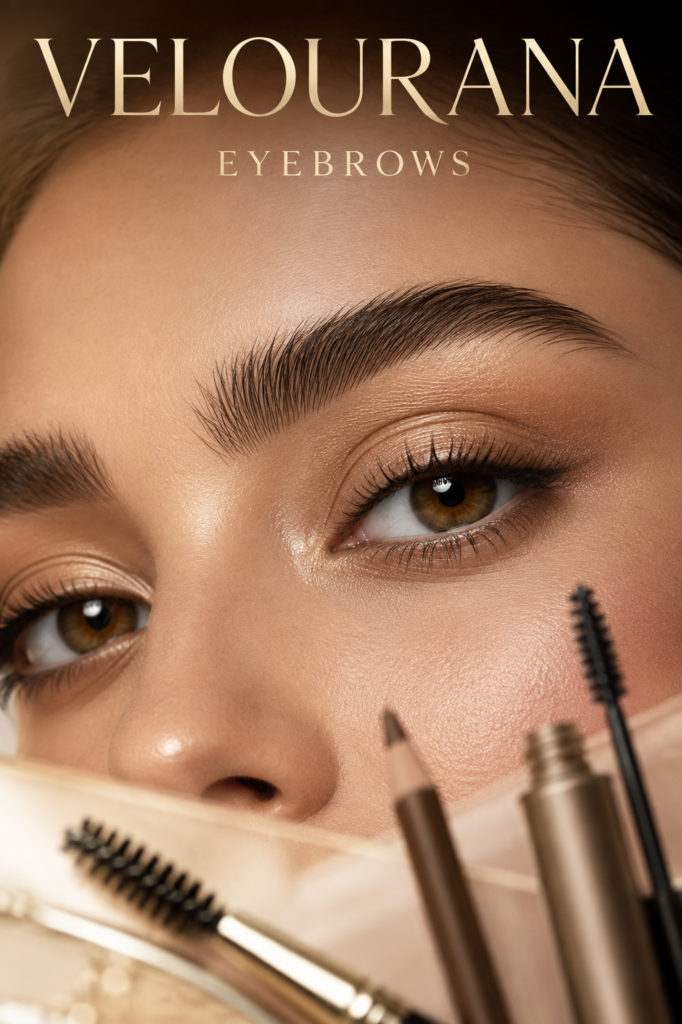
CATEGORY: Ombre Brows
Ombre brows are defined by transition. Rather than giving the entire eyebrow the same depth, color, and visual weight, the technique creates a controlled progression from a softer inner brow toward a more defined body, arch, and tail. The effect can range from exceptionally subtle to highly polished, but the central principle remains consistent: intensity develops gradually instead of appearing as a single block of pigment.
The technique takes inspiration from a characteristic already present in many natural eyebrows. Brow hairs are often less concentrated near the inner corners, increasingly dense through the central section, and more visually structured as they approach the arch. The tail then narrows toward its endpoint. Ombre brow makeup exaggerates and organizes this natural distribution of density while maintaining enough softness to prevent the eyebrow from appearing excessively heavy.
What distinguishes successful ombre brows is not simply a pale front and dark tail. A convincing gradient requires continuity. There should be no obvious point at which one intensity ends and another begins. Pigment, texture, and definition should evolve across the eyebrow in a way that feels intentional but visually seamless.
This makes ombre brows a study in controlled placement. Product quantity, brush pressure, color choice, blending, and the underlying brow shape all influence the final result. An eyebrow can contain technically correct colors yet fail to look ombre if the transitions are abrupt. Conversely, a single product can sometimes create a sophisticated gradient simply through variations in pressure and concentration.
The result is a brow that combines softness with definition: lighter where the eyebrow enters the face, stronger where structure is most useful, and precise enough at the tail to complete the frame around the eyes.
Understanding the Gradient That Defines an Ombre Brow
The word ombre describes a gradual transition between tones or intensities. Within eyebrow makeup, this usually refers to a progression from lighter to deeper pigmentation, beginning at the inner brow and becoming increasingly defined toward the outer portion.
The important word is gradual.
A pale rectangular front connected directly to a dark central brow does not create a convincing ombre effect. Neither does a sharply outlined eyebrow with pigment simply removed from the first few millimeters. The visual transition should extend across enough of the brow that the eye perceives increasing density rather than separate zones.
The inner portion normally receives the least product. Skin remains more visible between the hairs, and the upper boundary is often especially soft. Moving through the body, pigment becomes more noticeable. The lower boundary may acquire greater definition, and gaps are filled more completely. Around the arch, the eyebrow reaches much of its structural intensity. The tail can then become the most precise area, although it should still remain proportionate to the rest of the brow.
This progression can involve color, opacity, edge definition, or all three simultaneously.
A makeup artist may use one shade but vary its concentration. Alternatively, two closely related shades may be combined, with the softer tone concentrated toward the front and the deeper tone toward the tail. Another approach uses powder for diffused density and a pencil or pomade for stronger outer definition.
The best choice depends on the natural eyebrow, desired finish, and products available. The defining characteristic is not the number of products but the visual transition they create.
Why the Brow Front Determines the Success of the Look
The inner brow is one of the most important areas in ombre technique because it establishes the beginning of the gradient. When the front becomes too dark or sharply defined, the entire eyebrow can lose the softness associated with the style.
Natural inner brows frequently contain upward-growing hairs with visible skin between them. Even when they are dense, their edges often remain less rigid than the arch and tail. Ombre makeup uses this characteristic as a visual starting point.
Pigment near the front can therefore be introduced sparingly. Instead of filling the area to full opacity, a small amount of color can sit beneath or between the hairs. The upper edge can remain particularly diffused. If individual strokes are used, they can follow the direction of natural growth rather than creating a solid wall of color.
The lowest part of the front may receive slightly greater structure because defining the lower edge can help establish the overall brow line. Even this definition should usually dissolve quickly as it approaches the innermost point.
Brush pressure matters considerably. Beginning with a heavily loaded brush at the front can deposit too much pigment before there is an opportunity to blend it. Many ombre techniques therefore place the majority of the product through the body and tail first, then use whatever remains on the brush to shade the inner brow.
This naturally reduces intensity.
The front should not necessarily disappear. An ombre brow still needs a visible starting point. The objective is a beginning that feels gradual rather than abrupt, allowing the brow to emerge softly from the face.
Establishing Structure Through the Body of the Brow
The central section connects the softness of the front with the greater definition of the arch and tail. It is therefore where much of the actual transition occurs.
If this section becomes too dark too quickly, the ombre effect can appear divided. If it remains excessively pale until the arch, the eyebrow may look incomplete. The body must carry an intermediate level of intensity.
Existing hair density provides useful guidance. A naturally full central brow may require little additional pigment. A sparse brow may need a soft underlying layer to establish continuity. Rather than treating all eyebrows identically, the technique can adjust the amount of makeup according to what the natural hair already provides.
The lower edge often becomes more defined as it moves outward. This helps establish structure without requiring an equally sharp upper border. The top can remain comparatively diffused, especially through the first half of the eyebrow.
Powder works particularly well in this transitional region because it can be blended gradually. Pencil can also create controlled shading when used with light pressure and short marks. Pomade provides greater intensity and therefore requires careful distribution.
The body should visually connect every part of the eyebrow. When viewed from normal distance, there should be no obvious patch where the front stops and the defined brow begins.
This seamless connection is one of the technical differences between sophisticated ombre brows and simply dark brows with faded inner corners.
Building Definition Around the Arch
The arch often carries the greatest structural responsibility within an ombre brow. It establishes lift, contributes to facial expression, and marks the point at which the eyebrow begins transitioning toward its narrower tail.
Because the arch sits farther from the center of the face than the brow front, it can usually tolerate greater pigment intensity. Definition here helps balance the softness of the inner brow.
The lower arch may be clarified with a more deliberate line or concentrated shading. The upper arch can also receive definition, but maintaining some softness prevents the eyebrow from appearing cut out or pasted onto the skin.
The natural shape remains important. Ombre technique does not require creating a high arch where none exists. Straight, rounded, soft-angled, and highly arched brows can all carry a gradient. The ombre effect concerns pigment distribution rather than imposing one universal geometry.
If one arch is naturally lower than the other, makeup can provide subtle balancing. A few strokes above the lower arch may create the impression of greater height. Excessive correction, however, can enlarge the brow beyond its natural proportions.
Color intensity can reach near its maximum around this area, particularly when the tail is naturally fine. This creates a smooth transition into the final portion rather than saving all depth for the endpoint.
The arch should look connected to both sides: soft enough to emerge naturally from the body and defined enough to lead convincingly into the tail.
Creating a Tail That Is Defined but Not Disconnected
The tail usually carries the strongest precision in an ombre brow. Because it narrows naturally, greater edge definition can appear harmonious here even when the inner brow remains very soft.
A successful tail should taper rather than terminate as a thick block. Its upper and lower boundaries gradually approach one another until they form a controlled endpoint.
The tail can also carry somewhat deeper pigmentation than the rest of the brow. This reinforces the gradient and gives the eyebrow visual direction. However, excessively darkening the tail can create imbalance, particularly when the natural brow hair is light.
Length is equally important. Extending a short natural tail may improve proportion, but an extension that travels too far outward or downward can alter the expression. The endpoint should relate to the eye, brow bone, and existing direction of growth.
For sparse tails, fine strokes can provide texture before deeper shading is added. This helps prevent the outer brow from becoming a flat painted shape. A pencil or brow pen may create the initial hair illusion, while a small amount of powder or pomade increases density.
For naturally dense tails, very little additional color may be necessary. Grooming and gel may provide sufficient definition.
The ombre tail is therefore not automatically the darkest possible part of the makeup. It is the most resolved part: tapered, balanced, and visually connected to the gradient preceding it.
Choosing Products for a Controlled Ombre Effect
Different brow products create different kinds of gradients. Understanding their behavior allows the technique to be adapted without relying on one fixed formula.
Powder naturally produces diffused edges and can be built gradually. This makes it especially useful for softer ombre brows. A lighter application at the front can transition into more concentrated powder through the body and tail. Using a small angled brush provides greater control than a large brush that deposits pigment over too broad an area.
Pencils offer precision. A fine pencil can create individual strokes through sparse areas and stronger definition along the outer brow. Pressure can be adjusted so that one pencil produces multiple levels of intensity.
Pomades offer rich pigmentation and strong wear. They can create polished ombre brows, particularly when applied with a fine angled brush. Because a small amount of pomade can produce considerable color, excess should be removed from the brush before application. Gradual layering is generally easier to control than attempting to blend an initially heavy deposit.
Brow pens imitate hair and can be especially effective through the front when only a few additional strokes are needed. Their usefulness depends on maintaining variation rather than filling the entire brow with identical lines.
Tinted gels work primarily through existing hair. They can reinforce the gradient by adding subtle color and texture without creating heavy skin-level pigmentation.
Many ombre brows combine products because different areas have different needs. The front may need texture, the body may need density, and the tail may need precision. Yet a multi-product routine is not mandatory. Technique remains more important than product quantity.
Color Selection and the Difference Between Gradient and Contrast
A successful ombre brow does not require dramatically different colors. In fact, excessive contrast between the front and tail can make the transition appear artificial.
The gradient can be created entirely through opacity. One brow shade applied lightly at the front and more densely toward the tail may provide enough variation.
When multiple shades are used, they generally work best when closely related. A softer taupe or brown may occupy the inner portion while a slightly deeper corresponding shade defines the outer brow. The transition between them should be blended so that neither color appears isolated.
Undertone deserves attention. Combining a very warm front shade with a distinctly cool tail can disrupt continuity even if their depth differs appropriately. Closely related undertones usually create a more cohesive effect.
Hair color provides a reference rather than an absolute rule. Very dark hair does not always require black brow makeup, and blonde hair does not automatically require an extremely pale brow. Natural brow hair, skin tone, overall contrast, and desired intensity all contribute.
Color should also be assessed after blending. A shade that initially looks light may become significantly deeper when layered. This is one reason gradual application is valuable.
Ombre brows rely on progression rather than obvious contrast. The viewer should perceive increasing definition without necessarily identifying where the color changes.
Blending Without Erasing the Gradient
Blending is essential to ombre brows, but excessive blending can flatten the very gradient the technique is designed to create.
A spoolie is one of the most useful tools because it can disperse pigment while separating natural hairs. Brushing through the inner brow can soften concentrated product and expose small areas of skin. Through the body, lighter brushing can integrate makeup without removing too much intensity.
The direction of blending matters. Aggressively brushing dark pigment from the tail toward the front can transfer too much color into the softest region. Controlled movement allows each zone to maintain its intended depth.
Brushes used for powder or pomade can also perform the blending. Once most product has been deposited, the remaining pigment on the brush can be feathered toward adjacent areas. This creates a transition without introducing another heavy layer.
The gradient should be evaluated from a normal viewing distance. Close inspection may reveal individual marks and small variations that disappear when the face is seen as a whole.
If a visible boundary remains between light and dark sections, adding more dark pigment is rarely the only solution. Often the better correction is to soften the transition itself.
Blending succeeds when the eyebrow retains distinct levels of intensity but no obvious dividing lines.
Adapting Ombre Technique to Sparse Brows
Sparse eyebrows can benefit significantly from ombre styling because the gradient prevents extensive filling from becoming uniformly heavy.
The first challenge is establishing enough underlying structure. Areas with little hair may require a soft base of powder or pencil shading. This creates continuity across the brow without immediately producing maximum opacity.
Hair-like strokes can then restore texture. At the front, these strokes should remain relatively separated so that skin continues to show through. Through the body, they can become somewhat more concentrated. Around the arch and tail, greater definition can complete the shape.
Sparse brows often tempt the wearer to create strong outlines because boundaries are less obvious. Yet ombre technique benefits from resisting a fully enclosed shape, particularly near the inner and upper edges.
The natural hairs that remain should be integrated carefully. Their direction provides a model for cosmetic strokes, while gel can help them sit visibly above the background pigment.
When part of the tail is absent, the extension should develop naturally from the existing brow. Gradually narrowing strokes and shading can create a believable endpoint.
Sparse brows may require more makeup than dense brows, but they do not necessarily need to look more made up. Variation in opacity allows substantial reconstruction while maintaining dimensionality.
Ombre Brows on Naturally Full Eyebrows
Full eyebrows already contain much of the density an ombre technique attempts to simulate. Consequently, the emphasis shifts from creating fullness to organizing intensity.
The front may require almost no pigment. Brushing the hairs upward or diagonally can expose their natural softness. A clear gel may be sufficient to maintain direction.
Through the body, small gaps can be filled without coating the entire area. The natural overlap of hair already provides depth.
The arch and tail may receive slightly greater definition to strengthen the ombre progression. A pencil can clarify the lower edge or extend a fine tail, while tinted gel can subtly deepen the outer hairs.
Full brows should be evaluated carefully before adding powder or pomade because dense hair can make these products appear darker than expected. Pigment sitting beneath many overlapping hairs creates considerable visual intensity.
Selective enhancement often produces the most sophisticated result. The ombre effect may be quieter than on a sparse brow, but it can still be visible through differences in grooming, edge sharpness, and subtle depth.
The objective is not to force an obvious gradient onto naturally dense brows. It is to refine the gradient that the hair already creates.
Soft Ombre Versus Highly Defined Ombre
Ombre brows exist across a spectrum.
At the softer end, the gradient may be barely perceptible. The inner brow remains natural, the body receives modest filling, and the tail becomes slightly more defined. Edges remain diffused, and individual hairs dominate the visual texture.
A more polished ombre brow may contain clearer lower-edge definition, stronger pigmentation around the arch, and a precisely tapered tail. The front still remains softer, preserving the defining gradient.
Both approaches can be legitimate. The appropriate intensity depends on the surrounding makeup and desired aesthetic.
Minimal complexion makeup may pair naturally with a softer brow. Dramatic eye makeup or evening beauty can accommodate stronger outer definition. Photography may also change the required intensity because lighting can reduce visible contrast.
The mistake is assuming that ombre automatically means dramatic. Gradient is the defining principle, not maximum pigmentation.
A softly executed ombre brow can look almost indistinguishable from naturally balanced hair growth. A stronger version can appear intentionally sculpted while retaining a softer entry into the face.
Understanding this range makes the technique versatile rather than restrictive.
Maintaining Symmetry Without Destroying the Fade
Creating two similar gradients can be more challenging than creating two similar shapes. One brow may naturally contain greater density at the front, making it appear darker even when equal amounts of product are used.
Product quantity therefore should not necessarily be identical on both sides.
The naturally fuller brow may need less pigment. The sparse brow may require additional shading to achieve equivalent visual intensity. The objective is to match the perceived result rather than the number of strokes or amount of product.
The gradient itself should also be compared. If one brow becomes dark immediately after the front while the other transitions gradually, they may appear mismatched despite having similar overall shapes.
Moving between the brows during application helps maintain balance. Establish both fronts, compare them, develop both bodies, and then refine the arches and tails.
Small natural differences can remain. Ombre brows do not require geometric duplication.
What matters is that both brows share a coherent visual language: soft beginnings, increasing structure, and appropriately defined endpoints.
Ombre Brows as a Balance Between Softness and Structure
The lasting appeal of ombre brows comes from their ability to combine two qualities that can otherwise seem contradictory. They can be soft without appearing unfinished and structured without becoming uniformly heavy.
Their effectiveness depends on understanding where the face benefits from softness and where the eyebrow benefits from definition.
Near the center of the face, reduced intensity prevents the brows from appearing severe. Moving outward, greater density strengthens the frame around the eyes. The arch provides structure, and the tapered tail completes the direction of the brow.
Every element contributes to a visual progression.
The most refined ombre brows do not look as though several separate sections were created and then connected. They appear as one eyebrow whose density naturally evolves from beginning to end.
That illusion requires restraint, observation, and controlled application. It may involve powder, pencil, pomade, pen, gel, or combinations of these, but products remain secondary to placement.
When the gradient is seamless, the brow can look fuller, more balanced, and more polished without becoming visually flat. The front retains air and softness, the body develops presence, and the tail carries definition.
Ombre brows ultimately demonstrate how subtle changes in intensity can transform eyebrow makeup. Rather than treating every millimeter equally, the technique recognizes that different parts of the brow perform different visual roles. By allowing softness and strength to coexist within one shape, ombre brows create definition through transition rather than uniformity.
THE END VELOURANA
 Discover More From Our Family of Websites
 ZodiacBearing (Astrology, Tarot, Numerology, Angel Numbers & Spiritual Guidance)
 Velourana (Beauty, Makeup, Hair Care, Skincare & Beauty Tips)
 HavenBearing (Home, Living, Organization, Décor & Everyday Inspiration)
 PawBearing (Pet Care, Dog Breeds, Animal Health, Training & Pet Products)
 PsyCatherine (Notes From the Journal of a Psychologist on Real Life)

