
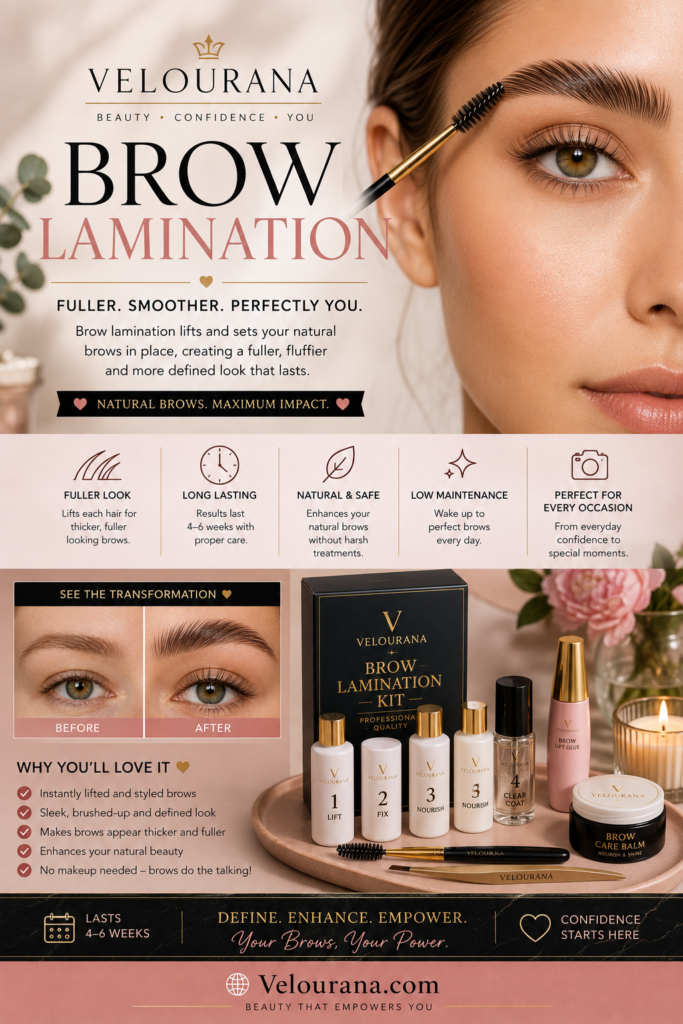
CATEGORY: Brow Lamination
Brow lamination can create one of the most noticeable transformations in modern brow grooming, yet the most sophisticated results are often the ones that attract the least attention to the treatment itself. Instead of brows that appear rigid, excessively upright, or obviously processed, natural brow lamination aims for something subtler: hairs that look fuller, more orderly, beautifully textured, and naturally inclined to sit in flattering positions.
This distinction has become increasingly important as brow trends have evolved. The highly vertical laminated brow helped make the treatment famous, particularly through editorial photography and social media. Every hair was brushed upward, the brow appeared considerably larger, and the difference between the before and after photographs was immediately obvious.
That style still has its place. Some people genuinely enjoy a dramatic, feathered brow.
But brow lamination does not require maximum drama.
A softer approach can preserve the natural personality of the eyebrows while solving the problems that make them difficult to groom. Downward-growing hairs can be lifted. Crossing hairs can be separated. A narrow-looking brow can gain visual width. The arch can appear more orderly, and the tail can become cleaner without forcing every hair to stand in the same direction.
The secret to natural brow lamination is understanding that the objective is not simply to lift the hairs. It is to determine where each part of the brow looks most flattering and use the increased flexibility created by lamination to support that shape.
Why Some Laminated Brows Look Too Strong
The most obvious sign of an overly dramatic lamination is often uniformity.
Natural eyebrow hairs do not normally grow in one identical direction from beginning to end. At the inner brow, hairs may grow upward or diagonally. Through the central portion, they tend to become increasingly angled. Toward the tail, their direction usually becomes more horizontal.
When every hair is instead brushed almost vertically, that natural progression disappears.
The result can certainly be fashionable, but it may also make the brow look unusually tall, especially if the person has long brow hairs. On a face with delicate features, the eyebrows can suddenly become the strongest visual element.
Dark brow hair can intensify the effect. A dense, dark brow brushed to maximum height creates considerably more visual weight than a fine, pale brow treated in exactly the same way.
This is why copying a lamination photograph is unreliable.
The model’s hair density, hair length, brow bone, eye shape, forehead proportions, colouring, and natural brow architecture may be completely different from yours.
Natural lamination begins with the individual brow rather than a predetermined finished shape.
Think in Terms of Direction Rather Than Height
One of the simplest ways to understand a natural laminated brow is to stop thinking about how high the hairs should go.
Think instead about where they should point.
The front of the eyebrow usually benefits from some upward movement because it creates an airy, open appearance. But even here, the hairs do not necessarily need to stand at ninety degrees.
A gentle diagonal can create lift without producing a startled or overly stylised appearance.
Moving toward the centre of the brow, the angle can gradually become more horizontal. This allows the hairs to contribute to fullness while still following the architecture of the brow.
Around the arch, direction becomes particularly important. If hairs are pushed too far upward, the upper edge can appear irregular or excessively high. If they are pushed downward, the arch may lose definition. A controlled diagonal direction can reveal the shape without making it severe.
At the tail, hairs generally look more natural when they are guided outward rather than upward.
Viewed as a whole, this creates a flowing transition.
The brow begins with lift and gradually becomes more streamlined.
That directional progression is one of the main differences between sophisticated natural lamination and the deliberately exaggerated editorial version.
Fullness Should Come From the Hair You Already Have
The fluffy effect associated with brow lamination works because individual hairs become more visible.
Before lamination, several hairs may lie on top of one another. They occupy the same visual space, making the brow appear narrower or less dense than it actually is.
Separating those hairs allows them to cover more area.
This does not mean they should be spread as widely as physically possible.
Natural fullness has boundaries.
If the hairs are brushed so far upward that the brow suddenly extends far beyond its natural proportions, the viewer begins noticing the styling technique rather than the brow itself. A softer result uses enough separation to expose the natural density without stretching the shape unnecessarily.
This is particularly useful for brows with long hairs.
Long brow hairs can be an enormous advantage in lamination because they provide coverage. They can help soften small gaps and create a fuller upper edge. But their length also means that aggressive vertical styling can make the brow disproportionately tall.
The same feature that makes lamination effective therefore requires restraint.
The Front of the Brow Sets the Tone
The inner portion of the eyebrow has a surprisingly strong influence on whether the finished result appears natural.
Traditionally, heavily made-up brows were sometimes given a sharply defined, almost square beginning. Modern softer brow styling generally avoids this because real brows rarely begin with a perfectly solid block of colour.
Lamination provides another option.
Instead of drawing a strong inner boundary, the natural hairs can create it.
Slightly lifting and separating the hairs at the front produces a feathered transition from skin to brow. The beginning appears lighter and less structured than the central portion, which can make the entire eyebrow look more natural.
However, there is a difference between feathering and fanning.
If the inner hairs are extremely long and pushed vertically upward, they may dominate the brow. A more controlled angle can preserve the airy quality without creating excessive height.
This is where personalised styling becomes valuable.
Someone with short inner hairs may tolerate considerably more upward direction than someone whose front brow hairs are long and dense.
There is no universal angle that works for everyone.
A Natural Arch Should Not Look Manufactured
Brow lamination can make the arch appear more visible because hairs that previously pointed downward or overlapped can be redirected.
That does not mean the treatment should be used to invent an extreme arch where none naturally exists.
Some eyebrows are naturally curved. Others are relatively straight. Some rise gradually and then taper gently toward the temple.
All can be attractive.
Attempting to force every brow into a highly arched shape can create tension between the hair pattern and the underlying facial structure.
A natural lamination works with the existing architecture.
If the brow is fairly straight, the treatment can emphasise its clean horizontal elegance. If there is a natural arch hidden beneath unruly hairs, strategic direction can reveal it. If one brow arches slightly higher than the other, careful styling may improve visual balance without requiring aggressive removal of hair.
The goal is refinement rather than reconstruction.
Why Trimming Can Make or Break the Result
Once brow hairs have been brushed upward, their true length becomes much more obvious.
This sometimes creates an immediate urge to trim everything that extends above the desired outline.
That can be a mistake.
The hairs may not actually be worn completely upright during everyday styling. Once brushed diagonally, the length that seemed excessive may be exactly what provides coverage through the body of the brow.
Over-trimming can produce blunt ends, visible gaps, and a less flexible finished shape.
It can also undermine the fluffy effect.
Natural feathered brows depend partly on variation. Individual hairs overlap and create texture. If they are cut into an overly uniform line, the result may appear more rigid.
This does not mean trimming is never useful. Exceptionally long hairs can disrupt the shape even when positioned correctly. The important principle is to evaluate them in the intended final direction before deciding how much, if anything, should be removed.
Brow grooming is usually more forgiving when approached conservatively.
Natural Does Not Mean Untidy
A common misunderstanding is that soft brows should be left completely uncontrolled.
Natural-looking grooming is still grooming.
The difference is that the intervention is less visible.
A beautifully laminated brow may contain carefully positioned hairs, subtle shaping, selective trimming, and perhaps tinting or makeup. Yet none of these elements needs to dominate.
Think of naturally styled hair. A hairstyle can require considerable professional skill while still appearing effortless. Brow grooming follows the same principle.
The objective is controlled texture.
Individual hairs remain visible, but they work together. The outline is defined without becoming excessively sharp. The brow has movement without looking chaotic.
This balance between structure and softness is what gives natural lamination its polished appearance.
How Tinting Changes a Soft Lamination
Tinting can make brow lamination look even fuller because lighter hairs become more visible.
For some people, this is exactly what the finished brow needs.
For others, it can push a subtle result into much stronger territory.
Consider a person with medium-density brows containing many fine, pale hairs. Lamination separates those hairs, but because some remain difficult to see, the visual increase in fullness may be modest. An appropriately selected tint can reveal those previously inconspicuous hairs and create a more complete-looking brow.
Now consider someone with very dark, dense eyebrows.
The lamination itself may already create substantial definition. Adding further colour intensity may make the brows appear heavier than desired.
This illustrates an important principle in natural brow styling: treatments should solve identifiable problems.
Tint because additional visible definition is wanted, not merely because tinting is routinely offered alongside lamination.
Makeup Should Become More Selective
People who have followed the same brow makeup routine for years often continue applying it automatically after lamination.
That can overwhelm the new shape.
Before the treatment, a person might have used pencil along the entire lower border, powder through the centre, additional pencil at the arch, and strong gel to force hairs upward.
After lamination, much of that work may no longer be necessary.
The natural hairs are now contributing more to the visible shape.
A better approach is to groom the brows first and then examine what is actually missing.
Perhaps there is one small sparse area beneath the arch.
Add a few fine pencil strokes there.
Perhaps the tail lacks definition.
Concentrate product there rather than colouring the entire eyebrow.
Perhaps nothing is missing at all and a light styling product is sufficient.
Selective makeup preserves the dimensional quality of real brow hair. Heavy, uniform colour can flatten that texture and reduce one of the main visual benefits of lamination.
The Importance of the Spoolie
A spoolie is one of the simplest beauty tools, yet it becomes particularly useful with laminated brows.
Because the hairs are easier to reposition, brushing allows the wearer to alter the character of the brow without another professional treatment.
For a relaxed daytime appearance, the hairs might be brushed gently upward and outward.
For a more polished evening look, they can be arranged with greater precision and paired with additional definition.
Someone who enjoys a dramatic feathered brow occasionally can brush the hairs higher when desired without having to wear that style every day.
The technique should remain gentle.
Repeated aggressive brushing is unnecessary. The objective is to arrange the hairs, not pull them.
This styling flexibility is one reason it is misleading to think of lamination as permanently fixing the eyebrow into one salon-created shape. A good treatment provides greater control; the wearer still decides how that control is used.
Healthy-Looking Hair Is Essential to a Soft Result
Natural-looking lamination depends as much on texture as shape.
Hair that looks excessively dry, frizzy, brittle, or damaged will not create the same luxurious effect, regardless of how carefully it has been positioned.
Brow hairs undergo chemical processing during lamination. For this reason, treatment timing, product selection, professional technique, treatment frequency, and aftercare all matter.
More frequent lamination does not automatically produce better brows.
The condition of the hairs should always be considered before repeating the treatment.
Professional recommendations regarding conditioning and aftercare should be followed according to the particular lamination system used. It is also sensible to avoid treating brow hairs as though they are indestructible simply because they are short.
Healthy texture contributes to softness.
A glossy, flexible hair naturally integrates with neighbouring hairs. A compromised hair can project awkwardly, making the brow look less controlled despite technically sitting in the correct direction.
Facial Features Should Influence the Finished Style
There is no single ideal brow because there is no single facial structure.
Strong, prominent brows can beautifully balance substantial facial features. On another face, the same brows may overwhelm the eyes.
Likewise, a subtle brow can look elegant on delicate features but may lack sufficient presence on a face that naturally suits stronger definition.
Natural lamination therefore involves proportion.
The width and density of the brow should be considered alongside the eyes, forehead, nose, cheekbones, and general visual balance of the face.
This does not require mathematical measurements or rigid beauty formulas.
It simply requires looking at the whole person rather than examining the eyebrow in isolation.
A brow can look extraordinary in a close-up photograph and still feel too dominant when the entire face is visible.
Professional brow design should work at both distances.
Soft Lamination Can Help With Asymmetry
Almost everyone has some degree of brow asymmetry.
One brow may sit slightly higher. One arch may be more pronounced. Hair may grow more densely on one side, or the tails may differ slightly.
Lamination can sometimes improve the visual relationship between the two brows because hair direction can be adjusted.
If one brow naturally appears narrower because its hairs lie flatter, lifting and separating them may make its width more comparable to the other side.
If several hairs on one arch point downward, redirecting them can make the upper line appear more balanced.
However, the goal should not be perfect duplication.
Faces move. Muscles affect eyebrow position. Bone structure is rarely identical on both sides.
Trying to force complete symmetry can lead to excessive tweezing, artificial shapes, or unnecessarily strong styling.
Balanced brows are usually more beautiful than identical brows.
Avoiding the “Stuck to the Forehead” Effect
Another concern sometimes associated with lamination is a very flattened appearance in which the brow hairs seem pressed tightly against the skin.
Immediately after certain styling steps, brows may naturally appear especially sleek, but an everyday soft lamination should retain visual dimension.
Brow hairs are three-dimensional.
Their shadows, overlaps, and slight differences in position create texture.
When styling laminated brows later, there is often no need to compress every hair completely against the skin unless that specific sleek effect is desired.
Gentle brushing can produce separation and movement while maintaining the directional benefits of the treatment.
Again, the difference comes down to treating lamination as a flexible grooming tool rather than one compulsory aesthetic.
Communicating the Result You Want
One of the easiest ways to avoid an overly dramatic result is to describe the desired outcome clearly before the treatment begins.
“Natural” is useful, but it can mean different things to different people.
More precise descriptions help.
You might explain that you want the front hairs slightly lifted but not vertical. You may want the body of the brow to look fuller while keeping the existing arch. You might prefer the tail to remain smooth and outward-facing rather than fluffy.
Reference photographs can help communicate style, although they should be treated as inspiration rather than a promise that one person’s brows can be reproduced exactly on another.
It is equally useful to explain what you do not want.
If you dislike extremely upright brows, say so.
If you prefer visible individual hairs rather than a sharply outlined brow, make that clear.
A good consultation translates aesthetic preferences into a result that works with the available natural hair.
Let the Brows Settle Into Your Routine
The salon finish is only one version of laminated brows.
The more meaningful test is how they integrate into everyday life.
After following the initial aftercare instructions provided by the professional, experiment with gentle styling. Brush the brows in slightly different directions and observe how the overall face changes.
You may discover that you prefer less lift than expected.
You may find that the front looks best fluffy while the remainder looks better smooth.
You may realise that the brow pencil previously considered essential is now unnecessary.
This experimentation helps turn a professional treatment into a personal grooming system.
The Best Natural Lamination Looks Like Better Brows, Not More Treatment
The most elegant brow lamination often creates a curious effect: the eyebrows look noticeably better, yet it is difficult to identify precisely what has changed.
They seem fuller without appearing drawn on.
They look groomed without appearing rigid.
The eyes may seem more open because downward hairs are no longer visually weighing on the brow line. Sparse-looking sections can appear less obvious because existing hairs are distributed more effectively.
Most importantly, the brows retain character.
That is the difference between using lamination to impose a trend and using it to enhance natural brow architecture.
Soft brow lamination is not about avoiding visible grooming altogether. It is about making every intervention earn its place.
Lift where lift improves the shape. Smooth where control is needed. Preserve length when it contributes to fullness. Trim only when necessary. Add colour only where it improves definition. Use makeup selectively rather than automatically.
The result is not the largest brow that lamination can create.
It is the most flattering brow that the existing hair can create.
And when brow lamination is approached with that philosophy, the treatment can move beyond a temporary beauty trend and become something much more useful: a sophisticated method of making natural eyebrows easier to manage while allowing them to remain recognisably, beautifully individual.
The End
Velourana
 Discover More From Our Family of Websites
 ZodiacBearing (Astrology, Tarot, Numerology, Angel Numbers & Spiritual Guidance)
 Velourana (Beauty, Makeup, Hair Care, Skincare & Beauty Tips)
 HavenBearing (Home, Living, Organization, Décor & Everyday Inspiration)
 PawBearing (Pet Care, Dog Breeds, Animal Health, Training & Pet Products)
 PsyCatherine (Notes From the Journal of a Psychologist on Real Life)

