
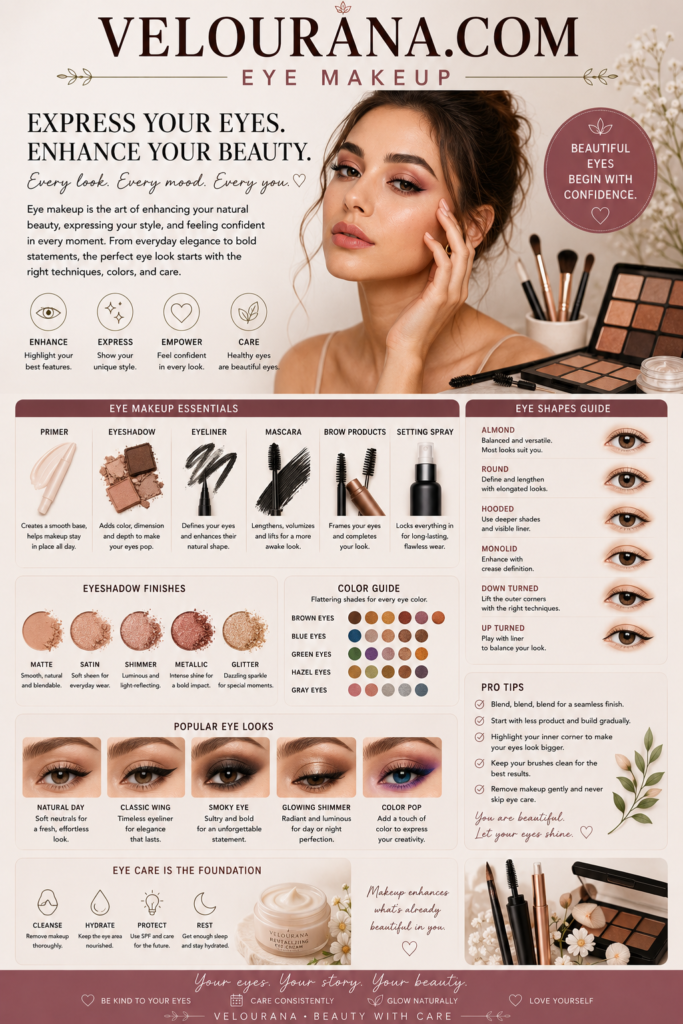
CATEGORY: Metallic Eyeshadow
Metallic eyeshadow occupies a distinctive place in eye makeup because it does something ordinary color cannot achieve on its own: it transforms light into part of the design. Instead of simply covering the eyelid with pigment, a metallic finish responds continuously to illumination. The eye moves, the angle changes, and the surface appears to brighten, deepen, or shift. What looks like a rich bronze in one position can suddenly reveal a molten gold reflection in another. Silver can move from cool steel to almost liquid brightness. Copper can appear earthy in shadow and incandescent when it catches direct light.
This interaction with illumination gives metallic eyeshadow its characteristic drama, but drama does not necessarily mean excess. Metallic finishes can be concentrated into a small point of brightness at the inner corner, softened across the lid for an elegant wash, or developed into an intensely reflective statement. Their effect depends as much on placement and surrounding texture as on the brilliance of the formula itself.
Unlike glitter, which usually creates visible individual points of sparkle, a sophisticated metallic shadow tends to produce a more continuous reflective surface. The eyelid can appear almost foiled, polished, or liquid. This distinction is important because metallic makeup is fundamentally about reflected light behaving across a field of color rather than isolated particles simply sparkling on top of it.
Understanding metallic eyeshadow therefore requires more than choosing the brightest shade in a palette. Texture, base color, particle size, application method, eye shape, surrounding mattes, and lighting all influence whether the result appears smooth and dimensional or fragmented and heavy.
What Creates the Metallic Effect
Metallic eyeshadow achieves its characteristic appearance through reflective materials incorporated into the formula. These can include pearlescent pigments and other effect pigments designed to interact strongly with light. Their size, concentration, coating, and relationship with the underlying color influence whether the finished shadow looks softly metallic, highly polished, sparkling, or almost mirror-like.
This explains why the word metallic describes a broad family of finishes rather than one identical texture.
Some metallic shadows resemble brushed metal. Their reflection is noticeable but relatively smooth and restrained. Others produce an intense foiled appearance in which the eyelid seems covered by a thin layer of molten color. Still others sit close to the boundary between metallic and shimmer, offering significant luminosity without creating the dense reflective surface associated with the strongest formulas.
The base pigment is equally important. Metallic gold is not simply gold reflection floating independently on the skin. The underlying tone might be yellow, antique, greenish, bronze, champagne, or rose. Copper can lean orange, red, brown, or pink. Silver may be icy and bright or softened with gray. These undertones influence how the metallic interacts with complexion, surrounding eyeshadow, and the overall makeup.
The smoothness of the reflective effect also matters. When reflective particles are distributed evenly and adhere well to the eyelid, the result can look seamless. When the formula scatters unevenly, the finish may appear fragmented rather than polished.
Modern metallic formulas often feel noticeably different from traditional powder mattes. Some are exceptionally creamy to the touch despite being pressed powders. Others have a dense, almost putty-like consistency. Liquid metallic shadows may begin fluid and then set into a thin reflective film. Cream formulations can provide richness and flexibility but vary considerably in how quickly they dry.
These textures are not interchangeable. A soft pressed metallic may respond beautifully to fingertip application, while a fast-setting liquid formula requires more immediate control. The formula determines not only the final appearance but also the technique required to achieve it.
Why Metallic Shadow Changes the Apparent Shape of the Eye
Reflective finishes visually attract light, and areas that catch light tend to appear more prominent. This gives metallic eyeshadow an almost sculptural function.
Placed at the center of the eyelid, a bright metallic can make that area appear more rounded or projected. Concentrated toward the inner portion of the lid, it can create brightness near the inner eye. Extended broadly across the mobile lid, it can emphasize visible lid space and produce a strong luminous plane.
The surrounding makeup determines how dramatic this illusion becomes.
A metallic champagne placed beside a softly matte taupe crease creates a gentle contrast between brightness and recession. A brilliant gold surrounded by deep matte brown creates a much stronger dimensional difference. The metallic appears even more reflective because it is framed by areas that absorb rather than return light.
This relationship is one of the foundations of dimensional eye makeup.
It also means that conventional metallic placement does not suit every desired effect. Someone with naturally prominent eyes may prefer to keep the brightest reflection more concentrated rather than covering every visible area with intense shine. Someone who wants to emphasize the mobile lid may deliberately use a broad reflective surface.
Hooded eyes provide another interesting example. Metallic pigment placed only in an area hidden beneath the fold may be barely visible when the eyes are open. Adjusting the position so that some reflection remains visible in a normal expression can completely change the finished makeup.
On monolids, metallic shadow can create striking uninterrupted fields of light. It can be concentrated near the lash line and diffused upward, placed centrally for dimension, or extended graphically across a larger area. The absence of a conventional crease does not reduce the possibilities; it changes the geometry through which reflection is organized.
The most useful approach is therefore to evaluate metallic placement while the eyes are naturally open. The makeup should be designed for the expression in which it will actually be seen.
From Sheer Luminosity to a Foiled Lid
Metallic intensity is not fixed. The same shadow can often produce remarkably different effects depending on how much product is applied and how densely it is pressed onto the skin.
A light layer can create a translucent metallic veil in which the natural eyelid remains partially visible beneath the reflection. This effect can feel refined and contemporary because the metallic quality is present without becoming completely opaque.
Increasing the density changes the character. As more reflective pigment accumulates, the surface begins to look richer and more continuous. At high intensity, the finish can resemble foil.
Application method strongly affects this transformation.
A fluffy brush tends to disperse reflective pigment over a wider area, producing a softer effect. A flatter, denser brush can press more product directly onto the lid and increase opacity. Fingertips often work particularly well with soft metallic powders because natural pressure and warmth can help deposit a dense layer with minimal scattering.
This does not mean fingers are automatically superior. Precision may be difficult around small areas, and some formulas respond better to brushes. The objective is simply to match the tool to the desired density.
A slightly tacky eye base can increase adhesion and make certain metallic shadows appear more saturated. Specialized mixing mediums or suitable eye products can also intensify compatible formulas, although products should always be used according to their intended directions. Not every powder shadow is designed for wet application, and introducing moisture into a pressed pan can alter its surface or performance.
The important principle is density. The more evenly reflective material is concentrated, the more continuous and metallic the finish appears.
This is why a shadow that seems moderately luminous when swept lightly across the lid can look dramatically different when pressed densely over a prepared surface.
The Importance of Contrast Around Metallic Color
Metallic eyeshadow rarely exists visually in isolation. Its brilliance is interpreted relative to everything surrounding it.
This becomes especially apparent when metallic and matte finishes are combined. A medium matte transition can define the general eye shape, while a deeper matte establishes recession at the outer corner or lash line. Against those quieter surfaces, metallic pigment becomes the point toward which light naturally travels.
The contrast can be subtle. Soft bronze paired with muted brown creates a cohesive tonal effect in which texture provides more variation than color. Alternatively, contrast can be dramatic: icy silver surrounded by charcoal, vivid metallic blue beside deep navy, or molten gold framed by black.
Color temperature introduces another layer.
Warm metallics such as copper, bronze, antique gold, and warm rose can create a rich, glowing impression. Cooler metallics such as silver, pewter, icy lavender, and blue-toned shades produce a different atmosphere. Mixing warm and cool tones can create deliberate tension rather than traditional harmony.
The base complexion and surrounding makeup influence these perceptions but do not impose rigid rules. A metallic does not have to match skin undertone. Deliberate contrast can be exceptionally effective.
What matters is understanding what the contrast will do.
A metallic close to the wearer's natural coloring may integrate softly into the face. A highly contrasting metallic will become more visually dominant. A deep metallic may create both reflection and shadow simultaneously, while a pale metallic emphasizes brightness.
This ability to control both color and reflection makes metallic eyeshadow unusually expressive.
Texture, Eyelid Preparation and Smoothness
Because metallic formulas reflect light, they can reveal surface texture differently from matte shadows. A highly reflective finish can emphasize every small change in the eyelid when light strikes it, particularly when the product is thick, dry, or unevenly applied.
Preparation can therefore make a substantial difference.
The eyelid should be comfortable, but an excessively emollient surface may interfere with adhesion or encourage creasing. Heavy layers of skincare immediately beneath eye makeup can also cause some formulas to move. Allowing skincare to settle before beginning makeup often provides a more stable surface.
Primer can improve wear and create a more uniform base, particularly for oily eyelids or formulas prone to migration. The type of primer matters. A smooth base may help reflective pigment appear more even, while a tackier base can increase intensity but may require more careful placement because pigment can grip immediately.
Product thickness deserves particular attention with creams and liquids. Applying an unnecessarily heavy layer may produce cracking, creasing, or uneven drying. Thin layers are often more flexible and can be built where greater intensity is required.
The objective is not to erase natural eyelid texture. Eyelids move, fold, and possess texture because they are skin. Rather, good preparation helps the metallic layer sit as evenly as the formula permits.
A polished metallic effect comes from continuity of reflection, not from pretending the eyelid is a perfectly flat surface.
Metallic Color in Daylight and Evening Light
One of the most fascinating characteristics of metallic eyeshadow is how dramatically it changes under different lighting conditions.
Soft daylight reveals color and texture relatively honestly. A bronze may appear nuanced and dimensional rather than overwhelmingly reflective. Under stronger direct illumination, the same shadow can produce a much brighter flash.
Artificial evening lighting changes the relationship again. Directional lights, warm interiors, photography, and movement can make metallic surfaces appear significantly more dramatic than they did during application.
This is worth remembering when building intensity.
A metallic eye created beneath strong bathroom lighting may appear different beside a window. Makeup intended for evening photography may benefit from greater definition around the reflective area so that the eye retains structure when the metallic catches strong light.
Photography introduces additional variables because cameras compress three-dimensional information differently from human vision. A very bright metallic can sometimes dominate the eyelid in photographs, particularly under direct flash, while surrounding depth becomes less obvious.
Balancing reflection with sufficient definition helps preserve the design.
This does not require darkening every metallic look. Even a pale, ethereal eye can retain structure through subtle tonal variation. The principle is simply to consider the environment in which the makeup will actually be viewed.
Metallic Eyeshadow Without Excess
Because metallic finishes can be intensely reflective, they are often associated with elaborate evening makeup. Yet some of the most sophisticated metallic looks are remarkably restrained.
A soft bronze pressed lightly over the mobile lid can provide dimension without obvious drama. Champagne concentrated near the center of the eye can create a quiet highlight. A muted pewter wash can feel understated while remaining more dimensional than a flat neutral.
The surrounding makeup determines much of the mood.
Pairing metallic shadow with minimal liner and softly defined lashes can make the finish appear modern and effortless. Combining the same shadow with a dramatic smoky outer corner, sculpted brows, and strong lashes changes its character completely.
This flexibility makes metallic eyeshadow useful far beyond special occasions.
The finish can be incorporated into mature, minimalist, artistic, classic, romantic, or highly experimental makeup. There is no requirement that metallic shadow cover the entire lid or reach maximum intensity.
Sometimes a small amount of reflection is more powerful precisely because the rest of the eye remains quiet.
The Lasting Appeal of the Metallic Eye
Metallic eyeshadow repeatedly returns to beauty because its fundamental attraction is not tied to one trend. Human vision is naturally responsive to changes in light, and metallic finishes exploit that response beautifully.
They make makeup dynamic.
A matte shadow remains comparatively stable as the wearer moves. A metallic shadow changes. Its reflective surface appears brighter from one direction and deeper from another. The makeup therefore becomes part of the movement of the face.
This quality can make even a simple application feel sophisticated.
A single metallic shade across the eyelid can create apparent variations in tone purely through the curvature of the eye and changing illumination. Add matte depth around it, and the dimensional effect becomes stronger still.
The greatest strength of metallic eyeshadow is therefore not simply brightness. It is transformation.
Metallic pigment turns illumination into an active element of makeup design. It allows the eyelid to move between color and reflection, softness and intensity, shadow and brilliance.
Whether expressed through muted bronze, antique gold, polished copper, cool pewter, luminous rose, vivid jewel tones, or brilliant silver, metallic eyeshadow remains one of the most powerful ways to make light itself part of the beauty look.
THE END VELOURANA
 Discover More From Our Family of Websites
 ZodiacBearing (Astrology, Tarot, Numerology, Angel Numbers & Spiritual Guidance)
 Velourana (Beauty, Makeup, Hair Care, Skincare & Beauty Tips)
 HavenBearing (Home, Living, Organization, Décor & Everyday Inspiration)
 PawBearing (Pet Care, Dog Breeds, Animal Health, Training & Pet Products)
 PsyCatherine (Notes From the Journal of a Psychologist on Real Life)

