
CATEGORY: Buns
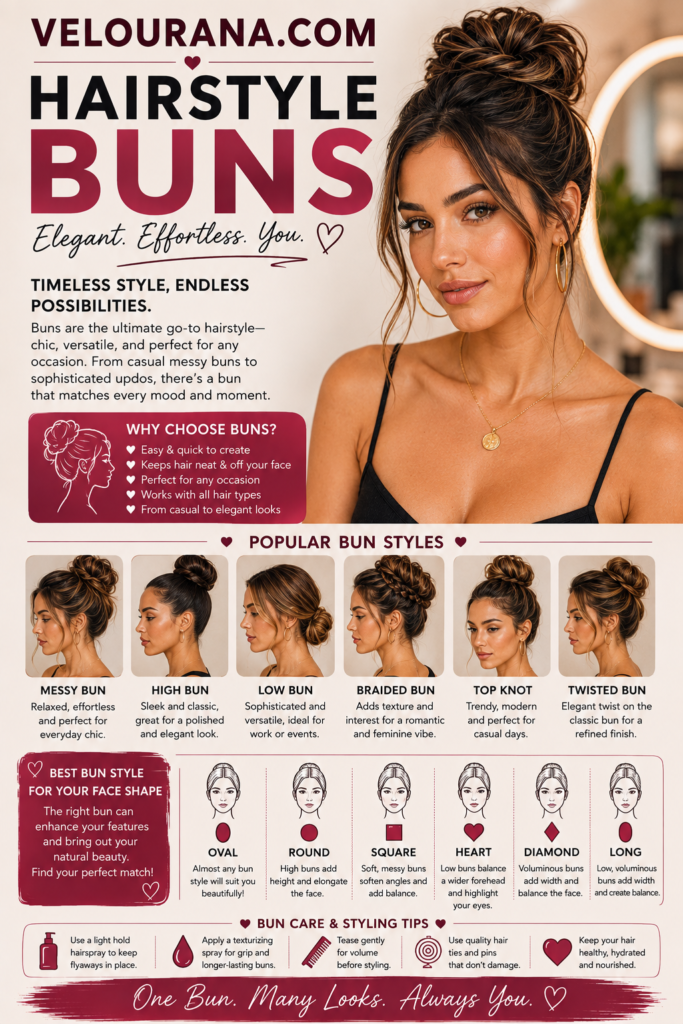
The messy bun is one of the most misunderstood hairstyles because its name suggests that almost anything will work. Twist the hair, secure it somehow, allow a few strands to escape and the result should look effortless.
Sometimes it does.
Often it simply looks unfinished.
The most attractive messy buns usually have far more structure than their relaxed appearance suggests. The base is secure. The placement is intentional. The volume is distributed carefully. Loose pieces are released selectively rather than randomly. The bun may be asymmetrical, but it still has a recognizable shape. The roots may be soft, but they are not collapsing unpredictably.
This is what gives the hairstyle its characteristic balance.
A messy bun is not really about making the hair messy. It is about removing excessive precision without removing structure.
That distinction explains why the style can move easily between completely casual and unexpectedly elegant. A high messy bun can feel energetic and informal. A low version can become romantic. A loose bun with face-framing pieces can soften an otherwise simple outfit. A slightly more controlled version can work beautifully for evening styling without becoming rigid.
The foundation remains similar.
The difference lies in how much softness is introduced after the hairstyle is secure.
Placement Still Determines the Character
Even a deliberately relaxed bun changes dramatically according to where it sits.
A high messy bun creates vertical emphasis. The neck remains exposed and the bun becomes visible from the front.
A mid-height version feels more balanced and often provides a comfortable everyday position.
A low messy bun sits close to the nape and naturally creates a softer, more understated silhouette.
Moving the bun to one side adds asymmetry.
Because the finish is already irregular, an off-center position can make the style feel especially natural.
Choosing placement before creating the bun prevents the shape from drifting into an unintended area while the hair is being wrapped.
The Base Should Be More Secure Than the Surface Looks
One of the easiest mistakes is trying to create softness by making the entire hairstyle loose from the beginning.
This often produces instability.
The roots shift.
The bun slides.
Sections fall out in places that were never intended to be loose.
A more reliable approach is to establish a secure gathering point first.
The hair can be collected into a ponytail or held firmly at the chosen position.
The bun is then built around that base.
Once the structure is stable, softness can be introduced deliberately.
The crown can be loosened slightly.
The bun can be widened.
A few front sections can be released.
This creates the visual impression of ease without sacrificing the practical security of the hairstyle.
The High Messy Bun Has a Casual Energy
A high messy bun usually feels less formal because the placement itself creates movement.
The hair travels upward.
The bun becomes visible above the crown.
Loose sections can interrupt the otherwise vertical silhouette.
The shape may contain loops, visible ends and irregular volume.
Fine hair may form a smaller bun.
Dense hair can create substantial width naturally.
The important thing is avoiding the temptation to make the bun as large as possible regardless of the available density.
A smaller high messy bun can look much more convincing than an oversized shape that depends on excessive manipulation.
The Low Messy Bun Feels Softer
Moving the same idea to the nape creates a different mood.
The hairstyle becomes quieter.
The bun is less visible from the front.
Attention shifts toward the face and loose sections around it.
This placement works especially well with soft crown volume and face-framing layers.
The hair can be twisted loosely, folded or arranged into several irregular loops.
The lower position also makes it easier for shorter sections to remain outside naturally.
Instead of forcing them upward, they can become part of the relaxed silhouette.
A Mid-Height Messy Bun Is Exceptionally Practical
The middle position avoids the strongest advantages and disadvantages of either extreme.
The bun remains high enough to keep the neck clear but low enough to avoid concentrating all the weight at the crown.
It can work particularly well on long or dense hair when a top knot feels too heavy.
The style can remain visible from the side without dominating the entire silhouette.
This makes it one of the most practical interpretations for everyday wear.
A Messy Bun Should Still Have a Shape
Irregularity does not mean shapelessness.
From a distance, the bun should still read as one coherent form.
Perhaps it is round but softly distorted.
Perhaps it spreads slightly horizontally.
Perhaps one loop sits higher than another.
These differences create character.
What should be avoided is a collection of unrelated pieces extending in every direction with no visible center.
The hairstyle can be imperfect while still having visual organization.
The Loop Bun Is a Natural Foundation
One of the easiest ways to create a relaxed bun is to leave the hair partially pulled through the elastic during the final pass.
This creates a loop.
The remaining ends can wrap around the base, hang partially free or be tucked underneath.
The loop itself can be widened.
One side can be pulled slightly larger.
The top can be loosened.
This creates natural irregularity without requiring complicated construction.
It is especially useful on medium lengths that may not wrap around the base several times.
Twisting Creates a Softer Spiral
Another simple method begins with a ponytail that is loosely twisted.
Instead of tightening the twist until it becomes rigid, the hair is allowed to retain some volume.
The length is then wrapped around the base.
The resulting bun contains visible directional movement.
Sections can be pulled outward afterward.
The ends can remain partly visible.
The twist provides enough structure to prevent the shape from becoming completely random.
Folding Creates a Broader Messy Bun
Rather than wrapping the hair around one central point repeatedly, the length can be folded back on itself.
This creates a wider structure.
The bun can spread across the back of the head rather than projecting outward.
This can be particularly attractive in low messy buns.
Pins can secure the folds while allowing the edges to remain soft.
The result often resembles a relaxed chignon more than a conventional circular bun.
Fine Hair Needs Texture More Than Size
Fine hair can create beautiful messy buns because the style does not depend on a perfectly solid surface.
Small irregularities add visual interest.
A smaller bun can be widened gently.
The roots can retain some volume.
The lengths can be looped rather than tightly wrapped.
Braiding or twisting before securing can make the surface more visible.
The objective should be to create dimension rather than simply maximum volume.
A compact bun with well-placed softness can look more substantial than a larger shape stretched beyond what the hair can comfortably support.
Thick Hair Can Become Too Heavy if Everything Is Loosened
Dense hair already creates substantial volume.
A messy bun therefore requires less expansion.
If every section is loosened aggressively, the shape can become enormous and difficult to secure.
The better strategy is often selective softness.
The crown may remain relatively controlled.
Only certain parts of the bun are widened.
A few face-framing sections are released.
The rest of the structure stays supportive.
This allows thick hair to look abundant without becoming overwhelming.
Straight Hair Needs the Construction to Create the Texture
Straight hair may not provide natural bends or curls within the bun, so the arrangement itself becomes important.
Loops can create dimension.
Twists can make directional lines visible.
Visible ends can add irregularity.
The crown can be loosened to reduce the sleekness of the roots.
This gives straight hair a soft appearance without requiring it to be curled first.
If additional texture is desired, pre-existing waves or heatless bends can make the bun even more dimensional, but they are not essential.
Wavy Hair Naturally Supports the Style
Wavy hair is particularly compatible with messy buns because the texture already creates variation.
The roots rarely need to be perfectly controlled.
The lengths form natural bends as they are wrapped.
Loose sections around the face fall into movement easily.
The bun can look finished even when some edges remain irregular.
There is often no reason to straighten wavy hair before creating the style.
Doing so may remove the softness that makes the hairstyle convincing.
Curly Hair Creates a Highly Dimensional Messy Bun
Curly hair can create volume and texture almost automatically.
The bun may consist of visible curl loops rather than one continuous wrapped surface.
Some curls can remain outside the structure.
Others can be pinned into different positions.
The roots can remain naturally full.
Face-framing curls can be released selectively.
This creates a bun that feels integrated with the natural texture rather than as though the curls were hidden inside an updo.
The shape should still remain secure.
Texture provides softness, but the foundation still needs support.
Coily Hair Can Create Strong Relaxed Shapes
Coily textures can form beautifully full messy buns because the hair naturally occupies space.
The shape can be compact or expansive.
Some texture can remain visible around the surface.
Twists or braids can be incorporated before the bun is formed.
The edges can remain natural rather than being pulled excessively.
A relaxed bun should look relaxed because of its surface and shape, not because the scalp is carrying extreme tension underneath.
Face-Framing Pieces Are One of the Most Important Details
The front often determines whether the bun feels deliberately soft or simply untidy.
Too many loose sections can make the hairstyle look unfinished.
Too few can make a supposedly messy bun feel unexpectedly severe.
Selecting a small number of pieces usually creates the strongest result.
Temple sections can soften the forehead.
Cheekbone-length pieces create more movement.
Longer sections near the jaw can frame the face dramatically.
Natural texture should influence which pieces are released because some sections may already fall beautifully while others require unnecessary manipulation.
Curtain Bangs Work Naturally With Messy Buns
Curtain bangs already create an open, soft frame around the face.
They can remain completely separate while the rest of the hair is gathered.
The contrast works particularly well with high buns because the fringe brings visual movement back down toward the face.
In a low bun, the bangs connect naturally with the relaxed character of the hairstyle.
They do not need to be incorporated just because the lengths are being gathered.
Full Bangs Create a Different Kind of Contrast
A blunt fringe can sit against a messy bun beautifully because the front and back communicate different levels of structure.
The bangs remain defined.
The bun becomes loose and textured.
This contrast prevents the hairstyle from becoming visually monotonous.
It also allows someone with a strong fringe to change the rest of the hairstyle without altering the familiar front.
The Crown Should Be Loosened Gradually
One of the most common techniques for softening a bun is pulling gently at the crown after the hair has been secured.
This should be done incrementally.
Small sections can be lifted slightly.
The objective is creating volume, not pulling the entire foundation apart.
Too much loosening can create large uneven bumps.
A subtle amount often changes the side profile more effectively than dramatic pulling.
Softness Around the Ears Can Make the Style Feel More Natural
Hair does not always need to be pulled tightly behind the ears.
Allowing some movement around them can soften the sides.
Small strands may remain partially free.
A gentle curve can develop above the ear.
This works especially well with low and mid-height buns.
The sides feel connected to the relaxed bun rather than forming an unexpectedly sleek contrast.
The Nape Can Remain Slightly Imperfect
Shorter hairs at the nape may escape from a high messy bun.
They do not always need to be forced upward.
A few soft strands can support the casual appearance.
For a cleaner version, they can be secured gently.
The decision depends on the intended finish.
The important point is not to create unnecessary tension simply to capture every short hair.
A Side Part Adds Direction
A side part can make a messy bun feel more styled immediately.
The front sweeps toward one side.
One temple becomes more exposed.
The opposite side carries more volume.
This asymmetry complements the irregularity of the bun.
The gathering point can remain centered, or the bun can move slightly toward the same side for a stronger directional effect.
A Center Part Provides Structure Against the Softness
A center part does the opposite.
It introduces a clear organizing line through an otherwise relaxed hairstyle.
The two sides frame the face symmetrically.
Behind them, the bun can remain loose.
This contrast can make the style feel more deliberate.
The part tells the eye that the softness is intentional.
No Visible Part Creates a More Casual Front
Bringing the hair loosely backward without a defined part can create a particularly effortless appearance.
The roots retain natural movement.
Small irregularities remain visible.
The style avoids obvious geometry.
This works well with high buns and top knots where the hair already travels upward strongly.
The front becomes part of the overall softness.
Braids Can Add Detail Without Making the Bun Formal
A small braid near the temple can feed into a messy bun.
Two narrow braids can meet at the back.
The ponytail can be loosely braided before being wrapped.
Because the rest of the hairstyle remains relaxed, the braid becomes a detail rather than turning the entire style into a formal updo.
This works especially well with natural waves and curls.
A Loose Braided Bun Has Built-In Texture
Braiding the gathered length before forming the bun creates visible pattern.
Once wrapped, the braid can be widened.
Some edges may be pulled out slightly.
The result becomes broader and more textured.
This is useful for hair that otherwise forms a very compact bun.
The braid provides structure while the loosening provides softness.
Twists Blend Easily Into a Messy Style
Twists are less visually structured than braids, which makes them ideal for relaxed buns.
Two front sections can twist toward the back.
The ponytail itself can be divided into loose twists.
Several twisted sections can be pinned around the base.
The finished bun appears complex without looking overly constructed.
Visible Ends Can Be Part of the Style
A messy bun does not require every end to be tucked away.
A few visible sections can add character.
They may point outward slightly, curl naturally or rest against the bun.
The amount matters.
A small number of visible ends looks intentional.
Too many can make the hairstyle appear unfinished.
The placement should support the overall shape.
Not Every Flyaway Needs to Be Controlled
The relaxed surface allows some fine hairs to remain visible.
A few flyaways can soften the hairstyle.
Attempting to eliminate every one can make the bun feel inconsistent with its intended mood.
This does not mean the hair should become frizzy everywhere.
The difference is between natural softness and uncontrolled texture.
The hairstyle should still look cared for.
Hair Color Can Make the Bun Look More Complex
Highlights and tonal variation become especially visible in an irregular bun because strands travel in multiple directions.
A lighter section may curve across the surface.
Darker roots create depth underneath.
Balayage ends can appear in unexpected parts of the shape.
This can make a relatively simple bun look highly dimensional.
The color itself provides detail.
Gray and Silver Strands Can Add Natural Texture
Natural gray hair often contains several tones.
When gathered loosely, these variations become more visible.
Silver strands cross darker sections.
The bun appears textured even without elaborate construction.
A relaxed style can showcase this variation beautifully because it does not attempt to make the entire surface uniform.
Accessories Should Match the Casual Structure
A messy bun can support accessories, but they should feel integrated.
A soft ribbon can wrap around the base.
A decorative pin can sit slightly off-center.
A scarf can become part of a high bun.
An extremely formal accessory may create interesting contrast, but it can also compete with the relaxed structure if the rest of the style is very casual.
The accessory should support the intended balance.
Scrunchies Naturally Suit Relaxed Buns
A visible scrunchie can become part of the hairstyle rather than something that needs to disappear.
It emphasizes the casual character.
The bun can sit around or above it.
The fabric adds another texture.
This is very different from a sleek bun where the securing method is often concealed.
The construction itself becomes part of the final appearance.
Pins Can Be Hidden or Deliberately Visible
Traditional hairpins usually disappear inside the bun.
Decorative pins can remain visible.
A few well-positioned pins can also shape the bun rather than simply secure it.
One loop can be held outward.
Another section can be tucked closer.
The goal is to support the irregular shape without compressing it into a perfect circle.
The Messy Bun Is Especially Useful on Layered Hair
Layered hair naturally contains multiple lengths.
Those shorter sections can be difficult to hide in a perfectly smooth bun.
In a messy bun, they become an advantage.
They create softness.
They break up the surface.
They frame the face.
Instead of fighting the haircut, the hairstyle uses its structure.
This is one reason messy buns often look particularly natural on heavily layered hair.
Very Long Hair Needs Enough Structure Underneath
Extremely long hair can create a very large messy bun.
Simply twisting all of it loosely may produce excessive weight and instability.
Dividing the hair can help.
One section can establish the central bun.
The remaining length can be wrapped or pinned around it more loosely.
This allows the hairstyle to look relaxed without relying on one enormous, unstable knot.
Medium Hair Can Create an Excellent Messy Bun
The hairstyle does not require extreme length.
Once enough hair can be gathered and looped, a messy bun becomes possible.
Shorter ends naturally create texture.
Some nape pieces may remain outside.
The bun itself may be small, but this often suits the casual character.
Medium hair can therefore create a convincing bun without trying to imitate the proportions of very long hair.
Shorter Pieces Can Be Secured Without Making the Style Sleek
If certain layers fall in inconvenient positions, small pins can guide them into the structure.
The pinning does not need to flatten everything.
A section can remain slightly curved while still being secure.
This preserves softness while improving practicality.
The Bun Should Be Comfortable Enough to Forget About
A messy bun often functions as an everyday hairstyle, which makes comfort particularly important.
The elastic should not pull aggressively.
Pins should not dig into the scalp.
Heavy hair should be supported adequately.
A bun that constantly needs adjusting is not functioning well simply because it looks relaxed.
The style should be both soft and stable.
High Messy Buns Can Create More Tension
The higher the hair travels, the more redirection occurs.
Long or dense hair can feel heavy at the crown.
If discomfort develops, lowering the bun slightly may solve the problem without changing the overall character.
The hairstyle can still read as high even when it is not sitting at the absolute top of the head.
Low Messy Buns Are Often Easier for Heavy Hair
The nape provides a more natural gathering point.
The hair travels less distance.
The bun can rest closer to the head.
This often distributes weight more comfortably.
For very long hair, the low position can therefore be particularly useful for extended wear.
Repeated Tightness Defeats the Purpose
A messy bun does not benefit from being painfully tight underneath.
The style is supposed to have softness.
Using excessive tension at the base while loosening only the surface creates unnecessary stress.
A secure but comfortable foundation supports both the appearance and the hair better.
A Bun Can Soften Naturally as the Day Continues
Movement causes the hairstyle to evolve.
The crown may loosen.
Small pieces escape.
The bun can widen slightly.
For a messy style, these changes are often welcome.
The hairstyle becomes more natural.
This makes the messy bun particularly forgiving compared with styles that depend on preserving a perfectly smooth surface for many hours.
It Can Be Rebuilt in Seconds
If the bun becomes too loose, the basic structure is simple enough to redo.
The hair can be gathered again.
The bun can be looped or twisted.
The same face-framing pieces can remain outside.
This practicality is part of its appeal.
The hairstyle does not require lengthy reconstruction to remain wearable.
Releasing the Bun Can Create Another Texture
Hair held inside a loose bun can emerge with broad bends.
Straight hair may gain soft waves.
Wavy hair can become more defined.
Curly hair may change slightly according to how it was gathered.
This can create an easy transition from an updo to loose hair later in the day.
The Style Works Precisely Because It Can Change
A sleek bun depends on consistency.
A messy bun allows evolution.
Its shape can shift slightly without losing its identity.
The roots can soften.
The edges can become irregular.
A few additional pieces can appear.
As long as the central form remains visible, the hairstyle continues to work.
This tolerance is one of its greatest practical strengths.
Messy Does Not Mean Careless
There is a difference between a hairstyle designed to look relaxed and one created without any consideration at all.
The first has balance.
The second depends on luck.
A good messy bun knows where the volume should sit.
It knows which pieces can remain free.
It has enough security to stay in place.
It uses texture rather than being controlled by it.
This is what makes the effortless appearance convincing.
The Best Version Often Uses Less Manipulation
Overworking a messy bun can make it look overly styled.
Too much pulling, separating and arranging removes the spontaneity.
Often the better result comes from securing a good foundation and making only a few deliberate adjustments.
The crown is softened.
The bun is widened slightly.
Two or three face-framing pieces are released.
Then the hairstyle is left alone.
When Imperfection Becomes the Design
The messy bun succeeds because it rejects the idea that every strand needs to occupy one exact position.
One loop can be larger.
A few ends can remain visible.
The roots can contain natural movement.
A curl can escape.
The shape can sit slightly off-center.
These irregularities become the personality of the hairstyle.
But beneath them, structure remains.
There is still a base.
There is still a bun.
There is still a clear relationship between the front, crown and gathered hair.
That combination of control and imperfection is what makes the style so enduring.
It can be created quickly without looking purely practical. It can work with fine hair, thick hair, straight hair, waves, curls and coils because it does not demand one perfect surface. It can move high, low or sideways and still remain recognizable.
The messy bun does not ask the hair to become flawless.
It asks the hair to become organized just enough that its natural irregularity can look beautiful.
The End
Velourana.
 Discover More From Our Family of Websites
 ZodiacBearing (Astrology, Tarot, Numerology, Angel Numbers & Spiritual Guidance)
 Velourana (Beauty, Makeup, Hair Care, Skincare & Beauty Tips)
 HavenBearing (Home, Living, Organization, Décor & Everyday Inspiration)
 PawBearing (Pet Care, Dog Breeds, Animal Health, Training & Pet Products)
 PsyCatherine (Notes From the Journal of a Psychologist on Real Life)

