
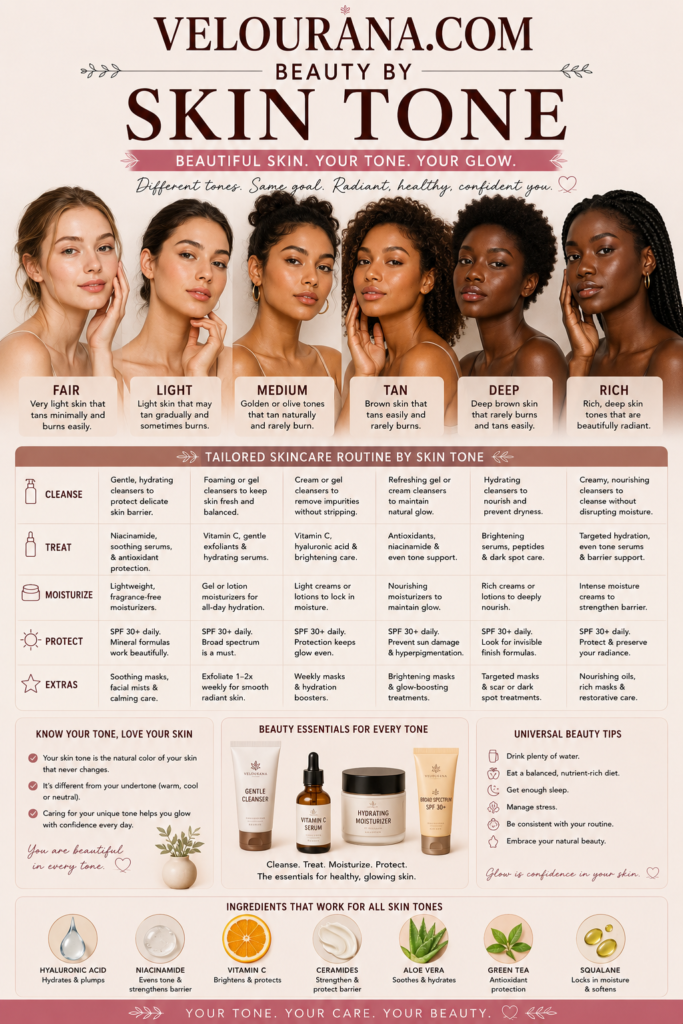
CATEGORY: Medium Skin Makeup
Medium skin offers one of the most adaptable canvases in makeup because it can hold both softness and intensity without requiring either extreme. A relatively sheer base can preserve warmth and natural variation, while deeper blush, bronzer, eye color, and lipstick can still remain visible without immediately overpowering the complexion. This gives medium skin considerable freedom, but that freedom works best when color is approached as a composition rather than as a collection of isolated products.
The category itself is broad. Medium skin can be golden, olive, peach, neutral, rosy, warm, cool, muted, or somewhere between these descriptions. Two people who wear a similar foundation depth may need completely different approaches to bronzer, blush, contour, eye makeup, and lip color because their undertones and natural contrast differ.
This is why the most successful medium-skin makeup does not begin with a fixed palette. It begins with observing what is already present.
A complexion with visible golden warmth may respond naturally to bronze, terracotta, warm rose, and caramel tones. Olive skin may interact beautifully with muted rose, plum, earthy brown, sage, burgundy, and antique gold. A neutral complexion can move between warm and cool families with relative ease, while a cooler medium complexion may create natural harmony with mauve, berry, cool brown, charcoal, plum, and blue-based red.
These relationships provide useful direction, but they do not create restrictions. Makeup can repeat the natural complexion or deliberately contrast with it. Warm skin can wear cool color. Olive skin can wear vivid pink. Cool skin can wear copper or coral. What matters is that the final look has visual logic.
Medium skin can support subtle makeup, graphic makeup, monochromatic makeup, traditional glamour, colorful editorial looks, and highly polished complexion work. The essential skill is learning how to distribute depth, saturation, warmth, and light across the face without allowing one element to distort everything else.
The Complexion Should Establish the Makeup, Not Disappear Beneath It
The base determines how every color placed above it will behave.
When foundation matches accurately, blush remains true to its intended character, bronzer can introduce controlled warmth, contour creates believable depth, and highlighter interacts with the actual skin rather than an artificial layer of color. When foundation is noticeably too warm, too pink, too deep, or too gray, the rest of the makeup begins adapting to the mistake rather than to the complexion.
Medium skin often contains visible variation. The center of the face may be slightly lighter or redder, the forehead can be deeper, the jaw may differ from the neck, and areas of pigmentation may create additional depth. Trying to make all of these areas identical through foundation alone can remove much of the natural dimensionality of the face.
The amount of coverage should therefore reflect the desired finish rather than an assumption that makeup requires complete uniformity.
A sheer foundation or skin tint can soften unevenness while allowing undertone, freckles, and natural pigmentation to remain part of the finished look. Medium coverage can refine the complexion more significantly while preserving some variation. Full coverage can create a deliberately perfected surface when greater uniformity is desired.
The choice is aesthetic.
What matters is that the foundation remains connected to the neck and body. Medium skin should not be made several shades deeper in order to look bronzed, nor should it be lightened excessively to create artificial brightness. Those effects can be introduced selectively later.
Concealer gives the base greater precision. Hyperpigmentation, blemishes, redness, or under-eye darkness do not necessarily justify increasing foundation coverage everywhere. Local correction allows the rest of the complexion to remain lighter and more dimensional.
This approach also gives blush and bronzer more room to work. If the base has been made completely uniform and heavily opaque, color needs to be rebuilt. If some natural variation remains, complexion products can enhance rather than reconstruct.
Warmth, Shadow, and Flush Should Remain Distinct
Bronzer, contour, and blush are often placed close together on the face, yet they represent three very different types of color.
Bronzer suggests warmth and exposure to light.
Contour suggests recession and shadow.
Blush suggests circulation and living color.
When these products are selected or applied as though they perform the same role, medium skin can quickly become muddy.
Bronzer works best when it introduces warmth without turning the entire complexion orange, red, or excessively deep. Golden medium skin may suit bronzers with warm caramel, bronze, or golden-brown undertones. Olive skin often benefits from more neutral or muted warmth. Cooler medium complexions may prefer bronzers that are less aggressively orange and more softly brown or rosy.
The bronzer does not need to be dramatically darker than the skin.
Its effectiveness comes from placement and temperature rather than depth alone.
Contour requires a different character. Natural shadow tends to be more neutral and less saturated than bronzer. On medium skin, taupe-brown, neutral brown, cool cocoa, or muted deep beige can create more believable recession than warm bronze.
The objective is not to make the face look gray.
It is to avoid using obvious warmth where shadow is intended.
Blush then reintroduces life into the complexion.
Medium skin can often carry richer blush shades than expected. Rose, coral, berry, terracotta, plum, peach, warm red, muted mauve, and deep pink can all work depending on undertone and desired intensity.
The important relationship is not whether each product is visible.
It is whether the three colors remain distinguishable.
Warmth should still look like warmth.
Shadow should still look like shadow.
Blush should still look alive.
When these functions remain separate, the complexion gains structure without losing clarity.
Blush Can Set the Emotional Tone of the Entire Face
On medium skin, blush can be subtle or powerful without becoming fragile.
A soft rose can make the complexion appear polished and balanced. Peach can introduce warmth. Coral can create energy. Mauve can produce sophistication. Berry can deepen the face without becoming heavy. Terracotta can create an earthy warmth that sits somewhere between blush and sculptural color.
This versatility makes blush one of the easiest products to use as the emotional center of the makeup.
Undertone provides a useful starting point.
Warm medium skin often interacts naturally with peach, coral, warm rose, cinnamon, terracotta, and muted red. Cool medium skin may create easy harmony with berry, mauve, plum, cool rose, and cranberry. Olive complexions often respond beautifully to muted rose, earthy berry, burgundy, softened terracotta, and complex mauves. Neutral skin can often move between these families.
But harmony is only one option.
A cool berry blush can look striking against golden skin because the contrast is visible. Warm coral can energize a cooler complexion. Bright pink can become exceptionally vivid against olive undertones.
Application intensity determines whether this contrast becomes subtle or dramatic.
Medium skin usually has enough depth to support stronger pigmentation without a shade immediately looking disconnected, but buildup still matters. A blush applied in thin layers creates more control than one heavy application, especially when the formula is highly saturated.
Placement also influences the character of the face.
Color concentrated around the apples creates a softer central flush. Placement carried outward toward the temples can produce a more lifted appearance. Blush applied higher along the cheekbones can become part of the sculptural structure of the makeup rather than simply adding color.
The most sophisticated blush application often allows the skin to remain visible through the pigment.
Even when the shade is strong, a diffused edge makes it feel integrated.
Eye Makeup Can Use Medium Skin as a Stable Background for Depth
Medium skin can support substantial eye definition because deeper shades do not always create the same extreme separation they do against very pale complexions.
This creates considerable freedom.
Taupe, bronze, cocoa, muted rose, olive-brown, soft plum, and medium charcoal can define the eyes while remaining relatively restrained. Espresso, navy, burgundy, forest green, deep bronze, charcoal, black, and rich plum create stronger intensity without necessarily overwhelming the face.
The key is deciding where the deepest color should sit.
Concentrating depth close to the lash line creates structure while preserving softness elsewhere. Deepening the outer eye can create dimension without turning the entire eyelid dark. A smoky look can move gradually from the darkest pigment near the lashes toward softer transitions around the edges.
This distribution of depth is often more important than the specific color.
Black eyeliner can look completely natural in a high-contrast face with dark hair, strong brows, and deep eyes. On softer coloring, black becomes more graphic. Brown, espresso, plum, charcoal, or navy can provide alternatives when a gentler transition is desired.
Metallic eye color also works particularly well on medium skin because the complexion can support both pigment and reflection.
Bronze and copper can enhance warmth.
Gold can create luminosity.
Champagne offers a lighter reflective effect.
Pewter and silver introduce cooler contrast.
Rose gold bridges warmth and pink.
Deep metallic plum, olive, or teal can create richer evening looks without relying exclusively on black or brown.
Eye color can also interact deliberately with iris color. Warm bronze can intensify blue or gray eyes. Plum and burgundy can emphasize green. Hazel can shift toward gold or green depending on surrounding shades. Brown eyes can support an enormous range of both warm and cool color.
The eye area therefore becomes one of the most flexible places for medium skin to experiment with contrast.
Brows and Lashes Determine How Much Structure the Face Already Has
The strength of the brows and lashes changes the amount of additional eye makeup the face appears to need.
Medium skin with dark hair and naturally strong brows may already have considerable structure. A small amount of brow grooming and mascara can be enough to frame the eyes.
Medium skin with lighter or softer brows may benefit from more deliberate definition if the rest of the makeup contains strong color.
Brow products should generally create believable depth rather than simply matching the darkest strand of hair.
Warm brown hair may work with neutral or warm brown brows. Ash-toned hair often benefits from more muted shades. Black hair can support deeper brow definition, though pure black products can still look overly dense when the natural brows are softer.
Texture matters.
Visible hair-like strokes, softly filled spaces, and graduated intensity usually create more dimensional brows than one uniform block of pigment.
Mascara then determines the strength of the lash frame.
Black produces maximum definition.
Brown-black provides slightly softer depth.
Deep brown may integrate beautifully with warmer or lower-contrast coloring.
Colored mascara can introduce a subtle alternative. Burgundy, navy, forest green, and plum can remain dark enough to define the eye while introducing a quieter layer of color.
The relationship among brows, lashes, and eyeliner should feel intentional.
When the brows are extremely strong, lashes heavy, and liner equally dark, the eye area can become dense. That may be desirable in dramatic makeup, but softer looks often benefit from allowing one structural element to lead.
Lip Color Can Shift Medium Skin From Understated to Dramatic Instantly
Medium skin has enough depth to carry a broad range of lipstick without requiring every shade to be either pale or intensely dark.
Nude lipstick can remain clearly visible when it contains enough rose, peach, brown, mauve, caramel, or berry influence to distinguish it from the skin. Extremely pale beige can sometimes flatten the mouth, particularly when the complexion base is already highly uniform.
The most convincing nude usually relates to the natural lip color rather than attempting to imitate foundation.
Warm medium skin may respond beautifully to peach-brown, caramel nude, warm rose, cinnamon, and soft terracotta. Cool medium skin can carry mauve, rose-brown, berry nude, and cooler pink-brown. Olive skin often works beautifully with muted rose-brown, mauve-brown, warm berry, and complex neutral tones.
Neutral medium skin has considerable flexibility.
Red expands the palette dramatically.
Blue-red can create a crisp, polished contrast.
Tomato red introduces warmth.
Brick and rust-red create earthiness.
Crimson adds depth.
Wine and burgundy move toward richer drama.
Medium skin often allows these reds to remain strong without the lips appearing isolated from the rest of the face.
Berry, plum, brown-red, and deep rose offer similarly sophisticated options.
The relationship with blush becomes important.
A deep lip does not require matching cheeks, but enough color in the complexion can prevent the mouth from appearing disconnected. A berry lip with softly muted rose cheeks, or a brick lip with warm terracotta blush, can create coherence without exact duplication.
Lip texture changes the visual weight.
Gloss can make color appear more translucent and dimensional.
Satin provides polished richness.
Matte creates stronger boundaries and can make even medium-depth lipstick appear more graphic.
A blurred edge softens intense color, while precise liner increases structure.
Medium skin can support both approaches comfortably.
Highlighter Should Add Light Rather Than a Separate Stripe of Color
Highlighter is most convincing when its base pigment works with the complexion.
Medium skin can carry more depth in highlighter than very light skin, which opens the door to champagne, warm gold, rose gold, bronze-gold, peach-gold, neutral beige, and even some deeper metallic tones.
The challenge is selecting enough depth to blend with the complexion while avoiding a highlighter that becomes a visible dark patch when it is not reflecting light.
Golden and warm medium skin often interacts naturally with champagne, gold, bronze-gold, and peachy metallics.
Cooler medium skin can suit neutral champagne, rose, pewter, or cooler reflective tones.
Olive skin can be particularly striking with antique gold, neutral champagne, and complex muted metallics.
The finish determines whether the highlighter resembles skin or makeup.
Fine reflective particles create a more seamless luminosity.
Stronger metallic formulas announce themselves deliberately.
Both can be beautiful.
Placement should respect the structure of the face rather than simply spreading reflection everywhere.
Highlight works because some areas remain less reflective.
When the entire complexion becomes equally luminous, the distinction between highlight and general shine disappears.
Texture can also become more visible beneath intense reflection. A subtle sheen may appear smoother on textured areas than a highly metallic formula.
The result should therefore reflect both the desired aesthetic and the actual skin surface.
Cohesion Comes From Relationships, Not Exact Matching
One of the easiest ways to make medium-skin makeup look dated or overly formulaic is to assume that every color needs to match exactly.
The eyes, cheeks, and lips do not need to repeat one identical shade.
They simply need enough relationship to feel as though they belong in the same composition.
A warm look might combine bronze eyes, terracotta-rose cheeks, and a cinnamon lip. A cooler composition could use plum-brown eyes, berry blush, and a muted wine lip. A neutral look could bring together taupe eyes, rose-beige cheeks, and a brown-pink lip.
These colors communicate without duplicating one another.
Contrast can also create cohesion when it is deliberate.
Cool eye makeup with a warm cheek can look sophisticated if the lip contains enough neutrality to bridge them. A vivid red lip can sit beautifully with almost bare eyes when the brows and lashes maintain enough structure. Strong blush can become the focal point while the mouth remains understated.
Hierarchy matters.
If every area of the face carries maximum depth and saturation, the makeup becomes more theatrical. If one feature leads and the others support it, the composition becomes easier to read.
Neither approach is inherently better.
The important point is that intensity should appear chosen.
Medium skin can carry significant color, but it benefits from the same visual principles as any other canvas: contrast needs space, saturation needs balance, and strong elements become more effective when not every element competes equally.
Natural Makeup and Glamorous Makeup Use the Same Principles
Minimal makeup and high-glamour makeup are not opposites in technique. They use the same relationships at different levels of intensity.
A natural look might begin with a sheer base, localized concealer, restrained brow definition, softly diffused blush, mascara, and a lip color close to natural pigmentation.
The complexion remains visible and carries much of the visual interest.
A more polished daytime look can increase coverage slightly, add bronzer or contour, deepen the lash line, and use a more deliberate lipstick.
Evening makeup can increase contrast further through smoky eyes, stronger eyeliner, richer blush, metallic shadow, deeper lips, or more reflective highlight.
The success of the transition lies in increasing selected dimensions rather than simply adding more product everywhere.
A smoky eye becomes dramatic because the depth around the eye increases.
A red lip becomes dramatic because saturation and contrast increase.
Sculpting becomes stronger because shadow and warmth become more distinct.
The foundation does not necessarily need to become heavier.
The skin does not need to become darker.
Medium skin already provides enough depth to support drama.
The makeup simply decides where that drama should live.
Medium Skin Makeup Is Most Successful When the Skin Remains Recognizable
Makeup should not require medium skin to become something else before it can look polished.
Golden skin does not need to become orange.
Olive skin does not need to be neutralized until its muted character disappears.
Cool medium skin does not need excessive warmth to look healthy.
Neutral skin does not need to be pushed toward one undertone simply because a product range offers limited options.
The complexion itself is part of the finished look.
Foundation establishes continuity.
Bronzer introduces warmth selectively.
Contour creates recession.
Blush restores life.
Eye makeup determines structure and contrast.
Lip color controls focus.
Highlighter manipulates reflection.
When each product performs its own role, makeup becomes more sophisticated and easier to control.
Medium skin is particularly adaptable because it can move between low-contrast tonal makeup and strong saturated color without losing its identity.
It can carry warm earth palettes, muted neutrals, rich berry, classic red, deep smoky eyes, jewel tones, and luminous metallics.
The essential principle is not that medium skin can wear everything automatically.
It is that the complexion provides enough depth and flexibility for a wide range of color relationships to succeed when they are composed intentionally.
That is what makes medium skin makeup so expressive.
The strongest looks do not cover the complexion's natural character.
They use it as the foundation for everything that follows.
THE END VELOURANA
 Discover More From Our Family of Websites
 ZodiacBearing (Astrology, Tarot, Numerology, Angel Numbers & Spiritual Guidance)
 Velourana (Beauty, Makeup, Hair Care, Skincare & Beauty Tips)
 HavenBearing (Home, Living, Organization, Décor & Everyday Inspiration)
 PawBearing (Pet Care, Dog Breeds, Animal Health, Training & Pet Products)
 PsyCatherine (Notes From the Journal of a Psychologist on Real Life)

