
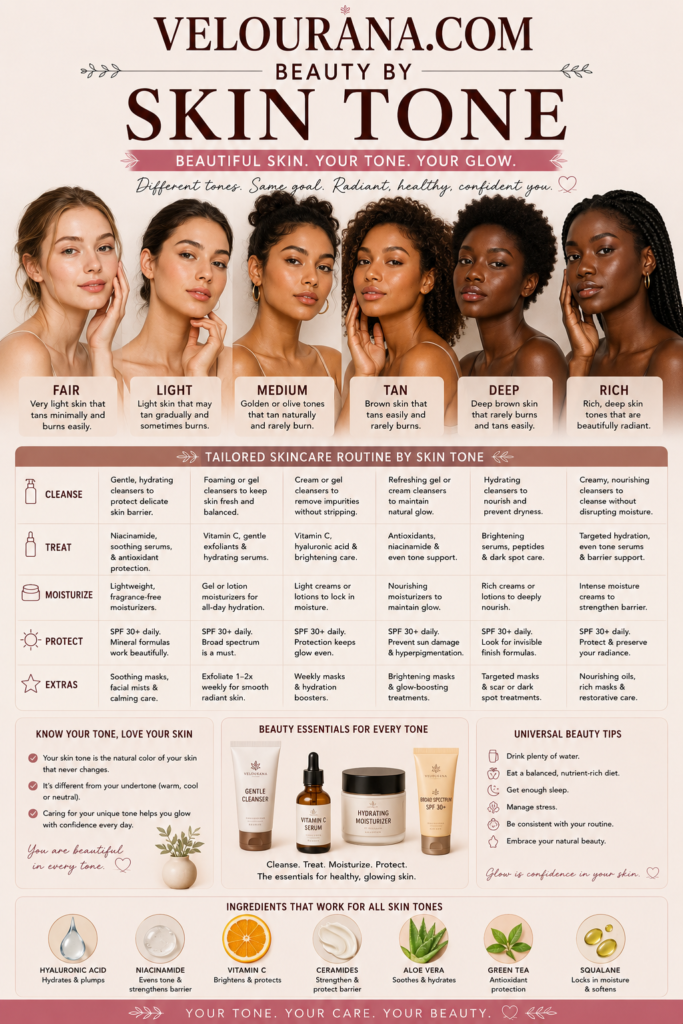
CATEGORY: Medium Skin Foundation
Foundation for medium skin is often treated as easier to match than foundation for very fair or very deep complexions, but that assumption overlooks how much variation exists within the category. Medium skin can lean golden, olive, peach, neutral, rosy, bronze, or muted, and each of these undertones changes how foundation behaves once it is applied across the face.
The most successful foundation does not simply sit somewhere in the middle of a shade range. It needs to reproduce the actual complexion closely enough that the face remains connected to the neck and body, while also providing the level of correction, texture, and finish the wearer wants.
A foundation can be close in depth and still look wrong because its undertone is too yellow, too red, too peach, or too neutralized. A warm formula can appear orange. A cool one can turn pink. A neutral formula can sometimes look gray or dull if the complexion has more warmth or clarity than the product accounts for.
Medium skin also changes significantly according to sun exposure, season, and surrounding colors. The same complexion may appear lighter during winter and warmer or deeper during summer. Freckles, pigmentation, and natural facial redness can further complicate the idea of one single skin color.
This is why foundation matching works best when it begins with the individual complexion rather than with the label on the bottle.
Medium Skin Is a Depth Category, Not a Complete Color Description
The word medium describes how light or deep the complexion appears overall. It does not reveal undertone.
Warm medium skin may contain golden, yellow, peach, caramel, or bronze influences. Cool medium skin may contain rosy, reddish, or bluish undertones. Neutral medium skin tends to balance warm and cool characteristics. Olive medium skin can contain green, gray-green, muted yellow, or golden-olive qualities.
These distinctions matter because foundation is applied over a large area. Even a subtle undertone mismatch becomes increasingly visible once the product covers the face.
A foundation that contains more yellow than the skin may create an artificial golden cast. Too much peach can become orange. Too much red can make the entire face look flushed. A muted formula may appear gray if the complexion is naturally clearer and more saturated.
The goal is not simply to identify whether the skin is warm or cool. It is to understand how strong that undertone actually is.
A golden complexion may require warmth without excessive yellow. An olive complexion may require muted depth without visible green. A rosy medium complexion may need enough red to avoid looking sallow, but not so much that foundation exaggerates surface redness.
The correct match reproduces the complexion rather than amplifying one part of it.
The Jawline Reveals More Than the Hand
Foundation swatches on the hand are useful for comparing texture or rough depth, but they are often unreliable for final shade selection.
Hands can be darker, more sun-exposed, redder, or simply different in undertone from the face and neck.
The jawline provides a better reference because it allows the face and neck to be evaluated together.
Several nearby shades can be placed in narrow vertical swatches along the lower cheek and jaw. Comparison usually reveals undertone differences more clearly than looking at one foundation alone.
One shade may suddenly appear too yellow.
Another may look peach.
A third may have the correct depth but appear overly pink.
The best match is usually the one that requires the least visual explanation.
It does not need to look attractive as a swatch. It needs to disappear into the complexion once blended.
Natural daylight is especially useful because artificial lighting can alter undertone perception. Warm indoor lights may disguise orange or golden foundation, while cool lighting may exaggerate pink or grayness.
The most reliable foundation remains believable across more than one lighting condition.
The Face, Neck, and Chest May Not Be Identical
Medium skin can show natural differences between the face, neck, and chest.
The face may contain redness or pigmentation.
The neck may be slightly lighter because it receives less sun.
The chest may be deeper or warmer because of exposure.
Trying to match one of these areas perfectly can sometimes create a mismatch with the others.
The objective is continuity rather than absolute uniformity.
A foundation that sits naturally between the face and neck often creates a more believable result than one that matches the deepest or reddest area exactly.
This is especially important when the face is visibly warmer or redder than the neck.
Matching surface redness can shift the entire face too far toward red. Matching a deeply tanned chest can make the foundation too dark.
Foundation should establish a coherent baseline rather than reproduce every temporary or localized variation in color.
Warm Medium Skin Requires Controlled Warmth
Warm medium complexions often have golden, yellow, peach, caramel, or bronze characteristics.
These undertones can look beautiful when foundation respects them, but warmth can easily become exaggerated.
Some warm foundation ranges rely heavily on yellow pigment. Others become increasingly orange as they deepen.
A complexion can be warm without being strongly golden.
The correct foundation should preserve the natural warmth while maintaining realistic depth.
If the face suddenly appears more golden than the neck, the shade is likely too warm.
If a peach formula turns orange, its saturation may be too high even if the general undertone direction is correct.
Warm medium skin often benefits from nuanced foundation tones that contain golden or peach influence without becoming visibly yellow.
The best result should look like the skin itself, only more even.
Cool Medium Skin and the Risk of Excessive Pink
Cool medium skin may contain rosy, reddish, blue, or muted violet characteristics.
Foundation ranges sometimes interpret coolness as strong pinkness.
This can create problems because visible surface redness is not always the same as true undertone.
If the cheeks are red but the neck is relatively neutral, selecting a strongly pink foundation can exaggerate the contrast between the face and body.
Cool foundation should contain enough red or pink influence to prevent the skin from appearing yellow or sallow, but not so much that the base becomes visibly rosy.
The correct foundation should integrate with the underlying complexion rather than imitate every flushed area.
Targeted concealer can address redness separately.
This prevents the entire face from becoming one uniform pink tone.
Neutral Medium Skin Is Not Colorless
Neutral medium skin contains a relatively balanced mixture of warm and cool characteristics.
This can provide flexibility, but it can also make foundation matching surprisingly difficult.
A strongly yellow shade looks too warm.
A pink shade appears too rosy.
A peach formula can become orange.
Some neutral foundations contain muted pigments that may look slightly gray.
The ideal neutral foundation should preserve balance rather than strip the complexion of color.
Neutral does not mean beige without undertone.
It means that no single undertone dominates strongly.
A successful match often looks relatively unremarkable in the bottle because it does not contain an obvious warm or cool bias.
Once applied, however, that restraint becomes its strength.
Medium Olive Skin and the Foundation Gap
Olive medium skin is common, yet conventional foundation systems can still struggle to represent it accurately.
Olive undertones may contain muted green, gray-green, yellow-green, or golden-olive characteristics.
These qualities often become most obvious when the wrong foundation is applied.
Pink foundation may look too rosy.
Peach foundation can become orange.
Strong yellow can look artificial.
Some neutral foundations turn pink because they still contain more red pigment than the skin.
The problem may initially look like an incorrect depth when the real issue is undertone.
A foundation can be exactly the right level of darkness and still look wrong because it lacks the muted olive component.
When an appropriate olive shade is unavailable, mixing can help.
A subtle undertone adjustment can reduce excess red or peach without dramatically changing the depth.
The purpose is not to create visibly green foundation.
It is to reproduce the muted balance that the complexion already has.
Coverage Changes the Visibility of a Mismatch
The more coverage a foundation provides, the more important shade accuracy becomes.
Sheer foundation allows natural skin color to remain visible through the product. This can make minor undertone differences more forgiving.
Medium coverage provides greater correction while preserving some natural variation.
Full coverage replaces much more of the visible complexion with foundation pigment.
At that point, an undertone mismatch becomes more obvious because the natural skin is no longer moderating the product.
A foundation that seems correct when applied lightly may become too yellow, too red, or too deep when layered.
This is useful information.
It suggests that the shade is only partially compatible with the complexion.
The ideal foundation should remain believable at the coverage level in which it will actually be worn.
Sheer Foundation and Skin Tint
Sheer bases can be particularly effective for medium skin when the objective is to preserve natural dimension.
Freckles, slight redness, pigmentation, and variations in warmth remain partially visible.
This creates a more transparent complexion in which foundation improves consistency without replacing the skin entirely.
Skin tints can also be more forgiving when the exact undertone is difficult to find.
Because the natural complexion contributes to the final color, a slightly imperfect formula may still integrate successfully.
However, a strongly mismatched tint can still alter the complexion.
A yellow product can make the face warmer.
A pink tint can increase redness.
Transparency reduces the effect; it does not eliminate it.
Medium Coverage as a Flexible Everyday Option
Medium coverage offers one of the most adaptable approaches to medium skin.
It can even the complexion, reduce visible pigmentation, and soften redness while still allowing some natural skin characteristics to remain.
Additional layers can be applied where more correction is needed.
This creates a flexible relationship between foundation and concealer.
Instead of using full coverage everywhere because of a few areas of pigmentation or redness, the foundation can remain moderate while concealer addresses specific concerns.
The finished complexion often retains more dimension and requires less bronzer or blush to restore natural variation.
Medium coverage also works well with seasonal changes because the natural skin remains partially visible through the formula.
Small shifts in complexion depth are therefore somewhat less obvious than with a completely opaque base.
Full Coverage and the Importance of Exact Color
Full coverage creates a more perfected, uniform surface.
It can be excellent for formal makeup, photography, significant discoloration, or simply personal preference.
The challenge is that it gives the foundation complete control over the visible complexion.
If the shade is slightly wrong, the entire face becomes that wrong shade.
A foundation that is too warm creates a uniformly golden or orange face.
A shade that is too cool can look pink.
A foundation that is too deep can make the face appear artificially tanned.
This is why full coverage benefits from especially careful jawline testing, settling time, and daylight evaluation.
The greater the opacity, the less room there is for the natural complexion to disguise a mismatch.
Foundation Finish Changes the Way Depth Is Perceived
Color is influenced by light.
A matte foundation diffuses reflection and can make the complexion appear more uniform and sometimes slightly deeper or flatter.
A luminous foundation reflects more light, which can create an impression of brightness and dimension.
Satin finishes sit between these extremes.
Medium skin can support all of them, but the choice should consider both skin type and desired effect.
Very matte foundation may emphasize dryness or texture if the skin is dehydrated.
Strongly luminous formulas can emphasize uneven texture or become excessively reflective on oily areas.
The correct finish is therefore not determined solely by skin depth.
It should cooperate with the skin's actual surface.
A foundation that remains even and comfortable will usually look more natural than one chosen according to a rigid matte-versus-dewy rule.
Oxidation Can Shift Medium Foundation Noticeably
Foundation can change after application.
Some formulas deepen.
Others become warmer.
Some simply look different once the liquid has fully dried.
On medium skin, this can transform a balanced shade into something noticeably orange, golden, red, or too deep.
Testing should therefore include time.
A fresh swatch does not always represent the final foundation color.
The product should be observed after it has settled and ideally after it has interacted with normal skincare and skin oils.
Oxidation may vary from person to person.
The same foundation can remain stable on one complexion and shift significantly on another.
The final judgment should therefore be based on actual wear rather than reputation alone.
Pigmentation Should Not Determine the Entire Foundation Shade
Medium skin can contain visible hyperpigmentation, freckles, sun spots, or areas that are deeper than the surrounding complexion.
Matching foundation to these darker areas can make the entire face too deep.
Foundation should generally correspond with the underlying skin tone.
Pigmentation can then remain visible, be softened through coverage, or be corrected with concealer depending on preference.
This separation is important.
Foundation establishes the overall complexion.
Concealer handles localized differences.
Using a much darker foundation because certain areas contain deeper pigmentation can make the unaffected skin look artificially dark.
The same principle applies to redness.
One area should not dictate the color of the entire face.
Concealer Should Work With the Foundation
Concealer becomes most effective when it performs a specific role rather than competing with the base.
For blemishes and pigmentation, a concealer close to the foundation shade usually integrates most naturally.
A very light concealer can highlight raised blemishes or create obvious pale patches.
Under the eyes, controlled brightening may be desirable.
However, concealer several shades lighter than the foundation can create an unnatural contrast, particularly when used over a large area.
Medium skin often benefits from correction based on the actual color of the under-eye darkness rather than simply adding more brightness.
Peach, salmon, or other correcting tones can be useful depending on the discoloration, but they should disappear beneath the final concealer rather than remain visible.
Powder Can Alter a Good Foundation Match
Powder is often treated as colorless, but many formulas contain noticeable tint.
A yellow powder can warm medium skin.
A pink or peach powder can shift the undertone.
A tinted beige powder can deepen the foundation.
Even translucent formulas can alter the finish enough to change how the shade is perceived.
Heavy powder also increases opacity.
This can make a natural-looking base appear more uniform and sometimes more disconnected from the neck.
Strategic setting is often more effective than automatically powdering every area heavily.
The objective is to control movement and shine without unnecessarily changing the foundation's color.
Foundation, Bronzer, and the Problem of Artificial Depth
Foundation should represent the actual skin.
Bronzer should add controlled warmth afterward.
Choosing foundation deliberately darker in order to look tanned removes this distinction.
The face can become uniformly deeper while the neck and body remain lighter.
Medium skin may tan relatively easily, which can make this temptation stronger, but foundation still works best when it matches the current complexion rather than an imagined warmer version.
Bronzer can then create targeted warmth around the areas where sun would naturally affect the face.
This preserves dimension.
A correct foundation gives bronzer somewhere to be visible.
A foundation that is already too deep reduces that contrast.
Seasonal Changes Are Especially Relevant to Medium Skin
Medium skin can change noticeably with sun exposure.
The complexion may deepen by more than a small fraction of a shade during warmer months.
Golden or bronze qualities can become more apparent.
Freckles and pigmentation may intensify.
Winter can return the complexion to a lighter or more muted state.
This often means one permanent foundation shade is unrealistic.
Two compatible depths can provide flexibility and allow mixing as the complexion changes.
The underlying undertone usually remains more stable than the surface depth.
A summer tan does not necessarily mean the complexion becomes fundamentally warmer in undertone.
The foundation should follow the actual change rather than assuming deeper automatically means more golden or orange.
Foundation Mixing Can Create a More Accurate Match
Mixing is particularly useful for medium skin because seasonal shifts can move the complexion noticeably between neighboring shades.
A lighter and deeper shade from the same formula can be blended in different proportions throughout the year.
Undertone can also be adjusted when the depth is correct but the color direction is slightly wrong.
Small amounts of appropriate mixers can reduce excessive orange, red, or another unwanted tendency.
Olive complexions may benefit especially when foundation ranges do not offer enough muted options.
The adjustment should begin with a nearly correct foundation.
Mixing works best as refinement rather than complete reconstruction.
Foundation Should Behave Well on the Actual Skin Type
An accurate color match cannot compensate for poor texture performance.
Dry skin can cause foundation to cling or collect around flakes.
Oily skin can cause separation or additional oxidation.
Combination skin may experience both behaviors in different areas.
Mature or textured skin may reveal accumulation around lines or uneven surfaces.
Thin layers generally provide more control.
Skin preparation can also be localized.
Drier areas may benefit from additional hydration.
Oily areas may require more strategic priming or powder.
The goal is to keep pigment evenly distributed because uneven accumulation changes both texture and apparent color.
Foundation should remain stable enough that the complexion still looks coherent after several hours of wear.
Daylight and Real-Life Wear Matter More Than the Bottle
Foundation should be judged where it will actually be seen.
A shade that looks beautiful under warm store lighting may appear orange outside.
A cool artificial light can make a balanced foundation look pinker than it is.
Natural daylight remains one of the most useful references.
Photographs can also reveal face-to-neck differences, although camera processing can distort color.
The most trustworthy foundation is one that remains believable under several conditions.
It should work in daylight, ordinary indoor light, and after settling into the skin.
The Best Medium-Skin Foundation Creates Continuity
A successful foundation does not need to make medium skin look lighter, darker, warmer, or cooler.
Its role is to establish continuity.
The face should remain visually connected to the neck.
The undertone should feel consistent with the body.
Coverage should refine the complexion without creating unnecessary flatness.
The finish should cooperate with the skin's texture.
Localized pigmentation or redness should not force the entire base toward the wrong color.
When these elements align, foundation becomes quiet.
It supports blush, bronzer, contour, eye makeup, and lipstick without distorting them.
Medium skin remains recognizably itself.
That is what makes the foundation successful.
It does not replace the complexion.
It gives the complexion a more controlled and even version of its own natural color.
THE END VELOURANA
 Discover More From Our Family of Websites
 ZodiacBearing (Astrology, Tarot, Numerology, Angel Numbers & Spiritual Guidance)
 Velourana (Beauty, Makeup, Hair Care, Skincare & Beauty Tips)
 HavenBearing (Home, Living, Organization, Décor & Everyday Inspiration)
 PawBearing (Pet Care, Dog Breeds, Animal Health, Training & Pet Products)
 PsyCatherine (Notes From the Journal of a Psychologist on Real Life)

