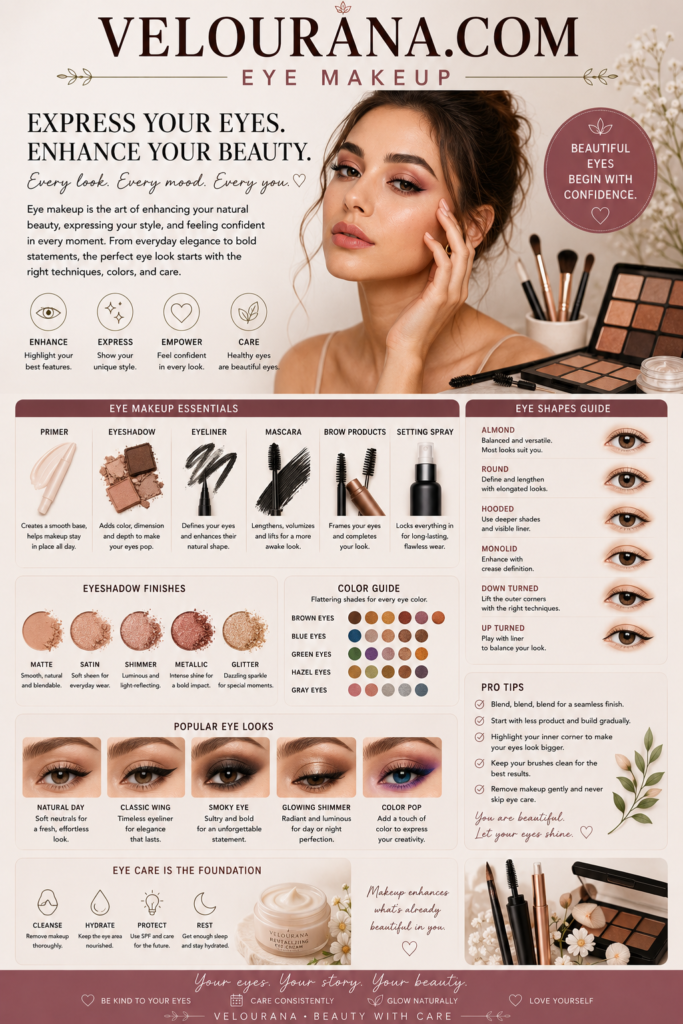
CATEGORY: Matte Eyeshadow
Matte eyeshadow rarely announces itself with sparkle, metallic reflection, or a dramatic flash of light. Its power is quieter. It changes the apparent depth of the eye, strengthens a crease, softens an edge, alters proportion, and creates the shadows that make eye makeup appear dimensional rather than simply colorful. A well-placed matte can make the eyes seem more sculpted without making the makeup itself obvious. A poorly chosen or badly blended matte, however, can reveal every uneven transition and every patch of excess pigment.
This is what makes matte eyeshadow one of the most fundamental yet technically interesting categories in eye makeup. The absence of visible shimmer does not make it visually simple. In many ways, it makes the formula more exposed. With no reflective particles to scatter light across the surface, the eye sees the pigment, its density, the transitions between shades, and the relationship between color and natural facial contours much more clearly.
For makeup lovers who prefer understated beauty, matte shadow can create an entire look without relying on anything reflective. For those who enjoy elaborate eye makeup, mattes often provide the underlying architecture that allows shimmer, glitter, metallic finishes, eyeliner, and lashes to make sense. They can recede, define, frame, enlarge, elongate, soften, or intensify depending on where and how they are placed.
Understanding matte eyeshadow therefore means understanding much more than a finish. It means understanding the visual language of shadow itself.
What Makes an Eyeshadow Truly Matte
A true matte eyeshadow is defined primarily by its lack of obvious reflective finish. Unlike shimmer, metallic, glitter, or many satin shadows, it does not depend on visible light-catching particles to create its effect. Instead, the color reads more evenly and diffusely across the skin. This quality is precisely why matte shadow is so useful for creating the impression of natural depth.
The distinction becomes especially clear when the same color family is compared across different finishes. A medium brown shimmer and a medium brown matte may appear similar in their pans, yet they can behave very differently on the eyelid. The reflective brown catches illumination and can visually bring an area forward. The matte brown tends to absorb or diffuse light more quietly, allowing the area to appear recessed. That difference gives makeup artists enormous control over apparent eye shape.
Not every product marketed as matte looks identical, however. Modern formulations range from very dry, powdery mattes to extraordinarily smooth textures that almost feel creamy beneath a fingertip. Some have a completely flat appearance, while others possess an extremely subtle softness that stops short of visible sheen. The important distinction is whether the finish visibly reflects light in the way satin or shimmer does.
Texture matters as much as the absence of shine. A sophisticated matte formula should distribute pigment evenly enough that the finish appears smooth rather than chalky. The difficulty for formulators is balancing strong color payoff with blendability, adhesion, softness, and sufficient working time. A matte that releases enormous amounts of pigment instantly may look impressive in a finger swatch yet become difficult to control on the eye. Conversely, a formula that is too sheer or stiff can demand repeated layering before meaningful depth appears.
The best matte texture is therefore not necessarily the one with the strongest first swipe. It is the one whose behavior suits its intended purpose.
A pale transition color benefits from gradual buildability because it may need to disappear almost imperceptibly into the surrounding skin. A very dark matte used for smoky definition requires enough saturation to produce genuine depth but should still allow its edges to be diffused. A vivid matte needs strong, even pigment dispersion because patchiness becomes particularly conspicuous in saturated colors.
This balance explains why two matte shadows that appear almost identical in a palette can perform completely differently once brushes touch them.
Why Matte Shadow Creates Such Convincing Dimension
Much of successful eye makeup is an illusion created through controlled light and shadow. The natural face already contains countless changes in depth: the orbital bone curves around the eye, the lid projects differently depending on anatomy, the crease forms a natural indentation, and the brow bone catches light differently from the socket beneath it.
Matte eyeshadow can strengthen, soften, or reposition those existing visual signals.
When a medium matte shade is blended through the crease, the eye interprets that darker area as additional depth. Extending the same color slightly outward can make the eye appear longer. Concentrating a deeper matte near the outer corner can visually increase dimension there, while carefully diffusing the color upward may produce a more lifted impression.
This is why matte eyeshadow should not be understood merely as colored powder placed on the eyelid. Its relationship with anatomy is central to the result.
Consider a completely monochromatic matte look. There may be no shimmer, glitter, eyeliner, or elaborate color contrast at all, yet the eye can still appear remarkably dimensional. A lighter version of the color can merge with the surrounding skin, a medium version can establish shape, and a deeper version can create apparent recession. The transitions between them become almost architectural.
The effect can also be reversed. Applying very dark matte shadow indiscriminately around the entire eye can reduce visible lid space or make an eye appear smaller. This is not inherently undesirable; intensely enclosed smoky eyes deliberately use this effect. The point is that matte placement changes visual proportion.
Eye anatomy also determines where conventional placement advice succeeds or fails. A crease that is visible when the eye is closed may disappear when the eye opens. Deep-set eyes already possess strong natural socket depth and may not require the same amount of crease darkening as other shapes. Monolids provide a different visual canvas in which gradients can be built according to visible lid area rather than a conventional crease structure.
For this reason, effective matte application begins with observation rather than rules. Looking at the eyes while they are naturally open often reveals more useful information than studying them only while the lid is closed. The question becomes not simply where the anatomical crease exists, but where depth needs to be visible in the finished expression.
Once this idea is understood, matte eyeshadow becomes significantly more intuitive. The makeup is no longer being placed according to a diagram. It is being used to manipulate perceived depth.
The Relationship Between Pigment, Texture and Blendability
Matte eyeshadow has a reputation for being more demanding than many reflective finishes, and there is a practical reason for this. Reflective particles can visually disguise small irregularities because they scatter light across the surface. Matte pigment leaves transitions much more exposed.
When a dark matte shadow catches unevenly on one part of the eyelid, the resulting patch can look unmistakable. When two matte shades have not been properly transitioned, the border between them may appear abrupt. When excessive powder accumulates in one area, additional blending can sometimes spread the problem rather than solve it.
Formula quality therefore becomes particularly important.
Powder eyeshadow generally contains a combination of pigments, fillers, binders, texturizing ingredients, and other materials designed to influence properties such as adhesion, slip, oil absorption, compression, and wear. Matte formulations present a distinctive challenge because they must produce saturated, even color without relying on obvious pearlescent particles to create visual smoothness.
Pigment treatment and dispersion can influence how evenly color transfers. Binders help the powder adhere both within a pressed pan and eventually to the skin. Ingredients that influence slip affect whether a brush glides smoothly or seems to drag. Oil-absorbing materials can help maintain a matte appearance but, in an unbalanced formula or on a dry surface, the finished texture may feel less forgiving.
These differences are immediately recognizable in use even when the wearer knows nothing about cosmetic chemistry.
One matte seems to blend almost automatically. Another deposits a stubborn patch of color wherever the brush first touches the eye. One deep brown can be built from a translucent haze into substantial depth. Another reaches near-opacity immediately and requires considerable control. One pale beige looks smooth over the brow area, while another becomes visibly powdery.
Neither pigmentation nor softness alone determines quality. Context matters.
Extremely pigmented mattes are valuable for artistic makeup and intense color work, but they demand restraint. More buildable formulas can be preferable for everyday sculpting because the wearer can approach the desired intensity gradually. A softer powder may blend beautifully but produce more loose product in the pan. A firmer shadow may create less kick-up yet require more deliberate loading of the brush.
The sophisticated way to judge matte eyeshadow is therefore through performance rather than spectacle. A dramatic finger swatch can reveal color but cannot fully demonstrate how a shadow will behave through a crease, over a primer, beside another matte, or after several hours of natural eyelid movement.
The true test happens on the eye.
Preparing the Eyelid Without Destroying the Matte Effect
Matte shadow often reveals the condition of the surface beneath it. Dryness, excess emollient product, uneven primer, and natural oil can all change how pigment adheres. This does not mean the eyelid must be transformed into a perfectly blank canvas. It means the preparation should support the intended finish.
A comfortable eye area is important because powder placed over visibly dehydrated or flaky skin can emphasize uneven texture. At the same time, applying matte shadow directly over a very rich layer of skincare can cause pigment to grip immediately and resist blending. The goal is balance: the lid should feel comfortable but not excessively slippery.
Eyeshadow primer can be particularly useful when natural eyelid oils cause fading or creasing, when stronger color payoff is desired, or when a more uniform base is needed. Different primers create different surfaces. Some remain tacky and intensify pigment adhesion, while others dry to a smoother finish that provides more freedom for blending.
The amount matters. A thick layer of primer can create texture of its own and may cause powder to accumulate. A thin, even film is generally easier to work over.
There is also an important relationship between base texture and application strategy. When a primer remains noticeably tacky, placing a heavily loaded blending brush directly onto it can create an intense patch that becomes difficult to diffuse. One approach is to establish the deepest areas deliberately and then soften their boundaries. Another is to lightly neutralize some tackiness before beginning broad blending.
Neither method is universally superior. A tackier surface can make vivid mattes appear richer and can increase adhesion. A smoother, lightly set surface can provide more working time for subtle gradients. The correct choice depends on whether intensity or effortless diffusion is the greater priority.
Preparation should ultimately disappear from the finished makeup. If the observer notices a beautiful matte gradient rather than the technical work beneath it, the base has done its job.
Blending Matte Eyeshadow Without Losing Its Shape
Blending is often described as though the objective were simply to keep moving a brush until every visible edge disappears. That approach can produce muddy makeup. Successful blending does not eliminate structure; it controls transitions.
A beautifully blended matte eye still contains distinct areas of depth. The deepest pigment remains concentrated where definition is wanted. Medium tones connect that depth to the surrounding skin. Softer shades allow the edges to dissolve gradually. What disappears is not the structure but the abruptness.
Brush pressure is crucial. Pressing heavily can move more product than intended and spread deep color into areas that were supposed to remain soft. Light pressure allows the tips of the bristles to manipulate the edge rather than disturb the entire application.
Brush size matters for the same reason. A large fluffy brush can create broad diffusion but cannot easily maintain precise depth in a small outer corner. A smaller tapered brush offers control but can create concentrated marks if used aggressively. Dense brushes deposit more color; airy brushes generally distribute it more softly.
The most polished matte looks often use different brush behaviors at different stages. Pigment may first be placed with controlled pressure where maximum depth is required. The border can then be softened using less product and a lighter motion. A cleaner brush can refine the outer transition without continually adding pigment.
Gradual layering is especially valuable with dark mattes. Once an area has become dramatically deeper than intended, removing that intensity while preserving a smooth gradient can be difficult. Building depth progressively keeps the shape under control.
This is also why repeatedly dipping into the darkest shade during blending can become counterproductive. Each return adds pigment while the wearer may believe they are merely softening what is already present. Eventually the dark area expands, swallowing the medium tones that once provided dimension.
Good blending involves knowing when to stop.
A transition does not need to be infinitely blurred. In editorial makeup, a deliberately graphic matte edge may be the point. In a smoky look, softness may extend much farther. In natural makeup, the shadow may need to become almost imperceptible before reaching the brow area.
The finish should serve the design rather than an abstract rule about what blending is supposed to look like.
Matte Color Beyond Beige and Brown
Neutral mattes dominate many palettes because they are exceptionally useful. Browns, taupes, creams, terracottas, muted pinks, charcoals, and similar shades can create believable shadows while integrating easily with other makeup. Yet limiting matte eyeshadow to neutral sculpting overlooks much of its expressive potential.
Color behaves differently when deprived of shimmer.
A matte cobalt can appear strikingly graphic and modern. Matte plum can produce smoky depth without the jewel-like effect associated with reflective purple. Matte forest green can feel sophisticated and earthy, while vivid orange, yellow, or pink can turn the eyelid into a field of uninterrupted color.
Because matte finishes do not depend on reflection, hue becomes the dominant visual event.
This makes undertone especially significant. Browns may lean red, yellow, olive, gray, orange, or purple, and those differences can completely alter the mood of an eye look. A cool taupe can create a shadow-like sculptural effect, whereas a warm caramel introduces visible warmth. Deep brown can replace black when definition is wanted without maximum contrast.
The same principle applies to pale mattes. A light shade that is too stark against the complexion can appear chalky even when the formula itself is excellent. A shade closer to the wearer's natural coloring may integrate more gracefully. On deeper complexions, richly pigmented medium and deep tones are particularly important because poorly balanced pale bases can mute or distort the intended color.
Color selection is not a matter of obeying rigid rules about skin tone or eye color. Contrast, harmony, wardrobe, lighting, and personal style all influence the result. Someone may deliberately choose a contrasting shade because they want the eye makeup to dominate. Another person may prefer tonal harmony because they want definition without obvious color.
Matte shadow accommodates both approaches unusually well. It can imitate naturally occurring facial shadow or reject naturalism completely.
Why Matte Eyeshadow Remains Essential
Beauty trends continually change the amount of reflection considered fashionable. Highly metallic lids dominate one period; sheer washes appear in another. Glitter returns, disappears, and returns again. Matte makeup alternates between intense full-face interpretations and softer combinations with luminous skin.
Yet matte eyeshadow never truly becomes obsolete because its primary function is structural.
Even when reflective eyeshadow is the visual centerpiece, matte shades frequently provide the surrounding depth that makes the reflection appear brighter. A metallic lid becomes more dimensional beside a softly darkened crease. Glitter appears more deliberate when its boundaries are supported by controlled matte shading. Graphic liner can gain greater presence when the surrounding lid has been quietly sculpted.
At the opposite extreme, matte shadow can stand completely alone.
A single muted shade swept across the eye can create sophisticated minimalism. A softly smoked brown can replace obvious eyeliner. A deep charcoal wash can create drama without a single reflective particle. Tonal mattes can produce complex dimension that becomes visible through color gradation rather than shine.
That versatility explains the enduring importance of the finish.
Matte eyeshadow does not need to compete with light to attract attention. It works by controlling where visual depth begins and ends. Once that principle is understood, the category becomes less about avoiding shimmer and more about deliberately shaping the eye.
The finest matte makeup can be almost invisible in its technique. The observer notices stronger eyes, greater dimension, or beautifully balanced color without immediately seeing how the illusion was constructed.
That quiet control is precisely what gives matte eyeshadow its lasting place in beauty.
THE END VELOURANA
 Discover More From Our Family of Websites
 ZodiacBearing (Astrology, Tarot, Numerology, Angel Numbers & Spiritual Guidance)
 Velourana (Beauty, Makeup, Hair Care, Skincare & Beauty Tips)
 HavenBearing (Home, Living, Organization, Décor & Everyday Inspiration)
 PawBearing (Pet Care, Dog Breeds, Animal Health, Training & Pet Products)
 PsyCatherine (Notes From the Journal of a Psychologist on Real Life)