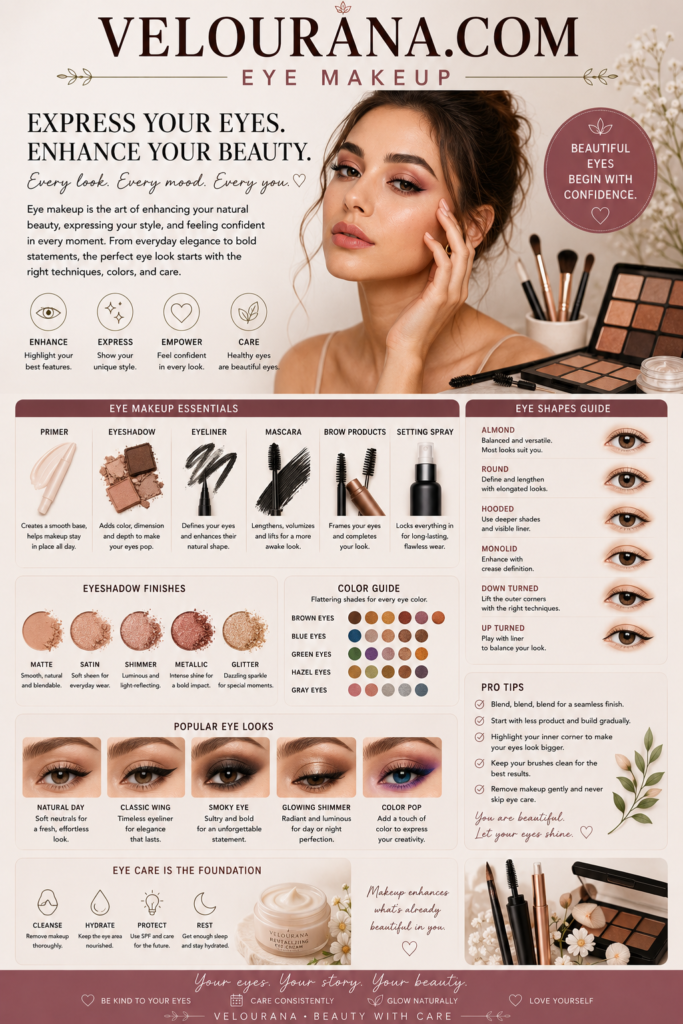
CATEGORY: Mascara Application
Mascara is often treated as one of the simplest products in an eye makeup routine. The tube opens, the wand moves through the lashes, and the eyes appear darker and more defined. Yet the difference between mascara that merely coats the lashes and mascara that genuinely enhances the eyes comes largely from application. The formula matters, the brush matters and the natural characteristics of the lashes matter, but technique determines how successfully all three work together.
Good mascara application is less about depositing as much product as possible and more about controlling where that product goes. The roots need enough definition to create visual depth around the lash line. The middle of the lashes needs sufficient coverage to strengthen the impression of volume and length. The tips usually benefit from a lighter touch so that they remain separated and refined rather than becoming thick and blunt. When those areas are treated identically, mascara can quickly begin to look heavy.
The most polished results therefore come from understanding lashes as a structure rather than simply as hairs that need to be darkened. Their direction, density, length, curl and spacing influence how mascara behaves. A technique that creates beautiful definition on naturally long, sparse lashes may produce excessive bulk on short, dense ones. Straight lashes often need greater attention at the root, while strongly curled lashes may require more restraint near the tips. The objective is not to force every lash type toward the same appearance but to use mascara to improve definition while preserving the natural architecture of the eye.
The Foundation of Successful Mascara Application
Mascara application begins before the wand reaches the lashes. The condition and position of the lashes influence whether the product spreads smoothly or collects unevenly. Lashes that are clean and reasonably dry provide a more predictable surface. Residue from rich eye creams, oils or previous makeup can interfere with adhesion and sometimes encourage mascara to transfer onto surrounding skin.
This becomes especially noticeable around the upper lash line. The skin there naturally moves whenever the eyes blink, and lashes repeatedly approach or touch the eyelid throughout the day. When the surrounding area is very emollient, even a mascara that normally performs well may become more likely to smudge. Preparing the eye area does not mean stripping it of skincare; it means allowing skincare to settle and avoiding an unnecessarily slippery surface immediately around the lashes.
The physical arrangement of the lashes also matters. Some lashes naturally overlap, cross or grow in several directions. Applying a thick layer of mascara immediately can lock those irregularities into place. A more controlled beginning gives the brush an opportunity to guide the hairs before the formula becomes too concentrated.
Curling, when desired, is generally most useful before mascara. An eyelash curler changes the angle from which the lashes emerge, opening the appearance of the eye and creating a shape that mascara can then emphasize. The effect does not need to be dramatic. A gentle lift can be enough to make the lash line appear more visible and allow length to register more clearly from the front.
The important distinction is that curling and mascara perform different visual functions. Curling changes direction; mascara changes visibility, thickness and definition. When those functions complement one another, the result often appears more intentional than simply adding repeated coats in an attempt to make the lashes stand out.
Why the Roots Matter More Than They Appear To
One of the most influential areas in mascara application is also one of the easiest to neglect: the base of the upper lashes. Concentrating definition near the roots creates darkness immediately above the eye, which can make the lash line appear denser without requiring every millimetre of each lash to carry the same amount of product.
This root emphasis explains why a controlled wiggle at the base can be effective. The movement is not valuable because mascara application requires a ritualized gesture; it is valuable because it allows the bristles to contact more of the lower portion of the lashes and distribute product around them. Once the roots have been engaged, the brush can travel outward through the lengths with progressively less pressure.
That change in pressure is significant. If the same heavy movement continues all the way to the ends, the tips can accumulate enough mascara to lose their natural taper. The lashes may technically become thicker, yet visually they can appear shorter because their delicate ends have been replaced by blunt masses of product.
A well-defined root with cleaner tips creates a different optical effect. The eye gains depth at the lash line while individual lashes remain visible above it. This combination is particularly useful when the desired finish is polished rather than deliberately dramatic.
The direction in which the wand travels also affects the final shape. Pulling every lash straight upward can create a rounded, open appearance. Guiding the outer lashes slightly outward can extend the visual width of the eye. Directing central lashes upward while allowing the outer section to fan toward the temple can create a softer, elongated effect.
These changes can be subtle, but mascara is positioned at the boundary of the eye itself, so even small directional differences influence the overall impression.
Working With the Wand Instead of Fighting It
Mascara brushes vary considerably. Some have dense traditional bristles, others use molded silicone or elastomer teeth, and their shapes may be straight, tapered, curved, hourglass-like or unusually narrow. Application improves when the brush is treated as a tool with particular mechanical characteristics rather than merely as the object attached to the mascara cap.
A densely bristled brush can carry substantial product and surround several lashes simultaneously. This can create fullness efficiently, but it may require a lighter hand on naturally dense lashes. A brush with widely separated molded teeth may provide more obvious separation because the lashes pass between individual projections. Narrow brushes can make it easier to approach shorter lashes and inner corners without touching the eyelid.
Whatever the design, the amount of formula on the brush matters. An overloaded wand can place a concentrated deposit onto the first lashes it touches. That deposit then has to be redistributed, often resulting in repeated brushing and unnecessary manipulation. Allowing excess formula to remain controlled around the opening of the tube generally makes the application more manageable.
The wand should also be rotated thoughtfully rather than constantly. Different sides and edges of a brush can perform different jobs. The broader surface may coat the main body of the lashes, while a tapered tip can help reach shorter hairs around the inner or outer corner. Using the end of a mascara wand carelessly, however, can place a large blob of product exactly where precision is most important.
Movement through the lashes is most effective when it remains deliberate. The brush needs enough contact to deposit mascara but not so much repeated friction that partially drying formula is continually disturbed. Once mascara begins setting, excessive brushing can transform smooth coverage into irregular texture.
This is where restraint becomes part of technique. More strokes do not automatically produce more beautiful lashes. There is a point at which the brush has already arranged and coated the hairs effectively, and continuing beyond that point can undo the separation already achieved.
Building Intensity Without Creating Clumps
Layering mascara is one of the most common ways to increase volume and drama, but successful layering depends on timing and distribution. A second coat should add something useful to the first rather than simply repeating it.
The initial coat can establish the shape. It defines the roots, separates the lashes and creates the basic direction. Once that structure exists, additional mascara can be concentrated where more visual weight is wanted. Someone seeking stronger outer-corner emphasis may work slightly more product through the outer lashes. Someone wanting a rounded, doll-like effect may emphasize the central lashes instead.
The challenge is maintaining flexibility while layering. If a coat becomes completely rigid before another thick layer is applied, the new formula may sit on top rather than integrating smoothly. Conversely, repeatedly brushing very wet lashes can cause neighboring hairs to merge because they remain saturated and mobile.
Controlled application works between those extremes. The lashes retain enough flexibility to accept refinement without becoming so wet that they collapse into groups.
Clumping itself is not always undesirable. Modern mascara looks sometimes intentionally group a few lashes to create graphic definition. The distinction is between deliberate grouping and uncontrolled accumulation. Intentional definition still preserves an overall rhythm across the lash line. Accidental clumping tends to create random heavy sections separated by conspicuous gaps.
When lashes begin sticking together more than intended, the best correction is usually precision rather than another full coat. A clean lash comb or suitable separating tool can restore individual definition while the mascara remains workable. Continuing to add formula in an attempt to cover a clump generally makes the problem larger.
The final texture should support the intended aesthetic. Soft everyday lashes benefit from visible separation and relatively fine ends. Dramatic evening mascara can tolerate considerably more density. Neither finish is inherently more correct; the application simply needs to remain coherent with the desired result.
Upper, Lower and Corner Lashes Require Different Control
The upper lashes dominate most mascara looks, but treating the entire upper fringe as a single uniform section can limit precision. Inner, central and outer lashes differ in length, accessibility and visual influence.
Inner lashes are often shorter and more difficult to reach. A large brush pushed aggressively toward the inner corner can easily mark the skin. Using a smaller portion of the brush and reducing pressure makes it possible to define these hairs without depositing excessive product. Their contribution is subtle, but leaving them completely untouched while heavily coating the rest of the lashes can sometimes make the application appear abruptly incomplete.
Central lashes strongly influence the apparent openness of the eye. Emphasizing their upward direction can make the eye seem taller and more awake. Outer lashes contribute more strongly to elongation. Their natural angle can be reinforced by guiding the brush slightly outward rather than vertically.
Lower lashes introduce another set of considerations. They are usually shorter and finer, and heavy mascara beneath the eye can alter the visual balance of the entire makeup look. Strong lower-lash definition may create a dramatic frame, while a lighter application keeps attention concentrated on the upper eye.
The brush does not necessarily need to move through lower lashes in exactly the same way as the upper lashes. A large sweeping movement can deposit too much formula. Smaller, controlled contact allows individual hairs to receive color without becoming disproportionately heavy.
Some people prefer no lower mascara at all, particularly when seeking a lifted appearance or when transfer beneath the eyes is a recurring issue. Others find that subtle lower-lash definition makes the eyes appear more complete. Mascara application is therefore not simply a question of how much product to use but where visual emphasis should sit.
Adapting Technique to Different Natural Lash Characteristics
Natural lashes vary enough that a universal mascara technique is rarely ideal. Length, thickness, density, direction and curl all change how product should be distributed.
Long lashes already possess visible extension, so excessive product at their tips can make them look overloaded. Their application often benefits from root definition and careful separation, allowing natural length to remain the dominant feature. Sparse lashes present the opposite visual challenge. Their individual hairs may be perfectly long, yet gaps between them can make the lash line appear less substantial. Concentrating mascara near the roots can help create the impression of greater density without attempting to manufacture thickness through heavy coating alone.
Short lashes often benefit from a brush capable of reaching close to the base and maintaining contact as it travels outward. The technique needs precision because excessive formula can consume the visible length quickly. Fine lashes similarly require control. A very wet, heavy application can cause them to adhere to neighboring hairs, reducing rather than increasing the appearance of fullness.
Straight lashes place greater importance on direction. Curling before application can establish lift, while mascara applied with attention to the roots can reinforce that shape. Very heavy tips may pull against the effect, particularly when the formula remains wet for some time.
Naturally curly lashes can present their own challenge because the brush may not contact the entire length evenly from one angle. Changing the position of the wand slightly can help coat areas that otherwise remain hidden, but forcing strongly curved lashes into an unnatural direction can disturb their attractive natural shape.
The principle behind all of these adaptations is consistent: mascara should work with the physical characteristics already present. The product becomes more effective when application responds to the lashes rather than treating every eye as identical.
Preventing Smudges, Transfer and Application Marks
Even careful mascara application occasionally leaves a mark on the eyelid. This is especially common when trying to reach the roots or when working with long lashes that naturally touch the skin. The instinctive reaction is often to wipe the mark immediately, but wet mascara can smear and spread into the surrounding makeup.
Allowing a small accidental mark to dry can make correction easier because the dried formula may lift away more cleanly than a wet smear. This is particularly valuable when eyeshadow has already been completed and preserving the surrounding makeup matters.
Transfer that develops later in the day is more complicated because it can result from the interaction between formula, skin, eye shape and environment. Hooded or deep-set eyes may bring lashes into frequent contact with skin. Naturally oily eyelids can create conditions in which certain mascaras soften. Heat, humidity, watery eyes and rich skincare can also contribute.
Application can reduce some of these problems even when it cannot eliminate every cause. Avoiding unnecessary product on the extreme tips can help when long lashes repeatedly touch the brow bone. Allowing mascara to set before manipulating the eye area can also reduce immediate transfer.
The lower eye area deserves similar consideration. Heavy application to lower lashes can increase the amount of pigment positioned close to skin that may become warm or moist throughout the day. A restrained lower-lash application can therefore be both an aesthetic and practical decision.
The goal is not to make mascara application anxious or overly technical. It is simply to recognize that the product exists in a highly mobile area of the face. A few controlled decisions during application can improve how cleanly the result wears.
The Difference Between Visible Mascara and Beautiful Lashes
The most successful mascara application does not necessarily announce the amount of mascara being worn. Even a dramatic lash look can retain a sense of structure. The roots appear intentional, the lengths remain directional, and the overall shape complements the eye.
This is why application matters as much as claims about volume, length or curl. Mascara can only exaggerate what the brush and technique allow it to reach. A volumizing formula placed mainly on the tips may fail to create convincing density. A lengthening formula repeatedly layered until the lashes become thick and blunt may obscure the very length it was intended to emphasize.
Beautiful mascara application therefore depends on editing. The person applying it decides where the lash line needs darkness, where individual hairs should remain separated, where greater intensity improves the eye shape and where additional product would become excessive.
That process can produce very different results with the same mascara. A single controlled coat can create subtle daytime definition. Greater root concentration and strategic layering can create a stronger evening effect. Directional emphasis can make the eyes appear rounder or more elongated without changing the formula at all.
Mascara is therefore less passive than it appears. The wand is not merely transferring pigment; it is arranging one of the most expressive borders of the face.
Once application is understood in those terms, the objective becomes clearer. The aim is not simply darker lashes. It is a deliberate balance of definition, separation, direction, density and length that makes the eyes appear more expressive while allowing the lashes themselves to remain recognizably individual.
THE END VELOURANA
 Discover More From Our Family of Websites
 ZodiacBearing (Astrology, Tarot, Numerology, Angel Numbers & Spiritual Guidance)
 Velourana (Beauty, Makeup, Hair Care, Skincare & Beauty Tips)
 HavenBearing (Home, Living, Organization, Décor & Everyday Inspiration)
 PawBearing (Pet Care, Dog Breeds, Animal Health, Training & Pet Products)
 PsyCatherine (Notes From the Journal of a Psychologist on Real Life)