CATEGORY: Makeup Terminology
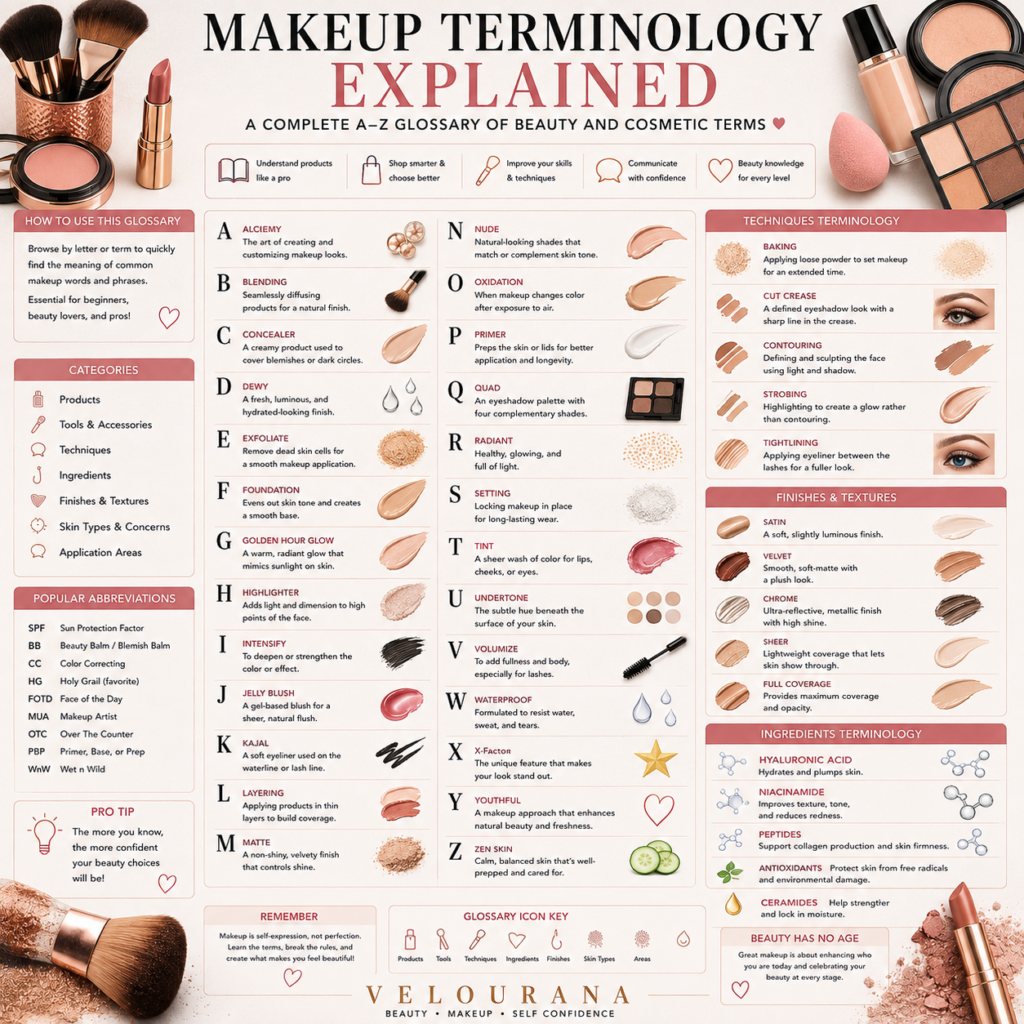
The world of makeup is filled with specialized words and expressions that can feel overwhelming, especially if you’re just beginning your beauty journey. Beauty tutorials, product descriptions, and professional makeup artists often use technical terms such as baking, cut crease, dewy finish, oxidation, waterline, and undertone without explaining what they actually mean.
Understanding makeup terminology makes it much easier to shop for cosmetics, follow tutorials, compare products, and develop your own makeup skills with confidence.
This comprehensive A–Z glossary explains many of the most common makeup terms in clear, beginner-friendly language.
—
A
Airbrush Finish
A smooth, flawless appearance where makeup blends seamlessly into the skin, creating a soft-focus effect.
—
Applicator
A tool used to apply makeup, such as a sponge, brush, doe-foot wand, or puff.
—
B
Baking
A makeup technique in which generous amounts of loose setting powder are applied over concealer or foundation for several minutes before brushing away the excess. This helps set makeup and reduce creasing.
—
Blending
The process of softening edges between makeup products so there are no harsh lines.
—
Blush
A cosmetic used to add color and a healthy-looking flush to the cheeks.
—
Bronzer
A product used to add warmth and create the appearance of naturally sun-kissed skin.
—
C
Cake Face
A term used to describe makeup that appears excessively thick, heavy, or layered.
—
Color Corrector
A product that neutralizes unwanted discoloration before concealer or foundation is applied.
Examples include:
- Green for redness.
- Peach for dark circles.
- Lavender for dullness.
—
Concealer
A cosmetic designed to hide dark circles, blemishes, redness, or pigmentation.
—
Contour
A technique that creates the illusion of shadows to define facial features.
—
Coverage
Describes how much of the skin a product hides.
Common levels include:
- Sheer.
- Light.
- Medium.
- Full.
—
Creasing
When makeup settles into fine lines or folds of the skin.
—
Cut Crease
An eyeshadow technique that sharply defines the eyelid crease to create dramatic eye makeup.
—
D
Dewy Finish
A radiant, hydrated-looking complexion with a healthy glow.
—
Doe-Foot Applicator
A soft, angled sponge applicator commonly used for concealer, lip gloss, and liquid lipstick.
—
E
Eyeliner
A cosmetic used to define the eyes along the lash line.
—
Eyeshadow
Colored cosmetic applied to the eyelids to enhance the eyes.
—
F
Fall-Out
Loose eyeshadow particles that drop onto the cheeks during application.
—
Fan Brush
A thin, fan-shaped brush commonly used for highlighter or gently removing eyeshadow fall-out.
—
Feathering
When lipstick spreads beyond the natural lip line.
—
Finish
The final appearance of makeup once applied.
Common finishes include:
- Matte.
- Satin.
- Natural.
- Dewy.
- Radiant.
—
Full Coverage
Products that conceal most discoloration and imperfections.
—
G
Glitter
Reflective particles that create sparkle in makeup products.
—
Glossy Finish
A shiny appearance commonly associated with lip glosses and dewy makeup.
—
H
Highlight
A product used to reflect light and emphasize facial features.
—
Hooded Eyes
An eye shape where the upper eyelid is partially covered by excess skin.
—
Hydrating Formula
A cosmetic designed to help maintain moisture while being worn.
—
I
INCI
The International Nomenclature of Cosmetic Ingredients used to standardize ingredient lists worldwide.
—
K
Kabuki Brush
A dense, rounded makeup brush used primarily for powder products and buffing foundation.
—
L
Lash Line
The area where eyelashes grow.
—
Lip Liner
A pencil used to outline the lips before applying lipstick.
—
Long-Wear
Products formulated to maintain their appearance for extended periods.
—
M
Matte Finish
A finish with little or no visible shine.
—
Micellar Water
A gentle cleansing solution that removes makeup using microscopic cleansing molecules called micelles.
—
Mineral Makeup
Cosmetics formulated primarily with mineral-based ingredients.
—
N
Non-Comedogenic
A formulation intended to reduce the likelihood of clogging pores.
—
Nude Makeup
A makeup style using natural-looking shades close to the wearer’s skin tone.
—
O
Oxidation
A process in which foundation or other complexion products appear darker after application due to interaction with air, skin oils, or product chemistry.
—
P
Patch Test
Testing a small amount of product on a discreet area of skin before full use to check for irritation.
—
Pigmentation
The intensity of color within a cosmetic product.
—
Primer
A product applied before makeup to improve smoothness, longevity, and application.
—
R
Radiant Finish
A luminous finish that reflects light while still appearing natural.
—
S
Satin Finish
A finish between matte and dewy with a subtle, soft glow.
—
Setting Powder
Powder applied to help lock foundation and concealer into place.
—
Setting Spray
A fine mist applied after makeup to improve wear time and reduce a powdery appearance.
—
Sheer Coverage
Light coverage that allows much of the natural skin to remain visible.
—
Shimmer
Small reflective particles that create a soft luminous effect.
—
Smokey Eye
An eye makeup style featuring blended darker shades around the eyes for a dramatic appearance.
—
Sponge
A soft applicator used to blend foundation, concealer, and cream products.
—
T
Tinted Moisturizer
A lightweight product that combines moisturizer with light complexion coverage.
—
Transfer-Proof
Products formulated to reduce transfer onto clothing or other surfaces.
—
Translucent Powder
A colorless setting powder suitable for many skin tones.
—
U
Undertone
The subtle color beneath the surface of the skin.
The three primary undertones are:
- Cool.
- Warm.
- Neutral.
Understanding undertones helps you choose flattering foundation shades.
—
V
Vegan Makeup
Cosmetics formulated without animal-derived ingredients.
—
W
Waterline
The inner rim of the eyelid where eyeliner may be applied.
—
Waterproof
Products designed to resist water, tears, humidity, and perspiration.
—
Common Makeup Abbreviations
You may also encounter abbreviations such as:
- BB Cream – Beauty Balm or Blemish Balm.
- CC Cream – Color Correcting Cream.
- SPF – Sun Protection Factor.
- PAO – Period After Opening.
- HD – High Definition.
- INCI – International Nomenclature of Cosmetic Ingredients.
Understanding these abbreviations makes reading product packaging much easier.
—
Why Learning Makeup Terminology Matters
Knowing the language of makeup helps you:
- Understand beauty tutorials.
- Compare products more effectively.
- Read cosmetic labels with confidence.
- Shop more intelligently.
- Communicate clearly with makeup professionals.
- Build a makeup collection that suits your needs.
Like any skill, makeup becomes easier and more enjoyable once you understand the vocabulary.
—
Final Thoughts
Learning makeup terminology is one of the best investments you can make as a beauty enthusiast. Whether you’re purchasing your first foundation, following an online tutorial, or exploring advanced techniques, understanding the language of cosmetics allows you to make informed decisions and develop your skills with greater confidence.
As the beauty industry continues to evolve, new products and techniques will undoubtedly emerge, but the core terminology explained in this glossary provides a solid foundation for understanding modern makeup. With these terms in your vocabulary, you’ll be better equipped to navigate the exciting world of beauty and create makeup looks that reflect your personal style.
The End,
Velourana
 Discover More From Our Family of Websites
 ZodiacBearing (Astrology, Tarot, Numerology, Angel Numbers & Spiritual Guidance)
 Velourana (Beauty, Makeup, Hair Care, Skincare & Beauty Tips)
 HavenBearing (Home, Living, Organization, Décor & Everyday Inspiration)
 PawBearing (Pet Care, Dog Breeds, Animal Health, Training & Pet Products)
 PsyCatherine (Notes From the Journal of a Psychologist on Real Life)