
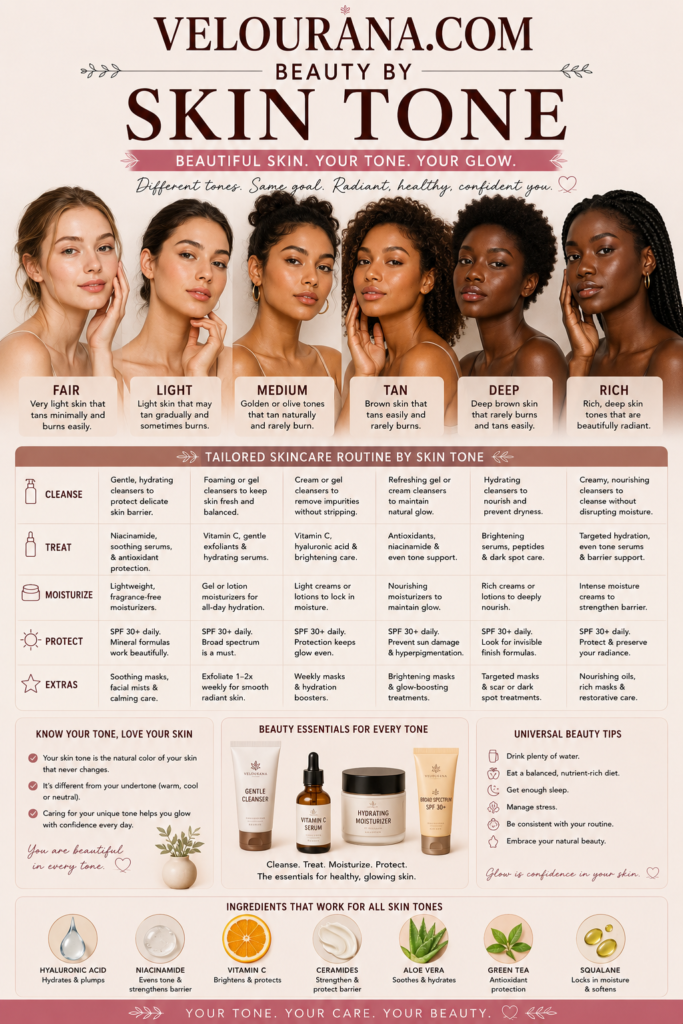
CATEGORY: Fair Skin Makeup
Makeup on fair skin is often described in terms of caution. Advice frequently focuses on avoiding colors that are too dark, bronzers that are too strong, blushes that are too bright, or eye makeup that creates too much contrast. While these concerns come from the fact that pigment is highly visible against a light complexion, they can create the misleading impression that fair skin should remain permanently soft, pale, and understated.
In reality, fair skin can support an enormous range of makeup.
Subtle beige, soft rose, and taupe can create refined natural looks. Red lipstick, black eyeliner, plum shadow, saturated blush, and deep berry lips can create equally successful high-contrast looks. The issue is not whether a shade is dark or bright. The issue is whether its depth, undertone, saturation, and placement are intentional.
Fair skin acts almost like a light canvas. Small amounts of pigment can produce substantial changes, which means makeup can be highly efficient. A slight increase in blush can noticeably alter the complexion. A thin black line can transform eye definition. A moderate lipstick shade can become a focal point.
This visibility rewards precision.
Understanding the structure of color allows fair-skin makeup to become more controlled, adaptable, and expressive.
Start With the Actual Skin Rather Than the Label
The category fair skin includes considerable variation.
Some fair complexions are very rosy. Others are creamy, peach, neutral, golden, olive, or muted. Some contain visible freckles. Others have translucent areas where veins are noticeable. Some flush easily while maintaining a warm undertone underneath.
This diversity means that products marketed broadly for fair skin may not necessarily match.
Foundation labeled fair could still be too pink, too yellow, too peach, too neutral, or too dark.
Blush described as ideal for pale complexions may look beautiful on one person and artificial on another.
The starting point should therefore be the individual complexion.
Depth determines how much contrast a cosmetic will create. Undertone influences whether the color feels harmonious or opposing. Natural contrast from hair, brows, eyes, and lips further shapes the final result.
When all of these elements are considered together, makeup becomes much easier to personalize.
Creating a Base That Looks Like Skin
Foundation should generally match the complexion rather than transform it.
Fair skin makes inaccurate foundation especially easy to detect.
A base that is too dark can create an obvious face-to-neck difference. A shade that is too warm can become orange. Excessive pink can create a flushed appearance. A foundation with too much gray can make the complexion look muted or lifeless.
Testing foundation directly on the jaw is usually more useful than testing it on the wrist or hand.
Natural daylight reveals undertone discrepancies more clearly than strongly warm or cool indoor lighting.
Fair complexions also benefit from checking foundation after it has had time to settle.
Oxidation can shift certain formulas darker or warmer. What appears accurate at first application may look different later.
Coverage should be chosen according to preference rather than skin depth.
Sheer foundation preserves natural variation and freckles. Medium coverage can even the complexion while maintaining dimension. Full coverage can create a highly polished surface.
Each can look beautiful.
The important factor is maintaining a believable relationship between the face and surrounding skin.
Skin Tint and Lightweight Coverage
Skin tints can be particularly effective on fair skin because they allow natural coloring to remain visible.
When the base is sheer, slight mismatches in undertone may also be less noticeable because the product blends with rather than completely replaces the complexion.
This can be useful for people who struggle to find exact foundation matches.
A lightweight base can reduce redness or unevenness while allowing freckles and natural shadows to remain.
The result often appears more dimensional because the face has not been reduced to one uniform tone.
However, sheer products still need reasonable undertone compatibility.
A strongly yellow tint can still warm the complexion. A pink formula can still emphasize redness.
The lower coverage simply makes the effect more subtle.
Concealing Redness Without Removing All Natural Color
Fair skin often shows redness clearly.
This can appear around the nose, cheeks, chin, or areas of irritation.
Completely covering all redness can sometimes make the face look flat because natural variation contributes to facial dimension.
Targeted concealing allows greater control.
A small amount of concealer can be applied where redness is strongest while leaving surrounding skin relatively untouched.
Green color corrector may be useful for pronounced redness, but fair skin often requires very small amounts. Too much green can remain visible beneath foundation and create a gray cast.
The objective is neutralization rather than replacing one conspicuous color with another.
A thin layer followed by skin-matching concealer generally produces a more natural effect.
Under-Eye Concealing on Very Light Skin
Under-eye darkness can appear particularly noticeable against fair skin because blue, purple, red, or brown discoloration contrasts strongly with the surrounding complexion.
Using an extremely pale concealer is not always the most effective solution.
Brightness without correction can simply create a light gray or ashy area.
Subtle peach, pink, or salmon correctors may help depending on the undertone of the discoloration, but they need to remain very light.
Orange correctors designed for deeper complexions can become too visible on fair skin.
The concealer placed over the corrector should integrate with the foundation rather than create an unnaturally white under-eye triangle.
Modern fair-skin makeup often benefits from strategic brightness rather than maximum brightness.
Choosing Blush by Effect Rather Than by Rule
Blush can make fair skin look lively almost immediately.
Because pigment shows easily, a small amount can create substantial change.
Soft pink is often considered the obvious choice, but the range of successful blush colors is much broader.
Rose can create natural definition. Peach introduces warmth. Mauve can look sophisticated. Coral produces energy. Berry creates richer contrast. Muted terracotta can provide an earthy effect.
Cool fair skin may naturally harmonize with rose, pink, mauve, and berry. Warm skin may suit peach, apricot, coral, and warm rose. Neutral skin often moves comfortably between both families.
Fair olive complexions may respond beautifully to muted rose, dusty mauve, neutral peach, and softened berry.
Blush should also be considered in relation to lipstick.
A warm coral lip combined with extremely cool mauve blush can create deliberate contrast, but if harmony is desired, closer temperature relationships may feel more cohesive.
There is no need for exact matching.
The colors simply need to participate in the same overall visual direction.
Cream Blush and Powder Blush
Texture changes how color appears.
Cream blush often melts into the foundation and can produce a translucent, skin-like effect. This can be particularly attractive on fair skin because strong edges are softened.
Powder blush allows precise layering and can be easier to control for oily skin or more structured makeup.
Pigmentation matters more than format.
A highly saturated cream blush can still become intense quickly. A softly pigmented powder can remain subtle.
Fair skin often benefits from applying less product initially and building gradually.
This preserves control over intensity without limiting the shade range.
Even deep berry or plum can work when applied in a sheer layer.
Bronzer Does Not Need to Create a Tan
Bronzer is often misunderstood as a product designed to make the entire complexion look darker.
On fair skin, this approach can easily produce an unnatural result.
Bronzer works more effectively when used to introduce localized warmth.
Areas where sunlight naturally touches the face, such as the forehead, temples, tops of the cheeks, and bridge of the nose, can receive subtle warmth without changing the entire complexion.
Fair bronzers generally need less depth than products designed for medium or deep skin.
Undertone is equally important.
A heavily orange bronzer can look artificial even on warm fair skin because the saturation may exceed the natural warmth of the complexion.
Muted golden beige, light tan, soft caramel, and neutral bronze can create more realistic effects.
Cool fair skin may prefer bronzers with reduced orange content.
Fair olive skin may benefit from neutral or olive-muted bronzers.
The ideal result should suggest warmth rather than an obvious layer of brown pigment.
Contour Is About Shadow
Contour is different from bronzer.
Bronzer creates warmth.
Contour creates the illusion of shadow and structure.
Natural shadow generally has a cooler, grayer quality than sun-warmed skin.
Fair skin therefore often suits contour shades based on taupe, cool beige, gray-brown, or muted neutral brown.
A contour that is too dark can become extremely visible.
Soft formulas that build slowly allow greater precision.
Blending is particularly important along the cheekbones and jawline, where harsh boundaries can remain obvious against light skin.
Cream formulas can diffuse seamlessly when worked into foundation. Powder contour can provide controlled sculpting.
Either can succeed when the shade resembles natural shadow.
Highlighter and the Importance of Base Color
Highlighter can look exceptionally luminous on fair skin.
The reflective particles are usually not the main challenge.
The underlying base color is.
A gold highlighter with a medium or deep base can leave a visible golden stripe when the face is turned away from the light.
Very fair skin often benefits from pale bases such as pearl, champagne, icy pink, light gold, or pale peach.
Cool complexions may naturally suit pearl and silver-champagne. Warm complexions may prefer champagne and light gold. Neutral skin can often wear either.
Strong metallic highlighter can still be used.
The key is ensuring that the base pigment does not sit dramatically darker than the surrounding complexion unless that contrast is intentional.
Eyeshadow for Soft Definition
Soft eye makeup can be especially elegant on fair skin because small differences in depth create visible structure.
Taupe, beige, light brown, muted rose, champagne, pale peach, soft mauve, and mushroom can define the eyes without creating a heavy appearance.
These shades are useful when the objective is polish rather than drama.
The best neutral depends on undertone.
Cool skin may prefer gray-taupe, mauve-brown, and cool beige. Warm fair skin may suit peach-brown, caramel, warm taupe, and light bronze. Neutral skin can often move between both.
Fair olive skin frequently works well with muted taupe, sage-brown, khaki, and antique gold.
Soft does not necessarily mean pale.
A medium-depth neutral blended lightly can appear more sophisticated than a chalky pastel.
Eyeshadow for Stronger Contrast
Fair skin can carry deep eyeshadow beautifully.
Charcoal, espresso, black, plum, burgundy, forest green, navy, deep bronze, and jewel tones create substantial definition.
The contrast can be dramatic because the surrounding complexion is light.
Smoky eyes therefore become especially noticeable.
Blending determines whether the look appears polished.
Dark shadow should transition gradually into medium and lighter tones unless a graphic boundary is intentional.
Plum and burgundy can create depth while adding visible color. Navy can substitute for black while maintaining intensity. Deep bronze can bring warmth. Charcoal provides a cooler smoky effect.
The eye area offers significant freedom because strong contrast is often desirable there.
Eyeliner Choices Beyond Black
Black eyeliner remains one of the most effective ways to create definition.
Against fair skin, even a thin line can have considerable impact.
Brown is softer and often works well for daytime or low-contrast coloring.
Charcoal creates subtle cool definition.
Navy can make the whites of the eyes appear brighter while remaining dark enough to function like a neutral.
Plum and burgundy can bring out green or hazel eyes while providing gentler contrast than black.
Gray and taupe liners can produce barely visible structure.
The choice should depend on the desired level of definition.
Black is not inherently too harsh.
It is simply the strongest common option.
Mascara and Lash Contrast
Mascara can completely alter the balance of fair-skin makeup.
Black mascara produces clear definition and can make the eyes the focal point even when the rest of the makeup is minimal.
Brown mascara creates softer contrast and may harmonize especially well with blonde, red, or very light hair.
Black-brown sits between these two effects.
Colored mascaras can also be effective because fair skin allows subtle pigment to remain visible.
Plum, burgundy, navy, and forest green can create understated color while still defining the lashes.
The desired result determines whether strong or soft contrast is preferable.
Eyebrows as Part of the Color Composition
Brows frame the face and influence how much contrast the complexion can visually support.
Light brows combined with fair skin produce a soft natural appearance.
Dark brows create stronger structure.
Brow makeup should generally relate to natural hair and brow color rather than being selected according to skin tone alone.
Blondes may suit taupe, ash blonde, or soft neutral brown.
Red hair can work with warm taupe, muted auburn, or reddish brown.
Brunettes may use medium or deep brown depending on hair depth.
Black hair can support strong brows, but pure black brow products may still appear severe depending on natural brow color.
The undertone of the brow product matters.
Too much warmth can turn orange. Too much ash can appear gray.
The most natural effect usually comes from mimicking the shadows between brow hairs.
Lip Liner on Fair Skin
Lip liner can become highly visible when it is much darker than the lipstick.
This can be used intentionally for dimensional or retro-inspired looks.
For seamless definition, a liner close to the natural lip color or lipstick shade works more subtly.
Fair skin often makes the natural lip boundary easy to see, so even small changes in shape can appear significant.
Softly overlining can increase fullness, while precise lining can sharpen the mouth.
Brown lip liner can add depth to nude lipstick. Rose liner can enhance natural pink tones. Mauve can cool the overall lip color.
The liner becomes another tool for adjusting undertone and contrast.
Nude Lip Makeup
A nude lip should maintain enough color to keep the mouth defined.
Extremely pale beige can make fair lips disappear into the face.
Rosy beige, peach nude, mauve nude, pink-brown, soft caramel, and muted rose often create more dimension.
Cool fair skin may naturally suit rose, mauve, and pink-beige.
Warm fair skin may respond to peach, apricot, warm pink, and caramel.
Neutral skin can often wear both.
Fair olive complexions may find muted rose-brown and mauve-beige particularly useful.
Gloss can make a pale nude appear fresher and less flat. Satin finishes create a balanced effect. Matte nudes can appear sophisticated but often benefit from enough depth to maintain separation from the complexion.
Pink and Rose Lip Colors
Pink lip color can range from nearly transparent to extremely saturated.
Soft rose can mimic natural lip pigmentation.
Cool pink can brighten a rosy complexion.
Peach-pink introduces warmth.
Fuchsia creates strong contrast.
Dusty rose provides muted sophistication.
Fair skin makes these distinctions especially visible.
A lipstick only slightly deeper than the natural lips can create a polished effect without looking obviously made up.
A saturated pink can become the defining feature of the entire face.
Both approaches can be successful.
Red Lipstick as a Fair-Skin Statement
Red lips and fair skin create classic high contrast.
The effect can be refined, glamorous, vintage, modern, or theatrical depending on texture and application.
Blue-red creates a cooler crisp effect.
Orange-red introduces warmth.
Tomato red feels bright and energetic.
Brick red is earthier.
Crimson and burgundy create deeper drama.
Undertone compatibility can produce harmony, but opposing undertones can also create beautiful tension.
A warm red on cool skin may bring noticeable heat. A cool red on warm skin can create sharper contrast.
Application changes everything.
A sheer stain keeps red approachable and translucent.
A blurred lip creates softness.
A precise opaque lip becomes graphic.
The complexion provides the contrast; the technique determines the mood.
Deep Lipstick and Fair Skin
Deep lipstick is sometimes discouraged for fair complexions because the contrast can be dramatic.
That contrast is exactly why deep lipstick can look exceptional.
Plum, wine, blackberry, burgundy, deep red, chocolate, and dark berry can create a sophisticated focal point.
The depth of these colors makes application precision more noticeable.
Lip preparation can prevent patchiness.
Liner can sharpen edges.
Blotting or layering can control intensity.
Sheer versions of deep shades offer another option.
A translucent burgundy can create a stained effect while maintaining the richness of the color family.
Fair skin does not need to avoid darkness.
It simply makes darkness more visible.
Matching Blush and Lipstick Without Making Them Identical
Blush and lipstick often look most cohesive when they share some relationship in temperature or saturation.
They do not need to match exactly.
A berry lip can work with muted rose blush.
Coral lips can pair with soft peach.
Red lipstick can sit beautifully beside neutral rose cheeks.
Nude lips can support stronger blush.
The goal is visual balance.
If both blush and lipstick are highly saturated, the look becomes more colorful and dramatic.
If one is strong and the other restrained, a clearer focal point develops.
Fair skin makes this balance especially important because both colors are highly visible.
Powder, Finish, and Skin Texture
The finish of complexion makeup changes how fair skin reflects light.
Matte foundation creates a smooth, controlled surface.
Satin finishes preserve some natural luminosity.
Dewy products can make fair skin appear fresh and translucent.
Powder should be used according to skin needs rather than automatically applied heavily.
Too much opaque powder can flatten the complexion.
Strategic powdering can control shine while preserving dimension on the cheeks and perimeter of the face.
Setting sprays can help powders integrate more naturally with cream and liquid products.
Texture becomes part of the color story because light reflection changes how pigments appear.
A dewy blush can seem fresher and more transparent.
A matte blush may look stronger and more defined.
A glossy lip can appear lighter than an opaque matte version of the same shade.
Makeup for Fair Skin With Freckles
Freckles add another layer of color to fair skin.
Some people prefer to preserve them, while others prefer fuller coverage.
Neither choice is inherently more natural or more correct.
When freckles remain visible, sheer foundations and skin tints allow their warmth and pattern to contribute to the overall complexion.
Blush and bronzer then interact not only with the base skin tone but also with the freckles.
Warm freckles can make peach, bronze, and earthy shades feel particularly integrated even when the underlying skin is cooler.
Fuller foundation can create a more uniform base, changing how the same color cosmetics appear.
The relationship between makeup and freckles is therefore another personal aesthetic decision.
Minimal Makeup Can Still Be Highly Intentional
Fair skin often needs relatively little product to create visible definition.
A small amount of concealer, soft blush, defined brows, mascara, and tinted lip balm can transform the face while maintaining a minimal appearance.
This simplicity does not mean the makeup is unsophisticated.
Color selection can still be precise.
A muted rose blush rather than peach, brown mascara rather than black, or mauve balm rather than beige can subtly alter the entire effect.
Minimal makeup works particularly well when each product has a clear purpose.
The result is less about quantity and more about placement and harmony.
Dramatic Makeup Can Celebrate Fairness
Fair skin can serve as an exceptional backdrop for dramatic makeup.
Deep smoky eyes, black liner, metallic shadow, sculpted cheeks, intense blush, red lipstick, or burgundy lips all create strong visual contrast.
Attempting to reduce this contrast by darkening the entire face is not necessary.
The fairness of the complexion can remain part of the dramatic aesthetic.
This approach has long appeared in fashion, editorial makeup, classic cinema, alternative styles, and high-glamour beauty.
The contrast itself becomes the design.
The important distinction is intentionality.
Strong makeup should look deliberately strong rather than accidentally mismatched.
Developing a Reliable Personal Routine
A successful fair-skin makeup routine becomes easier once a few dependable reference points are established.
An accurate foundation shade provides the base.
A reliable blush reveals how much pigmentation the complexion can comfortably carry.
A bronzer or contour shade establishes the appropriate depth for warmth and structure.
A familiar nude lip provides a neutral reference.
From there, stronger colors become easier to evaluate.
If a new blush is considerably deeper than the dependable one, less product may be required.
If a new lipstick is more saturated than the usual nude, the rest of the makeup can be adjusted according to the desired balance.
Understanding these relationships reduces trial and error.
Fair Skin Makeup Is About Control, Not Restriction
The central principle of fair-skin makeup is visibility.
Pigment often appears quickly and clearly.
That visibility can be managed through shade selection, texture, application strength, and placement.
It should not be confused with a need to avoid color.
Fair skin can wear pastel, earth, jewel, neutral, bright, and deep tones.
It can support delicate makeup and extreme contrast.
Warmth can be subtle or obvious.
Eyes can be softly defined or intensely smoky.
Lips can disappear into a tonal nude or dominate the face in burgundy.
The complexion does not determine one correct style.
It simply influences how strongly each choice will register.
Once that is understood, fair-skin makeup becomes less about caution and more about precision.
The light complexion remains visible.
The makeup adds definition, dimension, color, and personality around it.
That is what allows fair skin to support such a broad range of beauty aesthetics without losing its natural character.
THE END VELOURANA
 Discover More From Our Family of Websites
 ZodiacBearing (Astrology, Tarot, Numerology, Angel Numbers & Spiritual Guidance)
 Velourana (Beauty, Makeup, Hair Care, Skincare & Beauty Tips)
 HavenBearing (Home, Living, Organization, Décor & Everyday Inspiration)
 PawBearing (Pet Care, Dog Breeds, Animal Health, Training & Pet Products)
 PsyCatherine (Notes From the Journal of a Psychologist on Real Life)

