CATEGORY: Updos
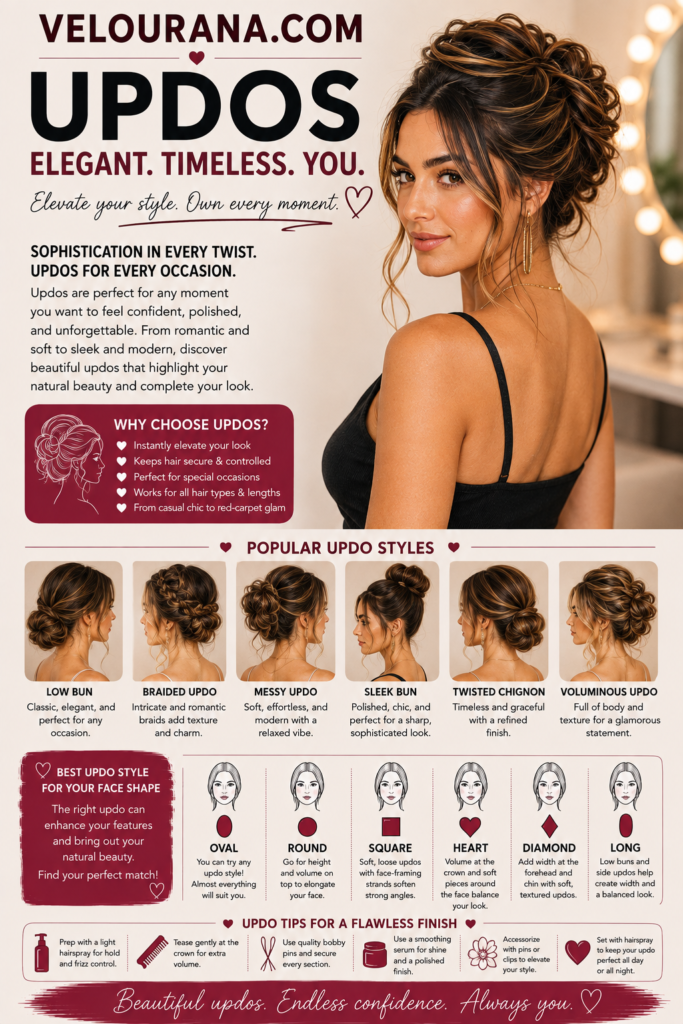
Low updos have an unusual ability to make a hairstyle appear considered without demanding dramatic height or excessive complexity. By concentrating the hair near the nape, they create a calm silhouette in which the face, neckline and shape of the head remain clearly visible while the lengths are organized into a compact structure behind them.
The category includes far more than the traditional smooth chignon.
A low updo can be a loose twisted bun with face-framing layers, a braided knot, a softly pinned collection of curls, a sleek folded shape, a side-positioned bun or a deliberately relaxed style that allows natural texture to remain visible.
What connects these variations is placement.
The visual weight stays low.
That single decision changes the direction of the entire hairstyle. Instead of pulling strongly upward toward the crown, the hair generally travels backward and slightly downward. The result can feel understated, elegant and exceptionally versatile.
Low updos also work across very different hair types because they do not demand one particular texture. Straight hair can create clean architectural shapes. Waves introduce softness. Curls create natural dimension. Coils and twists can produce substantial sculptural forms.
The most successful low updo is therefore not one specific technique.
It is a balanced relationship between placement, volume, texture and the way the front of the hair connects with the gathered structure at the back.
Why Nape Placement Creates a Distinctive Silhouette
The location of an updo determines where the eye perceives the greatest concentration of hair.
With a high bun, that concentration sits near the crown.
With a low updo, it moves close to the neck.
This changes the profile substantially.
The crown can remain relatively natural rather than being pulled strongly upward. The sides travel backward. The gathered structure forms near the base of the head and often continues the natural downward direction of the hair.
This makes low updos visually quieter than many elevated styles.
Quiet does not mean insignificant.
A large low chignon can still become a major focal point. A braided bun can contain intricate detail. A side-positioned structure can create strong asymmetry.
The difference is that the drama occurs lower in the silhouette.
The Classic Low Chignon
The chignon is one of the defining low-updo structures.
The hair is gathered around the nape and organized into a compact form through rolling, folding, twisting or wrapping.
A highly polished chignon can have a smooth surface and almost invisible securing points.
A softer version can retain waves and visible overlapping sections.
The structure can sit directly in the center or slightly toward one side.
The front can be center-parted, side-parted or brushed backward.
These variations allow one basic concept to produce very different results.
A Center-Parted Chignon Creates Symmetry
A center part divides the front into two clear sections.
Each side moves backward toward the low gathering point.
This creates a balanced pathway from the face to the chignon.
When the roots are smooth, the result can feel extremely clean.
The bun itself may remain compact, or it can become larger and more textured.
The symmetry through the front provides enough structure that the back does not necessarily need to be perfectly uniform.
A Side Part Makes the Chignon More Directional
Moving the part away from the center changes the movement immediately.
One front section becomes broader.
The hair sweeps across the head before reaching the back.
This can make a low updo feel softer and less formal.
A deep side part creates stronger asymmetry.
A subtle side part introduces only gentle direction.
The chignon can remain centered or move slightly toward the opposite side to continue the visual flow.
A Part-Free Low Updo Creates Continuous Movement
The front can also be directed backward without preserving a visible part.
The hairline becomes the starting point of one continuous movement toward the nape.
A sleek finish makes this highly polished.
A little crown volume makes it softer.
The absence of a part places more emphasis on the overall silhouette than on the front division.
Crown Volume Prevents a Low Updo From Looking Flat
Low placement does not require the upper hair to sit completely against the scalp.
A small amount of lift through the crown can make a major difference.
From the side, the head develops a gentle curve before the hair descends into the chignon.
This creates dimension.
The adjustment can be subtle.
The crown does not need exaggerated height.
Often, a little space is enough to prevent the hairstyle from appearing overly compressed.
A Smooth Crown Creates a More Architectural Result
When the crown remains sleek, the low structure becomes visually stronger.
The hair follows uninterrupted lines toward the nape.
The contrast between smooth upper hair and a textured bun can be particularly effective.
Alternatively, both areas can remain smooth, creating an exceptionally minimal hairstyle.
Straight hair naturally supports this interpretation because its surface makes the direction easy to see.
Soft Crown Texture Creates Romance
Allowing natural movement through the roots creates a different atmosphere.
The crown can remain slightly loose.
Waves can be visible.
Small sections near the ears can soften.
The chignon then feels like a continuation of that texture rather than a separate polished object.
This approach works particularly well for relaxed and romantic low updos.
The Twisted Low Bun
A twisted bun is one of the simplest low-updo variations.
The hair is gathered near the nape.
The length is twisted.
The twist is wrapped around its base and secured.
The final shape depends on how tightly the hair is twisted and wrapped.
A compact twist creates a smaller, cleaner bun.
A looser twist creates greater volume and a softer surface.
Long hair may wrap several times.
Medium hair may create one compact turn.
The technique adapts naturally to the amount of length available.
A Loose Twist Makes the Bun Appear Larger
Twisting too tightly compresses the hair.
That can be useful when a small bun is wanted.
For greater volume, the twist can remain softer.
The hair occupies more space.
Individual sections become slightly visible.
The resulting bun feels less rigid.
Fine hair can benefit from this because the structure appears larger without requiring additional hair.
Dense Hair Needs Less Expansion
Thick hair already produces substantial volume.
A relatively compact twist may still create a large bun.
Excessive loosening can make the structure difficult to control.
The amount of expansion should therefore respond to natural density rather than following one fixed method.
The Low Knot Is a Minimal Alternative
Instead of wrapping the hair repeatedly into a conventional bun, the length can be formed into a knot-like structure.
This can create a cleaner, more compact appearance.
The ends may be hidden underneath.
They can also remain partly visible when a relaxed finish is preferred.
A sleek low knot works particularly well when simplicity is the objective.
The structure itself becomes the focal point.
Folded Low Updos Create Clean Geometry
Hair does not always need to be twisted.
The length can be folded back on itself and secured.
This creates broader surfaces and fewer visible spirals.
Straight hair makes folded shapes particularly clear.
The style can feel modern because it relies on form rather than intricate texture.
The French Twist Can Be Positioned Low
Although the French twist is generally associated with a vertical structure, its visual weight can remain close to the nape.
The hair is swept to one side, folded inward and secured vertically.
The upper part may remain narrow while the lower section carries more volume.
This creates a hybrid between a low updo and an elongated twist.
The hairstyle can remain polished or be softened with crown volume and loose front sections.
Vertical Structure Changes the Profile
A circular chignon creates width around one point.
A French twist distributes the volume upward.
The difference becomes especially clear from the side and back.
The twist creates length through the structure.
This can be useful when a round bun feels too concentrated.
Braided Low Buns Add Visible Pattern
Braiding the ponytail before wrapping it creates one of the easiest ways to add detail.
The hair is gathered low.
The tail is braided.
The braid is then wrapped around the base.
Instead of a smooth spiral, the bun contains repeated woven sections.
The pattern becomes particularly visible when the braid is widened gently before wrapping.
A Three-Strand Braid Creates Clear Structure
The conventional three-strand braid produces a recognizable pattern.
When wrapped, the crossings remain visible around the bun.
Straight hair makes them particularly clear.
Highlighted hair can make the structure even more noticeable because lighter and darker strands move across one another.
Fishtail Braids Create Finer Texture
A fishtail contains smaller repeated crossings.
Once wrapped, the surface appears more intricate.
The braid can be loosened before pinning to increase width.
The resulting chignon can look highly detailed even though it originated from one relatively simple braid.
Multiple Braids Can Form One Updo
The hair can also be divided into two or more braids.
Each braid is wrapped or pinned independently.
The structures overlap.
This creates greater complexity through the back.
The technique can be particularly useful for very long or dense hair because the total volume is divided before being arranged.
Side Braids Can Lead Into the Chignon
Braiding does not need to begin only after the ponytail.
A braid can travel from the temple toward the nape.
Two braids can approach from opposite sides.
The chignon then becomes the point where the braided pathways meet.
This makes the entire hairstyle feel connected.
The bun is no longer an isolated structure attached to smooth roots.
Dutch Braids Create Stronger Surface Detail
Because Dutch braids sit more prominently on the surface, they create visible pathways toward the low updo.
The braid can be narrow for subtle detail.
A wider braid creates a more dramatic texture.
Once it reaches the nape, the remaining hair can join the bun.
French Braids Create a Softer Transition
French braiding integrates the sections more closely into the surrounding hair.
The result can feel less raised and more continuous.
This works particularly well when the low updo should remain soft rather than highly graphic.
Twisted Sides Create Detail Without Full Braiding
For a simpler approach, sections from each side can be twisted backward.
They meet around the nape.
The remaining hair becomes the bun.
The twists create visible direction while requiring less intricate weaving.
This can be particularly useful for layered hair because shorter sections can be incorporated gradually.
Several Twists Can Build a Textured Back
Instead of using only two side sections, the hair can be divided into several smaller areas.
Each one twists toward the center.
The ends are pinned into the low structure.
This creates an updo with multiple visible pathways.
The result can appear intricate even though each individual action is relatively simple.
A Topsy-Tail Foundation Can Create a Quick Low Updo
A low ponytail can be turned through an opening above its elastic.
This creates a twist at the base.
The remaining tail can then be folded upward and tucked inside or wrapped into a bun.
The first twist provides instant structure.
The second step converts the ponytail into an updo.
This is a useful example of how a simple foundation can produce a finished-looking style.
Curled Low Updos Create Soft Dimension
Pre-existing curls can be pinned individually around the nape.
Instead of forcing the hair into one smooth bun, the sections retain some of their curved shape.
One curl overlaps another.
Some disappear underneath.
Others remain visible.
The result has depth because the surface is not uniform.
The Curls Do Not Need Perfect Symmetry
A curled updo often looks more natural when the sections vary slightly.
One can sit higher.
Another can curve sideways.
A third can create width near the lower edge.
The structure remains balanced without becoming identical on both sides.
This controlled irregularity is part of the softness.
Naturally Curly Hair Is Already Excellent Updo Material
Natural curls provide movement without needing to be replaced by another texture.
The hair can be gathered loosely.
Sections can be pinned around a low foundation.
Curls around the face can remain free.
The crown can preserve natural volume.
The hairstyle organizes the curl pattern rather than erasing it.
Coily Hair Can Create Beautiful Low Sculptural Shapes
Coily hair offers substantial natural volume.
Twists and braids can become part of the structure.
The gathered shape can remain broad or compact.
The hair can be positioned centrally or asymmetrically.
A low location can also be comfortable because the texture does not need to be redirected dramatically upward.
Straight Hair Makes Minimal Low Updos Particularly Effective
Straight hair emphasizes clean lines.
A center part can remain precise.
The sides travel smoothly toward the nape.
A folded bun or knot creates a clearly defined structure.
There may be very little surface texture, but that simplicity can be the main strength of the hairstyle.
Wavy Hair Naturally Creates Softness
Waves introduce small changes in direction throughout the upper hair and bun.
Even a simple twist gains more dimension.
The surface does not look perfectly uniform.
This makes wavy hair especially suitable for relaxed chignons and loosely pinned styles.
Fine Hair Can Create Elegant Low Updos
Fine hair does not need to produce an enormous bun to look successful.
A smaller chignon can be refined and proportional.
The crown can retain a little lift.
The lengths can be waved before gathering.
A braid can be widened gently.
The bun can remain loose enough to preserve volume.
The objective is to distribute the available hair effectively.
Texture Can Increase Apparent Fullness
Straight fine hair can compress into a relatively small structure.
Adding bends or waves before pinning changes that.
The strands occupy more space.
The bun becomes less compact.
Individual sections create shadows and dimension.
The amount of hair has not changed, but its visual volume has.
Fine Hair Benefits From Avoiding Unnecessary Section Loss
If too much hair is left around the face, the remaining bun may become smaller than intended.
Face-framing pieces should therefore be selected carefully.
A few narrow sections can create softness without removing significant density from the back.
Thick Hair Creates Naturally Full Chignons
Dense hair can create substantial low updos without extensive preparation.
The challenge becomes controlling bulk.
Dividing the hair into sections can help.
Two twists may be easier to arrange than one enormous twist.
Several braids can be pinned together.
The structure can spread slightly across the nape rather than forming one very large central mass.
Low Placement Can Improve Comfort for Heavy Hair
Long dense hair carries considerable weight.
A high bun requires that weight to be supported near the crown.
A low updo keeps it closer to the natural resting position.
This can make a significant difference during long wear.
The hairstyle can still be secure without requiring extreme tension.
Long Hair Offers Many Construction Options
Long lengths can wrap repeatedly.
They can be braided before pinning.
They can form large knots.
They can be divided into multiple sections.
The main consideration is managing the excess length so that one area does not become disproportionately bulky.
Sometimes a wider, flatter chignon works better than a tightly concentrated bun.
Very Long Hair Can Be Folded Rather Than Continuously Wrapped
Repeated wrapping can create a thick central structure.
Folding the hair back and pinning it across a broader area can distribute the volume.
This creates a flatter updo with greater width.
The shape changes, but all of the length remains contained.
Medium Hair Is Particularly Convenient for Low Updos
Medium lengths often provide enough material for a visible bun without excessive weight.
A simple twist may be sufficient.
The ends can tuck underneath easily.
Shorter layers can soften the sides.
This makes medium hair well suited to quick everyday chignons.
Layers Can Become Part of the Design
Not every layer needs to reach the central bun.
Face-framing sections can remain loose.
Shorter nape pieces can create softness.
Sections that escape from a textured bun can contribute to the relaxed finish.
The haircut should inform the hairstyle rather than being treated as a problem to hide.
Long Layers Add Dimension Inside the Bun
Different lengths cause sections to end at different points.
When the hair is twisted or pinned loosely, this creates variation through the structure.
The bun becomes less solid.
The surface gains visible depth.
Low Side Updos Introduce Asymmetry
Moving the chignon away from the center immediately changes the hairstyle.
The hair travels diagonally toward one side.
The gathered structure may become visible from the front.
The opposite side of the neck remains more open.
This can create a particularly elegant and directional silhouette.
The Side Part Can Follow the Same Direction
A side part can reinforce an asymmetrical updo.
The heavier front section sweeps toward the bun.
The hairstyle develops one continuous movement.
This makes the asymmetry feel intentional rather than accidental.
A Side Chignon Can Sit Behind the Ear
Positioning the structure slightly behind one ear brings it into partial front view.
The bun becomes more visible.
Loose curls or waves can frame the same side.
The hairstyle gains a romantic quality without requiring elaborate decoration.
A Low Updo Can Be Extremely Sleek
A polished version can keep every major section controlled.
The part is clear.
The crown is smooth.
The sides follow uninterrupted lines.
The chignon is compact.
Pins remain hidden.
This creates a minimalist result where proportion becomes more important than texture.
Sleekness Makes Small Irregularities More Visible
When the hairstyle contains very little texture, each detail becomes easier to notice.
The parting matters.
The direction of the sides matters.
The relationship between crown and bun matters.
This is why simple polished updos often require careful placement even though their construction appears uncomplicated.
A Relaxed Low Updo Uses Imperfection Deliberately
The opposite approach allows more movement.
The crown remains soft.
Small sections escape.
The bun can be slightly irregular.
Face-framing pieces remain loose.
The structure still needs an anchor, but the anchor does not dominate visually.
The hairstyle feels effortless because the technical support remains largely hidden.
Messy Does Not Mean Unstructured
A relaxed bun still needs a stable center.
Loose sections should appear intentional.
The hairstyle should maintain a recognizable overall shape.
Without that underlying structure, the updo may simply loosen rather than becoming attractively undone.
Heatless Waves Are Excellent Preparation
Hair that has been braided or wrapped overnight already contains movement.
This can make a low updo appear fuller.
The waves create texture through the crown.
The bun contains visible bends.
The style can therefore be constructed without first creating a completely new texture.
Heatless Curls Can Be Pinned Individually
Fabric curls or roller curls can become the building blocks of a low updo.
Instead of brushing them out, individual sections can be arranged around the nape.
The result preserves much of the existing curl while transforming the overall silhouette.
Second-Day Hair Can Be Ideal for Low Updos
Hair does not need to look perfect when loose.
Previous styling can become useful texture.
Softened curls can be pinned.
Waves can create volume.
The roots can be reorganized with a part or backward direction.
This allows an earlier hairstyle to evolve rather than being completely replaced.
A Low Ponytail Is One of the Best Foundations
Many low updos begin more easily when the hair is first secured near the nape.
The ponytail establishes the exact location.
The tail can then be twisted.
Braided.
Folded.
Divided.
Rolled.
The elastic acts as an anchor beneath the final structure.
The Elastic Can Disappear Completely
Once the bun is formed, the original ponytail elastic may no longer be visible.
Hair wraps around it.
Pins secure the outer sections.
The foundation remains hidden.
This creates the impression of a more complex construction while retaining the stability of a simple ponytail underneath.
Not Every Low Updo Needs an Elastic
A French twist may rely mainly on pins.
Several twists can be secured individually.
A claw clip can hold the entire structure.
The foundation should suit the technique.
There is no requirement for every updo to begin identically.
Claw Clips Can Create Fast Low Updos
The hair can be gathered near the nape and twisted upward slightly.
A clip secures the central section.
The ends can be folded underneath or allowed to remain visible.
This creates a quick gathered hairstyle without extensive pinning.
A smaller clip can produce a compact shape.
A larger one can support dense or long hair.
Decorative Combs Suit Low Placement Particularly Well
A comb can sit above a chignon or enter from one side.
Because the structure is low, the accessory remains clearly visible from the back.
It can provide detail without changing the underlying hairstyle.
Barrettes Can Emphasize the Horizontal Shape
A low bun often creates width across the nape.
A barrette positioned above it can reinforce that horizontal line.
Alternatively, it can secure side sections where they meet.
The accessory becomes part of the architecture.
Pins Can Become Decoration
Pins do not always need to disappear.
Decorative pins can be placed deliberately through one side of the bun.
Several can follow the curve of a twist.
The difference between an exposed practical pin and a decorative pin is intentional placement.
Pearls Can Highlight Individual Sections
Small pearl details can sit inside twists, braids or curls.
They create points of contrast without changing the overall shape.
A few carefully positioned elements may be enough.
The hairstyle should remain visible beneath the decoration.
Flowers Can Become a Strong Focal Point
A floral accessory placed beside a low chignon immediately changes its character.
Because the bun already provides a clear foundation, the decoration can sit against it rather than needing additional structure.
Scale matters.
A large floral element becomes dominant.
Smaller pieces can blend into the hairstyle.
Hair Color Becomes Reorganized Inside the Updo
Highlights that normally travel down the lengths are redirected horizontally and diagonally.
They may wrap around the bun.
They can cross through braids.
Lighter ends may appear on the outside of the chignon.
The updo creates a completely different presentation of existing color.
Balayage Can Create Natural Contrast in a Low Bun
When the ends are lighter than the roots, wrapping them around a darker base creates visible tonal differences.
The bun can appear highlighted even without accessories.
A textured finish makes those contrasts especially noticeable.
Highlights Can Reveal Every Twist
A lighter strand moving through a darker twist outlines the direction.
The construction becomes easier to see.
This can make a simple low updo appear more intricate than it actually is.
Natural Gray Hair Can Create Beautiful Woven Patterns
Silver and white strands form natural highlights.
Inside braids and twists, they create visible lines.
A polished chignon can showcase them clearly.
A textured one blends the tones into a more complex surface.
Natural color variation can become part of the hairstyle's design.
Low Updos Showcase the Neckline
Gathering the hair at the back removes most of the lengths from the shoulders.
The neckline becomes more visible.
The neck appears clearer.
Collars, open backs and shoulder details are easier to see.
The hairstyle therefore interacts strongly with clothing.
The Bun Position Should Consider the Collar
A very low chignon can sit close to a high collar.
Moving it slightly upward may prevent the two from competing.
With an open neckline, a lower position can work beautifully.
The hairstyle does not exist independently from what surrounds it.
Earrings Become More Visible
Removing the hair from around the ears gives jewelry more visual space.
Large earrings can become part of the overall composition.
Small earrings also gain visibility.
Face-framing pieces can partially soften the area without covering it completely.
A Low Updo Can Work for Formal Occasions Without Becoming Elaborate
A simple chignon can look highly refined.
A smooth center part and compact bun may be enough.
The elegance comes from proportion and finish.
There is no need to add several braids, curls and accessories simply because the hairstyle is intended for a formal setting.
Formal Texture Can Still Be Soft
A formal hairstyle does not need to be rigid.
A softly waved crown can lead into a textured bun.
A few deliberate face-framing pieces can remain free.
The securing points can stay hidden.
The hairstyle remains refined because the overall shape is controlled.
Low Updos Work Equally Well for Everyday Styling
A twisted low bun can be created quickly.
A claw clip can gather the hair.
A braided ponytail can be wrapped around itself.
A loose knot can control the lengths.
The category is not limited to event styling.
Its practicality is one reason low updos remain so useful.
The Style Can Change During the Day
A low ponytail can become a bun.
A bun can be released into a ponytail.
A braid can be wrapped and later unwound.
A clip can replace pins.
The low position makes these transitions relatively easy because the hair is already gathered near its natural resting point.
The Updo Can Also Preserve Texture
Hair held in a twist or bun may develop gentle bends.
When released, the lengths can have additional movement.
This means the updo can function as both a hairstyle and a temporary setting structure.
Comfort Is Part of the Design
A low updo often feels comfortable because it does not require the entire length to be pulled high.
But it can still become uncomfortable if the base is excessively tight or pins are positioned poorly.
The structure should distribute weight effectively.
Dense hair may need several support points.
Fine hair may require less hardware.
Pins Should Anchor Rather Than Fight the Hair
A pin works best when it connects a section to an existing stable structure.
It should not need to force a large amount of hair into place by itself.
Strategic placement creates stronger support with less tension.
The Hairline Does Not Need Extreme Control
A low updo can remain polished without pulling every small hair tightly backward.
Natural sections around the temples can remain soft.
The front can retain a little movement.
This often makes the hairstyle more comfortable and visually balanced.
The Back View Matters Most With Low Updos
Because the gathered structure may barely be visible from the front, the back becomes particularly important.
The chignon should have a clear shape.
The relationship between the bun and crown should feel balanced.
Braids or twists should lead toward the structure coherently.
The securing points should either disappear or become intentional decorative elements.
The Side Profile Connects the Crown to the Bun
From the side, a low updo creates a line from the forehead across the crown and down toward the nape.
A completely flat crown can make the bun appear isolated.
A gentle curve often creates a smoother transition.
The exact amount depends on the desired finish.
The Front Still Determines the First Impression
Even when the bun is elaborate, someone looking from the front initially sees the part, bangs, crown and face-framing pieces.
This means the front should not be treated as an afterthought.
A beautiful back structure needs a complementary front.
The Best Low Updo Has a Clear Visual Priority
If the bun contains an intricate braid, the front may remain simple.
If a dramatic side sweep defines the hairstyle, the chignon can be understated.
If decorative accessories are prominent, the structure may not need additional complexity.
One strong focal point often creates greater elegance than several competing details.
Choosing the Right Low-Updo Style
For maximum polish, choose a sleek chignon or folded bun.
For softness, retain crown volume and face-framing pieces.
For texture, use waves, curls or several twists.
For visible pattern, incorporate braids.
For asymmetry, move the structure toward one side.
For quick everyday styling, use a twisted bun or claw clip.
For fine hair, preserve volume and avoid unnecessary compression.
For thick hair, divide the length when needed and prioritize comfortable support.
The technique should follow the desired effect.
Why Low Updos Remain Timeless
Trends can change the surface details.
One period may favor sleek center parts.
Another may favor loose waves.
Braids may become prominent.
Decorative clips may return.
The underlying low-updo silhouette continues to work because it is fundamentally simple.
Hair naturally falls downward.
The low updo gathers it close to where that fall already leads.
It reorganizes the lengths without forcing the entire hairstyle upward.
That creates an inherent visual calm.
When Simplicity at the Nape Becomes Elegance
A low updo can be created from one twist and a few securing points, yet the effect can transform the entire appearance of the hair.
The lengths leave the shoulders.
The neck becomes visible.
The front gains importance.
The crown connects with one concentrated shape at the nape.
Within that framework, almost every texture can retain its identity.
Straight hair can become a clean folded chignon.
Wavy hair can create a soft bun.
Curly hair can become a collection of dimensional pinned sections.
Coily hair can form twists, braids and sculptural shapes.
Fine hair can produce a delicate knot.
Dense hair can create substantial volume.
The style does not depend on one ideal amount of hair or one perfect texture.
It depends on proportion.
A low updo succeeds when the front, crown and gathered structure feel connected; when the volume is placed deliberately; when the securing method supports rather than fights the hair; and when softness or polish is chosen intentionally.
That is why the simplest low bun can sometimes look more elegant than a far more complicated hairstyle.
Nothing is competing unnecessarily.
The hair moves toward one place.
It gathers.
It becomes shape.
And at the nape, that quiet concentration of length and texture can create one of the most enduring silhouettes in hairstyling.
The End
Velourana.
 Discover More From Our Family of Websites
 ZodiacBearing (Astrology, Tarot, Numerology, Angel Numbers & Spiritual Guidance)
 Velourana (Beauty, Makeup, Hair Care, Skincare & Beauty Tips)
 HavenBearing (Home, Living, Organization, Décor & Everyday Inspiration)
 PawBearing (Pet Care, Dog Breeds, Animal Health, Training & Pet Products)
 PsyCatherine (Notes From the Journal of a Psychologist on Real Life)