
CATEGORY: Ponytails
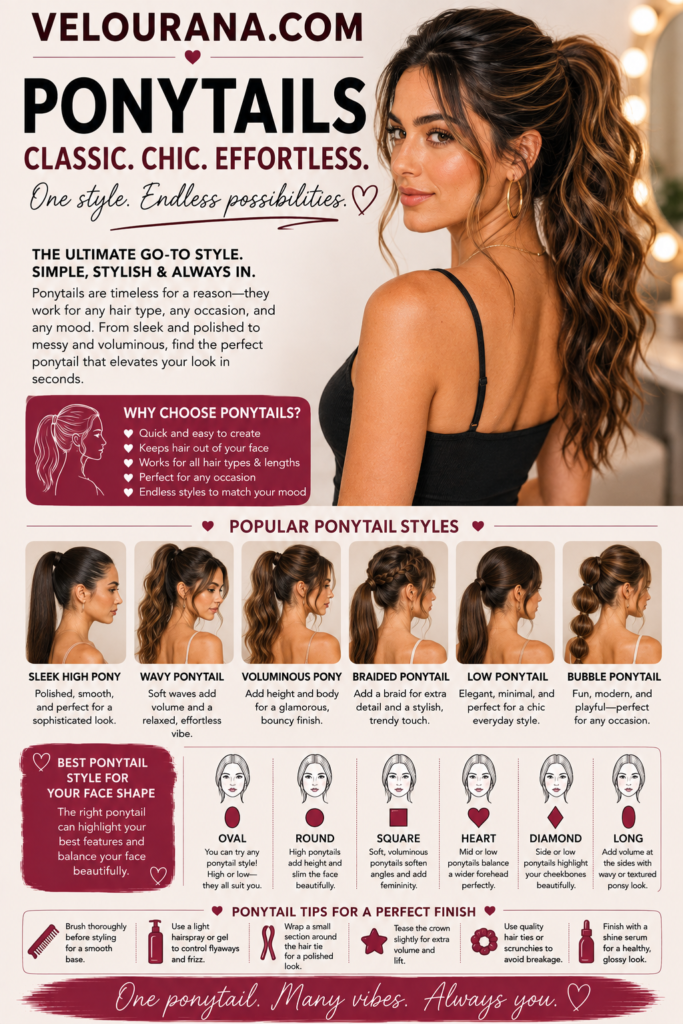
The low ponytail is one of those hairstyles that can look either completely practical or quietly sophisticated depending on only a few details. The basic structure never changes very much. The hair is gathered close to the nape, secured, and allowed to fall naturally down the back or over one shoulder. Yet the way the hair reaches that point—through a center part, a side sweep, a soft crown, smooth roots or loose face-framing pieces—can transform the entire result.
That understated quality is part of its strength.
Unlike a high ponytail, which creates immediate lift and obvious vertical movement, a low ponytail works closer to the hair's natural direction. The strands already want to fall downward. Gathering them near the nape simply organizes that movement rather than dramatically redirecting it.
This makes the hairstyle adaptable to many different textures and densities.
Straight hair can create a long, clean line. Wavy hair introduces softness. Curly hair gives the tail volume and movement. Coily textures can create beautiful density and structure while still allowing the upper hair to remain controlled or naturally textured.
The low ponytail can be sleek enough for a polished occasion or relaxed enough to wear every day.
Its simplicity does not limit it.
It simply makes every choice more visible.
Why Low Placement Changes the Mood
A ponytail positioned near the nape creates a very different silhouette from one gathered high on the head.
The roots travel mainly backward rather than upward.
The crown remains closer to its natural position.
The tail begins low and falls directly behind the neck.
This gives the hairstyle a calmer appearance.
The lower placement also means the ponytail itself may not be visible from the front. Instead, the face, parting and front sections become more important.
This is one reason the hairstyle can feel refined without needing much decoration.
The structure remains discreet.
The details around the face do most of the visual work.
A Center Part Creates Clean Symmetry
One of the most recognizable polished low ponytails begins with a center part.
The front is divided into two balanced sections.
Each side travels backward toward the same gathering point at the nape.
When the roots are smooth, the effect can be almost architectural.
The ponytail itself can remain straight, wavy or curled.
The upper structure stays controlled while the tail provides movement.
Curtain bangs can remain free while the rest of the hair follows the center part backward.
This softens the symmetry without removing it.
A Side Part Creates More Movement
A side part produces a completely different front.
One side carries more hair.
The front sweeps across the forehead.
The direction becomes asymmetrical before the strands reach the ponytail.
This can make a low ponytail feel softer and more fluid.
A subtle side part creates only a gentle shift.
A deeper part creates a more dramatic sweep.
The tail can remain centered or move slightly toward one side to reinforce the direction.
Brushing the Hair Back Removes the Part Completely
The hair can also be gathered without preserving a visible part.
The front moves backward in one continuous direction.
When the roots are sleek, this creates a clean, streamlined result.
When the roots retain some natural volume, the style becomes softer.
This version can feel particularly minimal because there are very few visible structural elements.
The hairline leads directly toward the gathering point.
The ponytail then becomes the only loose element.
The Crown Does Not Need to Be Flat
A common assumption is that a low ponytail should sit close to the scalp everywhere.
It does not.
A little volume through the crown can create a more flattering profile and make the hairstyle feel less severe.
Instead of pulling every strand tightly backward, the upper hair can remain slightly lifted.
The difference may be only a small amount.
Yet from the side, that small curve can change the whole shape.
The ponytail stays low.
The crown gains dimension.
The result feels softer without losing structure.
A Sleek Low Ponytail Relies on Surface
When the upper hair is intentionally smooth, the surface becomes part of the design.
The part needs to feel deliberate.
The sides should follow a clear direction.
The hair moves toward the base without unnecessary interruption.
The ponytail then emerges from that controlled upper section.
Straight hair can make this effect particularly clear.
But a sleek upper section can also contrast beautifully with wavy, curly or textured lengths.
The hairstyle does not require the entire head to have one finish.
Sleekness Should Not Require Excessive Tightness
A polished low ponytail can be secure without pulling aggressively at the scalp.
The hair can be smoothed carefully.
The elastic can hold the base firmly.
But the temples and hairline should remain comfortable.
This matters especially when the style is worn for many hours.
Neatness comes from organization.
It does not require pain.
A Soft Low Ponytail Creates a More Relaxed Look
Instead of smoothing every root, the upper hair can retain natural movement.
The crown can remain slightly loose.
A few pieces can fall around the ears.
Face-framing sections can remain outside.
The ponytail itself can contain waves or curls.
This creates an entirely different version of the same hairstyle.
The gathering point stays low.
The mood becomes softer.
Face-Framing Pieces Change the Front Immediately
Because the ponytail sits behind the head, the front is especially important.
Leaving selected sections loose can soften the hairstyle dramatically.
Short pieces near the temples create subtle movement.
Cheekbone-length layers frame the face more obviously.
Longer sections near the jaw create a romantic effect.
Natural waves and curls can remain untouched.
The goal is not to leave half the front loose.
A few carefully chosen sections are usually enough.
Curtain Bangs Work Naturally With Low Ponytails
Curtain bangs often pair particularly well with low placement.
The center remains open.
The outer sections move toward the temples.
Behind them, the remaining hair travels toward the nape.
This creates a natural transition.
The bangs soften the front while the ponytail keeps the back controlled.
A slightly loose crown can make the whole hairstyle feel cohesive.
Full Bangs Create Strong Contrast
A full fringe can remain completely separate from the ponytail.
The bangs define the front.
The rest of the hair moves backward.
This creates a strong division between the two areas.
A sleek low ponytail can make the contrast especially sharp.
A softer tail with waves or curls makes it gentler.
The fringe does not need to join the ponytail to make the hairstyle feel complete.
Straight Hair Creates a Clean Vertical Tail
Straight hair can make a low ponytail look exceptionally simple and polished.
The lengths fall directly from the nape.
The tail creates one clear vertical line.
A blunt haircut creates a strong perimeter.
Layers soften the lower section and create more movement.
The hairstyle can remain minimal because the clean fall of the hair already provides structure.
Wavy Hair Makes the Ponytail Look Fuller
Waves cause the tail to occupy more space.
Instead of falling as one narrow section, the lengths separate into broader movement.
This can make the ponytail appear more substantial.
The upper hair can remain sleek for contrast or maintain some wave for a continuous textured look.
Either approach can work.
The choice depends on whether the style should feel polished or relaxed.
Curly Hair Gives Low Ponytails Natural Volume
Curly hair creates a particularly rich tail.
The gathering point remains controlled near the nape.
Below it, the curls expand.
The hairstyle gains dimension without needing elaborate construction.
The roots can remain naturally textured or be smoothed more closely.
Loose curls around the face can connect the front with the tail.
There is no need to make the curls uniform.
Their natural variation creates the volume.
Coily Hair Can Create Beautiful Low Shapes
Coily textures can create substantial density even at low placement.
The upper hair can remain textured or be directed toward the nape more smoothly.
The tail can retain its natural volume.
The lower position can feel especially comfortable because the hair does not need to travel as far upward.
The hairstyle can be compact or expansive depending on the natural texture and how much the tail is allowed to open.
Fine Hair Can Benefit From Low Placement
A low ponytail can work particularly well for fine hair because the lengths remain close to their natural fall.
The hair does not need to travel upward before forming the tail.
This can help preserve the visible length.
A lower gathering point may also allow the ponytail to appear slightly fuller than an extremely high one.
The crown can retain a little lift so the upper hair does not look compressed.
The tail can remain straight or gain gentle waves for additional body.
Fine Hair Does Not Need a Huge Ponytail
A smaller tail can look elegant.
The goal should be proportion rather than maximum volume.
A wrapped elastic can make the base appear more finished.
Soft movement through the lengths can add dimension.
A few face-framing pieces can balance the front.
These small details can create a complete hairstyle without pretending the hair is denser than it actually is.
Thick Hair Can Create a Luxurious Low Tail
Dense hair naturally produces a substantial ponytail.
The lower position can help manage the weight.
Instead of suspending the entire length high on the crown, the hair rests closer to the nape.
This can feel more comfortable during long wear.
The tail can remain full and loose.
It can be braided.
It can be divided into a bubble ponytail.
It can move over one shoulder.
The density creates options.
Long Hair Looks Especially Elegant in a Low Ponytail
Very long hair emphasizes the understated nature of the style.
The base sits quietly at the nape.
The length then continues downward.
There is no need for dramatic height because the tail itself provides visual impact.
Straight long hair creates a sleek line.
Waves create a flowing effect.
Curls make the tail substantial.
The hairstyle displays length without allowing all the hair to move freely around the shoulders.
Medium Hair Creates a More Compact Tail
Medium hair creates a low ponytail with a different character.
The tail may sit around the upper back rather than extending far downward.
Layers can create movement.
The ends can flip naturally.
The hairstyle feels lighter.
This can make the low ponytail particularly easy to wear every day.
Layers Add Natural Movement
Layered hair rarely forms one solid tail.
Shorter sections sit around the upper part.
Longer pieces continue beneath them.
This creates volume and movement.
Waves make the difference more visible.
Straight hair creates a softer layered transition.
The ponytail can therefore showcase the haircut rather than hide it.
Shorter Front Layers Can Stay Outside
Face-framing sections do not always need to reach the elastic.
If they naturally fall around the cheeks or jaw, they can remain there.
This often improves the hairstyle rather than making it look incomplete.
The ponytail controls the longer lengths.
The haircut continues framing the face.
The two structures work together.
A Wrapped Base Makes the Hairstyle Feel More Finished
A very simple low ponytail can look more polished when the elastic disappears.
A small section of hair is taken from underneath the tail.
It wraps around the base.
The end is secured discreetly.
The visible band becomes hair.
This one detail can change the entire impression.
The Wrap Can Be Narrow or Wide
A narrow section creates a subtle finish.
A wider section makes the base more noticeable and can make the ponytail appear more substantial.
The correct width depends on the density of the hair and how much attention should be placed on the base.
Fine hair may benefit from a moderate wrap without sacrificing too much volume from the tail.
Dense hair offers more freedom.
A Ribbon Can Transform a Low Ponytail
The low placement is particularly suited to ribbons because the securing point sits in a visible area behind the head.
A narrow ribbon creates delicate detail.
A larger bow becomes more decorative.
The ends can fall into the tail and move with it.
The hairstyle itself can remain extremely simple.
The accessory provides the personality.
Scrunchies Create a Softer, More Casual Version
A scrunchie changes the look of the base immediately.
The fabric adds volume.
The securing point becomes visible.
The style feels less minimal.
A small scrunchie can create subtle softness.
A larger one becomes a focal point.
The tail can remain straight, textured or curled.
Barrettes Can Sit Above the Base
A barrette can decorate the area directly above the ponytail without needing to support all of the hair.
This is particularly effective when the crown is smooth and the back remains visible.
The accessory creates detail while the ponytail remains structurally simple.
The Low Ponytail Can Be Braided
Once the ponytail exists, the tail can become a braid.
The upper hair remains controlled.
The length gains structure.
A three-strand braid creates one familiar pattern.
A fishtail creates finer detail.
A rope braid creates spiraling movement.
The style becomes more decorative without changing the low foundation.
Braids Can Lead Into the Ponytail
The upper hair can also contain braiding.
Two small side braids can meet at the nape.
A French braid can travel backward and finish in a loose ponytail.
A Dutch braid can create raised texture before the tail begins.
This makes the ponytail feel like the destination of the hairstyle rather than an isolated gathering point.
Twists Can Create a Softer Approach
Twists are an excellent alternative when a full braid feels too structured.
Sections near the temples can twist backward.
They can meet around the base.
The tail remains loose.
The upper hair gains visible movement.
The hairstyle feels more detailed without becoming overly elaborate.
A Topsy-Tail Twist Adds Detail With Minimal Effort
A small opening can be created above the elastic.
The ponytail is then passed through that opening.
This turns the hair inward and creates a twisted structure above the base.
The tail remains completely loose beneath it.
The result can look more complex than the actual technique.
Several Twists Can Create a Layered Back
Side sections can be twisted in stages and brought toward the nape.
Each one overlaps the previous section.
The ponytail begins beneath them.
This creates a more decorative version while still preserving the simple low placement.
A Bubble Low Ponytail Creates Structure Through the Length
Additional elastics can divide the tail into sections.
Each section can be expanded gently.
Rounded bubbles form down the length.
Long hair can support several.
Medium hair can create a shorter version.
The low base keeps the hairstyle grounded while the tail provides the decoration.
Bubble Spacing Changes the Result
Wider spacing creates larger sections.
Closer spacing creates more frequent bubbles.
Uniform spacing looks polished.
Slightly irregular spacing feels softer.
The tail can therefore be adjusted from clean and sculptural to relaxed.
The Ponytail Can Move to One Side
A low ponytail does not need to remain centered.
Moving it behind one ear creates a side ponytail.
This brings the length forward.
The hair becomes visible from the front.
The asymmetry changes the entire hairstyle.
A Side Low Ponytail Works Beautifully With Waves
Waves naturally support the directional movement.
The hair can sweep toward one side.
The tail falls over the shoulder.
Loose pieces can remain around the opposite side of the face.
This creates balance without strict symmetry.
A Side Part Can Reinforce the Side Ponytail
If the ponytail moves toward one side, the front can follow the same direction.
A side part creates a sweep.
The hair travels diagonally toward the tail.
The entire hairstyle feels connected.
The Low Ponytail Can Be Extremely Minimal
Sometimes no accessory, braid, twist or wave is necessary.
A center part.
Smooth roots.
A low base.
Straight lengths.
That can be enough.
The hairstyle works because the proportions are clean.
Adding more detail would not necessarily improve it.
Minimalism Makes Small Details More Important
When there are few elements, each one becomes more visible.
The part matters.
The base matters.
The amount of crown volume matters.
The tail texture matters.
The hairline matters.
This is why simple hairstyles can require as much consideration as complicated ones.
A Soft Low Ponytail Can Be Just as Complete
At the opposite end, the hairstyle can remain relaxed.
The part can be less precise.
The crown can have movement.
Loose pieces can fall naturally.
The tail can contain waves.
The base can be wrapped loosely or secured with a soft accessory.
The structure remains recognizable without becoming rigid.
Heatless Texture Makes the Tail Look More Styled
Hair that has been braided, twisted or wrapped overnight can be gathered directly into a low ponytail.
The movement already exists.
The morning styling requires very little additional effort.
The upper hair gains structure from the ponytail.
The tail preserves the waves.
This can create a polished-looking result in only a few minutes.
Day-Old Waves Are Particularly Useful
Waves often soften after a day of wear.
They may no longer look as defined when the hair is loose.
Gathering them into a low ponytail can give them a second life.
The tail becomes fuller.
The softened texture looks natural.
The hairstyle extends the usefulness of the previous day's styling.
Curled Ends Can Make a Straight Ponytail Feel More Finished
The entire tail does not need obvious curls.
Sometimes only the ends need movement.
A broad curve at the bottom can make the style appear more deliberate.
This can be created with heatless rollers, a loose bun or other setting methods.
The roots and mid-lengths remain smooth.
The ends provide the finish.
A Low Ponytail Can Showcase Balayage
Color placement becomes highly visible through the tail.
Darker roots travel toward the base.
Lighter mid-lengths and ends fall below.
Waves can make the contrast even stronger.
The ponytail reorganizes the color into a concentrated vertical section.
This can make balayage appear especially dimensional.
Highlights Create Visible Lines Toward the Base
When the upper hair is smooth, highlighted strands form visible pathways toward the elastic.
The tail then redistributes them.
Straight hair creates clean contrast.
Waves make the tones overlap.
Both can showcase dimensional color.
Natural Gray Hair Can Look Striking in a Low Ponytail
Silver and white strands can become particularly visible in a sleek upper section.
They travel across darker hair toward the nape.
The tail then creates another arrangement of those tones.
A simple hairstyle can therefore highlight natural color variation beautifully.
The Low Ponytail Exposes the Neck and Shoulders Differently
Although the tail sits near the neck, most of the hair is removed from the sides and front.
This opens the shoulders more than wearing the hair fully down.
Earrings become more visible.
Collars and necklines are easier to see.
The hairstyle remains soft while clearing the upper silhouette.
Moving the Tail Over One Shoulder Changes the Clothing Interaction
A side ponytail covers one side of the neckline and leaves the other open.
This creates asymmetry beyond the hair itself.
The relationship between hairstyle, jewelry and clothing changes.
The ponytail becomes part of the overall silhouette rather than only a way of controlling the hair.
The Lower Position Can Be Comfortable for Heavy Hair
Very long, dense hair can make high ponytails feel heavy.
A low base reduces the distance the hair needs to travel upward.
The tail rests closer to its natural position.
This can make the hairstyle easier to wear for longer periods.
The Base Still Needs Adequate Support
Comfort does not mean the ponytail should be loose enough to slide.
The elastic needs to hold the weight.
Dense hair may require a stronger securing method.
The goal is stable support without excessive scalp tension.
The Hairline Can Remain Softer
Because the style does not depend on dramatic upward lift, there is often less reason to pull aggressively around the temples.
Small hairs can remain natural.
The front can stay slightly relaxed.
This makes the low ponytail particularly adaptable for everyday wear.
Repeated Tightness Is Still Unnecessary
Even a low ponytail can create stress if it is worn extremely tight at exactly the same point every day.
The base can move slightly.
The part can change.
The tension can vary.
Other hairstyles can be alternated.
A practical hairstyle should remain practical for the hair as well as for the schedule.
The Ponytail Can Become a Bun in Seconds
One advantage of the low position is how easily it transitions into a bun.
The tail can be twisted.
It can be wrapped around the base.
It can be braided first.
The low ponytail becomes a low bun without rebuilding the entire upper hairstyle.
This flexibility is useful throughout the day.
It Can Also Become a Braid Quickly
If more control is needed, the loose tail can simply be braided.
The roots remain unchanged.
The length becomes contained.
The hairstyle moves from soft to practical in a few moments.
Or It Can Be Released Completely
Removing the elastic returns the hair to its full length.
The roots may retain some backward direction.
The tail may have developed gentle bends.
The hairstyle can shift from gathered to loose without extensive restyling.
A Low Ponytail Can Look Better as It Softens
A freshly styled sleek ponytail may begin very controlled.
During the day, small hairs can emerge.
The crown may gain a little movement.
The tail can loosen slightly.
For relaxed styles, this can improve the result.
The hairstyle begins to look less constructed.
For highly polished styles, more control may be needed if the exact finish must remain consistent.
The Low Ponytail Is Ideal for Second-Day Styling
Because the upper hair is gathered, the roots do not need to behave exactly as they would in a loose hairstyle.
Previous texture can remain through the lengths.
The tail can preserve curls or waves.
The front can be adjusted separately.
This makes the low ponytail especially useful when the hair no longer looks perfect worn down but still contains attractive movement.
The Best Version Fits the Hair Rather Than Fighting It
Fine hair does not need a giant tail.
Dense hair does not need to be compressed into the sleekest possible shape.
Waves do not need to be straightened.
Curls do not need to become uniform.
Layers do not need to be forced into one length.
The hairstyle works best when the natural characteristics of the hair are allowed to participate.
Why the Low Ponytail Continues to Feel Timeless
The low ponytail survives changing trends because its basic structure is so neutral.
It can absorb almost any current styling preference.
When sleek hair is fashionable, the roots can become polished.
When natural texture dominates, the tail can remain soft.
Braids can be added.
Ribbons can be added.
Accessories can disappear completely.
The part can move.
The basic silhouette still works.
When Understatement Becomes the Main Feature
The low ponytail does not need to create dramatic height or complicated texture to succeed.
Its strength comes from how little it asks the hair to do.
The strands move backward.
They meet near the nape.
Then they fall.
Within that simple movement, there is enormous freedom.
The crown can be sleek or soft. The part can be centered, shifted or removed. Bangs can remain free. Face-framing layers can fall naturally. The tail can be straight, wavy, curly, coily, braided or divided into bubbles.
Fine hair can create a delicate line.
Thick hair can produce substantial volume.
Long hair can showcase length.
Medium hair can create bounce.
The hairstyle adapts because its foundation is so simple.
And that is why the low ponytail can feel more sophisticated than many far more complicated styles.
It does not depend on decoration.
It depends on proportion, direction and finish.
When those elements are chosen deliberately, gathering the hair at the nape becomes more than a practical solution.
It becomes a complete hairstyle.
The End
Velourana.
 Discover More From Our Family of Websites
 ZodiacBearing (Astrology, Tarot, Numerology, Angel Numbers & Spiritual Guidance)
 Velourana (Beauty, Makeup, Hair Care, Skincare & Beauty Tips)
 HavenBearing (Home, Living, Organization, Décor & Everyday Inspiration)
 PawBearing (Pet Care, Dog Breeds, Animal Health, Training & Pet Products)
 PsyCatherine (Notes From the Journal of a Psychologist on Real Life)

