CATEGORY: Pixie Cuts
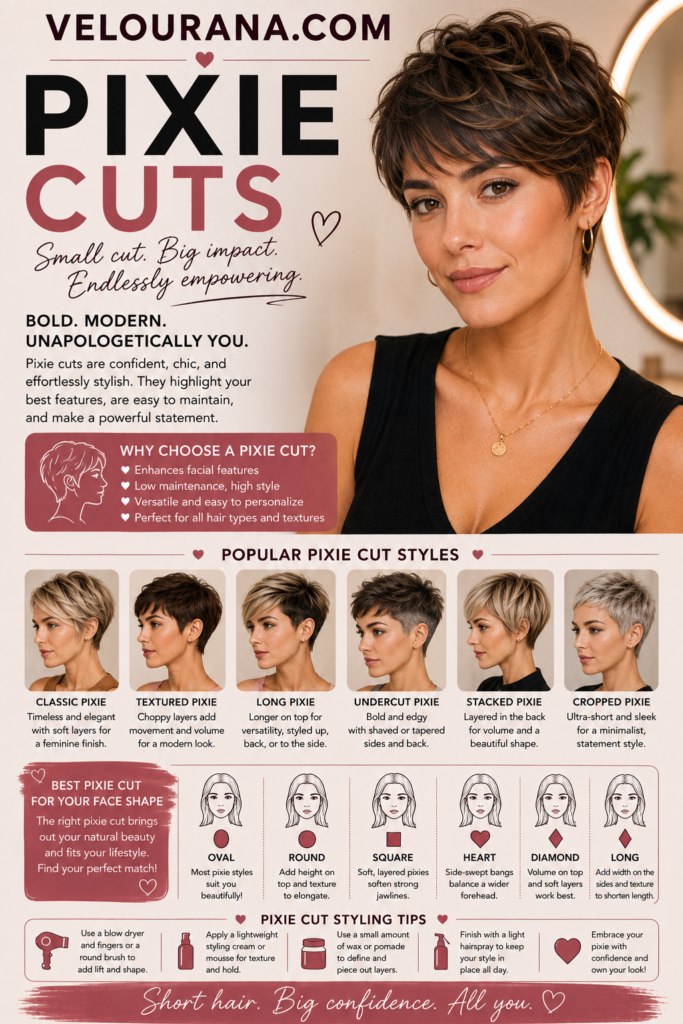
A pixie cut does not have to be extremely short to have the unmistakable character of a pixie. In fact, some of the most versatile versions preserve considerably more length through the crown, fringe and sides while keeping the overall silhouette compact. This is the territory of the long pixie: short enough to expose the neck and remove the weight of medium or long hair, yet long enough to move, sweep, separate and change direction.
That additional length changes the experience of wearing short hair.
A very cropped pixie depends heavily on the precise shape created by the cut. With only a small amount of hair available, there is limited distance for the strands to travel. A long pixie introduces more possibilities. The fringe can sweep across the forehead, move away from the face or fall forward. The crown can be lifted or worn flatter. Longer sections around the ears can create softness, while the back can remain neatly tapered.
For someone considering short hair for the first time, this can make the transition feel considerably less abrupt.
The hair is undeniably short, but it does not lose all of the movement associated with longer styles. There are still pieces to touch, reposition and style. The front can still frame the face. Natural waves and curls have enough length to develop visible shape.
The long pixie also occupies an interesting position between established haircut categories. Allow it to grow and it begins approaching a bixie, the hybrid territory between a pixie and a bob. Shorten the sides and back while preserving the top and it becomes more recognizably pixie-like again.
This flexibility is precisely what makes the style so useful.
What Actually Makes a Pixie “Long”
There is no universal measurement separating a standard pixie from a long one. The distinction comes from proportion.
The sides and back remain relatively short, but the upper sections retain enough length to create visible movement. The fringe may become the longest area, sometimes reaching the brows, eyes or even cheekbones. The crown can contain enough hair to develop texture rather than simply following the shape of the head.
Some versions leave additional length around the ears and nape as well.
The haircut therefore feels softer at its boundaries.
Instead of a very close transition between hair and exposed skin, there may be small sections that move naturally around the perimeter.
The result still looks short because the shoulders and most of the neck remain free of hair. Yet the upper structure has considerably more flexibility than a tightly cropped style.
The Fringe Often Becomes the Main Feature
In many long pixies, the fringe carries much of the haircut's visual identity.
The sides may remain neat and relatively compact while the front extends significantly farther.
This difference creates immediate movement.
A long fringe can sweep diagonally across the forehead, producing a softer and more asymmetrical appearance. It can be parted and moved away from the face. It can be textured into separate sections or styled upward for greater volume.
The same haircut can therefore appear very different depending on what happens at the front.
This is especially valuable for someone concerned that cutting short will eliminate styling variety.
There may be less total hair, but the hair that remains is positioned where small changes have enormous visual impact.
A Side-Swept Long Pixie Creates Natural Movement
One of the most recognizable ways to wear a longer pixie is with the front directed predominantly toward one side.
The asymmetry creates a flowing line across the forehead and toward the temple.
If the fringe is sufficiently long, it may approach the cheekbone before connecting with the shorter sides.
The style can look smooth and polished when the strands are kept together, or more relaxed when they are separated and textured.
Natural growth patterns can make this version particularly easy for some people.
Hair that already prefers moving toward one side may require relatively little encouragement.
Rather than forcing a perfectly centered structure onto the hair, the haircut can use its natural direction.
This can make the finished style feel less constructed and easier to reproduce outside the salon.
Keeping Length Around the Ears Softens the Transition
A pixie with completely exposed ears can look clean and precise, but it is not the only option.
Longer pieces around the ears create a softer perimeter.
They can be tucked behind the ears for a neater finish or allowed to fall naturally when a less structured appearance is wanted.
This small amount of additional length can significantly change how dramatic the haircut feels.
Someone transitioning from a bob or medium hair may find the softer sides more familiar because the face is not suddenly surrounded by an extremely close crop.
As confidence with the shorter style develops, those sections can always be reduced later.
Beginning with more length preserves options.
The Nape Can Remain Clean Even When the Top Is Long
A long pixie does not need to be long everywhere.
One of the most attractive contrasts comes from preserving substantial movement through the top while keeping the nape comparatively neat.
The back gradually becomes shorter as it approaches the neck.
This prevents the haircut from feeling heavy and maintains the clearly short silhouette.
The transition can be extremely soft rather than sharply clipped.
A gently tapered nape can make the haircut feel polished while allowing the crown and fringe to remain loose and expressive.
As the haircut grows, this area usually reveals the change relatively quickly.
The nape becomes fuller and begins moving toward the early stages of a bixie.
Someone maintaining a clear pixie silhouette may therefore pay particular attention to this section during trims.
Fine Hair Can Benefit From the Reduced Weight
Long fine hair can sometimes become flat because the strands carry considerable weight relative to their diameter.
A long pixie removes most of that weight.
The crown may lift more easily.
Natural body can become more visible.
The hair can appear fuller around the head because there is no thin lower perimeter drawing attention downward.
Preserving some length on top can be particularly useful.
If every section is cut extremely short, fine hair may reveal more scalp than desired depending on its density.
A longer crown provides coverage and movement.
The fringe can also create visual fullness around the front.
The objective is not to create artificial thickness through excessive cutting. It is to position the available hair where it produces the strongest overall shape.
Dense Hair Gives the Long Pixie Richness
Thick hair can make a long pixie look exceptionally substantial.
There is enough density for a full fringe, textured crown and soft sides without the haircut appearing sparse.
The challenge is controlling how that density behaves after the weight of long hair disappears.
Hair that previously lay relatively flat may expand considerably once shortened.
The crown may develop strong volume.
The sides can become wider than expected.
This is why dense hair needs thoughtful shaping rather than indiscriminate thinning.
The haircut can preserve richness through the areas where fullness contributes to the design while reducing unnecessary bulk elsewhere.
A long pixie should still look like thick hair when thick hair is what the wearer naturally has.
The goal is organization, not elimination.
Straight Hair Can Make the Cut Look Sleek or Textured
Straight hair gives the long pixie two very different personalities.
When smoothed, the longer sections can create elegant continuous lines.
The fringe sweeps cleanly across the forehead.
The crown follows the shape of the head.
The sides can be tucked neatly behind the ears.
Introduce texture and the same haircut changes.
Individual sections become visible.
The crown gains separation.
The fringe can break into smaller pieces rather than forming one smooth sweep.
This ability to move between polished and tousled finishes makes straight hair particularly adaptable at this length.
The haircut provides the structure, while styling determines how much of that structure is emphasized.
Waves Can Become Stronger After the Cut
Someone with long wavy hair may not know how much texture they actually have until substantial length is removed.
Long strands stretch waves downward.
A pixie releases that weight.
Suddenly the crown may form visible bends.
The fringe may curve naturally.
Sections around the sides can develop movement without any curling tool.
A long pixie gives those waves enough length to become recognizable rather than cutting them away entirely.
This can create a soft, naturally textured appearance.
It also means the haircut should anticipate how much the pattern may strengthen.
Cutting based only on the stretched or heavily styled version of the hair can lead to a shorter-looking result once the waves return.
Curls Can Turn the Long Pixie Into a Sculpted Shape
Curly hair can make a longer pixie particularly expressive because the additional centimeters allow individual curls to form more completely.
The crown can carry rounded volume.
The fringe can consist of curls falling toward the forehead or moving to one side.
The sides can remain shorter without becoming completely close to the scalp.
The silhouette is created through the distribution of curl rather than through a perfectly visible perimeter.
Shrinkage remains one of the most important considerations.
Removing weight can cause curls to contract more strongly.
A section that appears relatively long when stretched may become much shorter once released.
For this reason, the natural resting position should guide the final shape.
A long curly pixie should be allowed to behave like curly hair rather than being designed according to the proportions of a straight reference photograph.
The Crown Provides the Volume
The longer crown is one of the defining features that separates this haircut from a very close crop.
It creates space for lift and movement.
The exact amount of length determines how the volume behaves.
Keep the crown moderately short and the shape remains controlled.
Leave considerably more length and the hair can be swept, tousled or lifted.
Texture strongly influences the result.
Fine straight hair may need strategic shaping to encourage lift.
Dense wavy hair may create volume almost automatically.
Curly hair may require enough length to form the desired pattern without becoming excessively tall.
The crown should therefore be designed according to what the hair naturally does rather than according to one standard measurement.
A Long Pixie Can Work With a Center Part
Although side-swept versions are common, longer pixies do not need to depend on asymmetry.
When enough length remains through the front, a center or slightly off-center part can create a softer curtain effect.
The fringe separates toward both sides.
Longer pieces can move toward the temples and ears.
The result begins approaching the visual territory of a very short bob while retaining the lighter pixie structure through the back and sides.
This can be particularly appealing for someone who prefers symmetry or frequently changes their part.
The additional front length gives the haircut enough flexibility to support several directions.
Tucking the Hair Behind the Ears Changes the Entire Silhouette
One of the simplest styling changes available with a long pixie is also one of the most effective.
Leave the sides loose and the haircut appears softer and fuller.
Tuck them behind the ears and the face opens immediately.
The silhouette becomes narrower.
The ears and earrings become more visible.
The same haircut can therefore move between a more relaxed and a cleaner appearance in seconds.
This small versatility is part of the appeal of retaining additional side length.
The hair remains short, but it is not fixed permanently into one position.
Texture Products Can Reveal the Structure
Because the haircut contains relatively short sections, a small amount of separation can reveal its architecture clearly.
The crown begins showing individual pieces.
The fringe develops definition.
The ends stop blending into one continuous surface.
This can make a long pixie appear more casual and dimensional.
A smooth finish creates the opposite effect.
The sections merge and the overall silhouette becomes more important than individual strands.
Neither finish is essential to the haircut.
The ability to move between them is part of what makes the longer version so adaptable.
The Long Pixie Can Be Easier to Air-Dry Than a Highly Styled Crop
Short hair is often assumed to require constant styling, but the amount of work depends heavily on how closely the haircut follows natural texture.
A long pixie that allows waves to wave and curls to curl may need surprisingly little intervention.
Straight hair can settle naturally if the growth pattern supports the intended direction.
The additional length also provides some weight, preventing every section from standing independently.
This can make the haircut more forgiving than an extremely short, highly precise style.
However, the natural drying pattern should be considered before the cut.
If the fringe consistently separates in one place or the crown grows strongly in a particular direction, those behaviors will still exist.
Designing around them makes air-drying considerably more successful.
A Few Minutes of Styling Can Produce a Large Change
When styling is desired, short hair responds quickly.
There is less length to dry.
The crown can be redirected rapidly.
The fringe can be reshaped without working through large sections.
A small change in root direction can alter the entire silhouette.
This creates an interesting trade-off.
The haircut may need more deliberate attention than a long style that can simply be tied back, but the amount of hair requiring that attention is dramatically smaller.
For many people, this makes short-hair styling feel more creative than burdensome.
The Haircut Can Be Changed Without Cutting It Again
A long pixie offers several appearances within the same structure.
The fringe can move sideways one day and forward another.
The crown can be smooth or lifted.
The sides can be tucked or left loose.
Natural texture can be emphasized or softened.
A deep side part can create dramatic asymmetry.
A softer central separation can make the haircut feel more balanced.
This variety contradicts the idea that short hair provides fewer options.
It provides different options.
There may be no long braid or high ponytail, but the silhouette itself can be changed far more quickly.
Color Can Emphasize the Longer Sections
Because the long pixie contains clear differences between the upper and lower areas, color can emphasize those proportions.
Highlights through the crown can make texture more visible.
Variation through the fringe can emphasize movement.
Contrasting tones can make the longer sections appear even more distinct from the shorter sides.
The compact scale of the haircut means color changes are visually concentrated.
A relatively small section represents a meaningful part of the entire hairstyle.
This can make subtle placement appear surprisingly significant.
The Cut Can Be a Practical Bridge From a Bob
Someone moving from a bob toward shorter hair may find the long pixie a natural intermediate step.
The overall length is reduced, but some familiar movement remains through the top and front.
The sides do not necessarily need to become extremely short immediately.
The fringe can remain relatively long.
This gives the wearer time to experience an exposed neck, lighter hair and a much shorter silhouette before deciding whether an even closer pixie is desirable.
If the answer is yes, the haircut can become shorter at a future appointment.
If not, it already functions as a complete style.
It Is Also One of the Easier Pixies to Grow
The same qualities that make the long pixie approachable also make it useful when growing toward longer hair.
There is already substantial length through the crown and front.
The sides gradually catch up.
The nape becomes fuller.
The haircut moves naturally toward a bixie.
Eventually the front can tuck behind the ears more easily, and the lower sections begin developing the structure of a bob.
Periodic reshaping can prevent the silhouette from becoming unnecessarily bulky while preserving overall growth.
This makes the journey toward longer hair more manageable than many people imagine.
Growth Changes the Shape Quickly
Although a long pixie grows gracefully, the change is visible relatively soon.
Short sides begin covering more of the ears.
The nape loses some of its taper.
The crown becomes heavier.
The fringe moves farther down the face.
Someone who wants the haircut to remain recognizably pixie-like will need to maintain those proportions.
Someone comfortable moving toward a bixie can simply allow the shape to soften.
The desired destination determines whether growth is something to correct or something to use.
The Style Does Not Need to Follow Face-Shape Formulas
A long pixie offers so many adjustable proportions that rigid face-shape rules are particularly unhelpful.
The fringe can be shortened or lengthened.
Volume can be concentrated at the crown or kept relatively flat.
The sides can remain fuller or become compact.
The ears can be exposed or partly covered.
The forehead can remain open or be framed.
These choices change the appearance substantially.
There is no single pixie reserved for one type of face.
The useful question is what proportions the wearer enjoys and how those proportions can be created with their actual hair.
The Hairline Becomes Part of the Style
Once the hair becomes short, its natural growth direction becomes much more visible.
A cowlick near the forehead can influence the fringe.
The temples may grow backward or forward.
The crown may spiral in a particular direction.
The nape may contain several growth patterns.
Long hair often suppresses these tendencies through weight.
A pixie reveals them.
This is not necessarily a disadvantage.
A natural lift at the front can create volume.
A strong directional pattern can establish an effortless side sweep.
The haircut becomes easier when these characteristics are incorporated rather than treated as obstacles.
A Long Pixie Can Feel Soft Without Becoming Anonymous
One of the attractions of retaining additional length is that the haircut can avoid the severity sometimes associated with very close crops.
The perimeter can remain delicate.
The fringe can move.
The crown can have softness.
The ears can be partially framed.
Yet the haircut still has a clear identity.
The neck remains exposed.
The silhouette remains compact.
The relationship between short sides and longer upper sections is unmistakable.
Softness does not mean the haircut lacks structure.
It means the structure is expressed through gradual transitions rather than sharp boundaries.
Short Hair Can Still Move
Perhaps the greatest misconception corrected by the long pixie is the idea that movement requires substantial length.
Movement is relative.
A fringe shifting across the forehead can transform the entire front.
A crown section lifting several centimeters can change the silhouette.
A wave curving around the temple can soften the side.
A curl falling toward the brow can become the focal point of the haircut.
Because the total structure is compact, these small movements have enormous visual importance.
The hair does not need to reach the shoulders to feel dynamic.
Why the Long Pixie Is More Than a Compromise
It would be easy to describe the long pixie simply as the cautious version of a shorter haircut.
That misses much of what makes it distinctive.
The extra length is not merely there because someone was afraid to remove it.
It creates its own design possibilities.
It allows a substantial fringe.
It creates movement through the crown.
It accommodates waves and curls.
It permits the sides to be tucked or released.
It provides several parting options and makes the haircut responsive to different styling finishes.
At the same time, the neck remains free and the physical weight of long hair disappears.
This combination gives the long pixie an identity of its own.
It is not a pixie waiting to become shorter and it is not a bob that has been cut too far.
It occupies the space between those styles deliberately.
A Short Haircut With Room to Change
The long pixie demonstrates that going short does not require giving up softness, movement or variety.
It simply concentrates those qualities closer to the head.
The fringe replaces long face-framing sections as the primary source of movement. The crown replaces the lengths as the main area for volume. Small sections around the ears replace long layers as a way of softening the perimeter.
Every centimeter becomes useful.
That is what gives the haircut its versatility.
It can be polished in the morning and tousled later. It can expose the ears or partially cover them. It can emphasize natural waves, define curls or create smooth lines through straight hair.
And if the wearer eventually wants something different, the long pixie already stands close to several possible directions.
It can become shorter.
It can grow toward a bixie.
It can eventually become a bob.
Or it can remain exactly where it is: unmistakably short, deliberately soft and long enough to keep moving.
The End
Velourana.
 Discover More From Our Family of Websites
 ZodiacBearing (Astrology, Tarot, Numerology, Angel Numbers & Spiritual Guidance)
 Velourana (Beauty, Makeup, Hair Care, Skincare & Beauty Tips)
 HavenBearing (Home, Living, Organization, Décor & Everyday Inspiration)
 PawBearing (Pet Care, Dog Breeds, Animal Health, Training & Pet Products)
 PsyCatherine (Notes From the Journal of a Psychologist on Real Life)