
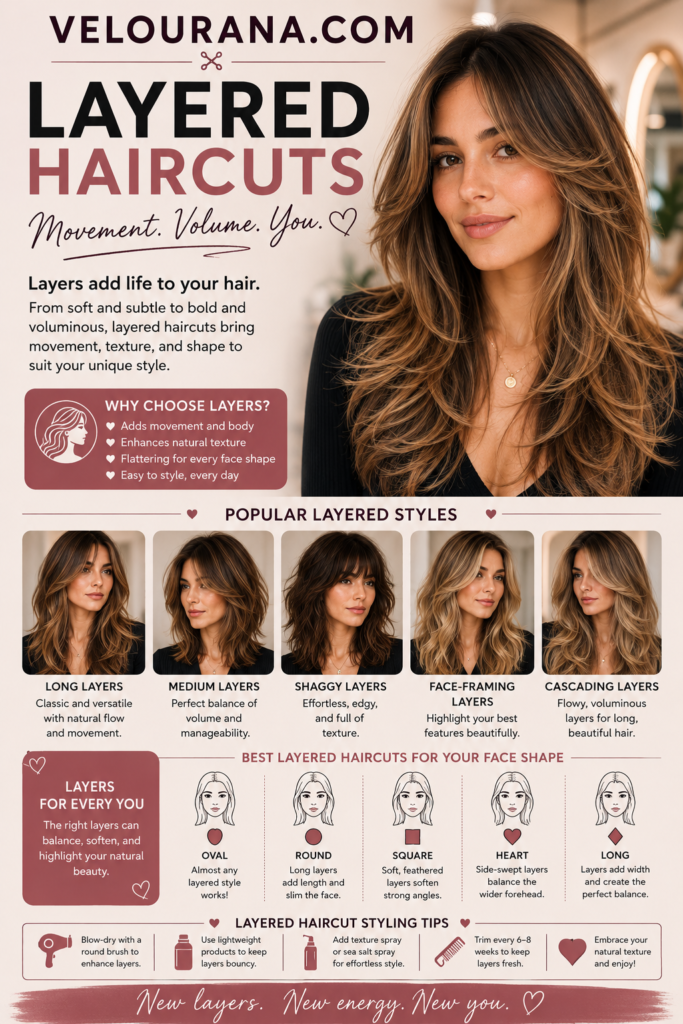
CATEGORY: Layered Haircuts
Long hair has a particular kind of presence. It can feel dramatic even when the haircut itself is simple, and for anyone who has spent years growing it, the thought of changing that length can be surprisingly difficult. Yet there comes a point when keeping every possible centimeter is not necessarily giving the hair its best shape. The length remains impressive, but the movement may disappear. The front can begin to feel heavy, waves may become stretched, and the entire hairstyle can fall as one continuous curtain from roots to ends.
Long layers offer a way to change that experience without abandoning the length that took so long to achieve.
Instead of transforming long hair into a visibly shorter haircut, layering introduces different lengths within it. The longest sections remain long, preserving the overall silhouette, while selected pieces are shortened enough to create movement. Depending on where those layers begin, the effect can range from almost imperceptible softness to dramatic flowing sections that become especially visible when the hair moves.
This is why long layers are often more sophisticated than they initially appear. A successful layered haircut is not simply a matter of cutting progressively shorter pieces through the hair. Every change in length redistributes weight. That redistribution affects fullness, movement, natural texture and the way the ends appear.
The objective is to create enough variation to bring the hair to life while preserving enough density to maintain the richness associated with long hair.
Why Very Long Hair Can Begin to Feel Heavy
As hair becomes longer, gravity increasingly influences the way it behaves. This is especially noticeable with thick or dense hair, but even finer hair can begin to look visually heavy when most of the strands travel uninterrupted from the scalp toward a distant perimeter.
Natural texture can be affected as well.
Someone with wavy hair may notice that the upper and middle lengths become relatively straight while movement survives mainly toward the ends. The wave has not necessarily disappeared. The weight of the hair may simply be stretching it.
Curly hair can experience a similar effect. Longer curls carry greater weight, which can elongate the pattern and move much of the volume toward the lower portion of the hairstyle.
Straight hair may remain straight but begin to lack dimension. Without variation in length, the entire hairstyle can move almost as one unit.
Long layers interrupt this heaviness.
Selected sections become lighter because they no longer carry the full length. They can move more freely, creating separation throughout the hairstyle rather than concentrating all movement at the bottom.
The result does not necessarily look dramatically layered.
Sometimes the most successful long layers are noticed primarily when the hair moves.
Preserving the Perimeter Is Often the Key
For many people with long hair, the greatest concern is not actually losing a few centimeters from selected sections. It is losing the appearance of fullness through the ends.
That concern is justified.
If too much hair is removed from the lower perimeter, long hair can begin to look sparse. The overall length remains, but only a relatively small number of strands reach the longest point.
This can create what sometimes appears as a thin or transparent tail beneath a much fuller upper section.
A well-designed long layered haircut avoids this by protecting enough density through the perimeter.
The longest line remains substantial.
Layers are then created above it without sacrificing so much hair that the ends lose their visual strength.
The appropriate balance depends on density.
Very thick hair can tolerate considerably more redistribution while still maintaining a rich perimeter.
Fine or lower-density hair generally requires greater restraint.
The purpose of layering is not to prove that the hair contains many different lengths.
It is to create movement while allowing the entire haircut to remain visually healthy and balanced.
Long Layers Can Begin Much Lower Than You Think
The phrase “long layers” can describe layers that begin surprisingly far down the hair.
Someone with waist-length hair may have the shortest internal layers beginning around the chest or even lower. That can still be enough to create movement through the bottom half of the hairstyle.
This approach is particularly useful for someone nervous about layering.
The difference between the shortest and longest pieces remains relatively modest compared with the total length.
When the hair is worn straight, the layering may appear subtle.
Once the hair moves, bends or is styled into waves, the different lengths become more visible.
Starting low also preserves considerable density through the upper and middle sections.
The haircut remains unmistakably long.
It simply stops behaving like one uninterrupted sheet of hair.
Face Framing Can Create the Biggest Visible Change
Long layers do not have to begin at the same height throughout the entire haircut.
The front can contain significantly shorter pieces while the back remains comparatively long.
This creates face framing.
A few carefully positioned sections around the cheeks, jaw and collarbone can transform how long hair looks from the front without dramatically altering its appearance from behind.
The shortest point determines the strength of the transformation.
Layers beginning around the cheekbones immediately introduce movement around the face.
Jaw-length pieces create a slightly longer and softer frame.
Layers beginning around the collarbone provide a conservative transition for someone who wants movement without anything resembling bangs.
These sections can then gradually blend into the longer hair.
The result is particularly effective because the eye encounters movement near the face before following the hair downward.
Long hair no longer appears to begin at the scalp and travel directly toward the floor.
There is shape along the journey.
Face-Framing Layers and Curtain Bangs Can Flow Together
One of the most natural combinations with long layered hair is a curtain fringe that gradually becomes part of the haircut.
The shortest pieces begin around the forehead or eyes.
They become longer toward the cheekbones.
From there, they can continue into jaw-length and collarbone-length sections before eventually merging into the full length.
This creates a continuous progression rather than an isolated fringe.
When styled away from the face, the different sections can create sweeping movement from the forehead through the sides of the hairstyle.
When worn more naturally, the same layers provide softness without requiring every piece to sit in a perfect arrangement.
The advantage is flexibility.
As curtain bangs grow, they simply become longer face-framing layers.
The transition is far less abrupt than growing out a short blunt fringe.
Someone who wants a noticeable change to long hair without committing to a completely separate bang can therefore use this gradual structure.
Fine Long Hair Needs Restraint
Long fine hair requires particular care when layering because length already places considerable demands on density.
The farther hair travels from the scalp, the more likely the ends are to show the effects of normal shedding, breakage and previous cutting.
If extensive layers are added, the longest perimeter may become even thinner.
This does not mean fine long hair should remain one length forever.
A modest amount of layering can actually improve its appearance by removing weak sections and introducing movement.
The difference lies in how much hair is shortened.
Long, subtle layers can prevent the hairstyle from appearing flat without sacrificing the majority of the perimeter.
Face-framing pieces can create visible change while leaving most of the density elsewhere untouched.
The finished haircut may not contain the dramatic separation seen on extremely thick hair, but that is not a disadvantage.
Fine hair often looks most luxurious when its density is protected.
Movement should enhance that fullness rather than compete with it.
Thick Long Hair Can Feel Dramatically Lighter
For someone with exceptionally thick long hair, layering can change not only the appearance but the physical experience of wearing it.
Dense hair at considerable length can be genuinely heavy.
Washing takes longer.
Drying takes longer.
The hair can feel substantial against the neck and back.
When much of that density reaches one perimeter, the hairstyle may also become bottom-heavy.
Long layers redistribute some of the weight without requiring a major reduction in overall length.
Shorter internal sections weigh less and move more independently.
The hair can suddenly feel lighter even though the longest strands remain almost unchanged.
The temptation, however, is to remove too much.
Aggressive thinning can create its own problems. Shorter sections may expand, particularly when the hair has natural texture. The upper portion can become excessively full while the lower ends lose their richness.
Thick hair deserves controlled shaping rather than indiscriminate removal.
Its abundance is one of its greatest visual strengths.
The objective is to make that abundance manageable without destroying it.
Straight Hair Can Make Long Layers Look Polished
Long layers on straight hair often create a smooth, flowing appearance rather than dramatic texture.
The different lengths can be visible through the ends, but they usually remain connected enough to preserve an elegant silhouette.
A polished blow-dry can emphasize the movement.
Shorter sections may curve slightly while longer sections continue farther down, creating overlapping shapes rather than one single perimeter.
When the hair is worn completely sleek, the layering becomes more subtle.
This gives straight long hair considerable versatility.
The haircut can look relatively simple on one day and much more dimensional after styling on another.
Good blending is particularly important because straight hair reveals the transition between lengths clearly.
Layers should generally appear to flow into one another rather than forming accidental shelves.
The finished effect should look deliberate even when the hair is not curled.
Waves Often Become More Visible After Layering
Wavy hair can respond dramatically to long layers because reducing weight gives the natural pattern more opportunity to form.
Someone may leave the salon believing their hair has somehow become curlier.
Often the texture was already present.
It simply had more weight suppressing it before the haircut.
Shorter sections can develop stronger bends because they are lighter.
Movement begins higher in the hairstyle.
The result can make long hair feel considerably more dynamic.
The challenge is maintaining enough weight to prevent unwanted expansion.
Not every wavy pattern benefits from extensive short layering.
Some hair becomes beautifully voluminous when weight is removed. Other hair can become difficult to control if too many short sections are introduced.
The haircut should therefore be designed around the specific pattern rather than around a generic idea of wavy hair.
Curly Long Hair Is Shaped Through Volume
With long curls, layers determine where volume appears.
A largely one-length curly haircut can carry substantial weight toward the bottom.
The upper sections may appear relatively flat while the lower lengths expand.
Layering can redistribute that shape.
Shorter curls can create movement and fullness higher around the head, while longer curls preserve the overall length.
The result can become rounder and more balanced.
Shrinkage must be considered carefully.
The shortest layers may rise considerably once dry, particularly with tighter curl patterns.
Cutting based only on stretched length can therefore create much shorter sections than expected.
The desired silhouette should be evaluated with the curls behaving naturally.
Some people want dramatic volume around the crown and sides.
Others prefer an elongated shape.
Neither preference is more correct.
The layers should create the volume distribution the wearer actually wants.
The Butterfly Influence on Long Layered Hair
One popular interpretation of long layers uses a dramatic contrast between shorter movement around the face and much longer hair underneath.
The front and upper sections can create the impression of a shorter, voluminous haircut when viewed from certain angles, while the longest layers preserve considerable length through the back.
This type of structure is often associated with butterfly-style layering.
Its appeal is understandable.
It offers the visual excitement of shorter movement without requiring the entire haircut to become short.
When styled with volume, the face-framing sections can sweep outward dramatically.
The longer hair underneath provides length and weight.
However, the effect depends heavily on density and styling.
On very fine hair, removing too much from the upper sections may leave the lower perimeter sparse.
On thick hair, the contrast can be much easier to create because there is more density available to distribute.
The dramatic photographs associated with this style also frequently involve a substantial blowout.
Without that styling, the layers may appear considerably softer.
Understanding that distinction prevents disappointment and allows the technique to be adapted realistically.
A Blowout Reveals the Architecture
Long layered hair and blowouts work particularly well together because the styling makes each level of the haircut more visible.
Shorter face-framing pieces can move away from the cheeks.
Mid-length layers can create sweeping curves.
Longer sections maintain movement through the lower portion.
Instead of all the ends turning at one level, the hair moves in several overlapping directions.
This creates the luxurious flowing appearance often associated with heavily layered long hair.
The haircut provides the structure, but the blowout reveals it.
Someone choosing a haircut from a styled photograph should keep this relationship in mind.
The layers will still exist when the hair is air-dried or straightened, but they may not appear as dramatic.
That can actually be an advantage for someone who enjoys changing their look.
The same haircut can move between subtle and dramatic depending on how it is styled.
Long Layers Can Also Be Beautiful Without Styling
Not everyone wants to perform a full blowout after every wash.
Long layers can still work beautifully when they are designed around natural texture.
Straight hair may fall into a soft, understated shape.
Waves can create their own movement.
Curls can naturally reveal the different lengths.
The success of an air-dried layered haircut depends heavily on where the layers are placed.
Short pieces that require constant manipulation to sit correctly may become frustrating.
The goal should be to create a structure that works reasonably well with the hair's natural tendencies.
This is particularly important around the face.
Growth patterns can cause one side to curve differently from the other.
Perfect symmetry may require styling.
A more relaxed approach can allow those natural differences to become part of the haircut.
Long Layers Change the Way a Ponytail Looks
Layers remain part of the hairstyle when the hair is tied.
Face-framing pieces may fall naturally around the cheeks and jaw, creating softness around a ponytail or bun.
This can be attractive, but it is not always practical.
Someone who needs every strand secured for work, sport or exercise may find short front layers irritating.
The shortest sections should therefore be chosen with lifestyle in mind.
Longer face framing may still create movement while remaining easier to secure.
Braids are affected as well.
Shorter layers can begin escaping from the braid at different points, creating either a deliberately relaxed appearance or unwanted flyaways depending on preference.
The haircut should work not only when the hair is displayed loose but also when it is worn in the ways required by everyday life.
Healthy Ends Matter Even More When Length Is the Priority
People growing long hair sometimes become reluctant to trim it because every centimeter feels valuable.
Yet preserving damaged, extremely thin ends can make the hair look less impressive rather than more.
Length and healthy-looking density are not the same thing.
A slightly shorter perimeter that appears substantial can create the impression of better hair than several additional centimeters consisting of sparse or heavily split ends.
Regular maintenance does not necessarily mean removing large amounts.
Small trims can protect the visual quality of the perimeter while the overall hair continues gaining length.
Layered sections need maintenance too.
As they grow, the differences between lengths become smaller and the movement gradually shifts downward.
Refreshing the layers can restore shape without sacrificing the longest point.
Layers Can Grow Out Gracefully
One of the advantages of long layers is that they generally do not create a dramatic growing-out problem.
They simply become longer.
Face-framing pieces move from the cheekbones toward the jaw and shoulders.
Mid-length layers gradually approach the perimeter.
Shorter sections gain weight.
The haircut becomes less layered over time rather than suddenly becoming awkward.
Someone who decides to return toward a one-length style can allow this process to continue while trimming the longest perimeter conservatively.
Eventually the differences become small enough to remove.
This can take time on very long hair, but the hairstyle can remain attractive throughout the transition.
The Consultation Should Protect What You Value Most
When someone has spent years growing long hair, the consultation should begin with a clear understanding of what must be preserved.
If the longest possible length is the priority, say so.
If thick ends matter more than retaining every centimeter, communicate that instead.
If the goal is dramatic face framing but minimal layering in the back, make the distinction clear.
If ponytails are essential, discuss the shortest acceptable front pieces.
If the hair will normally be air-dried, the haircut should be evaluated with that routine in mind.
These details are more useful than simply requesting “long layers.”
The term describes the technique broadly.
Your priorities determine the actual haircut.
Movement Does Not Require Sacrificing Everything You Grew
Long hair and dynamic hair are not opposites.
The choice does not have to be between keeping the length and having a haircut with personality.
Thoughtful layering allows both.
The longest perimeter can remain dramatic while movement develops above it.
The face can be framed without cutting the entire hairstyle shorter.
Waves and curls can gain freedom.
Thick hair can become lighter.
Straight hair can gain dimension.
A blowout can reveal sweeping sections that were barely noticeable when the hair was worn sleek.
The essential skill lies in knowing when to stop.
Every layer removes weight from somewhere.
The best long layered haircuts redistribute only as much as necessary to create the desired movement while protecting the density and length that give the hair its presence.
Long Hair That No Longer Feels Static
There is a particular beauty in very long hair moving as one smooth sheet, and there is no reason to change that if it is the effect someone loves.
But when long hair begins to feel static, heavy or disconnected from the face, layers provide another possibility.
They introduce movement without requiring a dramatic reduction in length.
They allow the front of the haircut to participate more strongly in framing the face.
They can release natural texture that has been stretched by weight.
They create opportunities for styling while still allowing the hair to remain recognizably long.
Most importantly, they can be adjusted.
Layering does not need to be dramatic simply because the hair is long.
A few carefully positioned differences in length can be enough.
The most successful result is not the haircut with the greatest number of layers. It is the haircut in which every layer contributes something useful to the shape.
When that balance is achieved, the length remains impressive, but it no longer carries the entire responsibility for making the hairstyle beautiful.
The hair gains dimension.
It gains movement.
And without giving up the length that took years to grow, it can feel entirely new.
The End
Velourana.
 Discover More From Our Family of Websites
 ZodiacBearing (Astrology, Tarot, Numerology, Angel Numbers & Spiritual Guidance)
 Velourana (Beauty, Makeup, Hair Care, Skincare & Beauty Tips)
 HavenBearing (Home, Living, Organization, Décor & Everyday Inspiration)
 PawBearing (Pet Care, Dog Breeds, Animal Health, Training & Pet Products)
 PsyCatherine (Notes From the Journal of a Psychologist on Real Life)

