
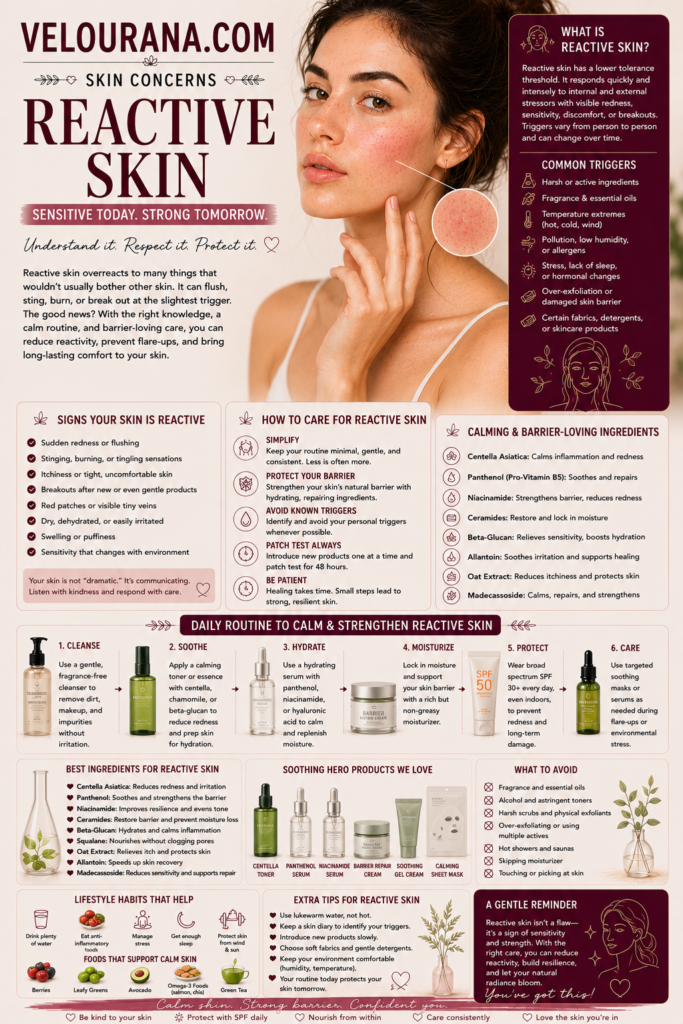
CATEGORY: Reactive Skin
There is a moment familiar to many people with reactive skin: standing in front of a shelf filled with products and realizing that the collection has become larger while the skin has become less predictable.
There may be a cleanser for sensitive days and another for normal days. Several moisturizers promise barrier repair. One serum targets redness, another dehydration, another pigmentation. There are products that were used once because they stung, others that worked initially but later became uncomfortable, and a few dependable formulas that remain in the routine simply because they never seem to cause trouble.
The shelf tells a story of searching.
Reactive skin encourages that search because unpredictability creates the impression that the right product has not yet been found. Somewhere, perhaps, there is a cleanser that will never sting, a moisturizer that will permanently prevent redness or a serum capable of making sensitivity disappear.
Sometimes changing a product genuinely helps.
But long-term comfort with reactive skin is rarely created by one exceptional purchase. It is built through a more complete understanding of tolerance: what the skin consistently accepts, what lowers its threshold, how environmental conditions influence it, when treatment becomes excessive and when symptoms require more than cosmetic care.
This is a quieter philosophy of skincare.
It does not promise that the complexion will never react again. Skin is living tissue, not a controlled laboratory surface. Weather changes. Hormones fluctuate. Products change. Sun exposure varies. Illness, stress and ordinary life introduce circumstances that no routine can completely control.
The realistic goal is different.
It is to make reactions less frequent, less confusing and easier to manage.
It is to create a complexion that spends more time feeling comfortable than demanding attention.
Begin with the Skin You Actually Have
One of the difficulties of skincare is that routines are often built for an imaginary version of the complexion.
The person wants brighter skin, so they create a brightening routine.
They want fewer fine lines, so they create an anti-ageing routine.
They want clearer pores, so they create an exfoliating routine.
But the skin receiving those treatments may currently be red, tight and easily irritated.
The ambition of the routine and the condition of the skin are therefore mismatched.
Reactive skin requires beginning with what is happening now.
If the complexion is comfortable and stable, there may be room for targeted treatments.
If it is burning after cleansing, repeatedly flushing and reacting to familiar products, the immediate priority changes.
Stability comes first.
This does not mean abandoning long-term cosmetic goals.
It means sequencing them intelligently.
A complexion struggling to tolerate basic skincare is unlikely to benefit from simultaneously being challenged with multiple intensive treatments.
The skin's current capacity should determine the routine's current intensity.
Establishing a Reliable Baseline
Every reactive complexion benefits from having a baseline routine.
This is the routine you understand.
You know how the cleanser behaves.
You know how the moisturizer feels.
You know whether the sunscreen is comfortable.
There are few enough variables that when something changes, you have a reasonable chance of identifying why.
A baseline does not need to be fashionable.
In fact, its value often comes from being uneventful.
The cleanser cleans.
The moisturizer moisturizes.
The sunscreen protects.
Nothing creates drama.
This baseline becomes particularly important when introducing additional treatments. If the skin is already stable before a new serum is introduced, subsequent changes are easier to interpret.
Without a baseline, skincare becomes a moving target.
A new cleanser arrives Monday.
A serum begins Wednesday.
An exfoliant is added Friday.
By Sunday, the cheeks are red.
There is almost no useful way to determine what happened.
A stable baseline converts experimentation into something closer to an actual experiment.
Gentle Cleansing Is More Than Choosing a Gentle Cleanser
The phrase “gentle cleanser” appears everywhere in sensitive-skin advice.
It is useful, but incomplete.
Cleansing is an activity, not merely a product.
A mild formula can still be used aggressively.
Very hot water can increase discomfort.
Prolonged washing can expose the skin unnecessarily.
Scrubbing with washcloths or cleansing devices adds friction.
Rubbing the face dry adds more.
Repeated cleansing because the skin does not feel sufficiently “clean” can increase the total burden.
Reactive skin often improves when the entire cleansing process becomes quieter.
Use water at a comfortable lukewarm temperature.
Allow the cleanser to do the work without excessive pressure.
Use fingertips unless there is a specific reason for another method.
Rinse adequately.
Dry gently.
Then stop.
There is no need for the skin to feel squeaky, polished or stripped.
Those sensations are sometimes mistaken for cleanliness because cosmetic culture has historically associated tightness with successful cleansing.
For reactive skin, tightness is usually more useful as a warning than an achievement.
Understanding Whether Morning Cleansing Is Necessary
Not every complexion requires exactly the same cleansing schedule.
Someone with oily skin, significant overnight product residue or other specific needs may prefer cleansing in the morning.
Another person with dry, reactive skin may find that a water rinse or another gentle approach is sufficient.
The important point is not to create a universal rule.
It is to question automatic habits.
If morning cleansing consistently leaves the face tight and uncomfortable, the routine deserves reconsideration.
If skipping cleanser creates congestion or discomfort, that information matters too.
Reactive skincare works best when habits have reasons.
“Everyone says I should” is not a particularly strong reason.
The skin's repeated response is more informative.
Moisturizer as the Anchor of the Routine
For reactive skin, moisturizer often becomes the anchor product.
It may not be the most exciting step, but reliability matters.
A useful moisturizer should improve comfort without repeatedly introducing new problems.
The ideal texture varies.
Dry reactive skin may appreciate richer formulations.
Combination or oily reactive skin may prefer lighter textures.
Season matters.
Climate matters.
Personal preference matters.
There is no single consistency that defines a good sensitive-skin moisturizer.
What matters is the result.
Does the skin feel more comfortable after application?
Does that comfort last?
Does the product consistently avoid burning or itching?
Does it work well alongside sunscreen and other necessary products?
If the answer is yes, there is little reason to replace it simply because something newer appears.
Reactive skin benefits from loyalty to products that work.
The Attraction of Barrier Products
Barrier care has become one of skincare's dominant themes.
Ceramides, cholesterol, fatty acids, panthenol, glycerin and other ingredients are frequently discussed in the context of supporting dry or compromised skin.
This attention has helped many people understand that irritation is not always solved by stronger treatment.
But the popularity of barrier care has also created another form of excess.
Someone can now build an entire ten-step routine composed exclusively of products marketed as barrier-supporting.
That defeats part of the purpose.
The skin barrier does not need every barrier product simultaneously.
A well-formulated moisturizer may already provide what the routine requires.
Additional products can be useful when they serve a specific purpose and are well tolerated, but the category label alone is not a reason to layer them.
Reactive skin benefits from function, not accumulation.
Sun Protection Without Daily Discomfort
Sun protection is particularly important for redness-prone skin, yet sunscreen is also one of the products reactive complexions frequently struggle to tolerate.
This creates a practical problem.
A sunscreen that causes significant burning will not encourage consistent use.
The solution is not abandoning protection.
It is finding a formulation that the individual can use comfortably.
Some people prefer mineral filters.
Others tolerate organic filters perfectly well.
Some need fragrance-free formulas.
Some dislike alcohol-heavy textures.
Others find rich mineral creams too occlusive.
There is no single sunscreen experience shared by everyone with reactive skin.
The search should focus on adequate broad-spectrum protection, appropriate SPF and real-world tolerability.
Sun protection also extends beyond sunscreen.
Shade reduces exposure.
Hats can protect the face.
Timing outdoor activities can matter during intense ultraviolet conditions.
Physical protection can complement topical protection rather than forcing sunscreen to perform the entire job alone.
Active Ingredients Need a Purpose
Reactive skin does not automatically require an active-free life.
But every active should answer a question.
Why is it here?
If the answer is vague—because it is popular, because everyone uses it, because the routine feels incomplete without it—the product may not deserve the irritation risk.
If the answer is specific, the decision becomes easier.
A retinoid may be used for acne or signs of ageing.
An exfoliating acid may address particular texture or congestion concerns.
A pigment-targeting ingredient may be used for hyperpigmentation.
The routine now has priorities.
This is important because reactive skin often struggles when every cosmetic concern is treated simultaneously.
Choosing one major treatment goal allows the rest of the routine to remain supportive.
Once tolerance is established, additional goals can be considered.
Frequency Is Part of the Formula
Consumers tend to think of a product as a fixed object.
But the experience of a product depends partly on how it is used.
A treatment applied twice weekly is not biologically equivalent to the same treatment applied every night.
Frequency changes exposure.
Amount changes exposure.
Combination with other products changes exposure.
Environmental conditions can change tolerance.
This means that a product may be appropriate while its current schedule is not.
Reactive skin often benefits from adjusting frequency before abandoning a potentially useful treatment entirely.
A product that causes irritation at daily use may be comfortable less frequently.
A treatment tolerated during humid summer conditions may require adjustment during winter.
Skincare is not only about what is applied.
It is also about how much, how often and alongside what else.
Avoiding the Active-Ingredient Traffic Jam
One of the easiest ways to overwhelm reactive skin is to stack several active treatments into the same period.
An exfoliating cleanser in the morning.
Vitamin C afterwards.
An acid toner in the evening.
A retinoid before bed.
A blemish treatment on top.
Each product may have evidence supporting its intended use.
The combination may still be excessive for one person's skin.
This is the active-ingredient traffic jam: too many interventions competing for the same limited tolerance.
Reactive skin benefits from spacing.
Not every treatment needs to be used every day.
Not every active needs to be layered.
Not every cosmetic concern needs simultaneous intervention.
Reducing overlap often preserves the benefits of treatment while lowering irritation.
Fragrance and Individual Sensitivity
Fragrance is frequently discussed in sensitive skincare, sometimes in overly absolute terms.
Fragrance ingredients can cause irritation or allergic contact dermatitis in susceptible individuals, and fragrance avoidance is often recommended for people with known sensitivity.
But the useful principle is not that every fragranced product is universally harmful.
It is that reactive skin benefits from minimizing unnecessary potential triggers, particularly when a pattern has already been established.
Someone who repeatedly reacts to fragranced skincare has a strong practical reason to avoid it.
Someone with suspected fragrance allergy may benefit from dermatological patch testing.
The objective is individualized avoidance based on evidence rather than fear-based elimination of enormous ingredient categories without context.
Patch Testing as a Habit of Patience
New products are exciting.
Reactive skin benefits from making their introduction deliberately boring.
Testing a product on a limited area before widespread use can sometimes reveal obvious intolerance.
It is not perfect.
A product tolerated on the arm may behave differently on the face.
A reaction may require repeated exposure.
Different facial areas can have different sensitivities.
Still, testing introduces something valuable: patience.
It interrupts the impulse to apply a new product everywhere immediately.
That alone can prevent some unnecessary problems.
When the product eventually enters the routine, introducing it without several other simultaneous changes makes observation much easier.
What to Do When Everything Suddenly Stings
There are periods when reactive skin seems to reject everything.
Cleanser stings.
Moisturizer stings.
Sunscreen stings.
Even water feels uncomfortable.
This is not the ideal moment for product exploration.
The routine should become easier to interpret, not more complicated.
Optional active treatments can be reconsidered.
Exfoliation can be reduced.
Unnecessary fragrance and potentially irritating products can be removed.
Cleansing technique can become particularly gentle.
Products with a long history of good tolerance can become the foundation.
If symptoms are severe, persistent or unexplained, professional assessment is appropriate.
The crucial point is resisting the temptation to introduce five new “recovery” products while the skin is already unstable.
Recovery needs clarity.
The Role of Climate in a Long-Term Routine
Reactive skin may need different support in January and July.
This is normal.
Winter often brings lower humidity, cold wind and indoor heating.
Summer brings heat, sweat and stronger ultraviolet exposure.
Travel can produce even more dramatic environmental changes.
Someone moving from a humid coastal climate to a cold, dry city may discover that a previously perfect moisturizer suddenly feels inadequate.
Someone travelling into tropical heat may find the same moisturizer unbearably heavy.
These changes do not mean the original routine failed.
They mean skincare exists within an environment.
Seasonal adjustment is therefore a sign of intelligence, not inconsistency.
Makeup and Reactive Skin Can Coexist
Having reactive skin does not mean makeup must be abandoned.
The objective is to make the complete makeup experience tolerable.
Preparation matters.
Application matters.
Wear matters.
Removal matters.
A foundation that requires aggressive scrubbing every evening may be less suitable during reactive periods even if it causes no immediate irritation during the day.
Brushes and sponges should be maintained appropriately.
Repeated friction should be minimized.
Products that consistently cause burning or itching deserve investigation.
But there is no reason to assume that reactive skin must remain cosmetically bare.
The routine simply needs to respect the same tolerance principles as skincare.
When Minimalism Becomes Too Minimal
Simplification is valuable, but it can also become dogmatic.
Some people become so afraid of reactions that they avoid moisturizer despite significant dryness.
Others abandon sunscreen.
Some refuse every treatment even when a dermatologist has recommended one.
This is not the objective.
Reactive skincare should not be defined by deprivation.
The goal is an effective routine containing what the skin needs without unnecessary complexity.
Minimalism is useful only when it serves function.
Three unsuitable products are not better than five appropriate ones simply because the number is smaller.
Quality, purpose and tolerance matter more than counting bottles.
The Emotional Burden of Unpredictable Skin
Reactive skin can affect more than physical comfort.
Visible facial redness is difficult to hide emotionally because the face is central to social interaction.
A sudden flush during a meeting can create self-consciousness.
A reaction before an important event can feel disproportionately upsetting.
Repeated product failures can create frustration and distrust.
Some people begin anticipating reactions before trying anything new.
That emotional burden should not be dismissed.
At the same time, pursuing absolute control can intensify it.
No routine can guarantee that the face will never flush.
No cosmetic can ensure that environmental changes never affect the complexion.
A more sustainable objective is confidence in how to respond.
Knowing your baseline routine reduces uncertainty.
Recognizing early warning signs reduces panic.
Understanding common triggers makes reactions less mysterious.
Knowing when professional assessment is appropriate prevents endless self-experimentation.
Knowledge cannot eliminate every reaction.
It can remove much of the confusion surrounding one.
Recognizing When Professional Care Is Necessary
Reactive skin is a descriptive concept.
Persistent symptoms may have a diagnosable cause.
Frequent or persistent facial redness can occur with rosacea.
Itching and scaling may accompany dermatitis.
Swelling may suggest an allergic process.
Recurrent rashes can require investigation.
Eye irritation alongside facial redness deserves attention.
A dermatologist can evaluate these patterns and determine whether medical treatment, patch testing or another form of assessment is appropriate.
This becomes particularly important when a supposedly gentle routine fails to improve symptoms.
Continuing to purchase increasingly specialized cosmetics is not always the answer.
Sometimes the missing product is not a product at all.
It is a diagnosis.
Learning to Trust Consistency
Reactive skin often makes novelty more attractive because existing products become associated with frustration.
Yet consistency is what makes patterns visible.
When the same basic routine is used comfortably over time, it creates a reference.
If a new product causes irritation, the change is easier to identify.
If weather produces redness despite an unchanged routine, the environmental relationship becomes clearer.
If symptoms persist regardless of cosmetic changes, the possibility of an underlying condition becomes more apparent.
Consistency produces information.
Constant experimentation destroys it.
A Routine Should Be Easy to Retreat To
Every reactive-skin routine should have a retreat position.
This is the simplified version used when tolerance decreases.
It contains products already known to be comfortable.
It avoids unnecessary experimentation.
It reduces optional treatments.
It emphasizes gentle handling and appropriate protection.
The exact products will differ among individuals.
What matters is knowing where to return.
This prevents every flare from becoming a complete skincare crisis.
Instead of buying an entirely new routine, the person returns to familiar territory.
Once stability returns, treatments can be reconsidered gradually.
Measuring Success Differently
Beauty culture encourages dramatic metrics.
How much brighter?
How much smoother?
How many fewer wrinkles?
How quickly did the pigmentation disappear?
Reactive skin benefits from quieter measurements.
How many mornings did cleansing feel comfortable this week?
How often did sunscreen sting?
How frequently did unexplained redness appear?
Can the skin tolerate the treatment being used?
Are reactive episodes shorter?
Is the routine easier to understand?
These outcomes may not create dramatic advertising photographs.
They matter enormously in daily life.
Comfort is not a secondary cosmetic achievement.
For reactive skin, it is foundational.
The Confidence to Leave the Routine Alone
Perhaps the final skill is knowing when not to change anything.
The skin is comfortable.
The routine is working.
There is no persistent redness.
The necessary treatments are tolerated.
Then a new launch appears.
A stronger serum promises faster results.
A social-media routine becomes fashionable.
A friend recommends an ingredient.
Reactive skin does not need to participate in every development.
A stable complexion is not an unfinished project.
There will always be another product.
There will always be another trend.
There will always be another ingredient described as essential.
None of them automatically deserves a place on your face.
The confidence to maintain a routine that works is one of the most valuable forms of skincare maturity.
Making Peace with a Skin Type That Notices Everything
Reactive skin notices.
It notices temperature.
It notices friction.
It notices excessive cleansing.
It notices ambitious combinations of active ingredients.
It may notice fragrance, particular preservatives, botanical ingredients or other components that another complexion ignores completely.
That sensitivity can be frustrating.
But once its patterns are understood, it becomes less chaotic.
You learn that a sudden sting does not automatically mean every product must be replaced.
You learn that a rough patch is not always asking to be exfoliated.
You learn that the skin can be oily and sensitive, acne-prone and reactive, mature and reactive, pigmented and reactive.
You learn that environmental conditions are part of skincare.
You learn that product frequency matters as much as product selection.
You learn that a quiet routine can be an excellent routine.
And you learn the boundary between ordinary cosmetic sensitivity and symptoms that deserve professional diagnosis.
Reactive skin does not require perfection.
It requires attention without obsession, treatment without aggression and experimentation without chaos.
The most successful routine may eventually become almost invisible in daily life.
You cleanse.
You moisturize.
You protect.
You use the treatments your skin genuinely needs.
You adjust when circumstances change.
And then you stop thinking about it.
That may be the most meaningful definition of comfortable skin: not a complexion that never changes, never flushes and never reacts, but one whose behaviour has become familiar enough that it no longer feels mysterious.
The goal is not to force reactive skin into silence.
It is to understand it well enough that you know when to listen.
The End
Velourana
 Discover More From Our Family of Websites
 ZodiacBearing (Astrology, Tarot, Numerology, Angel Numbers & Spiritual Guidance)
 Velourana (Beauty, Makeup, Hair Care, Skincare & Beauty Tips)
 HavenBearing (Home, Living, Organization, Décor & Everyday Inspiration)
 PawBearing (Pet Care, Dog Breeds, Animal Health, Training & Pet Products)
 PsyCatherine (Notes From the Journal of a Psychologist on Real Life)

