CATEGORY: Layered Haircuts
Layers are among the most frequently requested elements in a haircut, yet the word itself describes an enormous range of possibilities. Two people can both leave a salon with layered hair and have almost nothing else in common about their cuts. One may have long, nearly invisible layers that preserve the weight of waist-length hair. Another may have dramatic shorter pieces beginning around the cheekbones. A third may wear curls shaped through carefully distributed layers, while someone with a short haircut may use layering primarily to create texture and volume.
This variety exists because layering is not really a single hairstyle.
It is a way of distributing length and weight through the hair.
When all or most of the hair reaches approximately the same perimeter, the visual weight tends to collect toward the bottom. Introducing shorter sections changes that distribution. Hair begins to move at different levels. Some pieces become lighter. Natural waves or curls may gain greater freedom. The silhouette can become softer, rounder, fuller or more elongated depending on where those shorter lengths are placed.
This is why layers can produce wonderful results when they are designed around the actual hair and disappointing ones when they are added without a clear purpose.
More layers do not automatically create more volume.
Layers do not automatically make thick hair manageable.
Fine hair does not automatically need to avoid them.
Curly hair does not require one standardized layering pattern.
The real question is what the haircut needs the layers to accomplish.
Perhaps the ends feel too heavy.
Perhaps long hair hangs without movement.
Perhaps curls are collecting into a triangular shape.
Perhaps the front needs greater connection with the face.
Perhaps fine hair needs movement without sacrificing density.
Once the objective is understood, layering becomes far more precise.
Why Layers Change the Way Hair Moves
Imagine a curtain made from material that reaches the floor at exactly the same length. Most of its visual weight exists near the lower edge.
Hair with very little layering behaves somewhat similarly.
The strands travel downward together, and much of the visible density collects around the perimeter.
Now introduce different lengths.
Some strands stop earlier. Others continue farther down. Instead of all the movement occurring at one level, it becomes distributed throughout the shape.
This is the basic principle behind layering.
Shorter sections contain less weight than longer ones, so they can often move more freely. They may lift more easily at the roots, form stronger waves or create greater separation from surrounding hair.
Where those sections begin determines the character of the haircut.
Layers beginning relatively low may create only gentle movement through the ends.
Layers beginning around the shoulders can create much more obvious separation in long hair.
Shorter layers around the cheekbones can dramatically change the front of the haircut without altering the overall length.
Layers around the crown can redistribute volume higher on the head.
The technique therefore changes both movement and silhouette.
A good layered haircut considers both.
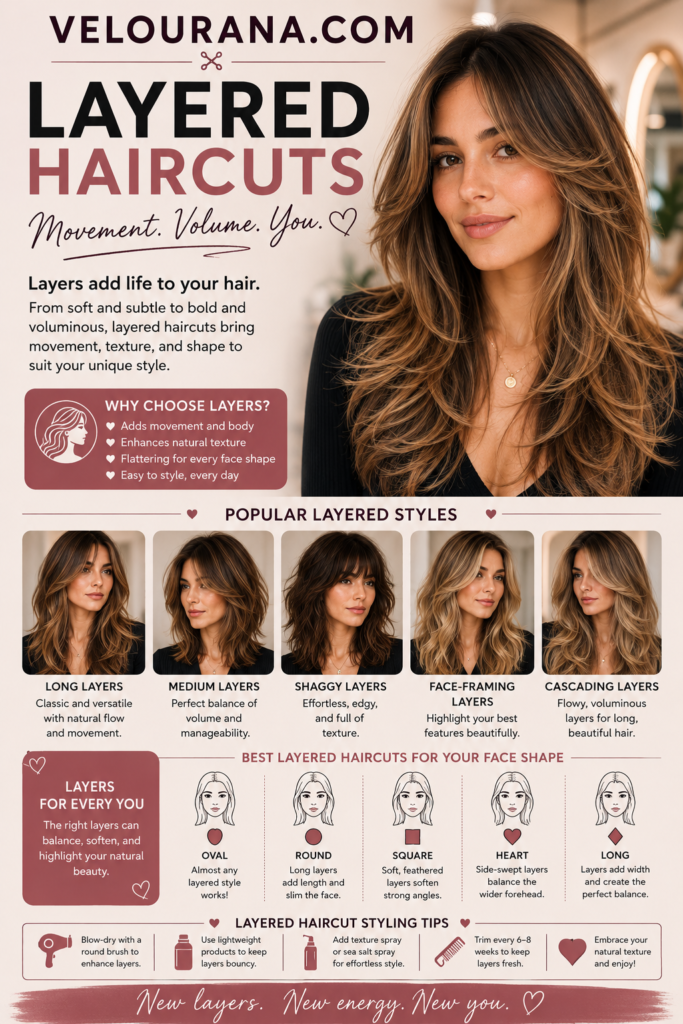
Long Layers Preserve Length While Removing Heaviness
Long layers are often the ideal introduction to layering for someone who wants movement but is reluctant to sacrifice the appearance of long hair.
The difference between the shortest and longest sections remains relatively modest.
Most of the overall length is preserved.
Instead of creating obvious steps, the layers blend gradually through the haircut.
This can prevent long hair from feeling like one heavy mass.
The ends gain movement. Waves may become more visible. Styling can develop greater dimension because different sections respond at different levels.
Long layers are particularly useful when the perimeter still needs to look substantial.
Someone with fine or medium-density hair may want movement without removing too much visual weight from the bottom. Keeping the layers relatively long allows the haircut to retain fullness.
On thick hair, long layers can begin redistributing weight without immediately creating a highly textured appearance.
They are also versatile.
Straight hair can make the layers appear subtle and polished.
Waves reveal more of the separation.
A blowout can emphasize movement through the ends.
The haircut changes according to styling without requiring a completely different structure.
Shorter Layers Create a More Obvious Transformation
The higher the layering begins, the more visible its influence becomes.
Shorter pieces around the crown, face or upper lengths create stronger differences between sections.
This can produce considerable movement and personality.
The hair may appear fuller around the upper portion because shorter sections are less weighed down. Texture can become more apparent. The silhouette may become rounder or more expansive.
But shorter layers require thoughtful placement.
If too much hair is removed from the lower lengths, the ends can lose density.
This is particularly important with fine or low-density hair.
Someone may ask for dramatic volume and receive numerous short layers, only to discover that the perimeter now appears thinner.
The apparent volume at one level has been created partly by moving hair away from another.
That trade-off is not necessarily wrong.
It simply needs to be intentional.
On very dense hair, shorter layers can be extremely useful because there is enough hair to redistribute without sacrificing the overall impression of abundance.
The objective should determine how dramatic the layering becomes.
Face-Framing Layers Can Transform Hair Without Changing the Back
Not every layered haircut needs extensive layering throughout the entire head.
Sometimes the most effective change happens only around the face.
Face-framing layers introduce shorter pieces through the front while preserving most of the length elsewhere.
The shortest point determines where attention is directed.
Pieces beginning around the cheekbones create movement through the middle of the face.
Jaw-length sections establish a softer transition toward the neck.
Longer pieces beginning below the chin create subtle movement without resembling bangs.
Shorter sections around the eyes begin overlapping with curtain bangs.
There is no strict boundary separating long bangs from short face-framing layers. One can gradually become the other.
This creates an opportunity for beautifully connected haircuts.
Curtain bangs can begin around the forehead, travel toward the cheekbones, continue into jaw-length framing and eventually merge with the full length.
Instead of seeing one isolated fringe and one separate haircut, the eye follows a continuous progression.
This can be particularly effective on long hair because it introduces detail around the face while allowing the overall length to remain dramatic.
Fine Hair Needs Layers That Protect Density
Fine hair often generates contradictory advice.
One person is told that layers will create volume.
Another is told never to have layers because they will make the hair look thinner.
Both statements can be true depending on the haircut.
Layers redistribute hair.
If fine hair already has limited density and large amounts are removed from the perimeter, the lower lengths may appear sparse.
This is why fine hair often benefits from restraint.
Long layers can create movement while preserving a relatively strong baseline.
Face-framing sections can introduce interest without removing density from the entire haircut.
Subtle internal shaping may help hair move without making the layers visually obvious.
The desired styling method also matters.
Someone who regularly creates a blowout may use layers to produce movement and lift.
Someone who air-dries extremely straight, fine hair may find that aggressive layering simply creates thinner-looking ends without generating the expected volume.
The haircut should therefore reflect how the hair behaves when it is not being professionally styled.
Fine hair does not need to avoid layers.
It needs layers that respect how much hair is available.
Thick Hair Can Use Layers to Redistribute Abundance
Thick hair has a different problem.
There may be so much density that long one-length hair becomes physically heavy.
The lower portion can feel bulky, and the weight can pull natural texture downward.
Layers allow some of that density to be distributed through different lengths.
This can make the haircut feel lighter while preserving the appearance of thick hair.
The distinction between layering and uncontrolled thinning is important.
Thick hair does not need to be attacked simply because there is a lot of it.
Its density can create beautiful movement and richness.
The goal is to decide where that density should remain and where reducing weight will improve the shape.
Removing too much can create short sections that expand unpredictably or ends that suddenly look much thinner than the upper hair.
Good layering preserves the advantages of thick hair while making the overall shape easier to manage.
Straight Hair Reveals the Architecture Clearly
On straight hair, the structure of a layered haircut can be particularly visible.
When layers are strongly graduated, the different lengths may appear clearly through the ends.
This can create beautiful movement when the transition is smooth.
It can also expose poor blending.
Straight hair therefore often benefits from careful attention to how one length flows into the next.
Long layers can look especially polished because they create subtle separation without dramatically fragmenting the perimeter.
A blow-dry can emphasize the movement by encouraging the ends to curve at different levels.
The hair does not need to become extremely voluminous.
Even a slight bend can reveal the structure.
Someone who prefers a completely sleek finish may choose softer layering so the haircut retains a clean appearance when straight.
Someone who enjoys visible movement can use shorter sections to make the architecture more obvious.
The natural texture does not dictate one correct option.
It simply changes how clearly the cutting technique will be seen.
Wavy Hair Can Become More Expressive After Layering
Waves are strongly influenced by weight.
Long, heavy sections can stretch a wave pattern downward. Removing some of that weight may allow the hair to form stronger bends.
This is one reason someone can discover noticeably more texture after receiving a layered haircut.
The hair itself has not fundamentally changed.
Its existing movement has been given more freedom.
The placement of the layers matters.
If the haircut removes weight in appropriate areas, waves can form more naturally throughout the shape.
If too much hair is removed or the layers are placed without considering the pattern, the result can become uneven or excessively expanded.
Different parts of the same head may also behave differently.
The underneath sections may wave strongly while the top remains relatively straight.
One side may form more pronounced bends.
The front may curl away from the face while the back behaves differently.
A good layered haircut responds to these variations rather than assuming the texture is identical everywhere.
Curly Hair Depends on Thoughtful Layer Placement
Layering can completely change the silhouette of curly hair.
Without layers, long dense curls may collect much of their volume toward the lower portion of the haircut. The upper sections can appear relatively flat while the bottom becomes increasingly wide.
Layers can move some of that volume upward.
The result may become rounder, more balanced and more dimensional.
But curly layering requires careful consideration of shrinkage.
A curl that appears relatively long while stretched can spring much higher once released.
Different curl patterns can also shrink by different amounts.
This means a layer that seems conservative during cutting may become surprisingly short when dry.
The desired volume distribution should therefore be discussed clearly.
Not everyone wants the same curly silhouette.
Some people love substantial width and rounded volume.
Others prefer a longer, more vertical shape.
Layers can create either depending on their placement.
The goal is not automatically to reduce or maximize volume.
It is to put volume where the wearer wants it.
Layers Can Encourage Volume, but They Cannot Create Hair
The promise that layers “create volume” needs to be understood properly.
Shorter sections can lift more easily because they carry less weight.
They can occupy different areas of the silhouette and make the hair appear more dimensional.
This can certainly create the visual impression of greater volume.
But the amount of hair has not increased.
If too much density is removed from the perimeter in pursuit of volume higher up, another area may appear thinner.
This is particularly relevant to fine hair.
The most successful layered cuts balance these effects.
They create movement where it is useful while preserving density where the haircut needs strength.
Volume can also come from styling.
Root direction, blow-drying, waves and texture all influence how much space the hair occupies.
The haircut provides the architecture.
Styling changes how strongly that architecture is expressed.
Layers and a Blowout Work Naturally Together
Layered hair becomes particularly visible during a blowout because different lengths move independently.
The shorter sections can gain lift.
Face-framing pieces can curve away from the cheeks.
Longer layers can create movement through the lower lengths.
Instead of one large bend occurring only at the bottom, movement appears throughout the haircut.
This is why many dramatic layered inspiration photographs are shown after professional blowouts.
The styling reveals the structure.
It is useful to recognize this when choosing a haircut from a photograph.
If the appearance depends heavily on styling, the unstyled haircut may look considerably subtler.
That is not a failure.
It simply means the photograph represents the combination of cut and styling rather than the cut alone.
Someone who enjoys blow-drying may consider this an advantage.
Someone who rarely styles should judge the haircut primarily by how it behaves naturally.
Air-Dried Layers Need to Work With the Hair
A layered haircut intended for air-drying requires a different kind of success.
The natural texture must create enough movement for the layers to make sense without extensive manipulation.
Wavy and curly hair often provides this naturally.
Straight hair can also air-dry beautifully with layers, but the result may be subtler.
The important issue is predictability.
If shorter pieces consistently flip in an unwanted direction when left alone, the haircut may require more styling than expected.
Growth patterns around the face can be particularly influential.
A face-framing layer may naturally curve away beautifully on one side and toward the face on the other.
Perfect symmetry is not always necessary.
Sometimes allowing the two sides to behave slightly differently creates a more natural result.
The haircut should be judged according to real-life behavior rather than only salon perfection.
Layers Can Make Long Hair Feel Lighter Without Making It Short
Many people want change but do not want to lose their overall length.
Layering is particularly useful in this situation.
The longest perimeter can remain almost untouched while shorter sections create movement above it.
The hair feels different without looking dramatically shorter from the back.
This can be especially satisfying after years of growing the hair.
Instead of sacrificing the length, the haircut gives that length more structure.
The change may be most noticeable from the front and sides.
Face-framing pieces move around the cheeks and jaw.
Shorter internal sections create dimension.
The ends no longer behave like one heavy curtain.
The overall impression becomes lighter while the longest strands remain long.
The Perimeter Still Matters
A layered haircut is not defined only by its shortest pieces.
The longest perimeter remains extremely important.
A strong baseline creates the impression of density beneath the movement.
A softer perimeter creates a more feathered or textured effect.
Neither is automatically preferable.
Fine hair may benefit from maintaining more strength through the lower edge.
Very thick hair may tolerate a softer perimeter without appearing sparse.
A heavily textured haircut may deliberately reduce the prominence of the baseline.
The perimeter and layers should work together.
If the upper hair contains dramatic movement while the bottom appears unexpectedly thin, the haircut may feel unbalanced unless that was the intended aesthetic.
This is why the entire silhouette should be considered rather than focusing only on the shortest layer.
Bangs Can Become the Beginning of the Layering
Bangs and layers can form one continuous structure.
Curtain bangs are perhaps the clearest example.
The shortest pieces begin near the forehead and gradually become longer toward the temples. Those pieces can then connect with cheekbone and jaw-length layers before merging into the rest of the haircut.
The result creates movement from the very top of the face through the full length of the hair.
Wispy bangs can provide a lighter starting point.
Side-swept bangs can introduce asymmetrical layering.
A full blunt fringe can create deliberate contrast against soft layers underneath.
The fringe should not automatically be treated as a separate haircut decision.
When the connection is considered from the beginning, the entire front of the hairstyle can feel more coherent.
Layering Can Change How Hair Looks When Tied Back
Long layers continue influencing the hairstyle even when the hair is not worn loose.
Shorter face-framing pieces may remain outside a ponytail.
This can create softness around the face, which many people enjoy.
It can also be inconvenient for someone who needs every strand secured for work or exercise.
Short crown layers may behave differently in a high ponytail.
Pieces may escape from braids.
A bun can appear more textured because shorter sections create natural separation.
These consequences are worth considering before requesting very short layers.
A beautiful loose hairstyle may not suit someone's everyday routine if the hair spends most of its time tied back.
The haircut should work in the positions where it will actually be worn.
Maintenance Depends on How Dramatic the Layers Are
Layers grow relatively gracefully because the differences between lengths gradually become smaller.
A dramatic layered haircut slowly becomes a longer, softer layered haircut.
Face-framing sections move downward.
Short crown layers gain weight.
The overall silhouette becomes less pronounced.
This can make layered hair more forgiving than a highly precise geometric haircut.
However, the structure eventually loses its intended balance.
Volume may begin sitting lower.
Face framing may stop framing the face.
Waves or curls may become heavier as the shorter sections grow.
Periodic reshaping restores the original movement without necessarily removing much from the longest perimeter.
Growing Layers Out Does Not Require Cutting Everything to One Length
Someone who decides they no longer wants layers does not need to immediately cut the entire hairstyle to the length of the shortest section.
The layers can gradually grow.
The longest perimeter can be trimmed conservatively while the shorter pieces catch up.
Over time, the differences become smaller.
During this process, the haircut can remain intentional.
Short face-framing pieces become longer framing.
Crown layers become long layers.
Long layers eventually approach the perimeter.
The process may take considerable time on very long hair, but there is no requirement to sacrifice all the length at once.
Inspiration Photographs Need to Be Read Carefully
Layered hair photographs can be deceptive because styling dramatically affects how visible the layers appear.
A voluminous blowout may make each layer obvious.
The same haircut worn completely straight can look much more uniform.
Strong waves can exaggerate separation.
Hair extensions may contribute density in some photographs.
Lighting and camera angle can also make texture appear more dramatic.
This does not make inspiration photographs useless.
They are extremely valuable for communicating preferences.
But it helps to identify exactly what you like.
Is it the shortest face-framing piece?
The overall length?
The volume at the crown?
The fullness of the ends?
The way the hair curves away from the face?
The amount of visible layering?
Showing several photographs can help separate the haircut itself from the styling.
A Good Consultation Should Begin With Your Hair, Not the Trend
Trend names can provide useful shorthand, but they should not determine the haircut automatically.
A stylist needs to consider what is actually present.
How dense is the hair?
How fine or coarse are the strands?
Where does natural texture appear?
Does the hair expand when shortened?
How much does it shrink?
Where are the growth patterns?
How strong should the perimeter remain?
How does the wearer normally style it?
These questions determine whether a particular layered look can be recreated directly or should be adapted.
Adaptation is not a compromise.
It is what turns an attractive photograph into a functional haircut.
The Best Layers Are the Ones With a Purpose
Layers should do something.
They may create movement.
They may redistribute weight.
They may encourage natural texture.
They may frame the face.
They may connect bangs with long hair.
They may create volume higher in the silhouette.
They may make thick hair feel lighter.
They may give long hair a new personality without sacrificing the overall length.
What they should not be is an automatic addition simply because layered hair is fashionable.
Every section that becomes shorter changes the balance of the haircut.
The strongest layered styles use those changes deliberately.
A Haircut That Moves With You
The real beauty of layered hair appears in motion.
When the head turns, different sections move at different speeds.
When the wind catches the hair, the shape separates and reforms.
When waves or curls develop, they appear at several levels rather than only at the perimeter.
When the hair is styled, the shorter pieces provide places for movement to begin.
That quality can make even very long hair feel lighter and more expressive.
The best layered haircut does not necessarily announce exactly where every layer begins.
Sometimes the technical structure almost disappears.
What remains is shape, movement and hair that seems to fall naturally into place.
Achieving that effect requires understanding density, texture, length and lifestyle rather than simply cutting shorter pieces throughout the head.
When those elements are considered together, layers become more than a technique.
They become the architecture that allows the hair to move.
The End
Velourana.
 Discover More From Our Family of Websites
 ZodiacBearing (Astrology, Tarot, Numerology, Angel Numbers & Spiritual Guidance)
 Velourana (Beauty, Makeup, Hair Care, Skincare & Beauty Tips)
 HavenBearing (Home, Living, Organization, Décor & Everyday Inspiration)
 PawBearing (Pet Care, Dog Breeds, Animal Health, Training & Pet Products)
 PsyCatherine (Notes From the Journal of a Psychologist on Real Life)