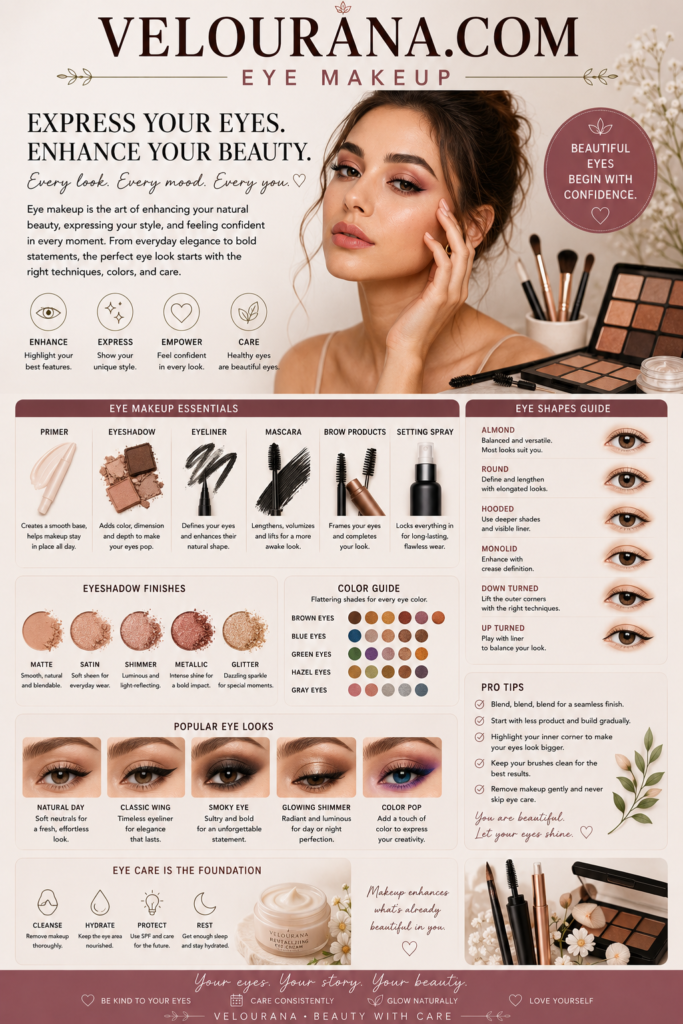
CATEGORY: Kohl Eyeliner
Few beauty products possess a history as visually powerful as kohl eyeliner. Long before eyeliner became associated with cosmetic counters, fashion photography, backstage makeup kits, or carefully engineered pencils, dark pigment around the eyes already carried meaning. Kohl has crossed civilizations, centuries, social classes, and changing ideals of beauty while retaining something remarkably close to its original visual purpose: intensifying the eye through darkness, contrast, and definition.
Modern kohl eyeliner sits somewhere between heritage and contemporary cosmetic technology. It may arrive in a familiar pencil rather than an ancient vessel of powdered pigment, yet its character remains recognizable. Kohl is prized for richness rather than clinical precision, softness rather than rigidity, and the ability to create depth without making the eye appear mechanically outlined. It can sharpen the gaze, deepen the lash line, disappear into smoky shadow, or create the darkened waterline that has become one of its most recognizable modern applications.
Its enduring appeal is partly explained by versatility, but versatility alone does not account for kohl's longevity. There is an emotional quality to the finish. A perfectly crisp liquid line can look architectural; kohl tends to look atmospheric. It responds to pressure, movement, blending, skin texture, and the natural architecture of the eye. Even when carefully applied, it rarely feels completely detached from the person wearing it.
That combination of history, intimacy, and adaptability gives kohl eyeliner a distinctive position within eye makeup. Understanding it requires looking beyond the simple idea of a dark pencil and considering the relationship between pigment, texture, placement, eye shape, wear, and the broader visual language of makeup.
From Ancient Pigment to Contemporary Cosmetic
The story of kohl begins thousands of years before the development of modern cosmetics. Dark eye preparations appeared prominently in ancient Egypt and across parts of North Africa, the Middle East, and South Asia, although historical formulations, terminology, ingredients, and cultural practices varied considerably by place and period. The broad modern use of the word "kohl" can therefore conceal a much more complex history.
In ancient Egyptian imagery, heavily defined eyes are among the most immediately recognizable aesthetic features. Men and women could wear dark eye preparations, and eye decoration carried cultural significance extending beyond what would now be understood simply as makeup. Historical preparations could contain mineral substances and other materials that would not necessarily correspond to modern cosmetic safety standards.
This distinction matters. Contemporary products marketed as kohl eyeliner are not simply ancient recipes placed inside pencils. Modern cosmetics are formulated within very different manufacturing, regulatory, stability, and consumer-safety environments. The word kohl now commonly describes a cosmetic style and textural character rather than guaranteeing adherence to one historical formulation.
Across later centuries, dark eye definition remained important in many regions. Traditions associated with kohl, kajal, surma, and related eye preparations developed within different cultural contexts. These terms are sometimes used interchangeably in contemporary beauty marketing, but historically and culturally they are not necessarily identical.
The globalization of cosmetics transformed these traditions again. Kohl entered mainstream Western beauty vocabulary as both a product name and a description of a particular aesthetic: dark, soft, intensely pigmented eye definition capable of being smudged into something mysterious and dramatic. Fashion repeatedly rediscovered the effect. Film, music, editorial photography, runway makeup, and subcultural styles gave dark-rimmed eyes new meanings while drawing, consciously or otherwise, on a much older visual tradition.
Modern kohl therefore occupies an unusual space. It is simultaneously ancient in inspiration and technologically contemporary in manufacture. Its heritage contributes to its mystique, but its present usefulness depends on modern formulation.
What Makes Kohl Feel Different on the Eye
Kohl eyeliner is usually understood through texture. Compared with formulas designed primarily for rigid precision or exceptional transfer resistance, kohl tends to emphasize glide, pigment release, and blendability. A good modern kohl pencil deposits substantial color without requiring repeated aggressive pressure against delicate eyelid skin.
That softness changes the appearance of the line itself.
When a very firm pencil is drawn across the lash line, it can create controlled definition but may require several passes to achieve substantial darkness. Kohl typically creates visual density more quickly. The pigment settles around the lashes and can be manipulated before it sets or gradually wears into the surrounding makeup.
This is why kohl excels at making the lash line look fuller. The objective does not always need to be a visibly separate stripe above the lashes. Pigment can be worked close to the roots so that gaps between lashes appear darker. The eye gains definition while the exact beginning and end of the eyeliner become less obvious.
The same characteristic makes kohl particularly suited to smoky makeup. A line can be applied with reasonable accuracy and then softened using a brush, cotton swab, or appropriate blending tool. Instead of remaining a distinct graphic element, the eyeliner becomes part of a gradient.
The effect can range from barely perceptible haze to dense, deliberately imperfect darkness. This flexibility is central to kohl's identity.
There is also an important difference between softness and uncontrolled creaminess. A useful kohl needs enough slip to move across the skin comfortably, but excessive emollience can increase migration. Eyelids are mobile surfaces. They fold, blink, produce oils, encounter moisture, and remain in near-constant motion. A formula that feels beautifully creamy during application may behave very differently several hours later.
Contemporary formulations therefore attempt to balance immediate glide with sufficient adherence. Some remain intentionally smudgeable; others allow a brief working period before becoming more resistant to movement. Neither approach is inherently superior. The appropriate choice depends on the desired finish and the individual eye area.
The Beauty of a Line That Does Not Need to Be Perfect
Much of modern makeup culture has treated eyeliner as a test of precision. Symmetrical wings, extremely sharp points, uninterrupted lines, and identical angles can make eyeliner seem like an exercise in geometry.
Kohl offers another philosophy.
Its most compelling looks often improve when the line is allowed to soften. A slight irregularity can disappear once pigment is diffused into the lashes. A dark outer corner can be blended upward rather than constructed as a rigid wing. The lower lash line can fade gradually rather than ending abruptly.
This creates a more forgiving relationship between eyeliner and anatomy. Human eyes are rarely perfectly symmetrical. Lid space may differ slightly between sides. One crease may sit higher. Lash density can vary. Facial movement continually changes the apparent shape.
A soft eyeliner technique can accommodate these differences instead of attempting to force both eyes into identical diagrams.
The result can also feel more dimensional because kohl interacts naturally with shadow. Deep brown, charcoal, black, plum, navy, bronze, and other darkened shades can merge into surrounding eyeshadow rather than sitting above it as an independent layer. The eye appears defined from within the makeup rather than outlined afterward.
For minimal makeup, the same principle works at a smaller scale. Kohl pushed tightly along the upper lashes can create subtle intensity without announcing itself as a dramatic eyeliner look. A little diffusion at the outer corner can visually extend the eye while maintaining softness.
This ability to move between restraint and drama explains why kohl remains relevant despite constant innovation in eyeliner formats. It does not demand one aesthetic identity.
Waterline, Lash Line and the Architecture of Depth
Kohl is strongly associated with waterline application because softness and pigment intensity can make it suitable for creating immediate depth around the eye. The waterline, however, is a sensitive area, and products should only be used there when their labeling indicates that they are appropriate for that placement.
When a dark shade is applied along the lower waterline, the visible white or pinkish area between the lashes and eye is reduced. This changes the apparent structure of the eye. The gaze can become more concentrated, intense, and dramatic.
The effect is not simply "making the eyes smaller," as it is sometimes described. Visual perception is more nuanced. Darkening the waterline reduces brightness inside the lash boundary, which can make the eye appear more enclosed, but the surrounding makeup can simultaneously extend the overall eye shape outward. A smoky lower lash line combined with dark waterline definition can therefore produce a larger field of makeup even while the visible waterline itself becomes darker.
Upper waterline definition can create a different illusion. When appropriate eyeliner is applied carefully between or immediately beneath the upper lashes, the lash base can appear denser. This can be particularly useful when the intention is to strengthen the eye without creating a thick visible line across the eyelid.
Placement becomes especially important because kohl has substantial visual weight. A small amount of black near the lashes can alter proportions more dramatically than a similarly sized area of pale shadow.
Someone with limited visible lid space may find that a very thick upper line consumes much of the eyelid when the eyes are open. Keeping darkness concentrated at the lash roots preserves more visible skin or eyeshadow while still producing definition.
Deep-set eyes may respond differently from prominent eyes; hooded lids introduce their own patterns of folding and transfer. Downturned, upturned, round, almond-shaped, close-set, and wide-set eyes each interact differently with the direction and concentration of darkness.
Kohl is useful precisely because it can be adapted rather than imposed.
Smudging as a Deliberate Technique
Smudged eyeliner is sometimes described as though it were simply precise eyeliner that has been made messy. Successful smoky kohl is more controlled than that.
The important principle is diffusion. Pigment is strongest where definition is required and progressively weaker as it moves away from that area. Without this gradient, dark eyeliner can look blurred rather than intentionally smoked.
Along the upper lash line, concentration generally begins around the roots of the lashes. The pigment can then be softened upward in small movements. The objective is not necessarily to spread black across a large portion of the lid but to erase the hard boundary of the original line.
The lower lash line requires similar control. A thick, equally dark band from inner to outer corner can visually weigh down some eyes. Gradual diffusion allows the makeup to retain intensity without becoming visually heavy.
Kohl's workable texture makes these transitions easier to create than they would be with a formula that sets immediately. Timing still matters. Some modern pencils become more resistant after a short period, so blending is usually most effective soon after application.
Layering can deepen the result without requiring one excessively thick application. Kohl can be placed close to the lashes, softened, and then reinforced selectively where greater intensity is desired. This produces dimension because not every area contains the same amount of pigment.
Eyeshadow can further refine the transition. A compatible powder shadow applied around the edge of the kohl can create a smoother gradient and may also help stabilize particularly creamy eyeliner. The shadow does not need to duplicate the liner exactly. Charcoal around black kohl can soften severity; deep brown can warm it; plum or burgundy tones can introduce subtle color complexity.
The most sophisticated smoky eye is rarely a single undifferentiated field of darkness. It is an arrangement of depth.
Black Is Iconic, but Kohl Has a Broader Color Language
Black kohl has an almost archetypal status. It produces maximum contrast against the whites of the eyes and can create immediate drama with minimal product. Yet limiting kohl to black overlooks how effectively softer or colored shades can reshape the character of eye makeup.
Deep brown retains definition while reducing contrast. It can appear particularly harmonious in daytime makeup or whenever black feels visually dominant. Brown is not necessarily less sophisticated or less dramatic; when layered heavily, a rich espresso shade can create considerable depth while maintaining warmth.
Charcoal occupies an interesting middle ground. It offers the smoky associations of black but can feel softer, especially when blended across the lash line. Gray-based tones also pair naturally with cool taupes, silvers, mauves, and muted neutral shadows.
Navy kohl can create darkness that initially reads almost as black while revealing blue under brighter light. Plum, aubergine, and burgundy-influenced shades introduce color without requiring the obvious brightness of conventional colored eyeliner. Bronze and deep metallic browns can create reflective definition that works particularly well in warmer makeup palettes.
The relationship between eyeliner color and iris color is often discussed through rigid complementary-color rules, but real makeup is more flexible. Skin tone, hair color, surrounding shadow, lighting, clothing, and personal aesthetic all influence the final effect. A shade does not need to "match" or deliberately contrast the iris to look successful.
What matters more is the total balance of contrast.
Black creates a strong boundary. Brown softens it. Jewel tones introduce chromatic depth. Metallic kohl catches light. Pale kohl can produce an entirely different effect when used appropriately, brightening rather than enclosing areas of the eye.
Color changes not only the makeup palette but also the emotional quality of the gaze.
Kohl and the Modern Smoky Eye
The smoky eye has been reinvented repeatedly because it is less a fixed look than a principle: concentrated depth dissolving into softer surrounding color. Kohl is naturally suited to that structure.
Classic versions often place the darkest pigment near the lash line, where eyelashes already create natural shadow. This is visually logical. By strengthening an existing dark zone and fading outward, makeup enhances the eye's natural architecture rather than covering it with a uniform block.
A contemporary smoky eye does not necessarily require dramatic black shadow across the entire lid. Kohl alone can create a compact version. A dark pencil applied around the outer portion of the lashes and softened into the surrounding skin can produce enough depth to transform the gaze.
For more elaborate makeup, kohl can function as an underlayer. Dark pencil placed beneath eyeshadow intensifies the pigment applied over it and can give the final result greater richness. Because the base is already dark, shadows may appear deeper and more dimensional.
This technique requires control because a creamy base can alter the behavior of powder placed on top. Too much product may crease or become difficult to blend. Thin, strategic layers generally create a more refined result than covering the entire lid with a heavy coat of pencil.
The beauty of kohl in smoky makeup is that edges can remain expressive. Not every boundary needs to be perfectly polished. Fashion makeup has repeatedly embraced lived-in eyeliner, deliberately softened edges, and darkness that appears to have evolved naturally over time.
There is a difference, however, between deliberate imperfection and uncontrolled wear. Successful makeup preserves the intended distribution of pigment even when the edges are relaxed.
Wear, Transfer and the Reality of Mobile Eyelids
Kohl's greatest strength can also create its primary challenge. The ingredients and formulation characteristics that allow easy glide and blending may make some products more susceptible to transfer.
Eyelid anatomy strongly influences performance. Hooded or deeply folded lids can bring eyeliner into contact with surrounding skin. Oily eyelids may break down certain formulas more quickly. Watery eyes can affect liner near the inner and outer corners. Warm weather, humidity, skincare, eye cream, and even the amount of concealer surrounding the eye can change wear.
This is why product performance cannot be assessed only by drawing a line on the hand. The eye area is a much more demanding environment.
Preparation can influence longevity. Heavy emollient skincare directly beneath eyeliner may increase movement, while excessive powder can make some pencils drag or apply unevenly. The ideal surface depends on the formula, but balance is generally more useful than extremes.
Application thickness also matters. A very heavy layer contains more material capable of moving. Building intensity gradually can create similar visual darkness with better control.
Some people intentionally choose a kohl that remains movable because they want the makeup to evolve into a softer, slightly worn finish. Others prefer contemporary long-wear pencils that preserve a kohl-like richness while setting more firmly.
These are different aesthetic priorities rather than evidence that one product category has failed.
A useful way to judge kohl is therefore to ask what type of movement is acceptable. A smoky look may tolerate slight diffusion that would be unacceptable in a sharply defined line. Makeup performance should be evaluated against the intended result.
Working With Different Eye Shapes Without Turning Makeup Into Rules
Eye-shape advice can become unnecessarily restrictive when presented as a collection of corrections. Kohl is more interesting when used to explore proportions rather than "fix" them.
Darkness attracts attention and creates visual weight. Extending pigment outward can emphasize horizontal length. Concentrating it near the center can strengthen roundness. Keeping the inner corner lighter can preserve openness, while carrying darkness inward creates a more enclosed and intense effect.
These principles can be adapted to individual features.
On hooded eyes, visible liner space may change dramatically between an open and closed eye. Kohl's softness allows definition to remain close to the lashes instead of requiring a large graphic shape that disappears into the fold.
On round eyes, extending smoky pigment slightly beyond the outer corner can emphasize length. Yet someone may deliberately choose full circular definition because they want to accentuate roundness rather than disguise it.
On almond-shaped eyes, following the natural lash contour can enhance existing proportions, while heavier outer-corner placement creates additional elongation.
Deep-set eyes already possess natural shadow around the socket, so extremely heavy darkness may produce considerable intensity quickly. Prominent eyes provide more visible surface and can support broad diffusion if that is the desired effect.
The important distinction is between understanding visual consequences and prescribing a supposedly ideal eye shape. Makeup does not require every face to move toward the same template.
Kohl is particularly compatible with this freedom because its edges can be adjusted incrementally. A line can begin small, then be expanded, deepened, or diffused according to what appears balanced on the actual face.
The Relationship Between Kohl, Lashes and Eyeshadow
Eyeliner is often treated as a separate stage of eye makeup, but kohl works best when considered in relation to everything surrounding it.
Lashes provide natural darkness. Kohl placed between their roots amplifies that darkness and can make mascara appear more integrated with the eye. If there is a visible strip of pale skin between liner and lashes, the effect may appear disconnected, particularly in dramatic makeup.
Mascara further changes the apparent thickness required from eyeliner. Before mascara, a line may seem relatively strong; after lashes become darker and more prominent, the same line can appear balanced. This is one reason judging the final result too early can lead to unnecessary overapplication.
Eyeshadow influences the perceived edge. Kohl over bare skin creates obvious contrast. The same liner over deep shadow may almost disappear except where it adds extra density. Over shimmer, it creates a strong textural contrast between reflective lid color and matte or satin darkness.
The order of application can therefore be flexible. Kohl applied after shadow creates visible definition, while kohl placed before and blended beneath shadow can contribute to depth without remaining distinctly recognizable.
The lower eye also depends on this relationship. Lower-lash mascara, kohl, eyeshadow, concealer, and waterline color all alter one another. Heavy darkness beneath the eye can be beautiful, but it changes the visual balance of the entire face and may require corresponding definition above.
This interconnected approach produces makeup that feels composed rather than assembled.
Safety, Hygiene and the Sensitive Eye Area
The romantic history of kohl should never obscure modern safety considerations. Historical cosmetic practices are not automatically appropriate for contemporary use, and products intended for the eye area should come from reputable manufacturers and comply with applicable cosmetic requirements.
Traditional preparations sold under terms such as kohl, kajal, or surma can differ significantly from regulated modern eyeliner products. Some traditional or improperly manufactured products have historically raised concerns about substances such as lead. Heritage terminology should therefore never be treated as proof of safety.
For modern consumers, labeling matters. A cosmetic described as "kohl" may simply refer to its color intensity or texture. If a product is intended for waterline use, that should be supported by the manufacturer's directions rather than assumed from the word kohl alone.
Hygiene is equally important. Eye cosmetics come into close contact with an area vulnerable to irritation and contamination. Pencils should be kept clean and capped appropriately. Sharpenable pencils gain the practical advantage of exposing a fresh surface during sharpening, although the sharpener itself also needs to remain clean.
Sharing eyeliner introduces unnecessary hygiene concerns, particularly when products contact the waterline. Eye makeup should also be treated cautiously during or immediately following eye irritation or infection, with appropriate professional guidance when necessary.
Old products deserve attention as well. Changes in smell, texture, performance, or appearance can indicate that a cosmetic is no longer in good condition. Manufacturer guidance concerning product life after opening provides a more appropriate reference than sentimental attachment to a favorite pencil.
Comfort should remain fundamental. Persistent stinging, redness, watering, or irritation is not something to accept simply because a particular makeup effect is desirable.
Why Kohl Continues to Survive Every Eyeliner Trend
Beauty periodically announces the arrival of a new eyeliner era. Graphic liner becomes dominant, then barely visible definition returns. Sharp wings give way to smoky edges. Black is replaced by brown, then vivid color, then black returns again.
Kohl survives because it is not dependent on any one of these cycles.
It can become the foundation of a dramatic evening eye or remain almost invisible between the lashes. It can create deliberate imperfection when fashion moves away from polish, then serve as a precise dark base when structure returns. It belongs comfortably with minimal makeup, classic glamour, alternative aesthetics, editorial experimentation, and traditional forms of eye definition.
More importantly, kohl allows the wearer to work with the eye rather than simply draw on top of it. The product can become shadow, line, depth, contour, or haze depending on how it is handled.
Its historical associations add richness, but longevity alone does not make a cosmetic useful. Kohl remains relevant because its essential visual mechanism still works. Dark pigment placed strategically around the eye changes contrast, emphasizes lashes, alters perceived proportions, and directs attention toward the gaze.
Modern cosmetic technology may continue to improve wear, comfort, pigmentation, and application, yet the fundamental idea requires little reinvention.
A dark line around the eye remains one of the simplest and most powerful transformations available in makeup.
That is the enduring character of kohl: ancient in visual language, contemporary in formulation, and endlessly adaptable in the hands of the person wearing it.
THE END VELOURANA
 Discover More From Our Family of Websites
 ZodiacBearing (Astrology, Tarot, Numerology, Angel Numbers & Spiritual Guidance)
 Velourana (Beauty, Makeup, Hair Care, Skincare & Beauty Tips)
 HavenBearing (Home, Living, Organization, Décor & Everyday Inspiration)
 PawBearing (Pet Care, Dog Breeds, Animal Health, Training & Pet Products)
 PsyCatherine (Notes From the Journal of a Psychologist on Real Life)