
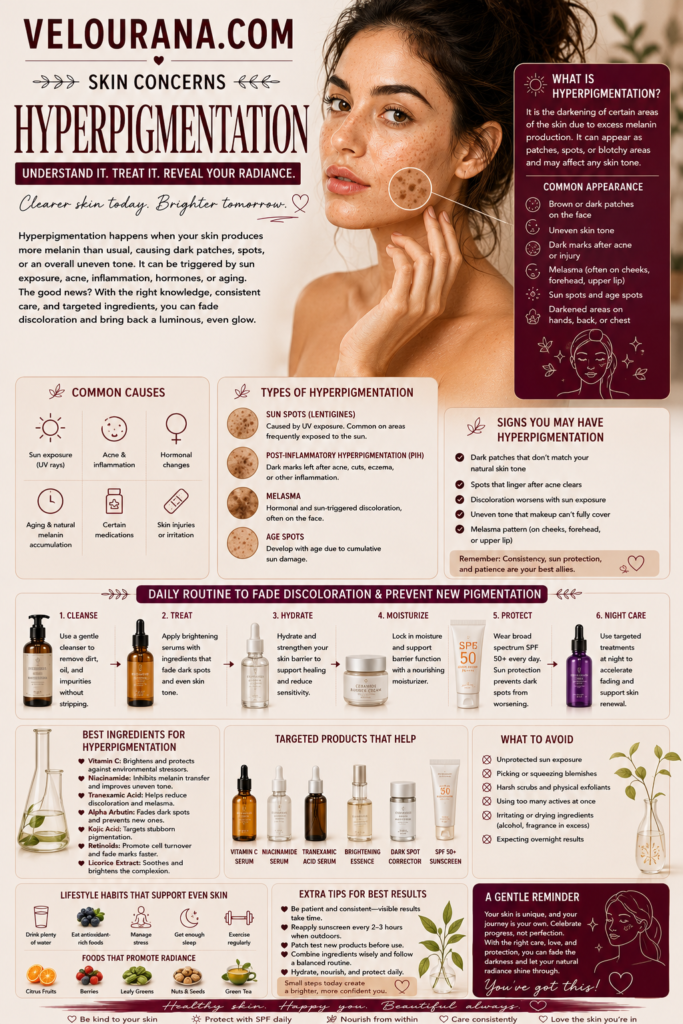
CATEGORY: Hyperpigmentation
Hyperpigmentation rarely behaves like a static mark.
It may appear darker in summer, soften during winter, intensify after a period of acne, become more noticeable during pregnancy, return after months of improvement or seem to change without any obvious alteration in skincare. This unpredictability can make pigmentation feel frustratingly irrational.
But pigment is responsive.
The skin does not produce melanin in isolation from the rest of life. It reacts to light, inflammation, hormonal changes, temperature, friction, skin-barrier condition, medications, procedures and repeated environmental exposure. What appears to be a simple brown patch may therefore be the visible result of several influences operating at the same time.
This is why hyperpigmentation should be understood not only as a condition of colour, but also as a condition of timing.
When did the pigmentation appear?
When does it become darker?
What happens in the weeks before it changes?
Does it follow summer exposure, acne flares, hormonal transitions or periods of irritated skin?
Does it remain stable for months and then suddenly intensify?
These patterns matter.
A successful pigmentation strategy should not only respond to what the skin looks like today. It should anticipate the circumstances under which that pigmentation is most likely to become active again.
Understanding those cycles can transform pigment care from a permanent reaction into something far more intelligent: prevention.
The Pigment System Is Continually Listening
Melanin production is regulated by specialised cells called melanocytes.
These cells are not simply factories producing a fixed amount of pigment throughout life. Their activity changes in response to signals.
Ultraviolet radiation is one of the best-known signals. Inflammation is another. Hormonal influences can alter melanocyte behaviour. Various signalling molecules released after injury or irritation may also affect pigment production.
This means the skin's pigmentation system is continually interpreting its environment.
When conditions change, pigment behaviour can change with them.
For someone without significant hyperpigmentation, these fluctuations may be barely noticeable. The complexion tans slightly during summer and becomes lighter during winter.
For pigment-prone skin, the same environmental changes can produce more localised and persistent effects.
Existing marks may darken.
Melasma may become more pronounced.
Recently healed blemishes may leave stronger post-inflammatory marks.
Areas of friction or irritation may become uneven.
This responsiveness is one reason treatment cannot be judged entirely by the product applied directly to the dark area.
A serum is only one influence among many.
The skin is simultaneously responding to everything else happening around and within it.
Summer Often Reveals the True Nature of Pigmentation
Many pigmentation routines appear more successful during winter.
Sun exposure is usually lower.
Days are shorter.
Outdoor activity may decrease.
Hats, coats and indoor lifestyles provide additional physical protection almost accidentally.
Then summer arrives.
Pigmentation becomes darker.
This can happen even when the skincare routine remains unchanged.
The explanation is not that the products suddenly stopped working.
The environment changed.
Longer daylight hours, more intense ultraviolet exposure and increased time outdoors can stimulate melanogenesis. Holidays often add several hours of concentrated exposure that would not occur during an ordinary working week.
Sunscreen use may also become less consistent than people realise.
A morning application can gradually be removed by perspiration, swimming, touching the face and towel drying.
Someone may believe they are maintaining the same level of protection simply because sunscreen was applied at breakfast.
But pigmentation responds to actual exposure rather than intention.
This is especially relevant for melasma, where light exposure can be a powerful trigger.
Summer therefore acts almost like a stress test for a pigmentation routine.
If discoloration immediately returns as exposure increases, it suggests that long-term management needs greater emphasis on protection rather than simply stronger nighttime correction.
Heat May Complicate the Picture
Sunlight receives most of the attention in pigmentation care, but heat can also complicate conditions such as melasma.
In everyday life, sunlight and heat frequently occur together, which makes their effects difficult to separate.
Someone spending hours outdoors is receiving ultraviolet radiation while also experiencing increased skin temperature.
Certain people with melasma report worsening during hot periods even when they are attempting to use sunscreen carefully.
This does not mean heat should be treated with the same level of concern as ultraviolet radiation.
It means pigment-prone skin can be influenced by a broader environmental context than simply whether sunscreen was applied.
Heat can also indirectly influence pigmentation by increasing sweating and irritation.
Sunscreen may move more easily.
The skin may be wiped repeatedly.
Friction increases.
Heavy products may feel uncomfortable and be used less consistently.
Acne can flare in some people during hot, humid conditions.
Those inflammatory lesions can then produce post-inflammatory marks.
So a summer pigmentation flare does not always have one cause.
It may involve more radiation, more heat, more perspiration, less consistent protection and more inflammation simultaneously.
This is why seasonal adaptation matters.
Winter Is Not a Pigment-Free Season
The opposite mistake occurs during winter.
Because pigmentation may appear lighter, people assume the problem has disappeared.
Sunscreen becomes inconsistent.
Active treatments are intensified dramatically.
The skin becomes dry from cold weather and indoor heating.
Barrier function deteriorates.
Irritation appears.
Then spring arrives with a compromised barrier and a sudden increase in sunlight.
The cycle begins again.
Winter can actually be an excellent period for carefully structured pigmentation treatment because exposure may be lower and certain corrective strategies can be easier to manage.
But winter should not become a period of uncontrolled aggression.
Cold air, wind and low humidity can already increase dryness.
Adding frequent exfoliation and strong retinoids without adequate barrier support can produce unnecessary irritation.
The strategy should therefore change in emphasis rather than intensity alone.
Lower-light months may provide an opportunity for correction.
They also require respect for seasonal dryness.
Spring Is When Prevention Should Begin
One of the most effective changes in pigmentation management is anticipating seasonal transitions.
Many people wait until pigmentation becomes visibly darker in late spring or summer before taking protection seriously.
By then, the melanocyte activity responsible for that darkening may already have increased.
A better approach begins earlier.
As daylight lengthens and outdoor exposure increases, sunscreen consistency becomes more important.
Hats and shade become more useful.
Tinted sunscreens may become especially relevant for individuals managing melasma or visible-light-sensitive pigmentation.
The routine can also be reviewed for unnecessary irritation before stronger sunlight becomes a daily factor.
If a winter routine contains several exfoliating treatments, spring may be the appropriate time to reconsider frequency.
This does not mean all active ingredients must be stopped.
It means the balance between correction and protection may need to shift.
Pigmentation management improves significantly when the routine responds to the calendar before the skin is forced to respond to it.
Autumn Can Be a Time of Assessment
By the end of summer, pigmentation often reveals what happened during the previous months.
Some marks are darker.
New spots may have appeared.
Melasma may have expanded or intensified.
Post-acne pigmentation may be more visible against a changing complexion.
Autumn provides a useful opportunity to assess rather than immediately attack.
Which areas actually changed?
Were there new inflammatory lesions?
Did sunscreen use become inconsistent during holidays?
Was there significant irritation?
Did pigmentation become darker everywhere, or only in specific areas?
This distinction can help determine whether the next step should focus on correcting accumulated pigmentation, controlling acne, restoring the skin barrier or seeking professional advice.
A seasonal review prevents the common pattern of responding to every autumn pigment increase with maximum exfoliation.
Sometimes the skin needs active treatment.
Sometimes it needs recovery first.
Hormones Create Their Own Seasons
Not all pigment cycles follow the weather.
Hormonal changes can produce their own timelines.
Melasma is particularly associated with hormonal influences.
Pregnancy is one of the most recognised examples, which is why melasma has historically been called the "mask of pregnancy."
For some people, pigmentation develops for the first time during pregnancy.
For others, existing melasma becomes more pronounced.
Hormonal contraception can also influence melasma in susceptible individuals.
This creates another important distinction: a skincare routine may remain exactly the same while the pigmentary environment changes internally.
Someone may conclude that a product has suddenly failed.
But the treatment is now working against a stronger biological stimulus than before.
This does not mean pigmentation associated with hormonal changes cannot improve.
It means expectations and treatment choices need to account for the underlying context.
Pregnancy also changes which topical treatments are appropriate. Certain ingredients, particularly retinoids, are avoided during pregnancy.
This makes professional guidance useful when managing significant pigmentation during hormonal transitions.
The objective should remain safe, gradual control rather than aggressive correction at any cost.
Menstrual and Hormonal Fluctuations Can Affect the Indirect Triggers
Even when hormonal changes do not directly create pigmentation, they may influence the conditions that produce it.
Acne is a good example.
Hormonal fluctuations can trigger inflammatory breakouts.
Those lesions heal.
Pigmentation remains.
The resulting dark marks are therefore indirectly linked to the hormonal cycle through inflammation.
This is important because treating only the pigment misses the sequence.
If acne predictably flares at certain times, preventing or controlling those lesions may reduce the accumulation of PIH over time.
Again, pigmentation management becomes more effective when attention moves backward through the chain of events.
The visible mark is the final consequence.
The earlier event may provide the better treatment target.
Age Changes Both Exposure and Recovery
Pigmentation evolves throughout life.
A teenager may deal primarily with post-inflammatory marks from acne.
In the twenties and thirties, acne-related pigmentation may coexist with early sun-related unevenness.
Later, years of accumulated ultraviolet exposure can become increasingly visible through solar lentigines and broader irregular pigmentation.
Melasma may also appear or change during hormonal transitions.
By middle age, several distinct forms of pigmentation can exist simultaneously.
This makes treatment more complicated because what looks like one general problem may actually represent several overlapping processes.
A dark spot related to decades of sun exposure may not behave like a recent acne mark.
Melasma may respond differently again.
The skin itself also changes with age.
Turnover, dryness, barrier resilience and tolerance of active ingredients can shift.
A routine that was comfortable at thirty may feel excessively drying later.
This means pigmentation care should evolve rather than remain fixed for decades.
The Skin Accumulates History
Sun-related pigmentation is particularly important because it illustrates how skin records cumulative exposure.
A single sunny afternoon does not usually explain the entire pattern of pigmentation appearing years later.
The effects accumulate.
Childhood summers.
Years of commuting.
Outdoor sports.
Beach holidays.
Gardening.
Walking.
Driving.
Ordinary daily exposure adds up.
This is why someone can begin using excellent sunscreen in later adulthood and still notice pigmentation associated with previous exposure.
Current protection cannot erase history.
It can help reduce additional accumulation.
This distinction matters psychologically because people sometimes feel that sunscreen is "not working" when new pigmentation becomes visible despite improved protection.
Some of what appears today reflects processes built over years.
Prevention does not mean the skin will instantly stop revealing its past.
It means fewer new insults are being added to that history.
Inflammation Has Its Own Timeline
Post-inflammatory hyperpigmentation follows a sequence.
First comes injury or inflammation.
Then comes healing.
Only afterward does the persistent discoloration become the dominant visual concern.
This delay can obscure cause and effect.
A person may look at a dark mark months later and focus entirely on removing it, forgetting the event that created it.
But if the same inflammatory process continues, new pigmentation will continue accumulating.
Acne illustrates this perfectly.
A person may use pigment serum diligently for six months and still feel that the complexion is becoming more uneven because inflammatory lesions continue producing new marks.
The problem is not necessarily failure of the pigment serum.
The rate of new pigmentation may simply exceed the rate at which old pigmentation fades.
This is why a pigmentation routine should be judged not only by how quickly old marks disappear but also by whether the number of new marks is decreasing.
Preventing one future mark can be more valuable than accelerating the fading of one old one.
Procedures Can Temporarily Rewrite the Pigment Cycle
Professional procedures can alter pigmentation dramatically.
Chemical peels, lasers, microneedling and other treatments may accelerate visible improvement in appropriate cases.
But procedures create controlled injury.
That means timing matters.
Performing aggressive resurfacing immediately before intense sun exposure can create a very different risk profile from undergoing carefully selected treatment during a period when photoprotection is easier to maintain.
Aftercare matters equally.
If the skin is inflamed after a procedure and then exposed to significant radiation, post-inflammatory pigmentation may develop or existing pigmentation may worsen.
This is particularly important for skin tones that are highly reactive to inflammation.
The season does not automatically determine whether a procedure is safe.
Professional technique and patient-specific factors matter far more.
But environmental timing should be part of the planning.
Pigmentation treatment is not simply about what is done to the skin.
It is also about what the skin experiences afterward.
The Barrier Has Seasonal Behaviour Too
The skin barrier does not remain identical throughout the year.
Cold weather and low humidity can increase dryness.
Hot, humid conditions can influence oiliness, sweating and product tolerance.
Air conditioning and indoor heating create additional environmental stress.
These changes influence how pigmentation treatments feel.
A retinoid that is perfectly comfortable in humid weather may become irritating during a cold, dry winter.
A rich moisturiser that works beautifully in January may feel occlusive during August.
This is why a routine should preserve its principles while allowing its textures and frequencies to change.
The goal is continuity without rigidity.
Someone may continue using the same central pigment treatment but reduce frequency during periods of dryness.
Moisturiser can become richer in winter.
Sunscreen texture may become lighter during summer to improve adherence.
The routine remains strategically consistent while adapting to practical reality.
Travel Can Disrupt Pigment Control Quickly
Travel compresses many pigmentation triggers into a short period.
Different climate.
Different sunlight.
Different humidity.
More time outdoors.
Irregular sleep.
Changes in skincare routine.
Long flights.
Swimming.
Sweating.
Forgotten products.
A person with well-controlled pigmentation can therefore experience a noticeable flare during a relatively short holiday.
This does not mean travel should be avoided.
It means the routine should be simplified before travel rather than abandoned.
A gentle cleanser, essential treatment, moisturiser and appropriate sunscreen may be enough.
The objective during travel is often maintenance rather than maximum correction.
Trying to reproduce an elaborate ten-product routine in unfamiliar conditions can make adherence less likely.
Pigmentation control benefits from portability.
A routine that works only in the perfect environment of the bathroom cabinet is not truly sustainable.
Stress Does Not Need to Be Blamed for Everything
Stress is frequently blamed for almost every skin change.
Its relationship with pigmentation is usually indirect rather than simple.
Stress can influence inflammatory skin conditions.
It can affect sleep.
It may alter behaviours such as picking at blemishes.
It can disrupt routines.
In some individuals, acne may worsen during stressful periods.
Those changes can then contribute to post-inflammatory pigmentation.
The important point is not to interpret every pigment flare as a psychological problem.
That can become both inaccurate and unhelpful.
Instead, look for concrete pathways.
Did stress coincide with increased acne?
Was skincare abandoned during an unusually demanding month?
Was picking more frequent?
Did sleep disruption coincide with worsening inflammation?
These are observable connections.
Pigmentation becomes easier to understand when vague explanations are replaced with specific biological and behavioural patterns.
Medication Can Change the Pattern
Certain medications can contribute to pigmentation changes directly or indirectly.
This is one reason unexplained new pigmentation deserves a complete history rather than immediate treatment with brightening products.
If discoloration begins after a medication change, the timing may be relevant.
But medication-related pigmentation should not be self-diagnosed from photographs or online lists.
Many pigmentary conditions resemble one another visually.
The appropriate response is professional assessment, particularly when pigmentation is widespread, unusual or progressive.
Stopping prescribed medication independently is not an appropriate pigmentation strategy.
The relationship between the medication and the skin needs to be evaluated in context.
This is another example of why hyperpigmentation sometimes belongs in medicine rather than simply cosmetics.
Friction Creates Repeated Micro-Seasons of Inflammation
Not every cycle lasts months.
Some pigmentation is created through daily repetition.
Tight clothing rubs the same area.
A mask repeatedly irritates the face.
Shaving inflames the same follicles.
Hair removal causes recurring irritation.
Skin folds experience friction.
The area becomes darker gradually.
In these cases, the pigment cycle can restart every day.
A brightening product may reduce some visible discoloration while the mechanical trigger continues without interruption.
This is why reducing friction can be more important than increasing exfoliation.
The same principle applies to picking and scratching.
Repeated mechanical injury prevents the skin from entering a stable recovery phase.
Pigmentation improves most effectively when the cycle is interrupted long enough for previous marks to fade.
Your Routine Should Have an Active Phase and a Quiet Phase
Many effective pigmentation strategies naturally alternate between correction and maintenance.
During an active correction phase, targeted treatments may be used more deliberately.
Once satisfactory improvement has been achieved, the routine can become quieter.
Photoprotection continues.
Barrier support continues.
Underlying triggers continue to be managed.
But the need for maximum corrective intensity may decrease.
This distinction is especially important with treatments that are not intended for indefinite unrestricted use.
It also prevents the psychological trap of believing the skin must always be under aggressive treatment.
Maintenance is productive.
Stable pigment is easier to manage than constantly recurring pigment.
The objective is not to keep the skin permanently in treatment mode.
It is to reach a point where less intervention is needed to preserve the result.
A Pigmentation Calendar Can Reveal More Than Another Product
Because hyperpigmentation changes slowly, memory can be unreliable.
Someone may believe a flare appeared suddenly when it actually began developing several weeks earlier.
Simple documentation can reveal patterns.
Monthly photographs under similar lighting can show whether pigmentation is truly changing.
Notes about major events can provide context.
Summer holiday.
Acne flare.
Pregnancy.
New medication.
Professional peel.
Change in sunscreen.
Period of intense irritation.
This does not need to become obsessive tracking.
The goal is simply to recognise patterns that daily mirror inspection hides.
If pigmentation worsens every summer, the routine needs stronger seasonal prevention.
If it follows acne, controlling inflammation deserves priority.
If it appears after repeated over-exfoliation, treatment intensity needs reconsideration.
Patterns transform pigmentation from something mysterious into something interpretable.
Do Not Judge the Skin at the End of Every Day
Pigmentation encourages over-observation.
Someone begins checking the same spot every morning and evening.
Different lighting changes its appearance.
Makeup, hydration, redness and shadows alter contrast.
One day it looks lighter.
The next day it appears darker.
This can lead to constant routine changes based on visual noise rather than meaningful biological change.
Pigment correction should be evaluated over longer intervals.
Weekly or monthly comparisons provide more useful information than hourly inspection.
This is particularly important because hyperpigmentation may appear more or less prominent depending on surrounding skin colour.
After summer tanning, a mark can seem relatively less obvious even though pigment has not changed significantly.
As the surrounding skin lightens, the contrast may return.
A single glance therefore cannot always reveal what the pigment itself is doing.
When a Change Deserves Medical Attention
Not every changing dark area should be assumed to be ordinary hyperpigmentation.
A new or evolving pigmented lesion deserves appropriate attention, particularly if it changes in shape, colour, border, size or behaviour.
Hyperpigmentation tends to be discussed casually because most cosmetic examples are benign.
But not every dark lesion belongs in a cosmetic routine.
If something looks distinctly different from the person's usual pigmentation pattern, medical evaluation is the safer approach.
The same applies to widespread unexplained pigmentation, pigmentation associated with other symptoms or discoloration that develops after a significant medical or medication change.
The role of skincare has limits.
Recognising those limits protects both the skin and the person treating it.
The Best Seasonal Strategy Is Not Constant Escalation
It can be tempting to respond to every seasonal pigment change by increasing treatment intensity.
Darker in summer? Add more acid.
Still visible in autumn? Increase retinoid frequency.
Dry in winter? Continue everything and simply use more moisturiser.
This assumes that the only direction of treatment should be upward.
A more intelligent approach changes emphasis.
Summer may require stronger protection.
Autumn may allow more corrective attention.
Winter may require additional barrier support.
Spring may be the moment to strengthen prevention before exposure increases.
The routine breathes with the environment.
This flexibility is not inconsistency.
It is adaptation.
Long-Term Pigment Control Is Built Before the Flare
The most effective time to manage hyperpigmentation is often before it becomes visibly worse.
Before summer exposure intensifies.
Before acne becomes severely inflammatory.
Before chronic irritation damages the barrier.
Before a holiday in strong sun.
Before a professional procedure.
Before stopping all maintenance after a successful treatment course.
This is the difference between reactive and preventive skincare.
Reactive skincare asks what to do now that the pigmentation is darker.
Preventive skincare asks what usually makes it darker and prepares accordingly.
The second approach usually requires less dramatic intervention.
It is easier to prevent a large flare than to correct one afterward.
Pigmentation Changes Because Life Changes
Hyperpigmentation can feel unpredictable because life itself is variable.
Light changes.
Weather changes.
Hormones change.
Skin conditions flare and settle.
Treatments begin and end.
Travel disrupts routines.
Age alters the skin.
Inflammation appears unexpectedly.
The skin responds to these changes rather than remaining frozen in one biological state.
This is why the perfect pigmentation routine cannot be a rigid list of products followed identically forever.
It is better understood as a framework.
Protect against triggers.
Treat the underlying condition where possible.
Use appropriate pigment-targeting ingredients.
Support the barrier.
Reduce unnecessary inflammation.
Adjust intensity according to tolerance and environment.
Observe patterns over time.
Seek professional assessment when pigmentation behaves outside the expected pattern.
These principles remain stable even when the details change.
Time Is Not the Enemy of Hyperpigmentation Care
Pigmentation treatment often feels like a battle against time.
People want marks to disappear faster.
But time is also one of the mechanisms through which improvement occurs.
Inflammation settles.
Pigmented epidermal cells move through turnover.
Triggers can be reduced.
Treatment accumulates its effects.
New marks become less frequent.
Seasons change.
The complexion gradually stabilises.
The objective should therefore not be to eliminate time from the process.
It should be to make that time biologically productive.
Six months of consistent protection and tolerable treatment can transform the skin more effectively than six weeks of aggressive experimentation.
A year of fewer inflammatory lesions may prevent dozens of future marks.
Several summers of disciplined photoprotection may dramatically reduce recurrent darkening.
Long-term improvement is created through accumulated decisions.
Hyperpigmentation Makes More Sense When You Stop Viewing It as a Fixed Spot
A dark mark may look motionless.
Biologically, it is not.
Pigment is being produced, transferred, retained, processed and gradually removed.
The environment surrounding that process is continually changing.
Some days the balance favours new pigment.
Other periods favour fading.
Treatment works by gradually shifting that balance.
This is why hyperpigmentation can improve, recur and improve again.
It is why one season can look different from another.
It is why hormonal transitions can matter.
It is why inflammation control matters.
It is why sunscreen matters even after the skin looks better.
And it is why successful pigmentation care should not be judged by whether a single mark disappears as quickly as possible.
The deeper goal is to make the pigmentary system progressively more stable.
When that happens, existing discoloration has time to fade without being constantly replaced.
The skin becomes easier to manage.
The routine can often become gentler.
Recurrences become less dramatic.
The complexion becomes more even not because pigment has been attacked relentlessly, but because the circumstances that kept producing it have gradually been brought under control.
Hyperpigmentation therefore has seasons, but those seasons do not have to dictate the appearance of the skin indefinitely.
Once the pattern is understood, treatment can begin before the flare rather than after it.
And that is one of the most powerful changes any pigmentation strategy can make.
The End Velourana
 Discover More From Our Family of Websites
 ZodiacBearing (Astrology, Tarot, Numerology, Angel Numbers & Spiritual Guidance)
 Velourana (Beauty, Makeup, Hair Care, Skincare & Beauty Tips)
 HavenBearing (Home, Living, Organization, Décor & Everyday Inspiration)
 PawBearing (Pet Care, Dog Breeds, Animal Health, Training & Pet Products)
 PsyCatherine (Notes From the Journal of a Psychologist on Real Life)

