
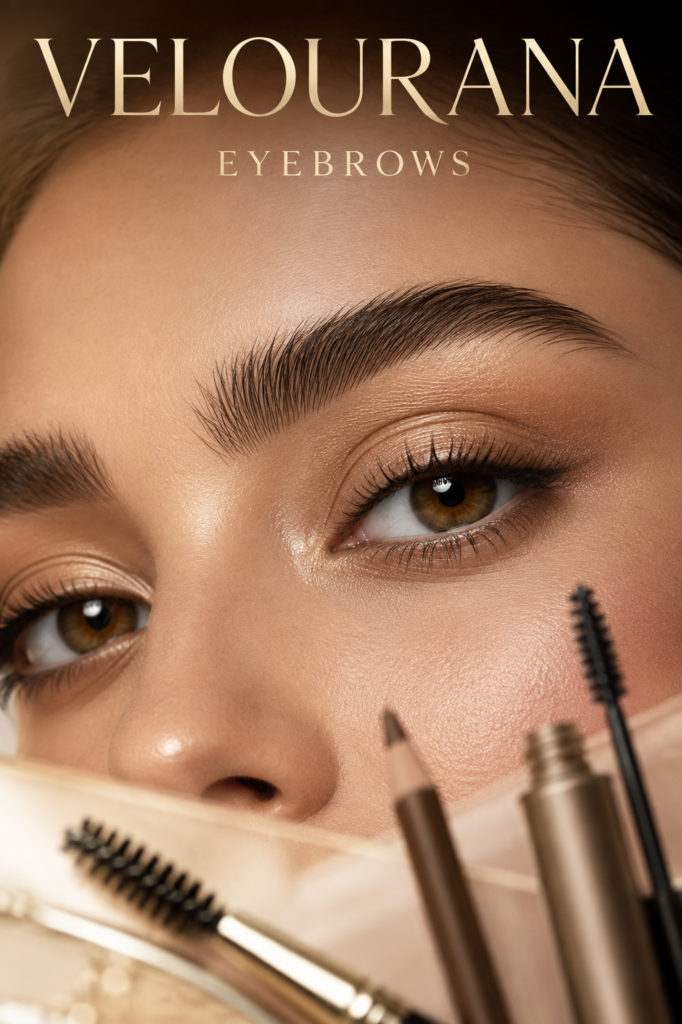
CATEGORY: Brow Pens
A beautifully defined eyebrow does not necessarily require more pigment. Frequently, it requires better placement. This is the principle that makes brow pens distinctive within eyebrow makeup. Instead of approaching the brow as a shape that needs to be filled from border to border, the pen allows makeup to be constructed one apparent hair at a time.
The technique can produce remarkably subtle results, but subtle does not mean effortless. Brow pens respond to pressure, angle, skin preparation, formula flow, shade selection, and the direction of existing hairs. Their fine applicators reveal small changes in hand movement that a softer pencil or powder might disguise.
Understanding these variables transforms the experience. Rather than trying to draw perfect eyebrows, the user begins studying the architecture already present and adding detail only where necessary.
That approach is particularly relevant to contemporary brow makeup, where visible texture is often preferred to dense blocks of color. Individual hairs are allowed to remain distinct, small spaces of skin remain visible, and the beginning of the brow can retain its natural softness. The finished effect may be polished and carefully constructed while still appearing relatively untouched.
The brow pen is exceptionally suited to this balance because it provides precision without demanding opacity.
Begin With the Brow That Already Exists
Before applying any cosmetic, it helps to look at the natural eyebrow as a pattern rather than a single shape.
At first glance, a brow appears to be an arch. Closer observation reveals considerably more complexity. Hair direction changes from the inner brow to the tail. Density increases and decreases. Individual hairs overlap. Some are longer than others. Small spaces reveal the skin beneath. One eyebrow may have a slightly stronger arch while the other has a denser front.
These characteristics are useful information.
At the inner brow, hairs often rise upward and slightly outward. Around the central body, they usually begin to angle toward the temple. Near the arch and tail, their orientation may become progressively more horizontal. These patterns vary from person to person, which is why generic diagrams can only provide a starting point.
A brow pen becomes convincing when its marks join this existing movement.
If an empty patch contains hairs pointing diagonally around it, adding vertical strokes through the gap can make the correction conspicuous. Following the surrounding direction instead makes the simulated hairs visually belong to the same eyebrow.
The same principle applies to stroke length. Existing short hairs suggest shorter cosmetic marks. Longer natural hairs can accommodate slightly longer ones. Variation matters because real hair is not manufactured to identical dimensions.
Before drawing, brushing the brow gently into its natural or desired position can reveal where correction is genuinely needed. Sometimes what appears to be a gap is simply an area where hairs have been lying in the wrong direction. Rearranging them may reduce the amount of makeup required.
This observation stage is one of the simplest ways to prevent overfilling.
Preparing the Surface for Fine Lines
A brow pen draws partly across skin, and fine liquid pigment behaves differently depending on the surface beneath it.
Freshly applied moisturizer, facial oil, rich sunscreen, creamy foundation, or concealer can make the area slippery. The tip may glide without depositing a crisp line, or pigment may spread beyond the intended stroke. On very oily skin, naturally produced sebum can create a similar challenge as the day progresses.
Very dry skin presents the opposite difficulty. Fine pigment can catch around flakes or texture, producing interrupted lines.
The objective is not to create an unnaturally dry eyebrow area. It is to provide a reasonably balanced surface on which the formula can adhere evenly.
Skincare should still be applied according to the needs of the skin, including appropriate sun protection. The practical consideration is simply whether excess product remains sitting directly where precision brow makeup will be drawn. Allowing skincare to settle before brow application can often improve control.
Complexion makeup also influences the result. Heavy foundation through the eyebrow can coat both hairs and skin, changing how a pen applies. Some users prefer completing brows before foundation reaches the eyebrow area; others work successfully over a thin complexion base. Formula compatibility determines which approach performs better.
If the pen seems to skip unexpectedly, preparation is worth examining before assuming the product itself is defective.
The condition of the applicator also matters. Liquid pens may require shaking or specific storage according to manufacturer instructions. A partially dry tip can create inconsistent strokes, while excessive liquid at the tip can make them too saturated.
Fine brow work depends on a combination of product and surface. Both deserve attention.
Understanding Pressure Before Building Shape
Pressure is perhaps the most important physical skill involved in brow-pen application.
The instinct when a line does not immediately appear dark enough is to press harder. With liquid brow cosmetics, this can quickly transform a delicate stroke into a thick mark. A better approach is usually to maintain light pressure and assess the line after the pigment settles.
The applicator should generally move with a flicking motion that becomes lighter toward the end. This can create a tapered appearance resembling the narrowing end of a natural hair.
Holding the pen at different angles changes how much of the tip contacts the skin. A more direct angle may produce a finer mark with some applicators, while laying the side of the tip against the skin can widen the line. Because designs vary, practicing briefly on the back of the hand can help reveal how a particular pen responds.
This practice is useful not because skin on the hand perfectly replicates the eyebrow area, but because it demonstrates the relationship between pressure, speed, angle, and pigment flow.
Slow, heavily pressed movements tend to deposit more product. Quick, light flicks tend to create finer marks.
Control improves when the hand has support. Instead of suspending the entire arm in the air, stabilizing the elbow or lightly resting part of the hand against the face can reduce unnecessary movement. Care should be taken not to pull or distort the eyebrow skin while drawing, because strokes positioned on stretched skin may appear differently once the skin returns to its normal position.
The objective is relaxed precision rather than force.
Constructing a Natural-Looking Brow Front
The beginning of the eyebrow is one of the easiest areas to overwork.
A naturally soft brow front contains space. Individual hairs are visible, and the skin between them contributes to the feathered appearance. When this region is densely shaded or surrounded by a sharp boundary, the brow can immediately look more cosmetic.
A pen offers an alternative because only the missing visual hairs need to be introduced.
Existing growth direction provides the guide. If the hairs rise vertically, the earliest strokes can follow that movement. As the brow progresses outward, their angle can gradually change. This creates a transition rather than an abrupt block.
Spacing should not be perfectly uniform. A row of evenly separated lines can resemble illustration more than hair. Some strokes can sit closer together while others leave slightly more skin visible.
Color intensity should also remain controlled. The brow front often appears naturally lighter because hair density and orientation expose more skin. Applying the same saturation used at the arch can eliminate this gradient.
A light hand is therefore especially valuable.
Another consideration is where the brow begins. Extending the front substantially inward can change facial proportions and create heaviness around the bridge of the nose. Brow mapping concepts can provide general guidance, but natural anatomy and personal aesthetic preference remain important. The pen should refine rather than automatically expand the existing structure.
When the front already contains adequate hair, it may require no pen at all. Leaving an area untouched is a legitimate makeup decision.
Adding Density Through the Body and Arch
The central body of the brow often contains the greatest natural density. This means pen strokes placed here need to integrate with a visually busier environment.
Rather than trying to make every hair equally dark, the pen can target specific spaces where skin appears unusually exposed. A few strokes positioned between existing hairs can create the impression of continuous density without covering the entire area.
Around the arch, placement becomes particularly influential because small changes can alter the apparent eyebrow shape.
Adding strokes primarily above the natural arch can make it appear higher. Concentrating pigment below it can visually thicken or lower the brow. Extending the outer edge can lengthen the shape. These adjustments can be useful, but they should be deliberate.
The natural bone structure surrounding the eye provides context. An exaggerated arch that does not relate to the underlying brow can look disconnected even if the individual strokes are beautifully executed.
Hair direction should continue evolving through this region. Strokes that were nearly vertical at the front generally need to become more diagonal or horizontal as they move outward.
Density can increase slightly through the middle because the natural brow often supports greater visual weight there. Still, skin should not necessarily disappear completely. Fine negative spaces maintain texture.
The arch is also an area where users sometimes repeatedly correct one eyebrow to match the other. A slight difference between arches is normal. Chasing perfect symmetry can cause both brows to become larger and darker than originally intended.
Balance is generally more flattering than mathematical duplication.
Refining a Sparse Brow Tail
The tail presents almost the opposite challenge from the front. Instead of preserving diffuse softness, the objective is often to maintain a narrow, controlled finish.
Natural brow tails frequently become progressively finer as they extend outward. Hair density decreases and the overall shape tapers. A pen can reconstruct missing density particularly effectively because individual strokes can continue this narrowing pattern.
The danger is turning the tail into one long drawn line.
A continuous line may define the lower edge efficiently, but it does not resemble hair. Several fine strokes following the direction of natural growth generally create greater realism. Their length and spacing can gradually decrease as the tail narrows.
If the natural tail is extremely sparse, it is useful to consider where the brow would plausibly continue rather than extending it simply because additional space is available. Excessively long tails can visually pull the eye area downward or outward.
The shade also matters. Because fewer hairs surround the cosmetic strokes at the tail, each mark may be more visible. A color that appears subtle within the dense central brow can look considerably stronger on relatively bare skin.
Building slowly becomes especially important here.
A slightly imperfect tail often looks more natural than an excessively sharp one. The human eye recognizes tiny irregularities as characteristic of hair, whereas geometric precision communicates makeup.
Correcting Differences Without Enlarging Both Brows
Few pairs of eyebrows are identical. One may begin slightly higher, one arch may be stronger, one tail may contain more hair, or density may differ because of natural growth, grooming history, or previous hair removal.
Brow pens can correct these differences with remarkable precision, but they can also encourage endless adjustment.
A common pattern begins by adding a little height to one brow. The second then appears too low, so additional pigment is added there. One becomes wider, prompting another correction. Gradually both brows expand.
A more controlled approach is to identify the smallest meaningful difference and correct only that area.
If one tail contains a small gap, a few strokes may be sufficient. If one front is naturally denser, adding several light hairs to the other can create visual balance. If the arches differ slightly but still complement the face, no correction may be necessary.
Stepping farther from the mirror is extremely useful. Close magnification reveals differences that may be invisible at ordinary viewing distance. Makeup is ultimately seen as part of the whole face, not as an isolated technical drawing.
Photographs can also reveal whether the brows feel balanced overall, although lighting and camera angles can exaggerate asymmetry. They should be treated as another perspective rather than an absolute measurement.
The precision of the pen is most effective when used selectively.
Combining a Brow Pen With Pencil, Powder, and Gel
Although brow pens can work independently, combining textures expands their possibilities.
A pencil can establish soft underlying structure where a brow is significantly sparse. The pen can then place hair-like detail over selected areas, breaking up the appearance of shading. This combination is useful when drawing individual strokes alone would require excessive time or pigment.
Powder can perform a similar function with an even softer background. A diffused shadow creates the impression of density, while the pen restores visible texture on top or in surrounding areas, provided the formulas layer successfully.
Brow gel serves a different role because it primarily interacts with existing hairs. Brushing hairs upward or outward can expose the pattern beneath and create dimensional separation between real hair and cosmetic strokes.
Clear gel preserves the existing color while adding hold. Tinted or fiber-containing gels can contribute additional apparent density. When combined with pen work, however, excessive pigment from several products can become heavy. Each formula should have a distinct purpose.
Pomade offers stronger structure and is useful for deliberately sculpted brows. Pen strokes can soften or texturize a pomade-based shape, although very waxy surfaces may interfere with liquid application. Compatibility needs to be tested.
The guiding principle is differentiation. If every product performs the same filling function, layering simply creates more makeup. If one provides soft density, another creates hair detail, and another controls the natural hairs, the combination can become more sophisticated.
Avoiding the Most Artificial Brow-Pen Effects
The difference between realistic and visibly drawn pen work often comes from several small decisions rather than one dramatic mistake.
Overly dark pigment is one of the most obvious problems. Fine strokes can still appear harsh if their color is significantly deeper than surrounding hairs. Shade depth should therefore be evaluated after the product has dried.
Uniformity is another issue. Identical strokes placed at identical distances and angles create an organized pattern that natural eyebrows rarely display. Slight variation improves realism.
Drawing a complete lower and upper outline before adding strokes can also undermine the hair-like effect. The outline becomes the dominant visual structure, and the fine marks merely fill it. Unless a graphic brow is intentional, allowing the perimeter to remain partly defined by actual hairs can look softer.
Too many strokes create a different problem. As marks accumulate, the spaces between them disappear and the result effectively becomes solid color. The pen then loses the very texture that distinguishes it from other brow products.
Incorrect direction is equally revealing. Hair-like strokes only resemble hair when they behave like hair. The direction should evolve across the eyebrow.
Finally, repeatedly working over a stroke that seems imperfect can make it larger and darker. Tiny irregularities are often less noticeable than corrections. If a mark is genuinely misplaced, allowing it to dry and removing it carefully according to the product's behavior may be preferable to continually adding pigment around it.
Adapting Brow-Pen Technique to Different Brow Densities
The amount of natural eyebrow hair determines how a pen can contribute.
Full brows often require the least intervention. Their existing density already supplies shape and texture. A pen may only need to correct a tiny gap, strengthen a sparse tail, or add one or two strokes near the front. Applying it throughout the entire brow can unnecessarily obscure natural dimension.
Medium-density brows provide greater room for adjustment. Selective strokes can strengthen the body, refine the arch, and balance the tail while leaving enough existing hair to camouflage the cosmetic marks.
Sparse brows require more strategic construction. The temptation is to reproduce every missing hair, but that can become visually and technically overwhelming. A soft pencil or powder base may establish subtle density before the pen introduces selected hair-like strokes. Alternatively, the pen alone can work when the desired result is especially light and natural.
Very sparse areas expose more skin, meaning shade accuracy and stroke quality become increasingly important. There are fewer natural hairs available to disguise a line that is too thick, too dark, or traveling in the wrong direction.
This is where patience produces a better result than intensity.
Rather than completing one eyebrow entirely before beginning the other, moving gradually between both can help maintain balance. A few strokes can be placed on one side, then mirrored conceptually—not identically—on the other.
Wear, Setting, and Maintaining Definition
Once a brow pen has created the desired pattern, giving the formula time to set can improve the integrity of the strokes. Liquid products vary considerably in drying speed, so individual instructions should be followed.
Immediately brushing aggressively through wet pigment can blur carefully created lines. Similarly, applying another creamy product directly over them may disturb the pattern.
Long-wearing and water-resistant formulas can improve durability, particularly in warm or humid conditions, but no makeup should automatically be assumed to withstand every form of moisture or friction. Skin oil, perspiration, touching the face, and environmental conditions all influence wear.
People with oilier skin may notice faster fading or softening of fine lines. Keeping unnecessary emollient products away from the brow can help, provided normal skincare needs are still respected.
During the day, touching or rubbing the eyebrow is more likely to disrupt makeup than ordinary facial movement. A well-set formula should generally move naturally with expressions without requiring attention.
At removal, patience remains important. A long-wear pen may need makeup remover or cleanser capable of dissolving its film. Rubbing repeatedly at the eyebrow can irritate the skin and pull on natural hairs.
Gentle removal preserves both the skin and the brows being enhanced.
Why Restraint Produces the Most Sophisticated Result
Perhaps the most important lesson in brow-pen application is knowing when the eyebrow is finished.
Precision tools invite precision work. It is easy to notice one more gap, then another, then a slightly uneven stroke. Each correction seems individually reasonable. Collectively, they can transform a light, realistic brow into something much heavier.
Natural brows contain empty spaces. They contain hairs that do not align perfectly. Their fronts are not mathematically identical, their arches may differ subtly, and their tails may taper unevenly.
These qualities are not necessarily flaws to eliminate. They are part of what makes hair look organic.
A brow pen is most convincing when it works within that natural variation. It can replace the visual suggestion of missing hairs without replacing the entire eyebrow. It can strengthen structure without drawing a rigid frame. It can increase density while still allowing skin to remain visible.
Viewed this way, successful application becomes less about mastering an elaborate makeup routine and more about developing visual judgment.
The user observes where hair exists, notices where it is missing, identifies its direction and color, and adds only enough information for the eye to perceive continuity.
That economy is what gives brow pens their distinctive elegance.
The finest stroke is not automatically the best stroke, and the fullest brow is not automatically the most flattering. The most effective mark is the one that integrates so naturally with the existing eyebrow that it is difficult to identify where real hair ends and makeup begins.
That is where the brow pen excels: not in covering the eyebrow, but in quietly completing it.
THE END VELOURANA
 Discover More From Our Family of Websites
 ZodiacBearing (Astrology, Tarot, Numerology, Angel Numbers & Spiritual Guidance)
 Velourana (Beauty, Makeup, Hair Care, Skincare & Beauty Tips)
 HavenBearing (Home, Living, Organization, Décor & Everyday Inspiration)
 PawBearing (Pet Care, Dog Breeds, Animal Health, Training & Pet Products)
 PsyCatherine (Notes From the Journal of a Psychologist on Real Life)

