CATEGORY: Cooling Eye Care
Spend a few minutes browsing beauty forums or skincare videos, and you will quickly notice a common feature appearing on dressing tables around the world: the skincare refrigerator. These compact refrigerators, often filled with eye creams, sheet masks, facial mists, serums, and cooling tools, have become symbols of modern skincare routines. Their growing popularity has also created a new belief that every eye cream should automatically be stored in the fridge.
But is that actually true?
Does refrigeration make an eye cream work better, or does it simply make it feel colder on the skin?
The answer is more nuanced than many people realise. While some cooling eye products genuinely become more enjoyable and refreshing when chilled, not every skincare formula benefits from cold storage. In some cases, storing products incorrectly may even reduce their stability or make them less pleasant to use.
Understanding how skincare products are formulated, how temperature affects different ingredients, and what manufacturers recommend allows you to protect your investment while getting the best possible performance from your cooling eye care routine.
Why Temperature Matters in Skincare
Every skincare product is carefully formulated to remain stable within a particular temperature range. The ingredients inside an eye cream do not exist independently; they work together as a balanced formula that includes moisturisers, emulsifiers, preservatives, active ingredients, fragrances, and water.
Extreme heat can gradually damage certain ingredients, alter texture, or shorten shelf life. This is one reason skincare should never be left inside a hot car or beside a sunny window during summer.
Cold temperatures are generally less harmful, but they also influence how products feel, spread across the skin, and sometimes even their consistency. A lightweight eye gel may become wonderfully refreshing after refrigeration, while a richer cream could become firmer and slightly more difficult to apply until it warms again.
For this reason, refrigeration should be viewed as an optional storage choice rather than a universal requirement.
Which Eye Products Benefit Most from Refrigeration?
Not every product responds to cooling in the same way.
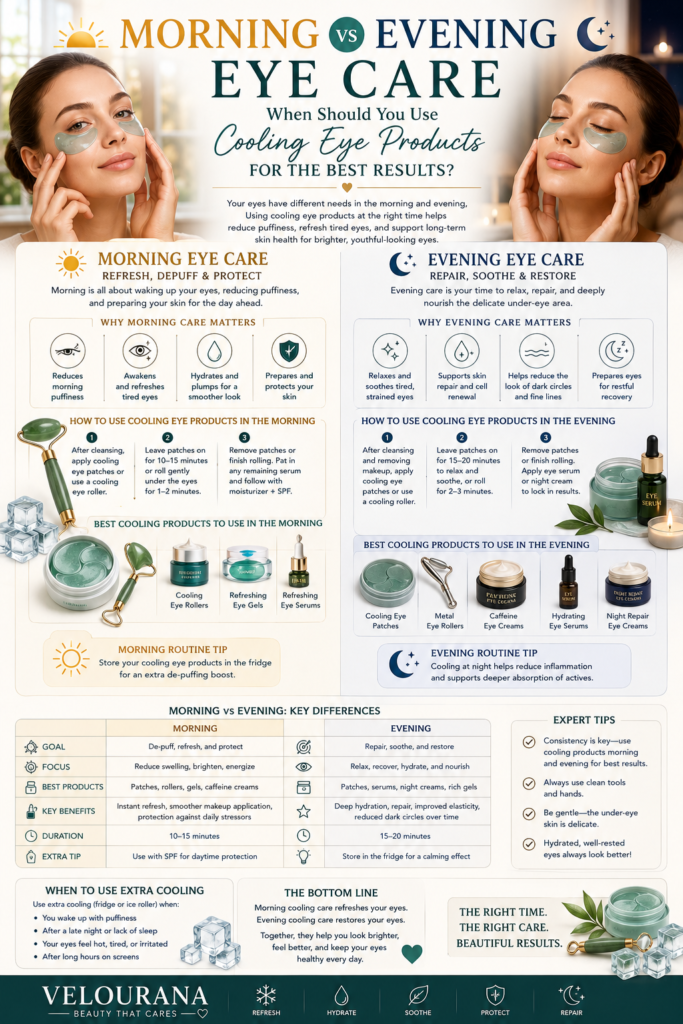
Water-based eye gels are among the most popular items to refrigerate because their lightweight texture already creates a naturally refreshing sensation. Chilling them enhances that feeling without significantly changing how they spread across the skin.
Hydrogel eye patches are another excellent candidate. When stored in the refrigerator, they combine cooling with hydration, making them especially enjoyable on mornings when puffiness or tiredness is more noticeable.
Metal eye rollers, stainless steel massage tools, and reusable cooling masks also become more effective when chilled because they retain low temperatures longer than creams or serums alone.
These products are specifically designed to provide a cooling experience, making refrigeration an entirely logical part of their routine.
Eye Creams That May Not Need Refrigeration
Rich nourishing eye creams often perform perfectly well at normal room temperature.
Many contain carefully balanced emulsions designed to maintain a smooth texture under typical household conditions. Refrigerating these products rarely increases their effectiveness, although some users still prefer the refreshing sensation.
Certain formulations may even become unusually thick when stored in colder environments, requiring extra time to soften before they can be applied comfortably.
This does not necessarily damage the product, but it may reduce the pleasant application experience the manufacturer intended.
Whenever possible, follow the storage recommendations printed on the packaging. Cosmetic chemists formulate products with expected storage conditions in mind.
The Difference Between Cooling and Preservation
A common misconception is that refrigeration dramatically extends the life of every skincare product.
While lower temperatures may slow some natural chemical reactions, modern cosmetics already contain carefully selected preservation systems designed to keep products stable during their recommended shelf life.
Proper preservation depends far more on hygiene than refrigeration alone.
Using clean hands or hygienic applicators prevents unnecessary contamination.
Closing containers tightly protects formulas from excessive air exposure.
Keeping products away from direct sunlight and high humidity helps maintain stability.
These everyday habits often contribute more to product longevity than refrigeration by itself.
Should You Buy a Skincare Refrigerator?
The popularity of skincare refrigerators has encouraged many people to wonder whether they need one.
For most households, the answer depends less on necessity and more on convenience.
An ordinary household refrigerator is usually perfectly suitable for chilling eye patches, cooling masks, rollers, and many eye gels. A dedicated skincare refrigerator simply offers easier access while avoiding strong food odours or frequent temperature fluctuations caused by repeated opening.
If refrigeration forms an enjoyable part of your daily routine, a small skincare refrigerator can certainly be convenient.
However, owning one is not essential for maintaining healthy skin.
Beautiful skincare routines existed long before specialised beauty refrigerators became fashionable.
Storage Mistakes That Can Shorten Product Life
Surprisingly, some of the biggest threats to skincare products have nothing to do with refrigeration.
Leaving products on a sunny windowsill exposes them to ultraviolet radiation and repeated temperature changes.
Keeping cosmetics inside very warm bathrooms may subject them to constant humidity and fluctuating heat generated by showers.
Failing to close lids tightly allows unnecessary air exposure, while repeatedly dipping unwashed fingers into jars increases the risk of contamination.
Ignoring expiration dates or the “period after opening” symbol can also reduce product safety and performance.
Simple storage habits often matter far more than purchasing expensive organisers or accessories.
Travelling with Cooling Eye Products
Travel presents its own challenges.
Products stored comfortably in a cool home environment may spend hours inside luggage exposed to changing temperatures.
Fortunately, most eye creams tolerate short periods outside ideal conditions without difficulty.
If travelling to particularly hot climates, keeping skincare inside insulated cosmetic bags and avoiding prolonged exposure to direct sunlight can help preserve texture and stability.
Cooling masks and reusable rollers can simply be chilled again once suitable refrigeration becomes available.
There is usually no need to worry if products spend part of a journey at room temperature.
How to Recognise When an Eye Product Has Gone Bad
Even carefully stored cosmetics eventually reach the end of their useful life.
Fortunately, the warning signs are often easy to recognise.
A noticeable change in smell is one of the earliest indicators.
The texture may separate into watery and oily layers or become unusually thick or grainy.
Colour changes, unexpected discolouration, or visible mould obviously require immediate disposal.
If a product begins causing irritation despite previously being well tolerated, discontinue use until the cause has been identified.
When in doubt, replacing an inexpensive eye cream is always preferable to risking unnecessary irritation around one of the most delicate areas of the face.
Building a Practical Storage Routine
An effective storage routine does not need to be complicated.
Choose a cool, dry location away from direct sunlight for products intended to remain at room temperature.
Refrigerate eye gels, hydrogel patches, rollers, or cooling masks if you enjoy the additional refreshing sensation.
Keep containers clean, tightly sealed, and within their recommended shelf life.
Most importantly, remember that consistency matters more than perfection.
Products stored sensibly and used regularly provide far greater value than expensive skincare collections forgotten at the back of a refrigerator.
Final Thoughts
Proper storage plays an important role in preserving the quality, comfort, and performance of cooling eye care products. While refrigeration can make eye gels, hydrogel patches, and cooling tools feel especially refreshing, it is not a universal requirement for every eye cream. Understanding which products genuinely benefit from lower temperatures allows you to enjoy their soothing effects without assuming that colder automatically means better.
The best skincare routines are built on simple, consistent habits rather than unnecessary complexity. By protecting your products from excessive heat, sunlight, humidity, and contamination while following the manufacturer’s recommendations, you help maintain both product quality and skin health. Whether your favourite eye cream lives in a dedicated skincare refrigerator or a cool bedroom drawer, thoughtful storage ensures that every application remains as effective and enjoyable as possible.
The End
Velourana
 Discover More From Our Family of Websites
 ZodiacBearing (Astrology, Tarot, Numerology, Angel Numbers & Spiritual Guidance)
 Velourana (Beauty, Makeup, Hair Care, Skincare & Beauty Tips)
 HavenBearing (Home, Living, Organization, Décor & Everyday Inspiration)
 PawBearing (Pet Care, Dog Breeds, Animal Health, Training & Pet Products)
 PsyCatherine (Notes From the Journal of a Psychologist on Real Life)