
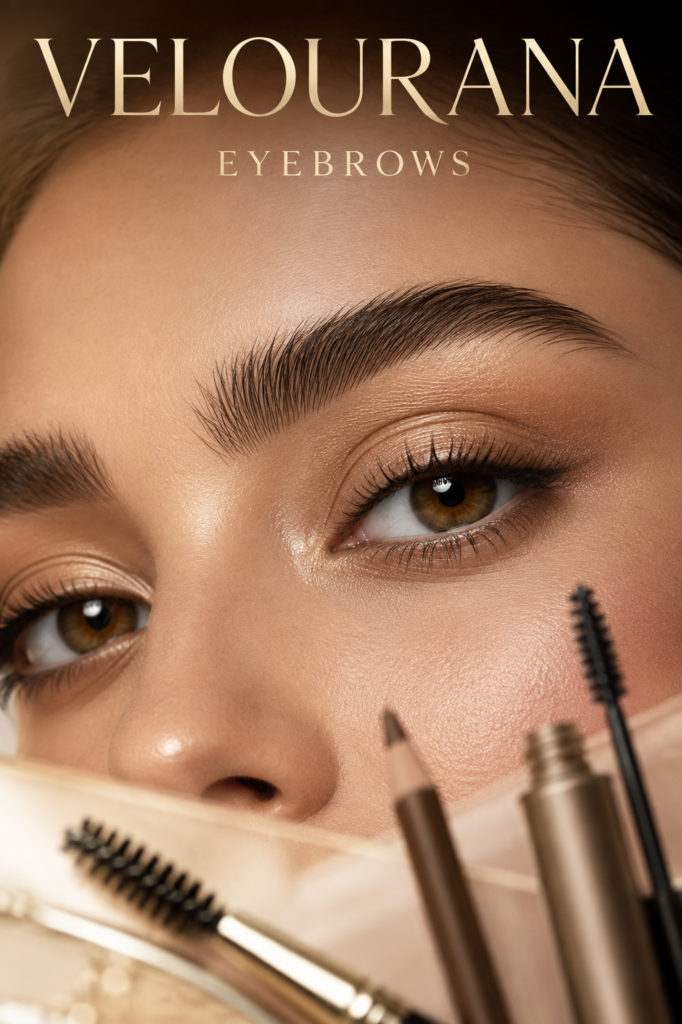
CATEGORY: Arched Brows
Creating attractive arched brows is less about drawing a dramatic angle and more about controlling proportion. The brow must rise, reach a believable peak, and descend into a refined tail while still retaining the irregular texture that makes eyebrow hair look natural. When any one of these elements is exaggerated, the arch can become visually disconnected from the face.
For people who already have naturally arched eyebrows, styling may involve little more than emphasizing the existing structure. For those whose brows are straighter, the objective may be to create the impression of greater elevation without removing excessive hair. Sparse brows require another approach because definition must often be created with cosmetic products rather than grooming alone.
The most useful principle is preservation. Brow hair is valuable because it provides texture, depth, and flexibility. Makeup can always create a stronger arch temporarily, whereas repeatedly removing hair to manufacture one can permanently limit styling possibilities. A considered approach therefore begins by understanding what the brow already does naturally.
Start With the Brow in Its Natural State
Before deciding how an eyebrow should be changed, it needs to be observed without heavy makeup or aggressive brushing. Clean brows reveal density, gaps, natural direction, and the true position of the upper and lower boundaries.
The first area to examine is the head. This is generally the broadest portion and establishes the visual beginning of the eyebrow. From there, the body normally extends outward with relatively consistent thickness before narrowing toward the arch and tail.
The next question is whether the brow already rises naturally. Even eyebrows that initially appear straight may have a subtle increase in height through their outer half. This small elevation can often be emphasized without significant hair removal.
The highest natural point should then be identified. It may be obvious in strongly arched brows or relatively subtle in softer shapes. Looking at both the upper and lower boundaries is useful because the arch is created by their combined movement.
Finally, the tail should be assessed for length, density, and direction. Sparse tails are extremely common, and they can make an otherwise well-shaped brow appear incomplete.
Observing all of these features before grooming prevents a common mistake: concentrating exclusively on the underside of the arch and ignoring the rest of the eyebrow.
Building an Arch Through Proportion
The visual strength of an arch depends on several proportions operating simultaneously.
The first is the relationship between the height of the head and the height of the peak. A small increase produces a gentle arch, while a larger difference produces a dramatic one.
The second is the horizontal distance between the brow head and the peak. When the rise occurs gradually over a longer distance, the eyebrow tends to look elegant and elongated. When the peak appears too early, the brow may look rounded or sharply angled in the middle.
The third is the relationship between the rising body and descending tail. The tail should appear to continue from the arch rather than falling suddenly from it.
Thickness is the fourth proportion. An arch can be high while the brow remains full, or relatively low while the brow is thin. These combinations produce very different visual effects.
Color intensity adds another dimension. A dark, sharply outlined arch appears stronger than an identical shape rendered with soft, hairlike strokes. Consequently, shaping and makeup cannot be considered separately. The cosmetic finish influences how the underlying geometry is perceived.
Successful styling coordinates all of these factors instead of trying to maximize any single one.
Refining the Lower Brow Without Creating a Hollow Arch
The underside of the eyebrow is where many arched shapes are refined, but it is also where over-plucking commonly occurs.
Removing a few hairs beneath the natural peak can reveal an existing curve. Removing too many creates a hollowed area that may look unnatural, especially when the upper boundary remains full.
The lower line does not need to be perfectly smooth. Natural brows contain slight variations, and a small degree of irregularity helps maintain authenticity. The objective is usually to remove obvious hairs that interrupt the silhouette rather than every hair that fails to align precisely.
Spacing between grooming sessions can also be useful. When hairs are removed frequently, it becomes difficult to see the brow's original structure. Allowing some regrowth periodically provides an opportunity to reassess the shape.
If uncertainty exists about whether a particular hair belongs to the brow, leaving it in place is generally the more flexible choice. Makeup or concealer can temporarily test how the eyebrow would look without it.
This cautious approach is particularly important near the peak because one or two hairs can noticeably change the apparent angle.
Controlling the Upper Boundary
The top of the brow receives less attention in many grooming routines, yet it strongly affects the arch.
The upper boundary often contains the clearest indication of the natural peak. Hairs may gradually rise and then change direction as the eyebrow approaches the tail. Preserving this pattern helps maintain a believable shape.
Excessive removal from the top can flatten the brow or lower the arch. It can also reduce overall density and make the eyebrow appear narrower.
There are situations where isolated hairs above the main brow can be removed for neatness, but distinguishing true stray hairs from structural hairs is important.
Makeup is usually a safer way to refine the upper boundary. A fine pencil can fill small dips around the arch, creating a smoother rise without removing anything. Powder can soften irregular density, while gel can position hairs so that the outline appears cleaner.
Because the upper line contributes so strongly to perceived height, very small additions can make an arch look more defined.
Creating a Softer Arched Brow
A soft arch is defined by gradual transitions. Instead of an obvious corner, the eyebrow flows upward and then curves gently downward.
This effect is particularly compatible with natural makeup because it retains visible hair texture and avoids severe boundaries.
Styling a soft arch often begins with brushing the brow upward and outward. The inner hairs may be directed more vertically, while the central and outer hairs follow the natural horizontal movement.
Sparse areas can then be filled selectively rather than covering the entire brow with pigment. A pencil with a fine point or a brow pen can reproduce individual hairs, while powder can create diffuse density.
The peak should not be heavily outlined. Instead, definition can be concentrated subtly beneath it and along the outer body.
The tail should taper rather than ending abruptly. Keeping the color slightly lighter or the strokes finer toward the end can help.
A soft arch is particularly forgiving because small asymmetries become less noticeable when the boundaries are not extremely sharp.
Creating a More Sculpted Arch
A sculpted arch uses stronger contrast between the rising body, peak, and descending tail. This can work particularly well with polished makeup where the eyebrows are intended to provide visible structure.
The difference between sculpted and artificial, however, often comes down to texture.
Even when the lower edge is clearly defined, retaining individual hairs throughout the brow prevents it from becoming a flat graphic shape. Pigment can establish the structure while brushing and fine strokes restore dimension.
The peak can be emphasized by adding slightly more definition immediately below and around it. Extending pigment too far above the natural brow should be approached carefully because the difference between real and drawn hair becomes more noticeable as the extension increases.
The tail can also be made more precise, but it should remain proportionate to the body. A razor-thin tail attached to a very full brow can appear disconnected.
A sculpted arch does not require an extremely dark brow. Definition comes from clean relationships between boundaries as much as from pigment intensity.
Filling Sparse Arched Brows
Sparse eyebrows present a particular challenge because the desired structure may exist even when there is insufficient hair to define it clearly.
The solution is usually to reconstruct missing density while preserving the impression of individual hairs.
Large gaps can benefit from a soft base of powder because it reduces contrast between skin and hair. Fine pencil or pen strokes can then be added where greater realism is needed.
The direction of these strokes should change across the brow. Near the head, hairs often grow upward or diagonally. Through the body, they typically become more horizontal. Around the arch and tail, they follow the brow's outward movement.
Using identical vertical strokes everywhere can make the brow look patterned rather than natural.
Sparse tails require particular attention because extending them with a solid line often looks obvious. Multiple fine strokes of slightly different lengths can produce a more believable taper.
Color choice also matters. Extremely dark pigment can emphasize every artificial mark. A shade that integrates with the natural brow hair usually creates greater depth than a single opaque block of color.
Using Brow Pencil to Refine an Arch
Brow pencils are particularly suited to arched brows because they allow precise control over small areas.
Rather than outlining the entire eyebrow first, the pencil can be used where structural support is needed. A small gap beneath the arch, an uneven upper edge, or a sparse tail can be corrected independently.
Pressure determines intensity. Light strokes create translucent marks that resemble fine hair, while heavy pressure produces solid lines. Beginning lightly allows definition to be increased gradually.
The brow head generally benefits from the least pressure because natural density there is rarely completely uniform. The body can receive somewhat more definition, and the outer portion can be refined carefully.
The pencil should not necessarily create a perfectly continuous boundary. Tiny interruptions help preserve natural texture.
Brushing through the finished brow with a spoolie can soften concentrated pigment and integrate it with the hair.
Powder, Pomade, and Brow Pens
Different brow products influence an arch in different ways.
Powder is useful when the basic shape already exists but needs greater visual density. Because its edges are naturally diffuse, it is well suited to softer arches. It can also provide a background beneath sparse hairs without making individual corrections conspicuous.
Pomade offers stronger control and can create crisp boundaries. This makes it suitable for sculpted arches, although excessive product can easily overpower the natural brow. Applying small amounts and building gradually usually produces greater dimension.
Brow pens are designed to imitate individual hairs. They are particularly useful around sparse tails, gaps, and areas where a few strategic strokes can improve the shape.
Pencils occupy a versatile middle ground, capable of both hairlike strokes and subtle shading depending on their texture and tip.
These products can also be combined. A light powder base may establish fullness, followed by pencil strokes for texture and gel for control. The objective is not to use as many products as possible but to choose techniques that solve specific structural needs.
Brow Gel and the Direction of Hair
Hair direction can change the appearance of an arch even when no pigment is added.
Brushing the inner brow upward makes the head appear fuller and more textured. Through the body, a diagonal upward-and-outward direction can increase the sense of lift. Near the arch, directing the hairs toward the tail clarifies the transition.
Strong-hold gels can create a laminated or feathered appearance in which individual hairs become more prominent. Softer gels maintain control without dramatically changing the natural direction.
Tinted gels add color as well as hold, which can be useful when the brow is sufficiently dense but individual hairs are pale or visually inconsistent.
Care is needed around the tail. Brushing those hairs excessively upward can disrupt the natural taper. Their direction usually becomes increasingly outward as the brow narrows.
Gel demonstrates an important principle of brow styling: an arch is not created only by the outline. The orientation of the hairs inside that outline contributes to the overall shape.
Avoiding an Overly Sharp Peak
A strong arch does not necessarily require a pointed corner.
When both the upper and lower boundaries meet at an extremely narrow peak, the brow can look triangular. This is particularly noticeable when the eyebrow is heavily filled.
Natural arches usually contain some degree of curvature. Even pronounced brows transition across several hairs rather than changing direction at a single mathematical point.
Softening the peak can therefore improve realism. Instead of drawing a hard angle, pigment can be distributed through the surrounding area so the rise and descent remain visible without forming a sharp vertex.
Brushing through the peak after applying makeup can also soften the effect.
If the natural brow already has a very pointed arch, preserving some fullness underneath it can reduce severity. Removing additional hair would exaggerate the angle.
The goal is controlled elevation rather than maximum sharpness.
Balancing Two Different Brows
Many people have one eyebrow with a stronger natural arch than the other. One may sit higher, contain more hair, or have a longer tail.
Trying to make the stronger brow match the weaker one through hair removal can sacrifice valuable density. Makeup offers a more conservative alternative.
The less pronounced arch can be enhanced slightly by adding strokes near its upper peak or refining the lower boundary. A shorter tail can be extended, while a sparse area can be filled.
At the same time, the stronger brow can be styled somewhat more softly so the difference becomes less noticeable.
This process aims for visual similarity rather than exact duplication.
Expressions should also be considered. People often raise one eyebrow unconsciously while applying makeup, which can make the brows appear more uneven than they actually are. Relaxing the forehead before comparing them provides a more accurate view.
Checking from farther away is equally important. Differences that seem enormous in a magnifying mirror may be virtually invisible when the whole face is considered.
Maintaining the Shape Over Time
Once a flattering arch has been established, maintenance should focus on preserving rather than repeatedly redesigning it.
New growth outside the established structure can be addressed carefully, while hairs within the main body should be evaluated before removal. Taking reference photographs can be useful for remembering the intended shape, especially when grooming intervals are long.
Long hairs may occasionally need trimming, but cutting should remain conservative. Brow hairs contribute to density by overlapping one another, and shortening them excessively can expose gaps.
The frequency of grooming varies according to individual growth. There is no universal schedule that guarantees a better shape.
Professional services can help establish or maintain an arch, particularly when the natural structure is difficult to assess. However, communicating preferences about thickness, peak height, and overall softness is important. “Arched” can describe many different eyebrow shapes.
A photograph of one's own brows when they looked particularly balanced may provide a more useful reference than an image of someone with completely different facial anatomy.
Adapting the Arch to Different Makeup Styles
One of the advantages of preserving natural fullness is that the same eyebrow can support several aesthetics.
For minimal makeup, the arch may need only brushing and perhaps a small amount of tinted gel. Natural gaps and texture can remain visible.
For polished daytime makeup, subtle pencil strokes and soft powder can clarify the shape without creating hard boundaries.
For stronger evening makeup, the tail and lower edge can be more defined, and the peak can carry greater contrast.
The underlying eyebrow does not need to change for each look. Cosmetic intensity changes the interpretation of the same architecture.
This flexibility is valuable because trends evolve. Extremely sculpted brows may dominate one period, while softer feathered styles become popular in another. Maintaining healthy brow density allows movement between these aesthetics without repeatedly reshaping the hair itself.
The Relationship Between Arched Brows and Eye Makeup
Eyebrows and eye makeup occupy the same visual region, so their shapes inevitably interact.
An arch naturally directs attention toward the outer eye. Eyeshadow placed with an upward and outward emphasis can reinforce this movement. Winged eyeliner can create a similar relationship when its angle complements rather than conflicts with the brow tail.
However, strong eye makeup combined with extremely dark, sharply arched brows can create considerable visual intensity. Sometimes this is desirable; at other times, softening one element creates better balance.
The space beneath the arch also affects how eyeshadow is perceived. A clean but natural lower brow boundary can provide definition without requiring a bright or heavily concealed brow bone.
Highlighter beneath the arch can emphasize elevation, but strong reflective products may make the area more prominent than intended. Subtle illumination often integrates more naturally with the surrounding makeup.
The eyebrow should therefore be considered part of the complete eye composition rather than an isolated feature.
Preserving Fullness Is the Long-Term Advantage
The most adaptable arched brow is usually one that retains enough natural hair to support different styles.
Repeatedly removing hairs to make an arch higher, thinner, or sharper can gradually narrow the possibilities. Makeup provides a reversible alternative. It can create the appearance of greater height today and a softer shape tomorrow.
Natural fullness also gives the brow dimension. Real hairs catch light differently from pigment and overlap in irregular ways that are difficult to reproduce perfectly with cosmetics.
This does not mean brows should never be groomed. Refinement can make the architecture clearer and remove distractions from the intended shape. The distinction lies between refinement and reconstruction.
A few carefully considered changes can reveal a natural arch. Extensive removal attempts to replace the natural structure with a new one.
Arched brows are most successful when the rise, peak, and tail appear to belong to the same continuous form. The beginning remains textured, the body retains enough fullness to support the elevation, the peak is defined without becoming unnaturally pointed, and the tail narrows gracefully.
When styling respects these relationships, the arch can frame the eyes and contribute structure to the face while still looking like an eyebrow rather than a diagram of one. That balance between definition and natural texture is what gives arched brows their enduring versatility.
THE END VELOURANA
 Discover More From Our Family of Websites
 ZodiacBearing (Astrology, Tarot, Numerology, Angel Numbers & Spiritual Guidance)
 Velourana (Beauty, Makeup, Hair Care, Skincare & Beauty Tips)
 HavenBearing (Home, Living, Organization, Décor & Everyday Inspiration)
 PawBearing (Pet Care, Dog Breeds, Animal Health, Training & Pet Products)
 PsyCatherine (Notes From the Journal of a Psychologist on Real Life)

