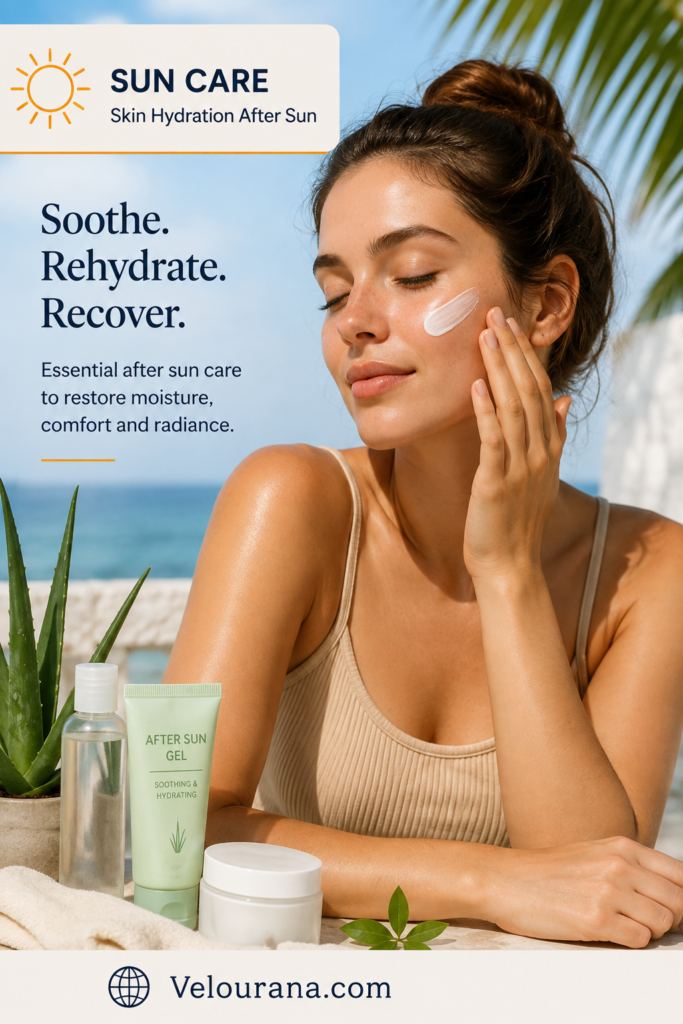
CATEGORY: Skin Hydration After Sun
A long day outdoors can leave the skin looking very different from the way it looked in the morning. The complexion may appear duller, feel tighter, show more visible fine lines, or seem less supple after hours of heat, wind, perspiration, swimming, and sunscreen wear.
This does not necessarily mean the skin has suddenly become dry in the permanent sense.
Often, the issue is temporary dehydration.
Dehydrated-looking skin lacks sufficient water in its upper layers, and this can affect any skin type. Oily skin can become dehydrated. Combination skin can become dehydrated. Dry skin can become even more uncomfortable when dehydration is added on top of its existing lack of oil.
After a summer day, the goal is not to attack the skin with strong treatments.
It is to restore comfort gradually.
A useful after-sun routine focuses on cooling, gentle cleansing, water-rich hydration, adequate moisturization, and protection from further exposure.
Dehydrated Skin Is Not the Same as Dry Skin
Dry skin is generally associated with reduced oil production and a tendency toward roughness, tightness, or flaking.
Dehydrated skin describes a lack of water.
The distinction matters because the two conditions can overlap.
Someone with oily skin may produce plenty of sebum while still experiencing dehydration.
This is why a shiny complexion can also feel tight.
The surface oil does not automatically mean the upper layers of the skin contain enough water.
Why Sun and Heat Can Make Skin Look Dehydrated
A day outdoors can involve multiple factors that influence moisture.
Heat increases perspiration.
Wind encourages evaporation.
Sun exposure contributes to environmental stress.
Swimming exposes the skin to salt or chlorine.
Air conditioning can create a dry indoor environment.
Cleansing removes sunscreen and residue at the end of the day.
Each factor may be manageable on its own.
Together, they can create a noticeable change in texture and comfort.
Fine Lines Can Look More Visible
One of the most common signs of temporary dehydration is that fine lines appear more noticeable.
This is especially common around the eyes and forehead.
When the skin lacks water, its surface can look less plump.
Hydration may improve the appearance of these temporary dehydration lines.
This should not be confused with reversing structural changes caused by ultraviolet exposure.
After-sun hydration improves surface comfort and appearance.
It does not erase sun damage.
Tightness Is Another Important Sign
Dehydrated skin often feels tight after cleansing.
This sensation may be mild or very noticeable.
If the face feels uncomfortable immediately after washing, consider the cleanser, water temperature, and overall routine.
Very hot water and aggressive cleansing can make the sensation worse.
A gentler approach creates a better starting point for hydration.
Dullness Can Follow a Hot Day
The skin may also look less radiant after environmental exposure.
Dehydration can contribute to this appearance because a well-hydrated surface generally reflects light more evenly.
However, dullness does not automatically mean the skin requires exfoliation.
This is important.
After sun exposure, the temptation to scrub away dullness can be counterproductive.
Hydration may be the more appropriate first response.
Start With Cooling Before Hydration
If the skin still feels hot, begin by cooling the environment.
Move indoors or into shade.
Allow the body to settle.
A comfortably cool shower can help remove perspiration and reduce the sensation of heat.
There is no need for extreme cold.
The purpose is gradual comfort.
Remove Sunscreen Carefully
Sunscreen is essential during outdoor exposure, but it should be removed properly at the end of the day.
Water-resistant formulas may require a more thorough cleansing method.
If makeup is also present, a first cleanser designed to dissolve makeup and sunscreen may be helpful.
Follow with a gentle cleanser if needed.
The goal is complete removal without leaving the skin stripped.
Avoid the Squeaky-Clean Feeling
A face that feels squeaky after washing is not necessarily cleaner in a useful sense.
For dehydrated skin, aggressive cleansing can increase discomfort.
Choose a cleanser appropriate for your skin type.
Use lukewarm or comfortably cool water.
Pat the face dry.
Do not scrub with a towel.
Apply Hydration Quickly but Gently
Once the face is clean, there is no need to wait until it feels completely dry.
Applying a hydrating product while the skin is still slightly damp can feel especially comfortable.
This first layer may be a mist, hydrating toner, essence, or serum.
The exact format is less important than the function.
Humectants Are Particularly Useful
Humectants are common ingredients in hydrating skincare.
They help attract and retain water in the upper layers of the skin.
Glycerin is one of the most established examples.
Hyaluronic acid is another widely used option.
Panthenol, beta-glucan, sodium PCA, and other ingredients can also appear in hydrating formulas.
There is no requirement to use all of them.
One well-formulated serum may be enough.
Glycerin for Dehydrated Skin
Glycerin works well across many different product textures.
It can be found in toners, serums, gels, creams, and lotions.
This versatility makes it useful for after-sun hydration.
Oily skin may prefer a glycerin-containing gel.
Dry skin may prefer a richer moisturizer containing glycerin alongside emollient ingredients.
The ingredient can support hydration regardless of the final texture.
Hyaluronic Acid for Temporary Tightness
Hyaluronic-acid serums can be particularly pleasant when the skin feels tight.
Their lightweight texture makes them easy to use after a hot day.
Apply a small amount.
More is not necessarily better.
If the serum remains sticky, reduce the quantity.
Dry skin should generally follow with moisturizer.
Panthenol and Comfort
Panthenol appears in many formulas designed around hydration and skin comfort.
A lightweight panthenol gel or serum can fit easily into an after-sun routine.
It can also be combined with other humectants in one product.
This allows the routine to remain simple.
Aloe Vera as a Hydrating Gel
Aloe gels are popular because their texture naturally feels refreshing.
They can be particularly satisfying when applied after a shower.
However, choose based on the complete formula.
A heavily fragranced aloe gel may feel very different from a simpler formulation.
The front label does not tell the entire story.
Centella Asiatica in Lightweight Formulas
Centella appears frequently in hydrating essences and gel creams.
Many of these products are designed with warm-weather textures in mind.
They can provide a refreshing first layer without creating much weight.
Again, there is no reason to use centella simply because it is fashionable.
Choose it if the formulation suits the skin.
Follow Hydration With Moisturization
This is one of the most important steps.
Hydration alone may provide only temporary relief.
A moisturizer helps maintain the comfort created by the hydrating layer.
For oily skin, a lightweight gel moisturizer may be enough.
For dry skin, a lotion, gel cream, or cream may be necessary.
The correct choice depends on how the skin feels after the hydrating product settles.
Why Gel Creams Work Well After Sun
Gel creams are ideal for people who need more than a serum but dislike heavy textures.
They combine a water-rich feel with more substantial moisturizing support.
This can be particularly useful in hot climates.
The skin receives hydration without feeling coated.
Ceramides Can Support the Final Step
Ceramide moisturizers are useful when the skin feels dry after swimming, wind exposure, or repeated cleansing.
They are available in many textures.
A lightweight ceramide lotion can fit into a summer routine just as easily as a richer cream can fit into winter skincare.
Do not assume ceramides automatically mean heavy texture.
Dry Skin May Need an Additional Layer
If the face still feels tight after serum and gel cream, dry skin may need something more substantial.
A richer moisturizer can be applied to the driest areas.
This does not mean the whole routine must become heavy.
Targeted application can be enough.
Oily Skin Should Not Skip Moisturizer Automatically
Oily skin often avoids moisturizer during summer.
Sometimes this works if the serum or sunscreen already provides sufficient comfort.
But if the skin feels tight, a lightweight gel moisturizer may help.
Oiliness and dehydration can exist at the same time.
The solution is usually better texture selection rather than eliminating hydration.
Combination Skin Can Be Treated by Zone
Combination skin can receive one hydrating serum across the entire face.
Then apply moisturizer selectively.
Use more on the cheeks.
Use less through the T-zone.
This avoids unnecessary heaviness.
Sensitive Skin Needs Fewer Variables
If the skin feels reactive after a long day outdoors, keep the routine familiar.
Use products already tolerated.
Avoid introducing several new active ingredients.
Fragrance-free options may be preferable for people who know they react to fragrance.
A simple hydrating serum and moisturizer can be enough.
Avoid Strong Acids
When skin looks dull and dehydrated, exfoliating acids may seem tempting.
But if the skin feels tight, warm, or reactive, strong exfoliation can make it more uncomfortable.
Hydrate first.
Allow the complexion to recover.
Exfoliation can wait until the skin feels normal.
Avoid Physical Scrubs
The same applies to abrasive scrubs.
Roughness after sun exposure may come from dehydration, salt residue, or environmental stress.
Scrubbing is not automatically necessary.
Gentle cleansing and moisturization often provide a better response.
Avoid Direct Ice
Direct ice can feel dramatic, but it is not needed for ordinary after-sun hydration.
A cool compress or refrigerated gel provides refreshment more gently.
The goal is comfort, not numbness.
Hydrating Mists Can Help Between Steps
A facial mist can provide an immediate boost of freshness.
Use it after cleansing or before serum.
If the skin feels tight after the mist dries, follow with moisturizer.
Repeated misting alone is not always enough.
Hydrating Toners Can Be Useful
A hydrating toner provides a lightweight layer of moisture.
Some people enjoy applying one layer.
Others use multiple layers.
There is no requirement to saturate the face repeatedly.
Apply enough to create comfort without stickiness.
Essences Can Replace Extra Serums
A hydrating essence may provide enough moisture to eliminate the need for a separate toner and serum.
This can simplify the routine.
The best summer skincare often involves fewer steps.
Sheet Masks for Dehydrated-Looking Skin
A hydrating sheet mask can provide a pleasant occasional treatment.
A slightly chilled mask may feel especially refreshing.
Use it according to the instructions.
Remove it when recommended.
Follow with moisturizer if needed.
Gel Masks
Gel masks can also work well after a hot day.
Their texture naturally feels cooling.
Some are designed to be rinsed off.
Others are sleeping masks.
Always use the product according to its intended format.
Overnight Moisture
Nighttime is when slightly richer hydration may feel more comfortable.
Once the skin has cooled completely, a richer cream or sleeping mask can be used if necessary.
This is particularly useful for dry skin.
The routine can remain light immediately after sun exposure and become more nourishing later.
Pay Attention to the Eye Area
The area around the eyes often shows temporary dehydration quickly.
A lightweight eye gel or familiar moisturizer may improve comfort.
A cool compress can also be refreshing.
Avoid extreme cold.
Neck and Chest Need Hydration Too
The face is not the only exposed area.
The neck and upper chest often receive significant sun exposure.
Cleanse them gently.
Apply moisturizer.
Include them in daytime sun protection as well.
Hydrate the Shoulders
Shoulders may feel tight after a day in sleeveless clothing or swimwear.
A lightweight body lotion or after-sun gel can restore comfort.
Apply gently.
Arms and Legs After Swimming
Swimming can leave the arms and legs feeling dry.
Rinse with fresh water.
Apply a body lotion while the skin remains slightly damp.
This can make the product spread more easily.
Salt Water and Dehydration
Salt water can leave residue on the skin as it dries.
This can increase the sensation of tightness.
Rinsing after swimming helps.
Do not scrub the salt away aggressively.
Fresh water and gentle cleansing are enough.
Chlorine and Dehydration
Pool water can also contribute to dryness.
Rinse after swimming.
Follow with moisturizer.
People who swim frequently may benefit from using body lotion consistently rather than only when the skin becomes very dry.
Wind Can Increase Discomfort
Windy beach days often leave the skin feeling drier than expected.
The combination of wind, salt, and sun can be particularly demanding.
A hydrating serum followed by moisturizer is useful afterward.
Air Conditioning Can Continue the Dehydration
After coming indoors, the skin may initially feel comfortable because the environment is cooler.
Several hours later, strong air conditioning may contribute to tightness.
If this happens, add a small amount of moisturizer.
The routine can evolve throughout the evening.
Humid Weather Does Not Eliminate Dehydration
Humidity can make the skin feel damp.
It does not automatically mean the skin is fully hydrated.
Swimming, cleansing, and air conditioning can still create dryness.
Judge by how the skin feels.
Dry Heat Often Requires More Moisturizer
In dry climates, a hydrating serum may evaporate quickly without enough moisturization afterward.
Follow with a lotion or cream.
Dry heat often requires a more substantial final layer than humid heat.
The Order of Products Matters
A simple after-sun sequence can be:
cleanse,
mist or toner,
serum,
moisturizer.
This order allows water-rich products to go on first and richer textures afterward.
There is no need to add many extra layers.
Smaller Amounts Often Work Better
Summer skincare can become sticky quickly.
Use modest quantities.
A few drops of serum may be enough.
A small amount of gel cream may provide sufficient comfort.
More product does not automatically create better hydration.
Wait Before Adding More
After applying serum, give it a moment to settle.
Then evaluate the skin.
Does it already feel comfortable?
If yes, use less moisturizer.
If tightness remains, add more.
This approach prevents unnecessary over-layering.
Avoid Chasing Instant Plumpness
Some hydrating products make the skin look temporarily plumper.
This can be appealing.
But the goal should remain lasting comfort rather than dramatic immediate effects.
A product that looks impressive for five minutes but leaves the skin sticky is not necessarily the best choice.
The Morning After Matters
Observe the skin the next morning.
If it feels comfortable and soft, the previous evening's hydration was likely appropriate.
If it feels tight, increase moisturization.
If it feels greasy or congested, reduce the amount or richness.
The morning response provides useful feedback.
Sun Protection Must Return the Next Day
After-sun hydration is only half of the cycle.
The following morning, protect the skin again.
Use broad-spectrum sunscreen appropriately.
Reapply according to product directions and circumstances.
Use shade, protective clothing, hats, and sunglasses where appropriate.
Hydration improves comfort.
Protection reduces additional exposure.
Do Not Use Hydration as Permission for More Exposure
A common mistake is assuming that because the skin feels better, it is safe to spend more time in direct sun.
Cooling and hydrating products can mask discomfort.
They do not erase the exposure that has already occurred.
Continue to manage sun exposure responsibly.
When Dehydrated-Looking Skin Needs More Than Cosmetics
Ordinary tightness and temporary dehydration can usually be managed with skincare.
Significant sunburn is different.
Severe pain, blistering, extensive burning, marked swelling, or other concerning symptoms may require appropriate medical attention.
Serious heat-related symptoms also require medical care rather than cosmetic treatment.
Hydration Is Not a Cure for Sunburn
This deserves repeating.
Aloe, hyaluronic acid, glycerin, ceramides, and other skincare ingredients can improve comfort.
They do not reverse ultraviolet injury.
Use after-sun hydration as supportive skincare, not as a cure.
Build a Minimal After-Sun Hydration Kit
A very simple kit can contain:
a gentle cleanser,
one hydrating serum,
one lightweight moisturizer,
one body lotion.
That is enough for many people.
A mist or mask can be added for enjoyment.
The Best Serum Is the One You Will Use
There is no universal winner.
One person may love hyaluronic acid.
Another may prefer panthenol.
Another may enjoy centella.
Another may use a simple glycerin serum.
The ideal product is the one that fits the routine and feels comfortable consistently.
The Best Moisturizer Depends on Climate
A gel may be perfect in humid weather.
A gel cream may work better in mixed indoor and outdoor conditions.
A lotion may be ideal in dry heat.
A cream may be necessary for dry skin at night.
Texture should follow environment.
Consistency Matters More Than Complexity
Using a simple hydrating routine regularly is more useful than having a complicated collection that is rarely used.
After-sun care should be easy enough to repeat after beach days, pool days, outdoor exercise, travel, and ordinary summer afternoons.
Dehydrated Skin Often Needs Less Drama
When the complexion looks dull or feels tight, it is tempting to respond aggressively.
Strong exfoliation.
Multiple masks.
High-strength serums.
Heavy creams.
Direct ice.
Often, none of this is necessary.
The skin may simply need water, moisturizer, and time.
Let the Skin Settle
A calm routine allows the complexion to return to normal gradually.
Cleanse carefully.
Hydrate.
Moisturize.
Rest.
Protect again tomorrow.
This is often enough.
After-Sun Hydration as a Summer Habit
Hydrating the skin after outdoor exposure can become a simple seasonal habit.
It does not need to feel like repairing a disaster.
Think of it as maintenance.
The skin has spent the day dealing with heat, wind, sunscreen, sweat, swimming, and environmental changes.
The evening routine restores comfort.
The Goal Is Supple, Comfortable Skin
The best result is not dramatic transformation.
It is skin that no longer feels tight.
Skin that feels softer.
Skin that looks less dull.
Skin that is comfortable enough to forget about.
That is what successful hydration should achieve.
After a long day in the sun, dehydrated-looking skin usually responds best to a gentle, layered approach rather than an aggressive one. Cooling removes the sensation of heat. Cleansing removes residue. Humectants provide hydration. Moisturizers help maintain comfort. Richer textures can be added only where necessary.
Keep the routine simple, pay attention to how the skin feels after each step, and avoid confusing temporary relief with protection from ultraviolet exposure.
The most effective after-sun hydration routine is the one that restores comfort without overwhelming the skin.
The End
Velourana.
 Discover More From Our Family of Websites
 ZodiacBearing (Astrology, Tarot, Numerology, Angel Numbers & Spiritual Guidance)
 Velourana (Beauty, Makeup, Hair Care, Skincare & Beauty Tips)
 HavenBearing (Home, Living, Organization, Décor & Everyday Inspiration)
 PawBearing (Pet Care, Dog Breeds, Animal Health, Training & Pet Products)
 PsyCatherine (Notes From the Journal of a Psychologist on Real Life)