
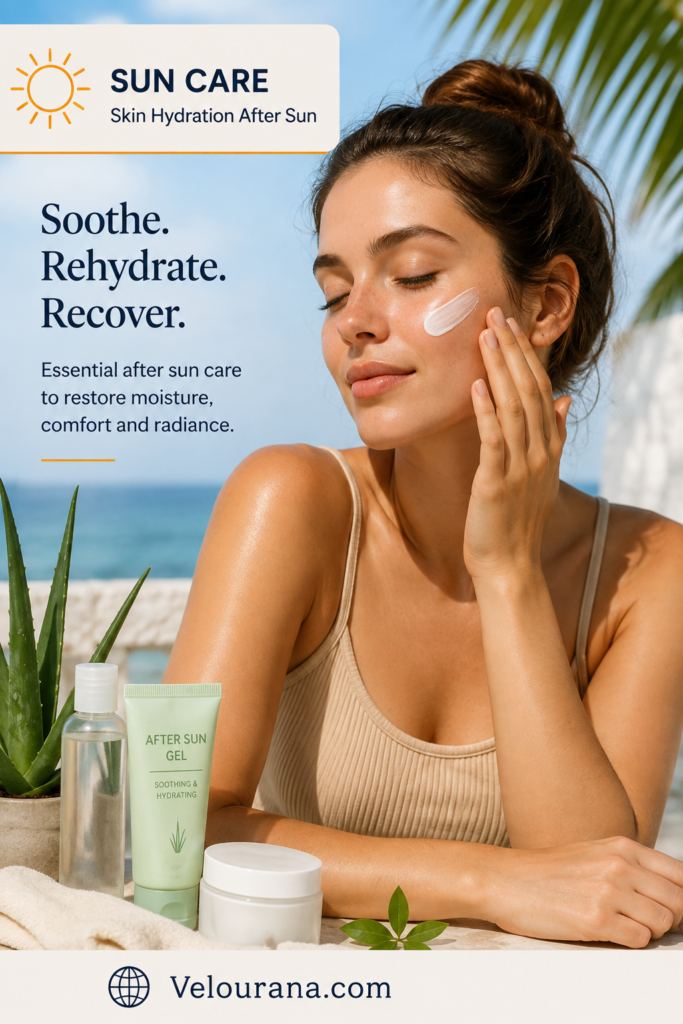
CATEGORY: Skin Hydration After Sun
A warm summer day can leave the skin looking luminous while simultaneously making it feel tight, thirsty, warm, or less comfortable than usual. Sunshine is only one part of the experience. Heat, perspiration, wind, salt water, chlorine, repeated sunscreen application, air conditioning, and cleansing can all influence how the skin feels by the end of the day.
This is why hydration deserves a central place in after-sun skincare.
Hydrating the skin after time outdoors is not about trying to reverse ultraviolet exposure. Moisturizers, serums, gels, and masks cannot undo UV damage, and after-sun products should never be treated as substitutes for sunscreen, shade, protective clothing, or sensible management of sun exposure.
Their purpose is different.
A thoughtful after-sun hydration routine helps restore comfort. It can replenish moisture after a day spent swimming or perspiring, soften the sensation of tightness after cleansing, and provide a calmer transition from a hot outdoor environment into the evening.
The most effective routine is usually straightforward: cool down, cleanse gently, add water-rich hydration, moisturize appropriately, and avoid overwhelming stressed skin with unnecessary treatments.
Why Skin Can Feel Dehydrated After a Day in the Sun
Skin can feel dehydrated even when the complexion looks oily.
This is particularly common during summer because perspiration and sebum create surface shine while environmental conditions simultaneously contribute to moisture loss and discomfort.
Heat encourages perspiration.
Wind can accelerate evaporation.
Swimming exposes the skin to salt water or chlorinated water.
Air conditioning can create a dry indoor environment.
Repeated cleansing may remove more surface lipids than usual.
By evening, someone may therefore have a shiny forehead while their cheeks feel tight.
This combination is one reason after-sun hydration should be chosen according to how the skin feels rather than simply how oily it looks.
Hydration and Moisturization Are Not Exactly the Same
The words hydration and moisturization are often used interchangeably, but distinguishing between them can make product selection easier.
Hydrating products generally focus on increasing water content within the upper layers of the skin. They frequently contain humectant ingredients such as glycerin or hyaluronic acid.
Moisturizers usually combine hydration with ingredients that soften the skin and help reduce moisture loss.
A watery serum may therefore provide excellent hydration but still feel insufficient for someone with naturally dry skin.
Conversely, applying a very rich cream without first addressing the sensation of dehydration may feel heavy rather than refreshing.
After-sun skincare often works particularly well when hydration comes first and moisturization follows.
Step One: Get Out of the Heat
Before applying skincare, allow the skin and body to move away from the source of heat.
Go indoors or into shade.
Allow body temperature to settle naturally.
Airflow can help create a more comfortable environment.
This first step sounds obvious, but it is important. Applying a refrigerated gel while continuing to sit in direct sunlight does not address the underlying exposure.
Cooling the environment makes the skincare routine itself more comfortable.
Step Two: Take a Comfortably Cool Shower
After a day outdoors, a shower removes much more than perspiration.
Sunscreen, salt, chlorine, sand, environmental particles, body products, and oil can all accumulate on the skin.
A comfortably cool or lukewarm shower helps remove these residues while reducing the sensation of heat.
Avoid extremely hot water when the skin already feels warm or tight.
There is also no need for painfully cold water.
The objective is gentle refreshment rather than temperature shock.
Cleanse Without Stripping
Thorough cleansing matters after sunscreen and swimming, but aggressive cleansing is unnecessary.
Choose a cleanser appropriate for the face and use gentle movements.
If makeup or water-resistant sunscreen is present, an appropriate first cleansing step may help dissolve it before a water-based cleanser is used.
The body should be treated similarly.
A gentle body cleanser is generally preferable to vigorous scrubbing after a long day outdoors.
The skin needs to be clean, not polished.
Pat Rather Than Rub
After cleansing, pat the skin gently with a soft towel.
Avoid vigorous rubbing.
This is particularly important if the skin feels sensitive after sun exposure.
Leaving the complexion slightly damp can also create a pleasant base for the first hydrating product.
Start Hydration While the Skin Is Comfortable
Once cleansing is complete, hydration can begin.
A facial mist, essence, hydrating toner, or lightweight serum can provide the first layer.
The product does not need to be complicated.
The goal is to deliver hydration in a texture that feels comfortable on warm-weather skin.
Water-rich products are particularly useful because they can provide moisture without immediately creating a heavy coating.
Glycerin in After-Sun Hydration
Glycerin is one of the most widely used humectants in skincare.
It appears in serums, lotions, gels, creams, masks, and cleansers.
Its familiarity should not make it seem unimportant.
A well-formulated glycerin-containing product can provide exactly the type of straightforward hydration that feels useful after a hot day.
There is no requirement for after-sun skincare to contain exotic ingredients.
Sometimes the simplest formulation is the easiest for stressed skin to tolerate.
Hyaluronic Acid
Hyaluronic acid is another familiar hydrating ingredient.
It is particularly common in lightweight serums and gels, making it naturally compatible with summer routines.
A hyaluronic-acid serum can be applied after cleansing and followed with moisturizer.
For dry skin, the moisturizer is especially important because a watery serum alone may not provide enough lasting comfort.
The goal is not to create as many hydrating layers as possible.
One effective serum may be enough.
Panthenol
Panthenol frequently appears in products marketed toward dry, sensitive, or stressed skin.
It can be found in gels, creams, serums, lotions, and after-sun products.
Its compatibility with lightweight textures makes it particularly convenient for summer.
A panthenol gel or serum can provide hydration without requiring a thick cream immediately after exposure to heat.
Aloe Vera
Aloe vera is perhaps the ingredient most strongly associated with traditional after-sun care.
Aloe gels feel naturally refreshing because of their water-rich texture.
When stored appropriately and used slightly cool, the sensory effect can be especially pleasant.
However, not every aloe gel is identical.
The complete formulation matters.
Some products contain fragrance, alcohol, colorants, or numerous botanical ingredients in addition to aloe.
People with sensitive skin should choose according to their individual tolerance rather than assuming every aloe product is automatically gentle.
Centella Asiatica
Centella asiatica has become popular in modern skincare, particularly in products designed around hydration and a soothing sensory profile.
It frequently appears in lightweight essences, serums, gels, and creams.
These textures can fit easily into an after-sun routine.
Again, the complete formulation matters more than one highlighted botanical ingredient.
Beta-Glucan
Beta-glucan can also be found in hydrating skincare.
It is often combined with other humectants in serums, essences, and moisturizers.
A product containing several complementary hydrating ingredients can simplify the routine by replacing the need for multiple separate serums.
This is useful after sun exposure because simplicity is often more comfortable than excessive layering.
Facial Mists After Sun
A cool facial mist can provide immediate refreshment.
It can be used directly after cleansing or before serum.
Some people also enjoy using a mist during the day.
However, repeated misting should not be confused with complete moisturization.
If the face feels tight once the droplets evaporate, follow with a hydrating serum or moisturizer.
Think of the mist as the beginning of hydration rather than necessarily the final step.
Hydrating Toners and Essences
Toners and essences can provide another lightweight way to introduce moisture.
They are particularly appealing to people who dislike heavy creams.
Apply gently.
There is no need to repeatedly saturate the skin with multiple layers unless the product is specifically intended for that method and the skin enjoys it.
A single comfortable layer may be sufficient.
Hydrating Serums
For many people, a hydrating serum is the most practical centerpiece of an after-sun routine.
It provides more substance than a mist but less weight than a cream.
A good serum should spread easily and settle comfortably.
If it remains extremely sticky, reducing the amount may help.
More serum does not automatically produce better hydration.
Gel Moisturizers
Gel moisturizers are particularly useful after sun exposure because their texture feels naturally refreshing.
They can provide hydration and moisturization without the dense sensation of traditional creams.
Oily and combination complexions may find a gel sufficient.
Dry skin may need a gel cream or richer moisturizer afterward.
Gel Creams
Gel creams bridge the gap between gels and conventional creams.
They maintain a fresh, water-rich texture while providing additional emollience.
This makes them particularly useful when the skin feels dehydrated but still needs more lasting moisturization.
A gel cream can be especially comfortable on summer evenings when a winter moisturizer feels too heavy.
Creams Still Have a Place
Cooling after-sun skincare does not mean abandoning cream moisturizers.
Dry skin may still need them.
The trick is timing and quantity.
Begin with a refreshing hydrating layer.
Allow the skin to cool.
Then apply a moderate amount of cream where needed.
The cream may feel much more comfortable once the initial warmth has disappeared.
Ceramides and Barrier Support
Ceramides are commonly incorporated into moisturizers designed to support the skin barrier.
They can be particularly useful when skin feels dry after swimming, wind exposure, or repeated cleansing.
Ceramide moisturizers are available in many textures.
A summer product does not need to be extremely rich.
Lightweight lotions and gel creams can provide barrier-supporting ingredients while maintaining a comfortable warm-weather feel.
Squalane and Emollient Ingredients
Dry skin may benefit from small amounts of emollient ingredients such as squalane.
These ingredients can help soften the skin after the hydrating stage.
They do not necessarily make a product heavy.
Formulation and concentration matter.
A lightweight moisturizer containing squalane can feel completely different from applying a layer of facial oil.
Refrigerating Hydrating Products
One of the easiest ways to make after-sun hydration feel more refreshing is to cool an appropriate product.
A mist, gel moisturizer, eye gel, or hydrating mask may feel especially pleasant when slightly chilled.
Always follow the manufacturer's storage instructions.
Not every cosmetic product is designed for refrigeration.
There is also no reason to freeze skincare.
Comfortably cool is enough.
Why Extreme Cold Is Unnecessary
When skin feels hot, extreme cold can sound appealing.
Direct ice, frozen tools, or extremely cold products are unnecessary for ordinary after-sun skincare.
A cool compress or chilled gel provides a gentler alternative.
Cooling should feel soothing rather than painful.
Hydrating Sheet Masks
A sheet mask can provide a more intensive hydration ritual.
After cleansing, apply the mask according to its instructions.
A slightly chilled hydrating sheet mask can feel particularly refreshing.
Do not assume that leaving it on much longer than recommended will provide better results.
Remove it at the appropriate time and follow with moisturizer if needed.
Gel Masks
Gel masks are another excellent summer format.
They combine water-rich texture with a longer application period.
Some are rinse-off products.
Others are sleeping masks.
Always use them according to their intended purpose.
A rinse-off mask should not automatically be left on overnight.
Eye Hydration After Sun
The eye area can feel tired after a bright day outdoors.
A cool eye gel or hydrating eye product can provide refreshment.
A clean cool compress is another simple option.
Apply products gently.
Extreme cold and aggressive rubbing are unnecessary.
Do Not Forget the Body
After-sun hydration should extend below the neck.
Shoulders, arms, chest, legs, and back may have received considerably more environmental exposure than the face.
After showering, apply a lightweight body lotion, gel, or moisturizer.
The product can be applied while the skin remains slightly damp.
This can make application easier and help the routine feel lighter.
Hydrating the Shoulders
Shoulders are particularly vulnerable during summer because they are often exposed by clothing and swimwear.
Apply moisturizer gently.
Avoid aggressive massage if the area feels sensitive.
A lightweight gel or lotion may feel more comfortable than a thick body butter immediately after sun exposure.
Hydrating the Chest
The upper chest is another frequently exposed area.
It deserves the same attention as the face and neck.
Cleanse gently and apply an appropriate moisturizer.
Daytime sun protection should also extend to exposed chest skin.
Hydrating the Arms and Legs
Arms and legs can become dry after repeated swimming and showering.
A body lotion provides an easy solution.
If the weather is humid, a gel lotion may feel particularly comfortable.
In dry heat or strong air conditioning, a richer lotion may be preferable.
Hands After Sun
Hands receive considerable environmental exposure and frequent washing.
A lightweight hand cream can restore comfort after the evening shower.
During the day, remember that the hands are also exposed to sunlight and should be included in appropriate sun-protection habits.
Lips Need Moisture Too
Lips can become dry from wind, heat, swimming, and air conditioning.
A suitable lip balm provides a simple final step.
Sun-protective lip products can also form part of daytime sun care.
Hydration After Sea Swimming
Sea water can leave salt on the skin as it dries.
This may contribute to a tight sensation.
Rinse with fresh water when practical.
After returning home, cleanse gently and apply hydration.
Avoid scrubbing the skin simply because salt and sand have made it feel rough.
Hydration After Pool Swimming
Chlorinated water can leave some people's skin feeling dry.
Rinsing after swimming can improve comfort.
At home, use a gentle cleanser and follow with moisturizer.
A hydrating serum or gel can provide additional facial comfort.
Hydration After Outdoor Exercise
Outdoor exercise combines heat, perspiration, and sun exposure.
After exercise, allow the body to cool and shower appropriately.
Cleanse the face.
Then use a lightweight hydrating product.
A heavy routine is rarely necessary immediately after exercise.
Hydration in Humid Weather
Humidity can make the skin feel wet without necessarily making it adequately hydrated.
Choose lighter textures rather than eliminating hydration completely.
A serum and gel moisturizer may provide enough support.
Apply modest amounts to avoid stickiness.
Hydration in Dry Heat
Dry heat may require more substantial moisturization.
Begin with a water-rich serum for refreshment.
Follow with a lotion or cream to help maintain comfort.
This combination allows the routine to feel fresh without leaving dry skin under-supported.
Air Conditioning and After-Sun Dryness
Moving from outdoor heat into strong air conditioning can create a dramatic environmental change.
After several hours, the skin may feel tighter than it did immediately after coming indoors.
A moisturizer that seemed unnecessary at first may become useful later.
This is why after-sun skincare should remain flexible.
Oily Skin Still Needs Hydration
Oily complexions should not automatically skip hydration.
A lightweight serum or gel can provide water without creating a heavy feel.
Avoid repeatedly cleansing until the skin feels completely oil-free.
The goal is comfort and balance.
Dry Skin Needs More Than a Mist
Dry skin can enjoy facial mists and gels, but these may not be sufficient alone.
Layer hydration beneath an appropriate moisturizer.
At night, a richer cream may be comfortable once the skin has cooled.
Combination Skin Can Be Treated Selectively
Combination skin does not require identical moisturization everywhere.
Use a lightweight product across the face.
Apply additional moisturizer to dry areas.
Use less through oilier areas.
This approach prevents unnecessary heaviness.
Sensitive Skin Benefits From Simplicity
When sensitive skin feels stressed after outdoor exposure, avoid introducing numerous unfamiliar products.
Use formulas already known to be comfortable.
Fragrance-free options may be preferable for people who know fragrance causes problems.
Cooling through product temperature can provide refreshment without strong sensory ingredients.
Avoid Aggressive Exfoliation
Skin can feel rough after a day outside.
This may be caused by dryness, salt, wind, or residue rather than a sudden need for exfoliation.
If the skin feels warm or sensitive, postpone strong scrubs and exfoliating acids.
Hydrate first.
Allow the complexion to settle.
Avoid Overloading the Skin With Actives
After-sun hydration does not need to become an intensive treatment session.
If the skin feels unusually reactive, a simpler evening may be more comfortable than layering multiple strong active products.
People using prescription skincare should follow the guidance appropriate to their treatment.
Do Not Use Hydration to Justify More Sun
One of the most important principles of after-sun skincare is that feeling better does not mean additional sun exposure is harmless.
A cooling gel can reduce discomfort.
It does not reset the skin's exposure history for the day.
Continue to use sensible sun-protection practices.
Sunscreen Remains Central
The best after-sun hydration routine begins with good daytime prevention.
Use broad-spectrum sunscreen appropriately.
Reapply according to the product directions and circumstances.
Seek shade when useful.
Wear protective clothing, hats, and sunglasses as appropriate.
After-sun products support comfort afterward.
They do not replace these measures.
A Simple Five-Minute After-Sun Routine
An effective routine does not need to take half an hour.
Cleanse gently.
Apply a hydrating serum.
Follow with a suitable moisturizer.
Apply body lotion to exposed areas.
Use lip balm.
That can be enough.
A More Relaxing Evening Routine
When there is more time, after-sun hydration can become a ritual.
Take a cool shower.
Cleanse the face carefully.
Apply a chilled hydrating mist.
Use a hydrating mask according to its instructions.
Follow with a gel cream or moisturizer.
Apply body lotion.
The additional steps are for comfort and enjoyment rather than necessity.
How to Know Whether Hydration Is Working
Do not judge a product only during application.
Wait.
Does the skin remain comfortable?
Has the tight sensation disappeared?
Does it feel sticky?
Does it feel excessively oily?
Does it need more moisturizer?
These observations help refine the routine.
When the Routine Is Too Light
If the skin feels tight again shortly after application, the routine may need more moisturization.
Add a lotion, gel cream, or cream.
Do not simply apply endless layers of watery serum.
Hydration needs to be supported appropriately.
When the Routine Is Too Heavy
If the face remains sticky or coated, reduce the number of layers.
Use smaller quantities.
Choose a lighter moisturizer.
After-sun hydration should feel refreshing rather than suffocating.
When Skincare Is Not Enough
Ordinary dryness, warmth, and tightness after a summer day can often be managed with gentle cosmetic skincare.
Significant sunburn is different.
Severe pain, blistering, marked swelling, extensive burns, or other concerning symptoms may require appropriate medical attention.
Serious symptoms associated with excessive heat are also not skincare problems.
Cosmetics have limits, and recognizing those limits is part of responsible sun care.
Hydrate the Body Internally Too
Skincare addresses the surface of the body, but hot weather and physical activity also make adequate fluid intake important for general health.
Drinking water should not be confused with applying moisturizer; they serve different functions.
A sensible summer routine considers both personal hydration and skin comfort.
Prepare for the Next Day
After-sun hydration is only one half of the cycle.
The following morning, return to prevention.
Use a comfortable skincare routine that layers well beneath sunscreen.
Avoid making the morning so complicated that sun protection becomes unpleasant to apply.
Keep Summer Skincare Flexible
Skin needs can change from one day to another.
A humid day may call for a gel.
A windy beach day may leave the skin wanting a richer moisturizer.
Hours in air conditioning may increase dryness.
A short outdoor walk may require no special after-sun routine at all.
The routine should respond to the situation rather than follow rigid rules.
Hydration Should Feel Comfortable
The best after-sun hydration routine is not the one with the greatest number of products.
It is the one that restores comfort efficiently.
Clean skin.
Fresh hydration.
Appropriate moisturization.
Gentle textures.
Responsible sun protection.
Those are the foundations.
After a long day outdoors, skin does not necessarily need a complicated rescue operation. It often needs something much simpler: relief from heat, removal of accumulated sunscreen and environmental residue, replenishment of moisture, and a moisturizer appropriate for its individual needs.
Treat hydration as part of a complete sun-care strategy rather than a cure for excessive exposure. Protect the skin during the day, care for it gently afterward, and allow lightweight, water-rich products to make summer evenings feel fresher and more comfortable.
The End
Velourana.
 Discover More From Our Family of Websites
 ZodiacBearing (Astrology, Tarot, Numerology, Angel Numbers & Spiritual Guidance)
 Velourana (Beauty, Makeup, Hair Care, Skincare & Beauty Tips)
 HavenBearing (Home, Living, Organization, Décor & Everyday Inspiration)
 PawBearing (Pet Care, Dog Breeds, Animal Health, Training & Pet Products)
 PsyCatherine (Notes From the Journal of a Psychologist on Real Life)

