CATEGORY: Curling
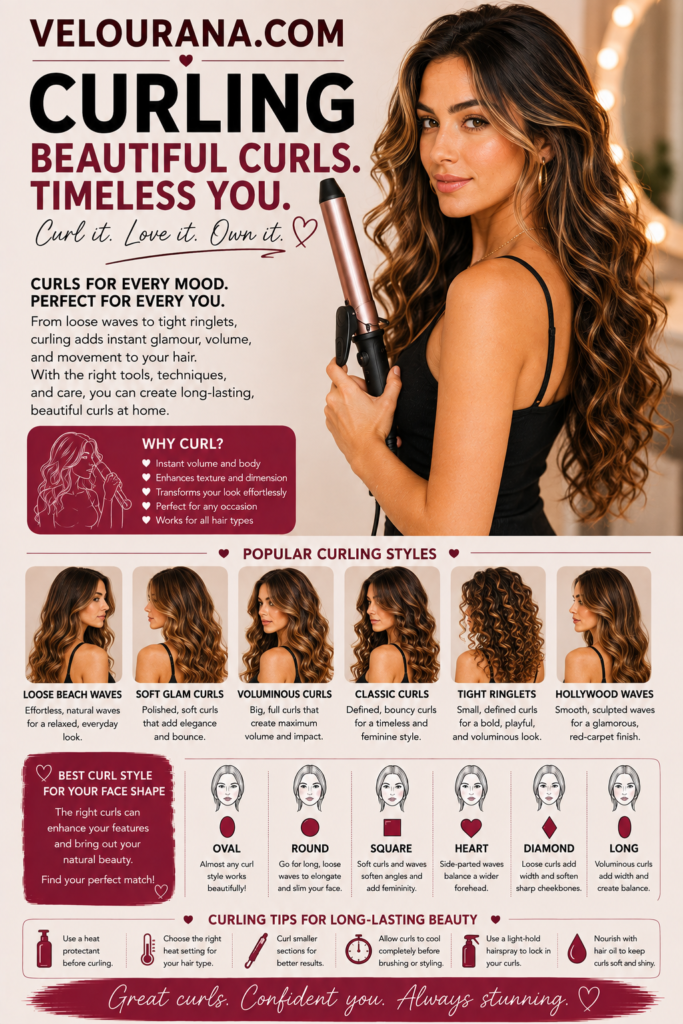
Curling can transform the appearance of a haircut without changing its length, layers or basic structure. A few carefully placed bends can soften straight hair, defined spirals can make a simple style dramatically more expressive, and broad waves can reveal layers that are almost invisible when the hair hangs straight. Yet the most successful curled hairstyles rarely come from treating every strand in exactly the same way.
Beautiful curling is largely about shape.
The size of the curl matters, but so does its direction. The position at which the curl begins influences whether the hairstyle feels polished or relaxed. The amount of movement around the face can completely alter the overall effect, while the way the curls are allowed to cool and eventually blend determines whether the finished style looks like natural flowing hair or a collection of separate ringlets.
Heat is only one possible way of producing this movement. Curling irons and wands offer speed and precision, while rollers, braids, twists and other heatless methods can create softer patterns over a longer period. Whatever method is chosen, the same fundamental principle applies: the goal is not simply to make hair curly. It is to create a pattern that complements the haircut, texture, length and desired silhouette.
Understanding that difference makes curling much more versatile. Instead of repeating one technique across the entire head, the hair can be shaped deliberately, with larger movement where softness is wanted, stronger definition where structure is useful and carefully chosen direction around the face.
The Best Curling Begins With the Finished Shape in Mind
Before reaching for a curling tool, it helps to decide what the hairstyle is supposed to become. A glamorous blowout-inspired finish requires a different curl pattern from loose beachy waves. Defined spirals behave differently from large brushed-out curls. A soft bend through the middle of long hair creates a completely different impression from curls beginning close to the roots.
This decision affects almost everything that follows.
Large curls generally create broad movement and visible body. Smaller curls produce stronger definition and can create considerably more volume. Curling only the lower lengths leaves the upper hair smoother and produces a relaxed finish. Beginning higher creates more movement throughout the hairstyle.
The haircut also influences what will look natural. Long layers can support cascading curves because the shorter sections move independently above the longer ones. A blunt cut creates a heavier perimeter and may look particularly striking with broad, uniform movement. Medium hair can hold substantial bounce because it has enough length to form curls without the weight of very long hair pulling them downward.
There is therefore no single ideal curl.
The right curl is the one that supports the hairstyle being created.
Preparation Determines How Easily the Hair Can Be Shaped
Curling usually works best when the hair is dry, detangled and organized before styling begins. Trying to create polished curls while simultaneously working through knots makes consistent sectioning difficult and can result in unnecessary pulling.
When heat tools are being used, an appropriate heat-protective product can be applied according to its instructions. Heat protection should be considered part of a sensible heat-styling routine rather than permission to use unlimited temperature or repeatedly re-curl the same section.
The hair should also be allowed to dry completely before conventional hot-tool curling. A curling iron or wand is designed to shape dry hair, not to function as a drying appliance.
Preparation does not need to mean coating the hair with numerous products. The amount and type should suit the texture and density. Fine hair can lose movement when overloaded, while thicker or coarser-feeling hair may respond differently to richer styling products.
What matters is creating a manageable foundation that allows the curling itself to remain controlled.
Sectioning Creates Consistency Without Making the Result Uniform
Curling an entire head without sectioning can quickly become confusing. Finished pieces mix with untouched ones, some strands are curled repeatedly, and others can be missed completely.
Dividing the hair creates order.
The lower hair can be styled while the upper lengths remain clipped away, with additional sections released progressively. This does not mean every curl must become identical. Sectioning simply makes the process easier to control.
Section size influences the finished pattern. A large amount of hair wrapped around a tool creates a different result from a narrow section. Smaller sections generally allow stronger, more defined shaping, while larger sections create broader movement.
Density also matters. Thick hair may require more sections because each piece needs to be manageable. Fine hair may need fewer.
The objective is consistency of technique rather than mechanical uniformity. A natural-looking curled hairstyle often contains subtle variations in size and direction.
Curling Iron Size Changes the Character of the Hairstyle
The diameter of a curling iron or wand strongly influences the scale of the movement.
Larger barrels create broader curves. On long hair, they can produce soft waves and blowout-like movement. On medium lengths, they can create substantial bounce. Very large barrels may create only a gentle bend on shorter hair because there is not enough length to wrap around them several times.
Smaller barrels produce tighter curves and stronger definition. They can be useful on short sections, smaller curls or hairstyles intended to have more texture and volume.
The relationship between barrel size and hair length is therefore important.
A tool does not create exactly the same curl on every haircut.
The amount of hair that can wrap around the barrel changes with length, and the weight of the hair influences how much the curl relaxes afterward.
Temperature Should Support the Technique Rather Than Replace It
Higher heat is not automatically better curling.
Hair characteristics, tool design, section size and styling technique all influence how effectively a curl forms. Using excessive temperature because a section is too large or because the same piece is being repeatedly corrected is not an efficient solution.
A better approach is to use a suitable setting for the hair and tool, work with manageable sections and avoid holding concentrated heat on one area longer than necessary.
The hair does not need to become extremely hot to prove that the curl has been created.
Heat exposure is influenced by more than the temperature setting alone. Duration matters. Repeated passes matter. The frequency of heat styling matters.
Good technique reduces unnecessary repetition.
The Position of the Tool Determines Where Movement Begins
A curl does not need to start at the scalp.
For relaxed waves, the upper portion of the hair can remain smoother while movement begins around the middle of the lengths. This creates a more casual transition and prevents the hairstyle from becoming overly full at the roots.
For a more glamorous or voluminous finish, the curl can begin higher.
The decision should reflect the desired silhouette.
If the crown already has substantial natural volume, beginning every curl close to the root may create more fullness than wanted. If the hair tends to lie flat, higher movement can help the hairstyle appear more dimensional.
Curl placement is therefore just as important as curl size.
Curl Direction Changes the Entire Flow of the Hair
Two curls created with the same tool can look completely different when they travel in opposite directions.
Around the face, curling away from the features creates an open effect. The hair sweeps backward, exposing more of the cheekbones and sides of the face. Curling inward creates a softer, more enclosed frame.
Neither direction is inherently better.
They simply create different visual effects.
The choice becomes particularly important with face-framing layers because those sections are designed to influence the front silhouette.
The rest of the hair can follow one consistent direction for a polished, coordinated result or alternate directions for a more relaxed appearance.
Alternating Curls Create Softer, Less Uniform Texture
When neighboring sections are curled in opposite directions, they are less likely to merge into one continuous wave.
The hairstyle gains separation.
This can create a casual, textured effect particularly suited to long and medium hair.
Alternating direction is often associated with beachier styles because the hair does not appear to follow one perfectly organized pattern.
The variation should still feel intentional. Randomly changing every aspect of the curl can make the hairstyle look confused rather than relaxed.
Consistency can remain in the barrel size and general curl strength while direction provides variation.
Curling in One Direction Creates a More Polished Pattern
When sections travel consistently, the curls can begin blending into larger waves.
This is useful for more glamorous finishes.
Once the curls have cooled, they can be brushed or gently blended so that individual ringlets become part of a continuous pattern.
The result can resemble sculpted waves rather than separate curls.
This style depends on planning because the direction established during curling determines how naturally the sections connect afterward.
Face-Framing Curls Deserve Special Attention
The sections nearest the face influence the entire hairstyle.
A beautiful pattern through the back can be overshadowed if the front pieces sit awkwardly.
Long face-framing layers often respond beautifully when directed away from the face. The movement exposes the features and blends naturally into longer curls behind them.
A softer inward curve creates another effect, particularly when the desired style is romantic or contained.
The front sections do not need to match the rest of the head exactly. They should support the shape of the haircut and the way the hair is intended to frame the face.
Curtain Bangs Can Become Part of the Curl Pattern
Curtain bangs already contain a directional concept: they separate around the center and move outward.
Curling can reinforce that shape.
The sections can be given a broad curve rather than a tight ringlet, allowing them to sweep naturally into the longer face-framing layers.
If the curl is too strong, the bangs can appear disconnected from the rest of the hairstyle.
The strongest result usually allows the movement to become progressively softer as the front blends into the lengths.
Long Hair Creates Space for Gradual Curl Patterns
Long hair offers enough length for curls to develop visibly.
A section can remain relatively smooth near the root, begin curving through the middle and finish with stronger movement toward the ends.
This gradual pattern can create a sophisticated result because the hair does not become uniformly curly from top to bottom.
Long hair also carries more weight.
A curl that appears strong immediately after styling may relax considerably as the lengths settle. This should be considered before aggressively brushing or stretching the curls immediately.
Allowing them to cool first preserves more control over the final degree of softness.
Long Layers Make Curls More Dimensional
Layered hair naturally creates several levels of movement.
Shorter pieces can form curls higher in the hairstyle.
Longer sections fall beneath them.
This produces depth that one-length hair cannot create in exactly the same way.
Curling can emphasize those differences without requiring every layer to become dramatically curled.
A broad curve in the shortest sections may be enough to reveal the haircut, while the longest hair carries softer movement below.
Medium Hair Can Hold Noticeable Bounce
Medium-length hair occupies an ideal space for many curled styles.
There is enough length to create clear curves, but less weight than very long hair to pull those curves downward.
The result can be particularly bouncy.
Large curls create a polished blowout effect. Smaller sections create stronger texture. Curling only the lower half can produce a relaxed style, while beginning higher creates more volume.
Shoulder-length layers can become especially expressive because each section moves independently.
Short Hair Requires More Attention to Scale
Short hair can be curled beautifully, but tool size becomes particularly important.
An extremely large barrel may not create much visible movement because the hair cannot wrap sufficiently around it.
A smaller tool can provide greater control.
The objective also changes. Short hairstyles may rely more on bends, direction and texture than on long spirals.
A bob can gain a soft wave.
A longer pixie can develop movement through the top.
Short face-framing sections can curve away from the features.
The curling technique should adapt to the available length rather than trying to reproduce a long-hair curl on a much shorter cut.
Bobs Become Completely Different With Curling
A sleek bob emphasizes the precision of the haircut.
Curling changes its personality.
Soft waves can make the perimeter appear lighter and more relaxed. Defined curls can create substantial volume. A single broad bend can produce a modern, understated finish.
The position of the movement matters because a bob already has a strong shape.
Too much volume concentrated at the ends can create excessive width, while well-placed movement through the middle can make the hairstyle feel balanced.
Fine Hair Benefits From Movement Without Excessive Manipulation
Fine hair can appear considerably fuller once it is curled because the strands no longer lie directly against one another.
Even broad waves create space.
The challenge is preserving that movement without weighing the hair down or repeatedly handling it until the curls disappear.
Fine hair may benefit from smaller, manageable sections and restrained finishing.
The curls can initially be left slightly stronger than the desired final appearance because they may relax naturally.
Once cool, they can be blended carefully.
There is rarely a need to brush aggressively through them immediately.
Thick Hair Can Carry Strong Curl Patterns
Dense hair offers substantial material for curled styles.
The result can be dramatic, but the process requires organization.
Large sections may appear curled on the outside while the interior receives much less consistent shaping. Dividing thick hair into manageable sections provides greater control.
The finished volume should also be considered.
If the hair already has significant density, very small curls throughout the entire head can create enormous expansion.
That may be desirable.
If a softer result is wanted, larger movement and strategic placement can create shape without maximizing volume everywhere.
Straight Hair Can Use Curls to Reveal Hidden Dimension
Straight hair often displays curling patterns very clearly because the contrast between the natural direction and styled movement is obvious.
Large curls can add body.
Soft waves can create texture.
Face-framing sections can gain direction.
A completely straight layered haircut may suddenly reveal much more structure once the layers are curved.
The hair does not need to become dramatically curly.
Sometimes a small amount of bend is enough to transform the silhouette.
Naturally Wavy Hair Can Be Refined Rather Than Rebuilt
Wavy hair already contains movement, so curling does not always need to begin from zero.
A few sections may need stronger definition.
The front may need more deliberate direction.
Some waves may be broader than others.
A curling tool can refine selected areas rather than being used over every strand.
This selective approach can create a more natural result because the original texture remains part of the hairstyle.
The objective becomes consistency of overall shape rather than identical curls.
Curly Hair Can Also Benefit From Selective Curling
Naturally curly hair sometimes contains sections with different degrees of definition.
A few pieces may stretch more than others.
The front may need reshaping.
Rather than restyling the entire head, selected curls can be refined to blend more naturally with the surrounding pattern.
Matching the approximate size and direction of the natural curls is important.
A highly artificial spiral placed among softer natural curls may stand out rather than integrate.
The Ends Should Not Automatically Receive the Most Heat
It is common to concentrate heavily on the ends because they are the final part wrapped around a tool.
Yet the ends may also be among the areas that have experienced the most previous styling and environmental exposure.
Technique should remain controlled.
Depending on the desired hairstyle, the ends can even remain slightly straighter.
This is particularly effective in modern loose-wave styles, where the bend occurs through the middle while the final centimeters remain less curled.
Straighter Ends Create a More Relaxed Wave
Leaving the very ends less curved changes the entire character of the hairstyle.
The result feels less like traditional ringlets and more like loose movement.
This can work especially well on long hair and blunt or lightly layered cuts.
The contrast between the curved mid-length and straighter end creates an intentionally undone finish.
Fully Curled Ends Create a More Finished, Romantic Shape
When the curl continues through the ends, the hairstyle becomes softer and more traditional.
Long layers can form cascading curves.
Medium hair can gain bounce.
The overall pattern appears more complete.
The choice between straighter and curled ends should therefore be made deliberately rather than occurring accidentally.
Cooling Is Part of Curling, Not an Afterthought
One of the most important stages happens after the hair leaves the tool.
A warm curl is still settling.
Immediately stretching, brushing or repeatedly touching it can weaken the shape before the hairstyle has had time to stabilize.
Allowing curls to cool before major manipulation gives greater control over the final result.
This does not mean every curl must remain untouched for an elaborate period. It simply means there is value in completing the head before aggressively blending the pattern.
Pinning Curls While They Cool Can Create Stronger Structure
For styles requiring more pronounced or lasting movement, a freshly formed curl can sometimes be supported in its coiled shape while cooling.
This creates a more structured starting pattern.
Once released, the curl can be softened to the desired degree.
The technique is particularly useful when the final hairstyle will eventually be brushed into broad waves because a stronger initial shape provides more room for controlled relaxation.
Brushing Curls Can Transform Them Rather Than Destroy Them
Brushing curled hair is sometimes treated as something that should never happen.
In reality, brushing can be an important styling stage when the intended result is broad, connected movement.
The timing matters.
Brushing immediately while the curls are still warm can remove more structure than desired.
Waiting until they have cooled allows the stylist to begin with a stronger pattern.
The brush can then transform individual curls into larger waves.
This is how a hairstyle can move from obvious ringlets to a softer, more polished finish.
Finger Separation Creates a Different Result
Using the fingers instead of a brush preserves more individual definition.
The curls can be gently separated and arranged without becoming one continuous wave.
This works particularly well for relaxed, textured hairstyles.
The amount of separation controls the final volume.
More separation creates more individual pieces and often a fuller silhouette.
Less separation preserves stronger curl groups.
A Wide-Tooth Comb Can Create Broad Separation
Between brushing and finger styling lies another possibility.
A wide-tooth comb can loosen curls while preserving more structure than a conventional brush might.
The finished result depends on the original curl strength, hair texture and amount of combing.
As with every finishing technique, restraint matters.
It is easier to soften curls gradually than to reconstruct them after they have been completely brushed out.
Heatless Curling Creates a Different Kind of Movement
Curling does not require a hot tool.
Braids, twists, rollers and wrapped techniques can reshape damp or appropriately prepared hair as it dries or sets.
The resulting pattern depends on the method.
Braids tend to create repeated waves.
Twists produce another type of movement.
Large rollers create broad curves and volume.
Smaller rollers can produce stronger curls.
Heatless methods generally require more time but less direct thermal styling.
Braids Create Soft Repeated Waves
The number and size of braids influence the pattern.
A few large braids create broader movement.
Smaller braids create more frequent bends and greater texture.
The hair should be completely dry before the braids are released if the pattern is expected to hold reliably.
Once opened, the waves can be separated carefully rather than immediately brushed away.
Twists Create Looser, More Irregular Movement
Twisting hair before it sets can create softer curves than a tightly structured braid.
The pattern may feel less repetitive.
This can be useful when the goal is relaxed texture rather than obvious uniform waves.
The final result varies according to hair type, section size and how tightly the twist was formed.
Rollers Can Create Classic Volume and Curl
Rollers shape hair around a fixed diameter, making them particularly useful for broad, controlled movement.
Large rollers can create root lift and sweeping curves.
Smaller rollers create stronger curls.
Placement determines direction.
This makes rollers a highly deliberate form of curling even though the method may not involve a traditional curling iron.
Heatless Curls Still Need Time to Set
Removing a heatless curling method too early can leave sections partially shaped or still damp.
The hair needs enough time to adopt and retain the new form.
This makes heatless curling particularly suitable for situations where the hair can remain arranged for several hours or overnight, depending on the method and hair characteristics.
Curling Should Work With the Haircut
The most convincing curls reveal the haircut rather than hiding it.
Layers should become more visible.
Face-framing sections should contribute to the front.
A blunt perimeter should retain enough structure to remain recognizable.
Short hair should gain movement appropriate to its scale.
Long hair should use its length to create gradual flow.
When every section is curled identically without considering the cut, some of that architecture can disappear.
Curl Placement Can Change the Apparent Shape of the Face
Hair around the face creates visual lines.
Movement directed outward opens the sides of the face.
Movement directed inward creates a closer frame.
Volume concentrated near the cheek area creates a different impression from volume beginning lower around the shoulders.
These effects can be adjusted without changing the haircut.
Curling therefore becomes a way of temporarily redesigning how the haircut frames the face.
The Crown Does Not Always Need Curl
A curled hairstyle can still have a relatively smooth crown.
Beginning the curls lower creates a relaxed appearance and keeps the upper silhouette controlled.
This can be particularly useful when the hair already has natural root volume.
Conversely, hair that tends to lie flat may benefit from movement beginning higher.
The curl pattern should respond to the existing volume rather than automatically treating every head of hair the same way.
Curling Can Create Volume Without Backcombing
Because curls occupy more space than straight lengths, the hairstyle can become fuller simply through movement.
Layers separate.
The ends expand.
The sides gain dimension.
This can reduce the need for aggressive teasing when volume is the goal.
Root lift can be created separately through blow-drying or styling if necessary, while the curls provide body through the lengths.
Finishing Products Should Preserve the Movement
Once the curls have been created and blended, finishing should support rather than bury them.
The appropriate product depends on the hair and desired result.
A soft wave should still move.
Defined curls should remain visible.
Fine hair should not become unnecessarily heavy.
The finish should complement the work already done rather than trying to create the hairstyle after the fact.
Humidity and Natural Texture Will Influence the Result
Curling temporarily changes the shape of the hair.
The environment continues to interact with it afterward.
Humidity may encourage naturally wavy or curly hair to move back toward its original pattern. Straight hair may lose some artificial curl. Dense hair may expand.
The exact response varies widely.
A curled hairstyle should therefore be expected to evolve.
Softening during the day can even improve some styles, particularly when the initial curls were deliberately created slightly stronger than the final desired appearance.
Second-Day Curls Can Become Beautiful Waves
A curled hairstyle does not necessarily end after one day.
As the pattern relaxes, defined curls may become broad waves.
The crown may soften.
The sections may blend more naturally.
Rather than recreating the entire hairstyle, only the pieces that have lost too much movement can be refreshed.
This can create a more relaxed second-day version of the original style.
Refreshing Selected Curls Is Usually Better Than Re-Curling Everything
The front may need attention before the back.
One side may have relaxed more because of sleeping position.
A few upper layers may have lost their curve.
Those pieces can be identified individually.
Re-curling every section simply because a few have changed adds unnecessary work and heat exposure.
Selective refreshing keeps the hairstyle looking intentional while preserving sections that are already behaving well.
Curling Should Become More Natural as the Technique Improves
Early attempts at curling often focus heavily on making every section identical.
With experience, the styling can become more selective.
Some curls can be larger.
Some can begin lower.
The front can receive special direction.
The crown can remain smoother.
The ends can vary slightly.
This controlled variation is often what makes the finished hairstyle appear effortless.
The Difference Between Randomness and Natural Variation
Natural-looking hair does not require random technique.
There should still be a plan.
The barrel size can remain consistent while direction alternates.
The front can always move away from the face while the back varies.
The curl can begin lower in selected areas while the crown retains more lift.
These decisions create variation within a coherent structure.
Randomness has no hierarchy.
Natural styling does.
When Curls Become Part of the Hair Rather Than the Hairstyle
The most attractive curled styles often reach a point where the individual technique becomes difficult to see.
The viewer no longer notices that one section was wrapped around a barrel, another was directed away from the face and another was deliberately left softer.
Instead, the hair simply appears to move beautifully.
That is the goal.
Curling should create shape without making the method more noticeable than the result.
Long hair can develop broad cascading movement. Medium hair can become buoyant and expressive. Short hair can gain texture and direction. Fine hair can appear fuller because the strands occupy more space, while thick hair can use larger curves to organize its natural density.
Straight hair can gain dimension.
Wavy hair can have selected sections refined.
Naturally curly hair can use targeted curling to restore pieces that have lost definition.
Heatless methods can create their own softer patterns when time allows.
The possibilities are broad because curling is not one hairstyle.
It is a method of introducing controlled movement.
Once barrel size, section size, direction, placement and finishing are chosen according to the haircut rather than applied mechanically, the result becomes more sophisticated. The curls can be strong or barely visible. They can remain individually defined or merge into polished waves. They can begin near the roots or appear only through the lower lengths.
What matters is that the movement has purpose.
The front frames the face deliberately. The crown carries the right amount of volume. The layers remain visible. The ends complete the shape. The curls are given time to settle before they are softened, and the finished hair is allowed to move rather than being forced into a rigid arrangement.
Curling is most successful when it stops being about producing as many curls as possible and becomes instead a way of shaping the entire hairstyle.
That shift—from creating individual curls to designing movement—is what turns a simple styling technique into a polished, adaptable finish.
The End
Velourana.
 Discover More From Our Family of Websites
 ZodiacBearing (Astrology, Tarot, Numerology, Angel Numbers & Spiritual Guidance)
 Velourana (Beauty, Makeup, Hair Care, Skincare & Beauty Tips)
 HavenBearing (Home, Living, Organization, Décor & Everyday Inspiration)
 PawBearing (Pet Care, Dog Breeds, Animal Health, Training & Pet Products)
 PsyCatherine (Notes From the Journal of a Psychologist on Real Life)