
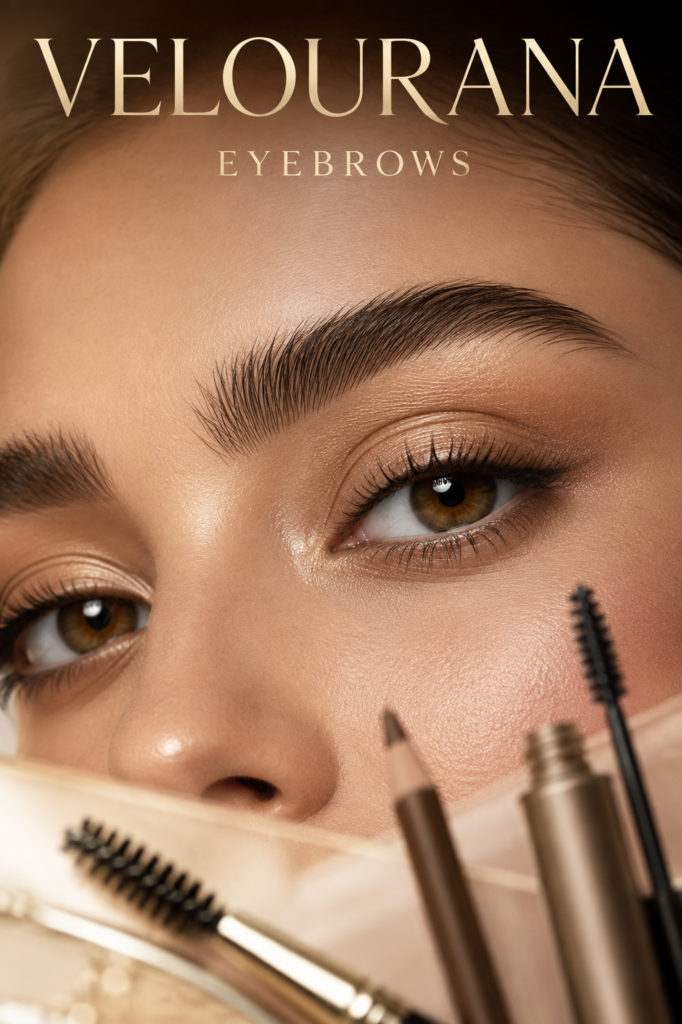
CATEGORY: Brow Pencils
The difference between an eyebrow that looks naturally fuller and one that looks obviously drawn can come down to details measured in millimeters. A pencil tip that is slightly too broad, a shade fractionally too warm or a little too much pressure at the front of the brow can change the entire impression. Conversely, several almost invisible strokes in exactly the right places can make sparse brows appear denser without announcing the presence of makeup.
This subtlety is what makes brow pencils deceptively sophisticated.
They are among the most accessible makeup products: portable, self-contained and generally intuitive to hold. Yet mastering them requires understanding color, texture, facial proportion and the natural behavior of eyebrow hair.
Choosing a brow pencil is therefore about more than deciding between blonde and brunette. Tip geometry influences the type of marks that can be created. Formula determines how easily pigment transfers and blends. Undertone affects whether the color appears integrated with natural hair. Even the spoolie attached to the pencil can influence the final result.
Once these variables are understood, brow pencil becomes less about correcting eyebrows and more about controlling visual balance.
Begin With the Brow You Actually Have
It is easy to approach brow makeup with an image of the eyebrow one wants rather than an understanding of the eyebrow already present.
That distinction matters.
Natural brows contain information about the proportions that suit the face. The position of the inner brow, direction of hair growth, highest point of the arch and natural trajectory of the tail collectively create an individual structure.
Before pencil is introduced, brushing through the eyebrow reveals that structure more accurately.
Hairs near the front may rise vertically or diagonally. Through the center they usually become more outward-facing, and near the tail their orientation changes again. Brushing also exposes areas where the skin is genuinely visible rather than merely hidden beneath overlapping hairs.
This examination can substantially reduce the amount of product required.
A brow that initially appears sparse may simply need hairs repositioned and two small gaps filled. Another may contain adequate density through the front but require reconstruction toward the tail.
Treating these brows identically would ignore their individual needs.
Pencil excels precisely because it allows selective intervention.
What the Pencil Tip Determines
The dimensions of a brow pencil tip affect both speed and precision.
Microfine tips are designed for extremely narrow marks. They can be particularly useful where individual simulated hairs are required, such as within sparse areas or near the front of the brow. Because each mark covers little surface area, density can be built gradually.
Fine traditional points offer similar control, especially immediately after sharpening. As the point wears down, however, the mark becomes broader unless the pencil is sharpened again.
Angled and triangular tips provide multiple working surfaces. The narrow edge can define while the wider face can shade. This versatility can make them efficient for fuller makeup looks or eyebrows requiring larger areas of pigment.
Broader pencils generally produce a softer shading effect rather than extremely fine hair simulation. This does not make them inferior. A person with relatively full brows who simply wants additional density may prefer this speed and softness.
The useful question is therefore not which pencil shape is objectively best, but what kind of mark the eyebrow requires.
If the goal is reconstructing isolated hairs, precision becomes important. If the objective is softly deepening a broad but pale eyebrow, a slightly larger tip may be entirely appropriate.
Formula Controls More Than Comfort
A brow pencil's texture influences how it interacts with both skin and hair.
Firm formulas tend to release pigment gradually. This can provide considerable control because several passes may be required to create strong color. For people who habitually press too hard, a firmer pencil may naturally moderate the result.
Creamier formulas deposit pigment more readily. Their glide can feel comfortable and make filling efficient, but they may become intense quickly. A light hand is particularly important.
Waxy formulas can offer grip and may contribute a small degree of control over brow hairs. Powdery pencils create a softer visual effect that can resemble the diffusion associated with traditional brow powder.
Long-wearing formulas are designed to resist fading, smudging, moisture or humidity to varying degrees. These qualities can be useful, although highly adherent products may provide less time for correction.
The relationship between formula and skin type should also be considered. An extremely creamy pencil may behave differently on oily skin than on dry skin. A very hard pencil may require more pressure on a dry or textured surface.
The ideal formula is therefore contextual rather than universal.
Undertone Is the Secret Behind Convincing Color
Brow color is often discussed primarily in terms of depth: light, medium or dark. Undertone can be just as important.
Two medium brown pencils may look completely different. One may contain noticeable warmth, while another appears neutral or ash. Against natural brow hair, this difference can determine whether the pencil disappears or becomes immediately apparent.
Many eyebrows contain cooler tones than people initially assume. This is one reason taupe and ash-based shades are so widely useful.
Warmth is not inherently undesirable. Auburn, copper and warmer brown coloring can harmonize beautifully with corresponding brow shades. The important issue is intentional harmony rather than selecting color solely from the name printed on the packaging.
Hair color on the head provides useful guidance but should not dictate the decision completely. Dyed hair, highlights, gray growth and naturally contrasting eyebrows can all complicate direct matching.
The complexion also changes how brow pigment is perceived. A particular brown may appear softer against one skin tone and considerably stronger against another.
Testing color within the actual eyebrow therefore provides information that a hand swatch cannot.
Building Dimension Instead of Filling a Shape
The phrase “fill in the brows” can encourage an unfortunate mental model. It suggests an outlined shape whose empty interior needs to be colored.
Natural eyebrows do not work that way.
They consist of individual hairs layered over visible skin. Density changes from one area to another. Borders are interrupted rather than perfectly continuous. Color varies because hairs overlap differently.
Convincing pencil work preserves some of this complexity.
Instead of imagining the eyebrow as an empty silhouette, it is more useful to view sparse sections as missing pieces of texture. Pencil marks can then replace only those missing pieces.
The inner brow is an excellent example. Completely shading this area can produce a dense rectangular beginning. Introducing several fine marks while allowing skin to remain visible creates a more dimensional transition.
Through the central brow, existing density may permit slightly more shading. Around the arch, carefully placed pigment can strengthen structure without requiring a hard outline.
The tail can tolerate somewhat greater precision because natural hairs already converge into a narrower shape there.
These variations prevent the eyebrow from appearing uniformly painted.
Pressure Is a Creative Tool
One pencil can effectively behave like several products depending on pressure.
Very light contact deposits a translucent trace of pigment. Repeating the stroke can gradually increase intensity. Firmer pressure produces a more immediate, opaque mark.
This ability to build color is one of the strongest arguments for starting gently.
A light mark can always be reinforced. A dark line may need to be erased, blended aggressively or covered with complexion product.
Pressure can also be intentionally varied across the eyebrow. The inner section can receive the lightest touch, while the middle and outer sections gradually gain definition.
This produces a visual gradient without necessarily changing shades.
Holding the pencil slightly farther from the tip may also encourage a looser touch, whereas gripping very close to the point can promote greater pressure and control. Neither position is inherently correct; they simply produce different movement.
The hand should respond to the effect being created rather than applying one fixed technique throughout.
Working With the Natural Direction of Hair
Individual pencil marks become more believable when they acknowledge how eyebrow hair actually grows.
At the inner brow, upward or upward-diagonal strokes may integrate naturally among existing hairs. Moving outward, strokes can gradually rotate to follow the changing direction of growth.
This variation is subtle but important.
Drawing every simulated hair vertically creates an exaggerated feathered effect. Drawing every mark horizontally can flatten the brow. Natural growth provides the most reliable guide.
Stroke length should also respond to surrounding hairs. Brow hairs are not identical, and simulated marks should not resemble repeated mechanical dashes.
This is where observation becomes more valuable than formulaic instructions.
A mirror positioned close enough to reveal hair direction allows the pencil to follow what is actually present. The user does not need to memorize an abstract brow pattern.
The eyebrow itself provides the pattern.
Correcting Asymmetry Without Erasing Character
The two eyebrows belong to the same face, but they are not mirror images.
One may begin slightly higher. One arch may be sharper. One tail may contain fewer hairs. Facial expressions and muscle activity can make these differences even more noticeable.
Brow pencil can create greater balance, but attempting mathematical symmetry may introduce new problems.
Suppose one brow sits slightly higher. Completely redrawing the lower eyebrow to match it could require expanding the entire shape. A smaller adjustment at one edge may provide enough visual balance without disguising the natural brow.
Similarly, if one arch is naturally more pronounced, softening or subtly strengthening selected areas may be preferable to reconstructing both arches.
The objective is not duplication.
When the face is viewed as a whole, minor differences between eyebrows often become insignificant. Excessive correction, by contrast, can make the makeup itself conspicuous.
This is why stepping back from the mirror periodically is useful. Close inspection reveals technical details, but normal viewing distance reveals whether those details actually matter.
Sparse Tails and Missing Sections
The tail is one of the most common areas for pencil correction because eyebrow density frequently decreases toward the outer edge.
Reconstructing it successfully requires more than drawing a line.
A natural tail is created by hairs converging into a taper. Pencil can imitate this by gradually narrowing the area of pigment as it moves outward.
If the extension maintains the same thickness from arch to endpoint, it can appear blunt. If it becomes an extremely thin dark line, it may look disconnected from the rest of the brow.
Integration is achieved through transition.
A few marks among existing hairs can gradually become more concentrated as natural density decreases. The final section can then taper without an obvious boundary between real and simulated brow.
The direction of the tail should also relate to the existing arch and eye area. Extending it dramatically downward can alter the perceived expression of the face.
Subtle extensions are often more convincing than ambitious reconstruction.
The Spoolie as an Editing Instrument
A spoolie is sometimes treated as preparation equipment, used before pencil and then forgotten.
Its greater value may actually appear during and after application.
Once pencil is added, the spoolie becomes an editing instrument. It can break up an overly concentrated area, redistribute pigment and expose whether strokes are sufficiently integrated with natural hair.
Brushing through the front can soften an abrupt beginning. Brushing through the body can reduce visible pencil marks without completely removing their contribution to density.
It can also reveal overapplication.
If the brow still appears substantially darker than intended after gentle blending, the problem may not require additional technique. It may simply contain too much pigment.
Using the spoolie intermittently encourages gradual construction. Pencil is added only where the blended brow still requires support.
This prevents a common cycle in which too much product is applied, aggressively blended away and then reapplied.
Combining Pencil With Brow Gel
Pencil and gel perform complementary roles.
Pencil primarily supplies pigment and visual structure where needed. Brow gel primarily influences the hairs themselves, although tinted gels can also contribute color and fullness.
For someone with long or unruly brow hairs, pencil alone may create beautiful definition that disappears as hairs shift throughout the day. Gel can maintain the arrangement that makes the pencil work visible.
Clear gel preserves the chosen pencil color while adding hold. Tinted gel introduces additional pigment and can make fine hairs appear more noticeable.
When combining them, restraint remains important. A strongly pigmented pencil followed by heavily tinted gel can quickly create more density than intended.
A lighter pencil application may be sufficient when tinted gel will subsequently deepen the eyebrow.
The relationship between products should therefore be considered as a whole rather than treating each application independently.
Pencil Makeup for Different Brow Personalities
Full eyebrows do not necessarily require less skill than sparse ones. They simply require a different kind of restraint.
On naturally dense brows, pencil may be confined to tiny interruptions in the hair pattern. Adding pigment everywhere can eliminate the very texture that makes the brows attractive.
Fine brows may benefit from carefully extending density around existing hairs rather than creating a strong outer border.
Coarse or wiry brows often depend more heavily on grooming and hold, with pencil providing selective definition beneath or between hairs.
Very pale brows may require color even when density is adequate. Here, broader soft shading can sometimes be more useful than drawing numerous individual hairs.
Brows affected by over-tweezing may contain distinct empty areas requiring precise reconstruction. Fine pencil tips can create structure without covering the entire eyebrow in equal intensity.
Mature eyebrows may become thinner or lighter with time. Softer color and controlled marks can restore definition without allowing the brow to dominate the face.
Each of these situations illustrates why brow pencils should be selected and used according to the eyebrow rather than according to a universal technique.
When Strong Definition Is Intentional
Natural-looking brows are only one aesthetic possibility.
Editorial makeup, evening makeup and more glamorous styles may deliberately emphasize the eyebrow. Stronger arches, cleaner borders and deeper color can create visual impact and balance dramatic eye makeup.
A pencil can create these effects while retaining more control than broad application methods.
The distinction between deliberate definition and accidental harshness is important. A sculpted eyebrow can still contain thoughtful gradients and clean transitions.
Even when the lower edge is sharply defined, the inner brow does not necessarily need identical intensity. Even when the tail is strong, the pigment can still taper deliberately.
Sophisticated dramatic makeup is not simply natural makeup with more product. It uses stronger structure intentionally.
Understanding subtle pencil technique therefore remains useful even for bold brows.
Knowing When the Brow Is Finished
Brow makeup is particularly vulnerable to overworking because the face can adjust visually to increasing intensity.
After several minutes of close inspection, a brow may begin to seem insufficiently defined even when it already appears strong at normal distance. Another stroke is added, then another, until the eyebrow becomes considerably darker than originally intended.
Stepping away from the mirror interrupts this process.
The finished brow should be assessed in relation to both eyes, the forehead, hair and overall makeup. What appears like a tiny imperfection in magnification may be completely invisible in context.
Natural brows contain irregularities. Preserving some of them can actually make cosmetic enhancement more convincing.
This is one of the paradoxes of brow pencil: technical precision often produces the best result when it is used selectively rather than everywhere.
Brow Pencil as Quiet Facial Architecture
Eyebrows contribute lines, angles and visual weight to the upper face. Changing them can subtly alter how other features are perceived.
Strengthening an arch may make the eye area appear more structured. Extending a short tail can change horizontal balance. Increasing density can create a stronger frame around the eyes, while softening an excessively dark brow may open the surrounding area.
These effects explain why brow pencil can make a noticeable difference even when observers cannot identify what has changed.
The product operates through small adjustments rather than obvious transformation.
This also explains why shade, pressure and placement matter so much. A few millimeters of added pigment in the wrong direction can influence shape disproportionately. The same amount placed carefully can restore balance.
Brow pencil is therefore a form of miniature facial architecture.
The best results are rarely about drawing perfect eyebrows from scratch. They emerge from reading the natural structure, identifying where visual information is missing and replacing only enough of it to complete the composition.
Whether the desired finish is feathered, polished, barely there or sharply defined, the principles remain remarkably consistent: observe first, choose color thoughtfully, work with hair direction, build pigment gradually and preserve dimension.
The pencil may be one of the smallest objects in a makeup bag, but its capacity for controlled definition is substantial. Used with sensitivity, it does not conceal the natural eyebrow beneath cosmetic color.
It simply helps the brow look more complete.
THE END VELOURANA
 Discover More From Our Family of Websites
 ZodiacBearing (Astrology, Tarot, Numerology, Angel Numbers & Spiritual Guidance)
 Velourana (Beauty, Makeup, Hair Care, Skincare & Beauty Tips)
 HavenBearing (Home, Living, Organization, Décor & Everyday Inspiration)
 PawBearing (Pet Care, Dog Breeds, Animal Health, Training & Pet Products)
 PsyCatherine (Notes From the Journal of a Psychologist on Real Life)

