
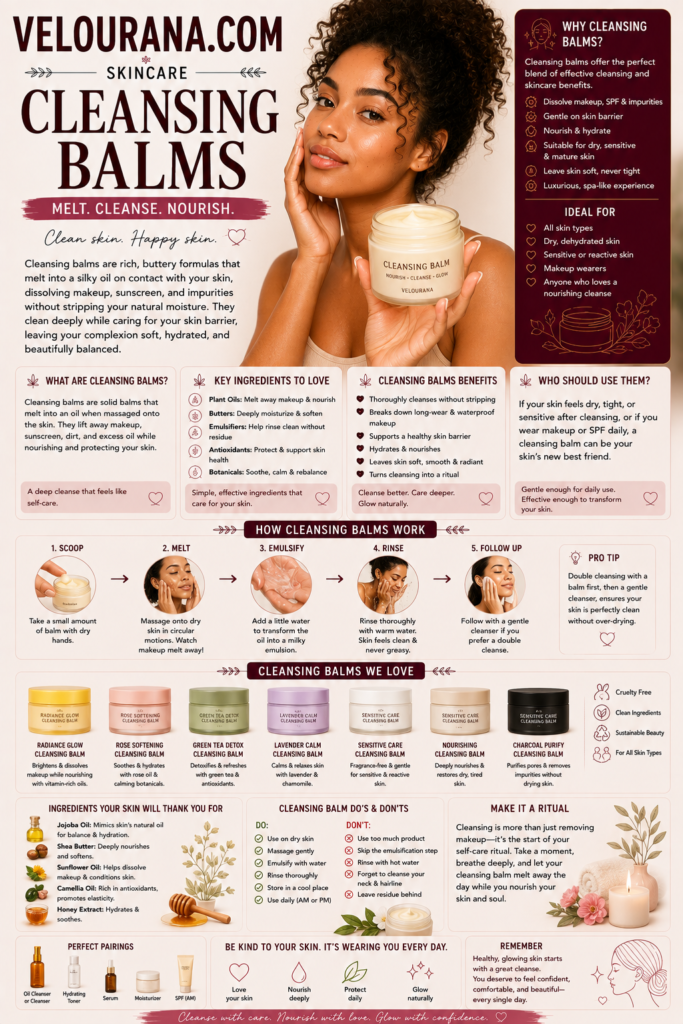
CATEGORY: Cleansing Balms
Choosing a cleansing balm looks simple until several jars are placed side by side.
One is firm and waxy. Another resembles soft sorbet. A third melts instantly. One turns milky the moment water touches it, while another remains rich and oily until it is removed with a cloth. Some contain fragrance and botanical oils. Others are deliberately minimal. Certain formulas leave the face exceptionally clean; others create a soft emollient film that remains noticeable after rinsing.
All of them may be called cleansing balms.
This is why shopping by category alone is not enough.
A cleansing balm is defined less by one ingredient than by the way a complete formulation behaves. It needs structure in the jar, enough slip to spread comfortably, sufficient oil-soluble capacity to loosen sunscreen and makeup, and an emulsifying system that determines what happens when water is introduced.
These properties create very different products even when the front labels sound almost identical.
The most useful way to choose among them is therefore not to ask which balm is “best” in the abstract.
The better question is what kind of cleansing experience the skin, makeup habits, sunscreen routine, and personal preferences actually require.
Start With What the Balm Has to Remove
A cleanser should be selected according to its workload.
Someone wearing lightweight moisturizer and a non-water-resistant sunscreen has a very different evening cleansing problem from someone wearing primer, long-wear foundation, waterproof mascara, setting spray, and several sunscreen applications.
The more persistent the daytime routine, the more important dissolving power becomes.
Heavy makeup users usually benefit from a balm with substantial slip and enough working time to loosen several layers without drying down or becoming difficult to spread.
Someone wearing only sunscreen may prefer a faster, lighter balm that emulsifies almost immediately and rinses with minimal residue.
This difference is easy to overlook because many balm cleansers are marketed as universal.
In reality, lifestyle strongly affects whether a formula feels elegant or excessive.
A very rich balm may be wonderful after a full face of evening makeup but unnecessarily heavy on a bare-skin day.
A lightweight balm may be perfect for everyday sunscreen removal but require too much rubbing when confronted with waterproof cosmetics.
Product performance makes more sense when judged against the job it was asked to perform.
Texture Tells You Something, but Not Everything
The first thing most people notice is texture.
Cleansing balms can range from almost solid to extremely soft.
Firm formulas often contain more structuring materials and may require warming between the fingertips before they spread smoothly.
Soft balms melt more quickly and can feel closer to cleansing oils once applied.
Neither structure is inherently superior.
A firmer balm can provide control because it stays where it is placed until massaged.
A softer balm may feel more luxurious because it transforms immediately.
Climate can influence preference as well.
A formula that feels beautifully buttery in winter may become much softer during hot weather.
Likewise, someone who dislikes the possibility of leakage during travel may appreciate a more stable, structured balm.
Texture can also affect dosage.
A firm balm taken with a spatula may encourage relatively consistent amounts.
A very soft balm may lead the user to scoop more than necessary.
These details seem small, but they influence how the product performs night after night.
The Melt Should Feel Effortless
A good cleansing balm should not fight the skin.
Once warmed, it should spread with enough slip that the fingers move comfortably across the face.
If significant pressure is required simply to distribute the product, the balm may be too firm for the user's preference or too little product may be being used.
The melt should create a continuous oil-like layer.
That layer is important because it allows the cleanser to contact the entire film of sunscreen or makeup.
Uneven application can leave resistant areas behind.
The sides of the nose, eyebrows, hairline, jaw, and around the lips often need deliberate coverage.
A balm with sufficient working time makes this easier.
The ideal melt is therefore not merely a sensory feature.
It determines how effectively the cleanser can reach what it needs to remove.
Emulsification Is the Property Most Shoppers Underestimate
When cleansing balms are discussed, ingredients receive enormous attention.
Emulsification receives much less.
Yet emulsification determines whether the dissolved makeup and sunscreen actually leave the face efficiently.
Before water is added, the balm has incorporated oily debris into its own oil-rich phase.
That mixture must then be converted into something water can carry away.
A strong emulsifying system makes this transition easy.
Wet fingertips are introduced and the balm quickly becomes thinner, cloudier, or milky.
Additional water disperses the mixture further.
Rinsing then removes most of the product without prolonged wiping.
A weaker or intentionally richer emulsifying system may leave more residue.
Some users love this finish.
Others dislike it intensely.
This single property can determine whether a balm feels elegant on dry skin, greasy on oily skin, soothing on mature skin, or frustrating on someone who wants a completely clean rinse.
The correct emulsification profile is therefore highly personal.
It is also one of the best reasons to judge cleansing balms by actual use rather than ingredient lists alone.
A Milky Transformation Is Useful, but It Does Not Need to Be Dramatic
Many people expect a cleansing balm to turn completely white when water is introduced.
Some do.
Others become only slightly cloudy.
The visual drama does not necessarily measure cleansing quality.
The real question is whether the product becomes more water-dispersible.
If the balm thins and rinses easily, emulsification is occurring even if the transformation is subtle.
Conversely, a dramatic white emulsion does not guarantee that the skin will be left completely residue-free.
Formulas vary.
Consumers should therefore focus less on how impressive the transformation looks and more on the final result.
The Finish Matters More Than the Marketing Language
One balm may promise nourishment.
Another may emphasize purification.
A third may describe itself as barrier-supportive.
These claims can sound meaningful, but the finish after rinsing often tells the user far more.
Does the skin feel clean?
Does it feel coated?
Does it feel tight?
Does the eye area remain comfortable?
Does subsequent skincare apply normally?
Does makeup remain around the hairline?
Does the surface feel soft without feeling greasy?
These observations are practical and reproducible.
They make it easier to compare products objectively.
A cleanser's job ends when cleansing is complete.
The state of the skin at that moment is therefore one of the most useful measures of performance.
Dry Skin Often Prefers Comfort Over Absolute Degreasing
Dry skin frequently responds well to balms that leave a soft emollient after-feel.
That does not mean residue is automatically beneficial.
It means that a completely stripped sensation is usually unnecessary.
A formula with moderate richness can remove sunscreen and makeup while leaving the skin comfortable enough to proceed with moisturizer without urgency.
The key distinction is between softness and coating.
Softness feels integrated.
Coating feels like the cleanser never quite left.
If the balm leaves a heavy layer that interferes with skincare or feels unpleasant beneath moisturizer, a cleaner-rinsing formula may be preferable even for dry skin.
The best product is not the one that leaves the most behind.
It is the one that leaves the right amount for the individual user.
Oily Skin Often Prefers Faster Rinsing
People with oily skin commonly appreciate balms that emulsify quickly and rinse with relatively little film.
This makes sense.
If the skin already feels oily by the end of the day, a cleanser that leaves a persistent emollient layer may feel unsatisfying.
A faster-rinsing balm can provide the dissolving advantages of oil cleansing without a heavy finish.
A second cleanser can also be used when necessary.
But the second step should not exist solely because the balm is impossible to remove.
Ideally, the balm should already perform most of the work.
The second cleanse should refine the finish rather than rescue the first cleanser from poor rinsability.
Sensitive Skin Benefits From Fewer Unnecessary Variables
For sensitive-feeling skin, simplicity can be valuable.
This does not mean every sensitive person must use an extremely short ingredient list.
It means ingredients should have a reason to be present.
Added fragrance can make cleansing more enjoyable, but it may also be unnecessary for someone who repeatedly reacts to fragranced skincare.
Essential oils may create an appealing botanical story while offering little benefit to the core cleansing function.
Colorants, aromatic extracts, and elaborate sensory ingredients are not automatically problematic, but they introduce variables.
A person with highly reactive skin may find a relatively plain balm easier to evaluate and tolerate.
The priority remains cleansing performance.
Everything else is optional.
Botanical Does Not Automatically Mean Gentle
The beauty industry often presents plant-derived ingredients as naturally compatible with sensitive skin.
That assumption deserves caution.
Plants contain biologically active compounds.
Some are beneficial.
Some are neutral.
Some can irritate or sensitize certain individuals.
Essential oils are a particularly clear example.
They may smell beautiful and contribute to the sensory identity of a cleansing balm.
But aromatic plant compounds are not automatically mild.
Someone who tolerates them well may have no problem.
Someone with fragrance sensitivity may prefer to avoid them.
The more useful distinction is not natural versus synthetic.
It is tolerated versus not tolerated.
The Ingredient List Cannot Predict Everything
Ingredient literacy is useful, but there are limits to what a consumer can infer from a label.
Two balms can contain similar oils and still behave very differently.
The percentages differ.
The emulsifying systems differ.
The wax structures differ.
The processing methods differ.
The overall architecture differs.
A familiar oil near the top of the ingredient list does not guarantee that the finished balm will be gentle.
Likewise, a formula containing unfamiliar esters may perform beautifully.
Cosmetic products are mixtures.
Performance arises from the complete system.
This is one reason reviews of rinsing behavior, texture, and actual makeup-removal performance can be more informative than trying to rank formulas according to isolated ingredients.
Oils Shape Slip and Solvency
The oil phase contributes strongly to how a balm feels and what it removes efficiently.
Different oils and esters vary in viscosity, spreadability, polarity, oxidative stability, and sensory finish.
Some feel rich.
Others feel dry and silky.
Certain esters create exceptionally light slip.
Hydrocarbon-based emollients can produce clean spreading and strong makeup-removal performance.
Plant oils may add a more familiar or nourishing narrative.
None of these categories is automatically superior.
The ideal oil phase is the one that allows the balm to spread well, dissolve the target products, remain stable, and rinse appropriately once the emulsifying stage begins.
This balance is more important than whether the oils sound luxurious on the package.
Waxes and Structuring Agents Determine the Jar Experience
A cleansing balm needs to remain a balm before use.
That requires structure.
Waxes, fatty materials, polymers, and other ingredients can create this architecture.
The exact system determines whether the product is brittle, buttery, sorbet-like, dense, whipped, or almost liquid.
This matters during storage.
A balm that becomes too soft in summer may be messy.
A formula that is too hard in winter may require excessive warming.
The best texture remains usable across the conditions in which the product is actually stored.
Consumers in hot climates may prefer a more structurally stable balm.
Those storing products in cooler bathrooms may tolerate softer systems easily.
Again, lifestyle matters.
Packaging Changes the Experience More Than Expected
Most cleansing balms come in jars.
This format suits the texture because a solid product is difficult to dispense through a conventional pump.
But jars require direct contact.
A spatula can improve hygiene and dosing, particularly when included with the product.
It also prevents long fingernails from becoming an obstacle.
Some users do not mind scooping with clean fingers.
Others dislike it enough that they ultimately stop using the product consistently.
Packaging preference should therefore be taken seriously.
The best cleanser is useless if its container makes the user avoid it.
Travel matters too.
A secure screw-top jar may be easier to transport than a cleansing oil bottle that could leak.
On the other hand, the jar is heavier and usually less convenient for rapid use.
No format wins universally.
Eye-Makeup Removal Deserves Its Own Evaluation
A balm may be exceptional at removing foundation and disappointing around the eyes.
This is not unusual.
Waterproof mascara presents a demanding removal challenge.
Some formulas dissolve it quickly.
Others require prolonged contact.
The presence of fragrance can also become more noticeable around the eyes.
A user who regularly wears waterproof eye makeup should therefore evaluate eye compatibility separately rather than assuming facial performance predicts everything.
The best eye-removing balm should loosen mascara without requiring aggressive rubbing.
It should not cause persistent burning.
It should rinse without leaving prolonged cloudy vision.
If the product repeatedly irritates the eyes, a separate eye makeup remover may be more sensible.
There is no rule that one cleanser must do everything.
Heavy Makeup Requires Working Time
Very fast-rinsing formulas can be appealing.
But a balm should not begin breaking down before it has had enough time to dissolve the products on the face.
Heavy makeup users often benefit from a formula that remains slippery for a little longer.
This gives the cleanser time to work through foundation, concealer, cream products, waterproof eye makeup, and long-wear lip color.
Working time should not be confused with prolonged massage.
The balm simply needs to remain spreadable while the makeup loosens.
Once the job is done, extended rubbing offers little extra benefit.
Sunscreen-Only Users Can Prioritize Efficiency
Someone who rarely wears makeup may not need a dense, luxurious balm.
A lighter formula can be more practical.
The cleanser only needs to dissolve sunscreen, sebum, and the day's accumulation.
Fast emulsification becomes especially appealing.
The entire process can remain brief.
This is an important reminder that balm cleansing does not need to become a ritual.
It can be purely functional.
A thirty-second efficient cleanse can be just as legitimate as a slower spa-like one.
Fragrance Changes the Emotional Experience
The aroma of a cleansing balm can influence how often someone wants to use it.
This is not trivial.
Skincare routines depend on consistency.
A product that feels pleasurable may be used more reliably.
At the same time, fragrance can complicate tolerance for some users.
Choosing fragranced or fragrance-free is therefore not a moral decision.
It is a balance between sensory preference and skin compatibility.
If fragrance causes no difficulty and makes cleansing enjoyable, there may be no reason to avoid it.
If the skin repeatedly reacts, the sensory benefit is not worth the irritation.
The correct choice is personal.
Luxury Price Does Not Guarantee Better Cleansing
Cleansing balms occupy an unusually broad price range.
Some are affordable everyday products.
Others are positioned as luxury skincare and priced accordingly.
A higher price may reflect packaging, fragrance development, brand positioning, ingredient sourcing, sensory refinement, or marketing.
It does not guarantee that the balm removes sunscreen more effectively.
A relatively inexpensive formula can have excellent emulsification and makeup-removal performance.
A luxury balm may justify its price through exceptional texture and sensory experience rather than superior basic cleansing.
Consumers should therefore decide what they are actually paying for.
If the goal is simple functional cleansing, performance matters most.
If the ritual itself is part of the pleasure, sensory refinement may legitimately matter more.
Both motivations are valid.
They should simply not be confused.
A Balm Does Not Need Ten Skincare Actives
Modern cleansers increasingly contain ingredients associated with serums and moisturizers.
Niacinamide.
Ceramides.
Antioxidants.
Peptides.
Botanical extracts.
These additions can make formulas more appealing.
But a cleansing balm is still a rinse-off product.
Its contact time is limited.
Much of the formula is deliberately removed.
This does not mean supportive ingredients are meaningless.
It means they should not distract from the core job.
A cleansing balm that contains fashionable actives but emulsifies poorly is not necessarily better than a simpler formula that removes sunscreen perfectly and leaves the skin comfortable.
Cleansers should be judged primarily as cleansers.
“Non-Comedogenic” Is Not an Absolute Guarantee
Acne-prone consumers often look for the words “non-comedogenic.”
This can be useful as a general formulation signal.
It should not be interpreted as a guarantee that no individual will ever develop congestion.
Comedogenicity is influenced by formulation, concentration, individual skin, use pattern, and the interactions between multiple products.
A balm labeled non-comedogenic may still feel too rich for someone.
A balm without the label may work perfectly.
Repeated skin response remains more informative than one marketing term.
Patch Testing Has Limits With Cleansers
Patch testing is commonly recommended for skincare.
With cleansers, it can identify obvious irritation in some cases.
But it cannot perfectly predict whether a balm will contribute to congestion across the face over several weeks.
Nor can a small patch replicate the complicated combination of sunscreen, makeup, massage, emulsification, and rinsing involved in actual use.
Testing is therefore useful but incomplete.
The real evaluation happens through repeated normal use.
This makes changing one product at a time especially valuable.
If several products are introduced simultaneously, identifying the cause of a reaction becomes difficult.
Watch What Happens Around the Hairline
The hairline is an excellent test of cleansing performance.
Foundation and sunscreen often collect there.
If a balm does not spread easily into the area, residue may remain.
If it emulsifies poorly, the hairline may feel greasy afterward.
Repeated residue can make the cleanser seem less effective than it initially appeared.
A balm that performs beautifully in the center of the face but consistently leaves product along the edges may require better technique or may simply be a poor match.
The same applies to the jaw and ears.
Cleansing should follow the territory of application.
The Spatula Is More Useful Than It Looks
Many balm cleansers include a small spatula.
It is easy to lose and easy to dismiss.
But it serves several practical purposes.
It keeps fingers out of the jar.
It helps control quantity.
It makes the product easier to use with long nails.
It can also prevent water from being accidentally introduced by wet fingertips.
Keeping the spatula clean and dry is important.
A dedicated place on or inside the packaging helps.
A tiny accessory can materially improve the usability of the product.
Storage Conditions Matter
Balm texture can change with temperature.
High heat may soften the formula.
Cold may harden it.
These changes do not necessarily mean the product has spoiled, but extreme conditions can affect the user experience.
Storage away from direct sun and excessive heat is generally sensible.
The bathroom may be convenient, but consistently hot or humid environments are not always ideal for cosmetic storage.
The manufacturer's instructions should take priority when specific conditions are provided.
Do Not Judge the Balm Before Emulsifying Properly
Many disappointing experiences with cleansing balms are really technique problems.
The balm is applied correctly.
Makeup dissolves.
Then the user immediately splashes water on the face and rinses.
A greasy film remains.
The cleanser is blamed.
Sometimes the formula truly is rich.
But sometimes the missing step is deliberate emulsification.
Wet fingertips should be worked through the balm before the full rinse.
This gives the emulsifying system time to reorganize the oily mixture.
Once the product becomes thinner and milkier, rinsing becomes easier.
Technique cannot rescue every poor formula.
But it can dramatically change how a good one performs.
Do Not Over-Massage in Search of Better Results
A more expensive balm does not need a ten-minute massage to justify itself.
Once sunscreen and makeup have dissolved, the useful work is largely complete.
Prolonged massage creates more friction without necessarily producing better cleansing.
This is especially relevant for acne-prone, rosacea-prone, or sensitive-feeling skin.
The balm's slip can make extended massage feel harmless.
But mechanical stimulation still accumulates.
Efficiency remains preferable to ritual for ritual's sake.
The Second Cleanser Should Complement the Balm
If double cleansing is part of the routine, the two products should work together.
A rich balm followed by an extremely stripping foaming cleanser creates an unbalanced sequence.
A cleaner-rinsing balm followed by a mild gel cleanser may feel more coherent.
Dry skin may prefer a balm followed by a creamy cleanser.
Oily skin may prefer a lightweight balm followed by a gentle gel.
Sensitive skin may use the balm alone when it removes everything adequately.
There is no universally correct pairing.
The final state of the skin matters more than the labels on the bottles.
How to Compare Two Balms Fairly
Trying two cleansing balms on different days can be surprisingly difficult because the makeup and sunscreen load changes.
One day may involve waterproof mascara.
Another may involve no makeup.
One day may be hot and humid.
Another may be spent indoors.
A fair comparison considers similar conditions.
Use similar amounts.
Wear similar products.
Follow the same emulsification process.
Observe the same areas.
Then compare spreadability, dissolving power, eye comfort, rinsing, residue, and post-cleanse comfort.
This produces much more useful information than simply asking which balm felt more luxurious during the first few seconds.
The Best Formula Disappears From the Routine
An excellent cleansing balm can be almost invisible in its effectiveness.
It does not require troubleshooting.
It does not leave makeup behind.
It does not force the user to scrub.
It does not sting.
It does not create a residue that must be corrected.
It simply works.
This is a useful standard because beauty products often become more complicated as they become more expensive.
But cleansing does not need complexity.
It needs reliability.
Choosing According to Skin, Not Identity
Skincare labels can become identities.
Dry skin.
Oily skin.
Sensitive skin.
Mature skin.
Acne-prone skin.
These categories are useful, but real skin often crosses several at once.
Someone can be oily and dehydrated.
Dry and acne-prone.
Sensitive and mature.
Oily in summer and dry in winter.
A cleansing balm should therefore be chosen according to actual current behavior rather than a permanent label.
The product that works in January may feel excessive in August.
The balm that worked before starting a retinoid may feel too fragranced afterward.
Adaptation is not inconsistency.
It is responsive skincare.
The Cleansing Balm Checklist That Actually Matters
The most useful evaluation can ultimately be reduced to a small group of observations, even though the formulation science behind them is complex.
Does it spread without tugging?
Does it dissolve what you actually wear?
Does it emulsify reliably?
Does it rinse to a finish you enjoy?
Does the skin remain comfortable?
Does repeated use appear compatible with your skin?
Everything else is secondary.
A Good Cleansing Balm Matches the Routine Around It
The best cleansing balm cannot be chosen in isolation.
It exists within a larger system.
The sunscreen used in the morning affects how much removal is needed at night.
The presence of waterproof makeup changes the cleanser's workload.
Acne treatments affect how much irritation the skin can tolerate.
Climate influences texture preference.
A second cleanser changes how much residue is acceptable.
Personal sensory preferences determine whether fragrance and richness make the routine enjoyable or irritating.
This is why there is no single ideal cleansing balm.
There are only formulas that fit particular routines exceptionally well.
Choosing Better Means Looking Past the Jar
Cleansing balms are easy to sell through texture.
The scoop.
The melt.
The fragrance.
The luxurious packaging.
The transformation can feel theatrical enough that performance becomes secondary.
But a cleanser should ultimately be judged by what happens after the theatre ends.
The sunscreen should be gone.
The makeup should be gone.
The cleanser itself should be gone to the degree the user prefers.
The skin should remain comfortable.
That is the entire standard.
A beautiful balm that cannot accomplish these things is merely beautiful.
A simple balm that accomplishes them consistently may be the more sophisticated product.
The most successful cleansing balm is therefore not necessarily the richest, most expensive, most botanical, or most heavily promoted.
It is the one whose texture, dissolving power, emulsification, rinse, and after-feel match the person using it.
When those elements align, cleansing becomes uncomplicated.
The balm melts.
The day dissolves into it.
Water transforms the mixture.
Everything that needs to leave is carried away.
And the skin is left ready for the rest of the routine without needing to recover from the first step.
That is what a cleansing balm should do.
The End Velourana
 Discover More From Our Family of Websites
 ZodiacBearing (Astrology, Tarot, Numerology, Angel Numbers & Spiritual Guidance)
 Velourana (Beauty, Makeup, Hair Care, Skincare & Beauty Tips)
 HavenBearing (Home, Living, Organization, Décor & Everyday Inspiration)
 PawBearing (Pet Care, Dog Breeds, Animal Health, Training & Pet Products)
 PsyCatherine (Notes From the Journal of a Psychologist on Real Life)

