CATEGORY: Dehydration
Dehydrated skin has a way of making simple skincare feel complicated. The complexion can look dull, feel tight, become more sensitive than usual and suddenly make familiar products seem less effective. Fine lines appear sharper, makeup becomes less forgiving, and even skin that normally feels oily may develop a dry, uncomfortable surface. Faced with these changes, many people respond by adding more: another serum, a richer mask, an extra essence, a barrier balm, perhaps an exfoliant to smooth the roughness that dehydration itself has created.
The result is often a routine that becomes larger while the skin becomes less predictable.
A better approach begins with a different question. Instead of asking how many hydrating products can be layered onto the face, it is more useful to ask what the skin actually needs in order to regain and maintain water comfortably.
In most cases, the answer is less dramatic than skincare marketing suggests.
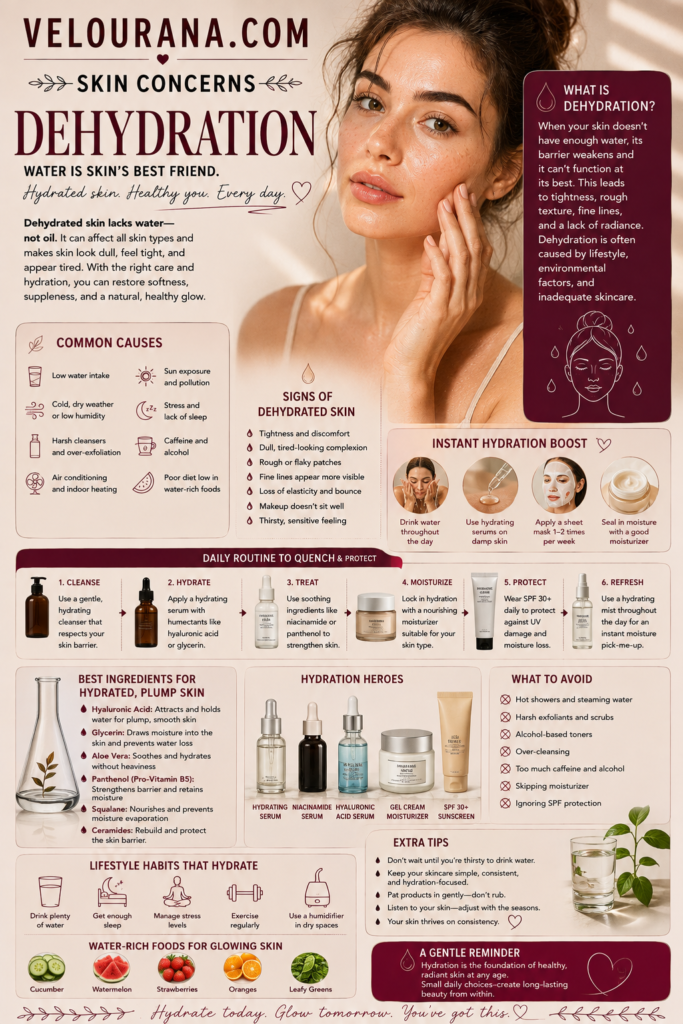
Dehydrated skin benefits from a routine that does four things well: cleanses without unnecessary stripping, attracts and binds water where useful, supports the outer barrier so that water is not lost too quickly, and protects the complexion from environmental stress. Everything else is secondary.
This does not mean sophisticated skincare is pointless. Serums, active ingredients and specialised treatments can all have legitimate roles. But they work best when they are built on a stable foundation rather than used to compensate for a foundation that is failing.
The most effective dehydration routine is therefore not necessarily the most elaborate one.
It is the one in which every step has a reason to exist.
Start by Understanding What Dehydration Is
Before building a routine, it helps to separate dehydration from dry skin.
Dry skin is generally associated with lower oil production. Dehydration refers primarily to insufficient water within the outer layers of the skin or to difficulty retaining that water.
The two conditions can overlap, but they are not identical.
Someone with naturally dry skin can certainly become dehydrated, especially during winter or after aggressive cleansing. But someone with oily skin can also become dehydrated while continuing to produce substantial sebum.
This distinction changes how a routine should be constructed.
A person with naturally dry and dehydrated skin may benefit from richer emollient and occlusive support. Someone with oily and dehydrated skin may prefer lighter textures while still needing humectants and barrier support.
The objective is therefore not to force every dehydrated complexion into the same routine.
It is to understand the skin's baseline type, then address the temporary water imbalance on top of it.
That prevents a common mistake: treating every tight-feeling complexion with the heaviest possible cream.
Heavy products can be useful, but they are not automatically the answer.
The First Step Is Often to Simplify
When skin is dehydrated, adding products can make it harder to understand what is happening.
A routine may contain a foaming cleanser, exfoliating toner, vitamin C serum, niacinamide serum, hyaluronic acid, retinoid, moisturiser, facial oil and sleeping mask. Each product has a purpose, but if the complexion suddenly becomes irritated, determining the source becomes difficult.
Simplification creates clarity.
A basic routine of cleanser, moisturiser and sunscreen can serve as a stable foundation. If the skin is significantly irritated, reducing optional active ingredients temporarily may allow the barrier to recover.
Once comfort improves, other products can be reintroduced gradually.
This is not a rejection of active skincare.
It is a way of separating essential support from optional treatment.
When dehydration is present, the skin may benefit more from consistency than innovation.
Morning Cleansing Does Not Need to Be Aggressive
The morning routine begins with cleansing, but how much cleansing is necessary depends on the individual.
Some people wake with noticeable oil and prefer a gentle cleanser. Others, particularly those prone to dehydration, may find that a simple rinse or very mild cleanse leaves the skin more comfortable.
There is no universal requirement that every person use a strong cleanser twice daily.
The most useful measure is how the skin feels afterward.
Clean skin should not feel painful, stretched or squeaky.
Persistent tightness after washing can indicate that the cleanser is too harsh, the water is too hot or cleansing frequency is excessive.
For dehydrated skin, the goal is effective cleansing with minimal disruption.
Warm water is generally preferable to very hot water, and vigorous scrubbing is unnecessary.
A cleanser should remove what needs to be removed and then leave the skin alone.
Hydrating Toners and Essences Are Optional, Not Essential
Hydrating toners and essences can be pleasant additions to a dehydration routine.
They often contain humectants such as glycerin, hyaluronic acid, panthenol or other water-binding ingredients. Applied after cleansing, they can provide an immediate feeling of softness and improve the sensory experience of the routine.
But they are not mandatory.
The idea that dehydrated skin requires multiple watery layers comes largely from modern multi-step skincare culture rather than from biological necessity.
A well-formulated moisturiser can provide hydration without an elaborate sequence beforehand.
This is important for people who feel overwhelmed by long routines or who have reactive skin.
Every additional product introduces another formulation, another set of ingredients and another potential source of irritation.
Hydrating toners are useful when they add genuine comfort.
They are unnecessary when they merely increase complexity.
Humectants Help Attract Water
Humectants form the core of many hydration-focused products.
Ingredients such as glycerin, hyaluronic acid and urea help attract and bind water within the outer skin.
They are valuable because they increase the water available to the stratum corneum.
Glycerin is particularly common and has been used in moisturising formulations for decades. Hyaluronic acid has become more fashionable, but both ingredients belong to the same broad functional category.
Humectants can make the skin feel plumper and smoother.
However, they are most effective when combined with ingredients that help reduce water loss.
This is why a hydrating serum alone may not be sufficient.
The skin needs both hydration and retention.
A Serum Should Solve a Specific Problem
The popularity of serums has created the impression that every routine needs several.
For dehydrated skin, one hydrating serum can be useful, but only if it adds something the moisturiser does not already provide.
A formula containing glycerin, hyaluronic acid, panthenol or similar ingredients may improve comfort.
The advantage of a serum is primarily formulation.
Because serums are usually lightweight, they can deliver humectants without the heavier texture of a cream.
This can be particularly helpful for oily or combination skin.
But redundancy is common.
If a toner, essence, serum and moisturiser all contain similar humectants, the routine may contain four different products performing essentially the same function.
More layers do not necessarily equal more hydration.
A single effective product can often do the job.
Moisturiser Is the Structural Centre of the Routine
If one step deserves particular attention in a dehydration-focused routine, it is moisturiser.
A well-formulated moisturiser can combine humectants, emollients and occlusive ingredients within one product.
Humectants help bind water.
Emollients smooth and soften the skin surface.
Occlusive ingredients reduce the rate at which water escapes.
This combination is what makes moisturiser more than simply another source of hydration.
It supports retention.
The right texture depends on the skin.
Oily skin may prefer a gel-cream or lightweight lotion.
Normal or combination skin may tolerate a medium-weight lotion or cream.
Dry skin may benefit from richer creams or products with stronger occlusive properties.
There is no virtue in choosing a heavier product than necessary.
The objective is sufficient support without creating discomfort.
Apply Moisturiser While the Skin Is Slightly Damp
One of the simplest hydration improvements requires no new product.
After cleansing, applying moisturiser while the skin is still slightly damp can help retain some of the water present on the surface.
This principle is commonly recommended in dermatological dry-skin care.
The idea is straightforward.
Water left on the skin begins evaporating.
Applying moisturiser soon afterward helps slow that process.
The skin does not need to be dripping wet.
Slight dampness is enough.
This technique works on both the face and body.
It is particularly useful after showering, when large areas of skin may otherwise lose water rapidly as they dry.
Facial Oils Are Not Hydration in Themselves
Facial oils are often marketed as deeply hydrating, but technically they do not add water to the skin.
Their main role is lipid-based.
They can act as emollients and, depending on the oil and formulation, may help reduce water loss to some degree.
This can make them useful for dry or dehydrated skin, but they work best as part of a broader system.
Applying oil to severely dehydrated skin without any water-based hydration underneath may improve softness while doing relatively little to increase water content.
This distinction matters.
Oil can help seal.
It cannot replace water.
Occlusives Are Powerful but Not Always Necessary
Occlusive ingredients create a more water-resistant layer on the skin surface.
Petrolatum is one of the best-known examples.
These ingredients can significantly reduce water loss and are particularly useful for very dry or compromised areas.
But a full occlusive layer is not necessary for everyone.
People with oily or acne-prone skin may dislike the texture.
Others may find it extremely useful on specific dry patches.
Targeted use can therefore be more practical than applying a heavy occlusive everywhere.
For example, the corners of the nose, lips or areas around the mouth may need more protection than the forehead.
Skincare does not have to be uniform across the face.
Sunscreen Belongs in a Hydration Routine
Sunscreen is not usually described as a hydration product, yet it belongs in any well-designed daytime routine.
Ultraviolet exposure contributes to premature skin ageing and can affect the overall condition of the skin.
Broad-spectrum sunscreen therefore supports long-term skin quality.
For dehydrated skin, texture matters.
Some sunscreens are mattifying and may feel drying.
Others contain moisturising ingredients and can function almost like an additional daytime moisturiser.
Choosing a formulation that suits the skin can make consistent application much easier.
The best sunscreen is one that provides adequate protection and can be worn comfortably every day.
Hydration and sun protection should complement one another.
A Simple Morning Routine Is Often Enough
A practical morning routine for dehydrated skin can be remarkably short.
Gentle cleansing or rinsing comes first.
A hydrating serum can follow if desired.
Moisturiser provides the main support.
Sunscreen completes the routine.
That is enough for many people.
The sophistication lies not in the number of steps but in whether the products work together.
A lightweight serum that pills beneath moisturiser is not helpful.
A moisturiser that makes sunscreen slide around is not ideal.
Compatibility matters.
The Evening Routine Has a Different Job
Evening skincare begins with removal.
Sunscreen, makeup, excess sebum and daily residue need to be cleansed appropriately.
For people wearing long-lasting makeup or resistant sunscreen, double cleansing can be useful.
But double cleansing should not become double stripping.
The first step should dissolve or loosen makeup and sunscreen.
The second should cleanse the remaining residue gently.
After cleansing, the evening routine becomes an opportunity for treatment and recovery.
Active ingredients can be included if the skin tolerates them.
Moisturiser should remain central.
For dehydrated skin, the evening routine often benefits from being calmer than the morning.
Retinoids Require Respect for Hydration
Retinoids are widely used for acne and visible signs of ageing.
They can be effective, but they can also cause dryness and irritation, especially during the early stages of use.
For someone with dehydrated skin, introducing a retinoid aggressively may worsen discomfort.
Frequency matters.
Starting slowly can improve tolerance.
Some people also use moisturiser before or after retinoid application depending on the formulation and professional guidance.
The objective is not to force the skin to tolerate the maximum possible amount.
It is to find a frequency that provides benefit without creating unnecessary irritation.
A treatment that repeatedly damages tolerance may become difficult to use consistently.
Exfoliating Acids Should Not Compete With Barrier Recovery
Alpha hydroxy acids, beta hydroxy acids and other exfoliating products can improve texture and address specific concerns.
They can also worsen dehydration if overused.
This is particularly important because dehydrated skin often looks rough.
The instinct is to exfoliate that roughness away.
But if the roughness is caused by insufficient hydration or barrier disruption, stronger exfoliation may make the problem worse.
When the skin is already tight, stinging or flaky, hydration and recovery generally deserve priority.
Exfoliation can be reconsidered once the skin becomes comfortable again.
The sequence matters.
Niacinamide Can Be Useful but Is Not Mandatory
Niacinamide appears frequently in barrier-focused skincare.
It can support several aspects of skin function and is often included in moisturisers and serums.
For many people, it is well tolerated.
For others, high concentrations may cause irritation.
This illustrates a broader principle.
No ingredient is universally essential.
A routine should not be built around collecting ingredients simply because they are popular.
If a moisturiser already contains niacinamide and works well, an additional niacinamide serum may add little.
The objective is function, not duplication.
Ceramides Support the Lipid Barrier
Ceramides are naturally present within the stratum corneum and contribute to barrier organisation.
Moisturisers containing ceramides are often marketed specifically for dry, sensitive or barrier-compromised skin.
These formulations can be useful for dehydration because they support the lipid environment involved in reducing water loss.
But ceramides are not magic in isolation.
Their effectiveness depends on the overall formulation.
A well-designed moisturiser containing ceramides can be a valuable choice.
A poorly tolerated product does not become suitable simply because the word "ceramide" appears on the label.
The complete formula matters more than one fashionable ingredient.
Dehydrated Oily Skin Needs Lighter Architecture
Oily skin often benefits from a different texture strategy.
The same functional categories still matter: water-binding ingredients, emollients and some form of barrier support.
But the formulation can be lighter.
A gel-cream containing glycerin, hyaluronic acid or panthenol may provide comfortable hydration without feeling heavy.
The moisturiser can then be adjusted according to season.
During humid weather, a lightweight formula may be enough.
In winter, a lotion or richer gel-cream may provide better support.
The objective is not to remove moisturiser because the skin produces oil.
It is to find a formulation that the skin actually wants to wear.
Dehydrated Dry Skin Needs More Lipid Support
Naturally dry skin often requires more than humectants.
Because sebum production is lower, richer emollient and occlusive support may be beneficial.
Creams containing ceramides, fatty alcohols, shea butter, petrolatum or other lipid-rich ingredients can help reduce water loss and improve softness.
For very dry areas, an occlusive layer at night may provide additional support.
The key is comfort.
Dry skin that remains tight despite multiple watery serums likely needs more than water-binding ingredients.
It needs retention.
Combination Skin Does Not Need One Uniform Strategy
Combination skin complicates hydration because different areas behave differently.
The forehead and nose may become oily.
The cheeks may feel normal or dry.
The area around the mouth may become tight.
Trying to force one texture everywhere can create problems.
A lighter moisturiser can be used across the entire face with additional cream applied only to dry areas.
Alternatively, different products can be used by zone.
This targeted approach is often more comfortable than choosing between one extreme and another.
Skin does not have to be treated as a single uniform surface.
Sensitive Dehydrated Skin Needs Fewer Variables
When dehydration is accompanied by sensitivity, simplicity becomes even more valuable.
Fragrance, strong acids, essential oils and multiple actives may increase irritation for some individuals.
The safest strategy is usually to establish a minimal baseline and introduce additional products cautiously.
Gentle cleanser.
Moisturiser.
Sunscreen.
Then one additional product at a time.
This makes reactions easier to identify and reduces the possibility of several irritating products interacting at once.
Sensitive skin rarely benefits from experimentation at maximum speed.
Seasonal Adjustments Keep the Routine Relevant
A hydration routine that works perfectly in summer may fail in winter.
Humidity, temperature, wind, indoor heating and air conditioning all affect how rapidly water is lost.
Skincare should therefore adapt.
A summer gel can become a winter lotion.
An evening cream can become richer during cold weather.
Exfoliation frequency can be reduced when the air becomes dry.
These small adjustments often prevent dehydration before it becomes severe.
The goal is not to rebuild the entire routine each season.
It is to change only what the environment requires.
Makeup Preparation Should Begin With Skin Comfort
Dehydrated skin often becomes most obvious when makeup is applied.
Foundation clings to dry patches.
Concealer collects in fine lines.
Powder exaggerates texture.
The instinct may be to buy a more hydrating foundation.
Sometimes that helps.
But makeup performs better when the skin underneath is comfortable first.
Applying a suitable moisturiser and allowing it to settle can improve the surface.
Very dry areas may need a little more product.
Very oily areas may need less.
The skin should feel flexible rather than coated.
Primer can then be used strategically if desired.
Makeup preparation works best when skincare does the foundational work.
Night Masks Are Supportive, Not Essential
Sleeping masks can provide additional hydration and occlusion.
They are especially popular for dehydration because they create an immediate sensation of softness.
Used occasionally, they can be useful.
But they should not compensate for an inadequate everyday routine.
If the skin requires a rescue mask every night simply to feel comfortable, the cleanser, moisturiser or active-product schedule may need reconsideration.
Daily stability matters more than emergency treatment.
Mists Provide Refreshment More Reliably Than Lasting Hydration
Facial mists can feel pleasant, particularly in dry indoor environments or during travel.
They cool the surface and provide immediate water.
But water alone evaporates.
A mist therefore does not necessarily create lasting hydration unless the surrounding routine helps retain that water.
For some people, applying a mist and then following with moisturiser can be useful.
Spraying repeatedly throughout the day without any barrier support may provide only temporary relief.
The distinction between refreshing and moisturising is important.
Do Not Chase Every Tight Day With a New Product
Skin naturally fluctuates.
Weather changes.
Hormones change.
Sleep changes.
Travel changes.
One unusually tight day does not necessarily require a new routine.
Repeated product changes can create more instability than the original problem.
Before buying something new, it is worth observing the skin for several days.
Was the weather unusually dry?
Was an exfoliant used recently?
Were showers hotter than usual?
Was the routine inconsistent?
Sometimes the cause is temporary.
Consistency gives the skin enough time to show whether the existing routine is actually failing.
A Good Routine Should Become Boring
There is a point at which successful skincare becomes uneventful.
The cleanser works.
The moisturiser feels comfortable.
The sunscreen sits well.
The skin stops stinging.
Fine dehydration lines become less obvious.
Makeup behaves predictably.
There is no constant crisis requiring another intervention.
This can feel almost disappointing in a beauty culture built around novelty.
Yet predictability is one of the best signs that the routine is working.
Healthy hydration is not dramatic.
It is stable.
When to Reintroduce Active Ingredients
Once dehydration has improved, active ingredients can be added back gradually.
One change at a time is easier to evaluate.
If the skin tolerates a retinoid twice weekly, there is no reason to immediately increase to daily use.
If an exfoliating acid works once weekly, that may be enough.
The skin should determine frequency.
Marketing schedules do not know the individual complexion.
Tolerance is part of effectiveness.
When Professional Advice Is Appropriate
Persistent dehydration-like symptoms deserve evaluation when they do not respond to sensible skincare changes.
Significant redness, itching, cracking, bleeding, pain, swelling or recurring rash may indicate something beyond simple dehydration.
Conditions such as eczema, contact dermatitis, seborrheic dermatitis, psoriasis and rosacea can produce symptoms that overlap with ordinary dryness.
A dermatologist can distinguish between them.
Professional evaluation is also useful when acne treatments, prescription retinoids or other medical therapies are causing significant irritation.
Skincare should support treatment, not compete with it.
The Best Routine Is the One the Skin Can Sustain
A dehydration routine does not need twenty products.
It needs structure.
Cleansing should remove what is necessary without leaving the skin stripped.
Hydrating ingredients can attract and bind water.
Moisturiser should help retain that water and smooth the surface.
Sunscreen protects during the day.
Active ingredients can then be added according to genuine concerns and individual tolerance.
This structure works because it respects the underlying physiology rather than chasing symptoms product by product.
The skin does not need to feel dramatically transformed after every application.
It needs to remain comfortable between applications.
That is the real test.
A routine is successful when the skin stops demanding rescue.
Hydration becomes consistent.
Texture becomes calmer.
Products stop stinging.
The complexion looks more even and flexible.
And skincare becomes something that supports the skin quietly rather than constantly trying to control it.
The End Velourana
 Discover More From Our Family of Websites
 ZodiacBearing (Astrology, Tarot, Numerology, Angel Numbers & Spiritual Guidance)
 Velourana (Beauty, Makeup, Hair Care, Skincare & Beauty Tips)
 HavenBearing (Home, Living, Organization, Décor & Everyday Inspiration)
 PawBearing (Pet Care, Dog Breeds, Animal Health, Training & Pet Products)
 PsyCatherine (Notes From the Journal of a Psychologist on Real Life)