
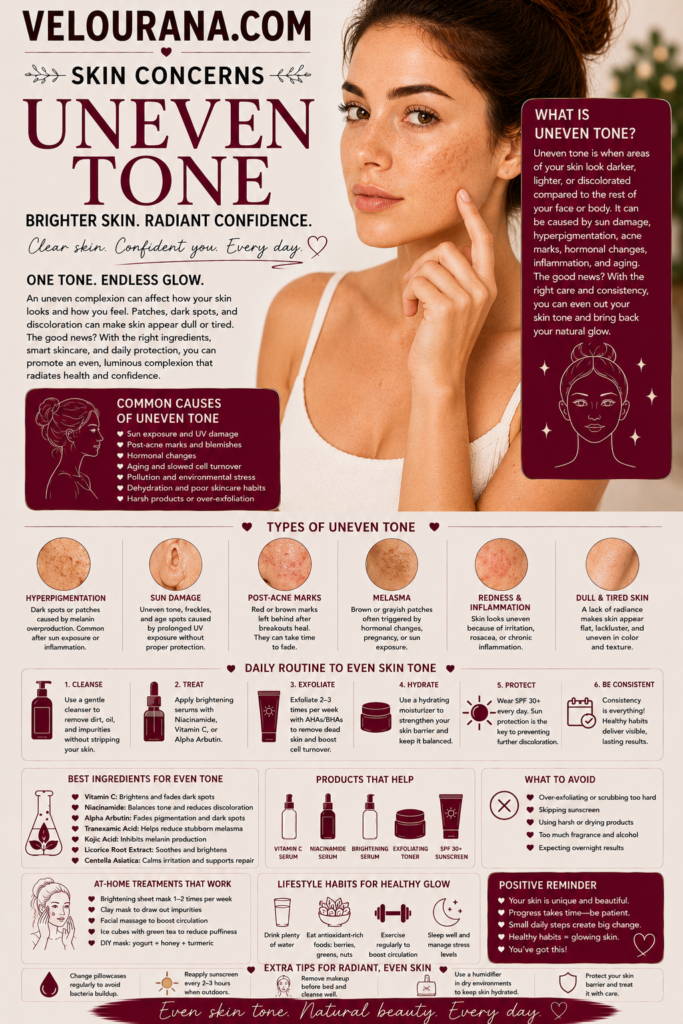
CATEGORY: Uneven Tone
Uneven tone rarely responds well to impatience.
That is one of the most important truths to understand before building any long-term skincare strategy for pigmentation. Dark marks, patchy discoloration, post-inflammatory pigmentation, redness, dullness, and sun-related changes usually develop gradually. They reflect biological processes that have been shaped by years of ultraviolet exposure, inflammation, hormones, skin injuries, environmental stress, and the natural evolution of the skin itself. Expecting all of this history to disappear within a few weeks almost guarantees frustration.
A better strategy begins with a change in perspective.
The goal is not to find the strongest brightening serum. It is not to use as many corrective ingredients as possible. It is not to force the skin into rapid transformation.
The goal is to create a stable environment in which fewer new pigmentary problems are formed, existing discoloration is gradually encouraged to fade, inflammation is kept under control, the skin barrier remains functional, and the complexion becomes progressively more coherent over time.
That approach may sound less dramatic than a concentrated peel or an aggressive resurfacing routine. In practice, however, it is much more compatible with the biology of mature skin.
Uneven tone is not simply something to remove.
It is a process to manage.
Begin With the Cause Rather Than the Color
Two dark marks can look similar and have completely different origins.
One may be the result of accumulated ultraviolet exposure.
Another may be left behind after acne.
A third could be related to melasma.
A fourth may be associated with irritation, medication, hormonal changes, or another dermatological condition.
This distinction is essential because effective treatment depends partly on what created the pigmentation in the first place.
If acne continues to produce new inflammatory lesions, treating only the residual marks is incomplete.
If the discoloration is driven by sunlight, no brightening routine will reach its full potential while ultraviolet exposure continues unchecked.
If persistent patches are related to melasma, long-term management may require a different approach from that used for isolated sun spots.
If a lesion is changing, unusual, bleeding, crusting, or otherwise suspicious, cosmetic treatment should not be the priority at all.
This is why an intelligent routine begins with observation.
Where is the pigmentation located?
When did it appear?
Does it follow blemishes?
Does it become more visible after summer?
Is the pattern diffuse or sharply defined?
Is redness present as well?
Are some areas gray or bluish rather than simply brown?
Does the skin feel irritated or sensitive?
These questions do not provide a medical diagnosis, but they help prevent the common mistake of treating every form of unevenness as though it were identical.
Prevention Has to Come Before Correction
When people notice dark spots, their instinct is usually to search for something that fades them.
That is understandable.
But fading existing pigment while continuing to create new pigment is an inefficient strategy.
Long-term improvement depends first on slowing the rate at which new unevenness develops.
For sun-related pigmentation, this means photoprotection.
For post-inflammatory pigmentation, it means controlling inflammation and avoiding unnecessary injury.
For irritation-related discoloration, it means reducing the products or habits that are keeping the skin chronically reactive.
For blemish-associated marks, it means addressing the acne itself rather than focusing only on the aftermath.
This shift from correction to prevention changes the entire trajectory of the complexion.
If ten new marks appear while five old marks fade, the skin may still look progressively more uneven.
If only two new marks appear while five old marks fade, the direction has changed.
The routine is finally gaining ground.
Sunscreen Is the Foundation of Every Serious Tone Strategy
There is no credible long-term strategy for uneven tone that ignores ultraviolet exposure.
Sunlight is one of the strongest external influences on pigmentation and photoaging.
Repeated exposure stimulates melanocytes, contributes to the development of solar lentigines, and can worsen several pigmentary conditions. It also contributes to structural skin aging, creating a combination of discoloration, fine lines, roughness, and loss of elasticity.
Daily broad-spectrum sunscreen therefore belongs at the center of tone management.
This does not mean sunscreen is the only treatment required.
It means every other treatment depends partly on it.
A retinoid can support skin renewal.
Vitamin C may contribute antioxidant protection and brightening benefits.
Azelaic acid may help certain forms of pigmentation.
Exfoliating acids may improve superficial discoloration.
But if the skin continues receiving significant ultraviolet stimulation, the biological signal for new pigment remains active.
Sunscreen helps quiet that signal.
Consistency matters more than occasional perfection.
A person who applies sunscreen every ordinary morning is building a stronger long-term strategy than someone who uses a very high SPF only during beach holidays.
The accumulated exposure of normal life matters.
Daily Exposure Is More Important Than Most People Realize
People often underestimate sun exposure because they equate it with deliberate sunbathing.
Most lifetime exposure does not occur while lying on a beach.
It occurs while walking.
Driving.
Sitting outdoors.
Eating at a terrace.
Waiting for public transport.
Gardening.
Shopping.
Working near bright windows.
Taking short trips outside repeatedly throughout the day.
Each individual episode may feel insignificant.
Collectively, they matter.
This is particularly important for exposed areas such as the face, neck, hands, and upper chest.
The pattern of pigmentation often reflects this geography.
Areas receiving the most cumulative light tend to show the strongest evidence of photodamage.
Once this becomes obvious, sunscreen stops feeling like an optional cosmetic step.
It becomes environmental management.
A Good Routine Should Not Depend on Perfect Behavior
Long-term skincare needs to survive ordinary life.
This is where overly complicated routines often fail.
A twelve-step program may sound comprehensive, but if it becomes exhausting after three weeks, its theoretical superiority becomes irrelevant.
The most effective routine is one that can be repeated.
Morning after morning.
Evening after evening.
Month after month.
This usually favors simplicity.
A well-designed morning routine may include gentle cleansing, one supportive active ingredient, moisturizer where needed, and sunscreen.
An evening routine may include cleansing, one principal corrective treatment, and moisturizer.
Additional exfoliation can be used periodically.
Recovery nights can remain simple.
This structure is sustainable because each step has a clear purpose.
Nothing is present simply because skincare culture says more products create better results.
Choose One Principal Corrective Treatment First
One of the most common mistakes in uneven-tone skincare is starting everything at once.
A new retinol.
Vitamin C.
Niacinamide.
Glycolic acid.
Azelaic acid.
Tranexamic acid.
A brightening toner.
A peel.
A new cleanser.
After a few weeks, the skin becomes irritated and nobody knows which product caused it.
A better strategy is sequential.
Begin with the foundation.
Cleanser.
Moisturizer.
Sunscreen.
Then introduce one major corrective active.
Give the skin time to adapt.
Observe the response.
Only then consider whether something else is actually needed.
This makes the routine easier to evaluate.
It also reduces cumulative irritation.
Skincare should produce information.
If too many variables change simultaneously, that information is lost.
Retinoids Are Often Valuable When Aging and Tone Overlap
Retinoids have particular relevance for mature skin because they can address several concerns at once.
They influence cellular turnover and can improve aspects of photoaging, fine lines, texture, and certain pigmentation irregularities.
For someone dealing with both uneven tone and other visible signs of aging, this versatility can make a retinoid an efficient principal treatment.
But the introduction needs to be controlled.
Retinoids can cause dryness, peeling, redness, and irritation.
This is especially important in pigmentation-prone skin because inflammation can contribute to further discoloration.
Starting slowly is therefore not unnecessary caution.
It is part of the pigmentation strategy.
A low frequency can be increased gradually if the skin remains comfortable.
Moisturizer can be used to support tolerance.
Other strong exfoliants may need to be reduced.
The correct pace is the pace the skin can maintain.
Azelaic Acid Can Be Particularly Useful When Blemishes Are Part of the Story
Uneven tone often does not exist alone.
Some people are dealing simultaneously with occasional adult acne, redness, and post-inflammatory marks.
In that situation, an ingredient such as azelaic acid may be especially relevant.
Its value lies partly in the fact that it can address more than one problem.
If blemishes are producing new dark marks, reducing the inflammatory process helps prevent future pigmentation.
At the same time, azelaic acid can contribute to improvement in certain forms of discoloration.
This kind of overlap is useful in mature skincare.
Instead of adding one product for acne, another for pigmentation, another for redness, and another for texture, one carefully chosen treatment may simplify the routine.
Simplification increases consistency.
Consistency improves the chance of long-term results.
Vitamin C Works Best as Part of a Defensive Morning Routine
Vitamin C is one of the most familiar ingredients associated with brightening.
Its role makes the most sense in the broader context of daytime protection.
As an antioxidant, topical vitamin C can complement sunscreen and contribute to the management of pigmentation and environmental oxidative stress.
It should not be expected to carry the entire strategy.
No antioxidant serum replaces sunscreen.
No vitamin C product can fully counteract repeated ultraviolet exposure.
No brightening ingredient can compensate for chronic barrier damage.
But when used within a stable morning routine, vitamin C can make sense.
The important questions are formulation and tolerability.
A product that repeatedly irritates the skin is not automatically superior because it contains a high concentration.
Theoretical strength matters less than usable strength.
Niacinamide Can Support the Routine Without Dominating It
Niacinamide is another useful example of an ingredient whose value lies partly in versatility.
It is commonly used to support barrier function, improve overall skin quality, and contribute to a more even-looking complexion.
This makes it particularly attractive when the skin is already using stronger actives.
Niacinamide does not need to be the hero of the routine.
It can function quietly.
That is often enough.
In mature skin, supportive ingredients may determine whether stronger treatments remain tolerable over the long term.
An ingredient that helps the skin stay comfortable can indirectly support better pigmentation results by reducing the interruptions caused by irritation.
Exfoliation Should Solve a Specific Problem
Exfoliation is useful when there is a reason for it.
Roughness.
Surface dullness.
Accumulation of dead skin cells.
Superficial pigment.
Textural irregularity.
But exfoliation should not become automatic.
A person should not use acids every night simply because acids are available.
Alpha hydroxy acids such as glycolic acid can support surface renewal and may improve superficial pigmentation, but excessive use can damage the barrier.
This is where maturity in skincare becomes visible.
The question is no longer, "What else can I add?"
It becomes, "What does my skin actually need?"
If texture is already smooth, the benefit of further exfoliation may be limited.
If the skin is irritated, the priority changes entirely.
The best routine is responsive rather than rigid.
Recovery Nights Are Part of the Treatment
One of the most useful long-term habits is allowing evenings when no strong active ingredient is used.
These recovery nights may contain nothing more than cleansing and moisturizer.
They can feel unproductive.
They are not.
The skin barrier is still functioning.
Water loss is being reduced.
Inflammation can settle.
Tolerance can improve.
The cumulative burden of retinoids and acids decreases.
For mature skin, especially when dryness or sensitivity is developing, these quieter nights can make a major difference.
A routine that contains planned recovery is often easier to maintain than one that demands daily correction.
The skin does not require constant stimulation to improve.
The Barrier Is the Infrastructure of the Routine
The skin barrier is easy to ignore when everything is functioning well.
Its importance becomes obvious when it fails.
Suddenly products sting.
The face feels tight.
Redness appears.
Flaking develops.
Sunscreen becomes uncomfortable.
Makeup sits badly.
The complexion looks dull and irregular.
At that point, every pigmentation treatment becomes harder to use.
This is why barrier health should be treated like infrastructure.
You cannot build an ambitious corrective routine on an unstable foundation.
Gentle cleansing, adequate moisturization, avoiding excessive exfoliation, and responding early to irritation all help preserve that foundation.
A mature complexion may require richer moisturization than it did years earlier.
That is not regression.
It is adaptation.
Cleansing Should Not Become an Exfoliation Ritual
Cleansing has one principal purpose: remove what needs to be removed.
Makeup.
Sunscreen.
Excess oil.
Pollution.
Debris.
It does not need to leave the face feeling stripped.
That tight sensation after cleansing is often mistaken for cleanliness.
In reality, it can indicate excessive removal of surface lipids.
For someone managing uneven tone, harsh cleansing offers little advantage.
It can increase irritation and make stronger treatments more difficult to tolerate.
A gentle cleanser used effectively is usually enough.
People wearing heavy makeup or water-resistant sunscreen may prefer a two-step evening cleanse, but even then the objective is efficient removal rather than aggressive friction.
Picking at the Skin Can Undo Weeks of Progress
There is an unglamorous truth about pigmentation treatment.
Behavior matters.
A person may spend significant money on carefully formulated serums and then repeatedly squeeze, scratch, or pick at blemishes.
The resulting injury increases inflammation.
Inflammation increases the risk of residual discoloration.
The expensive routine is then asked to repair damage that could have been reduced in the first place.
This is especially important for skin prone to post-inflammatory hyperpigmentation.
Hands can create more pigment than serums can remove.
Breaking the picking habit can therefore be a genuine tone-correction strategy.
Do Not Treat Every Dark Mark Automatically
As skin ages, the number of visible pigmented lesions often increases.
Most will be benign.
That does not mean every one should be assumed harmless.
A new or changing lesion deserves attention.
Changes in shape, border, color, size, surface, or symptoms should not simply be treated with brightening products.
Bleeding, crusting, persistent itching, ulceration, or rapid growth warrant medical evaluation.
This is not meant to create anxiety around normal age-related pigmentation.
It establishes an important boundary.
Skincare improves appearance.
Dermatology diagnoses disease.
Those functions should not be confused.
Professional Procedures Can Enter the Strategy Later
There may come a point when home skincare has achieved most of what it realistically can.
Some pigmentation remains.
A few sun spots persist.
Texture has improved but not enough.
At that stage, professional procedures may become worth considering.
Chemical peels, lasers, intense pulsed light, microneedling, and other treatments may be appropriate depending on the diagnosis and skin type.
The correct procedure is not simply the strongest one.
It depends on the kind of pigmentation present.
Melasma may require a different strategy from isolated solar lentigines.
Post-inflammatory pigmentation may need more caution.
Darker skin tones can require particular expertise because aggressive procedures may themselves trigger pigmentation changes.
Professional treatment works best when it is targeted.
Precision matters more than intensity.
Seasonal Adjustments Can Improve Long-Term Consistency
A skincare routine does not need to remain identical throughout the year.
Summer may require greater emphasis on photoprotection and more conservative use of irritating treatments during periods of intense sun exposure.
Winter may allow richer moisturization and, for some people, more comfortable use of corrective actives.
Humidity, temperature, travel, and lifestyle all influence how the skin behaves.
The routine should adapt accordingly.
This flexibility is useful because long-term skincare is not a fixed prescription.
It is a framework.
The principles remain stable while the details change.
Measure Progress With Photographs, Not Memory
Human memory is poor at detecting gradual visual change.
Someone can use a routine successfully for four months and feel that nothing has improved simply because they see their face every day.
Monthly photographs taken in similar lighting can reveal changes much more clearly.
The purpose is not obsessive documentation.
It is objective perspective.
Look at the overall complexion.
Are the darkest spots less distinct?
Is redness lower?
Does the skin reflect light more evenly?
Are fewer new marks appearing?
Is the texture smoother?
Does the face look calmer?
Progress should be assessed across the entire visual field rather than through one stubborn spot.
Think in Months, Not Weeks
Pigmentation requires patience.
Some superficial marks may improve relatively quickly.
Others can take many months.
Deeper pigmentation may persist longer.
Melasma can recur.
Sun-related changes accumulated over decades will not disappear because a serum was used for three weeks.
This does not mean skincare is ineffective.
It means biological processes have their own timetable.
The most useful mental shift is to stop asking whether a product worked this week.
Ask whether the complexion is moving in the right direction over six months.
Maintenance Is Not Failure
Eventually, a successful pigmentation routine enters a different phase.
Existing marks have faded.
The skin looks more even.
The routine feels stable.
At that point, people often wonder whether they can stop everything.
Some treatments may indeed be reduced.
But maintenance remains important because the biological tendency toward pigmentation does not necessarily disappear.
Ultraviolet exposure remains relevant.
Inflammation can still create marks.
Melasma can recur.
Aging continues.
Maintenance is not evidence that the treatment failed.
It means the strategy has moved from repair to preservation.
That is a more realistic model for mature skincare.
The Best Routine Becomes Almost Invisible
There is an interesting stage in long-term skincare when the routine stops feeling like a project.
The products are familiar.
The skin is no longer constantly reacting.
Sunscreen is automatic.
Actives are used without drama.
Recovery nights are normal.
New products are not introduced impulsively.
Progress is slow enough that it is barely noticed from day to day.
This is often when the routine is working best.
The complexion gradually becomes calmer.
Pigmentation becomes less dominant.
Texture feels smoother.
The skin tolerates change better.
Fewer new marks appear.
Nothing dramatic is happening.
That is precisely the point.
Long-Term Tone Correction Is Really Long-Term Skin Management
Uneven tone is often approached as though it were a temporary cosmetic problem.
Find the marks.
Fade them.
Finish the treatment.
For mature skin, a more realistic view is that tone requires ongoing management.
The complexion is continuously interacting with sunlight, inflammation, hormones, environment, and time.
New challenges will appear.
The goal is not to create skin that never changes.
It is to keep those changes from accumulating unnecessarily.
That requires a routine built around protection, restraint, correction, and recovery.
Protect against ultraviolet exposure.
Control inflammatory triggers.
Preserve the barrier.
Introduce active ingredients gradually.
Use exfoliation only when useful.
Allow recovery.
Treat blemishes before they leave marks.
Seek professional assessment when pigmentation is unusual.
Measure progress over months.
Maintain results rather than repeatedly starting over.
When these principles are followed consistently, uneven tone becomes less of an emergency and more of a manageable aspect of skin aging.
The complexion does not need to return to what it was twenty years ago.
That is neither possible nor necessary.
The more meaningful objective is to help the skin age without accumulating avoidable irregularity.
Over time, dark spots may soften.
Redness may become less prominent.
Texture may improve.
Light may reflect more evenly.
The complexion may begin to look quieter and more coherent.
That is what a successful long-term strategy ultimately creates.
Not perfect skin.
Stable skin.
And stability is one of the most valuable forms of beauty mature skin can achieve.
The End Velourana
 Discover More From Our Family of Websites
 ZodiacBearing (Astrology, Tarot, Numerology, Angel Numbers & Spiritual Guidance)
 Velourana (Beauty, Makeup, Hair Care, Skincare & Beauty Tips)
 HavenBearing (Home, Living, Organization, Décor & Everyday Inspiration)
 PawBearing (Pet Care, Dog Breeds, Animal Health, Training & Pet Products)
 PsyCatherine (Notes From the Journal of a Psychologist on Real Life)

