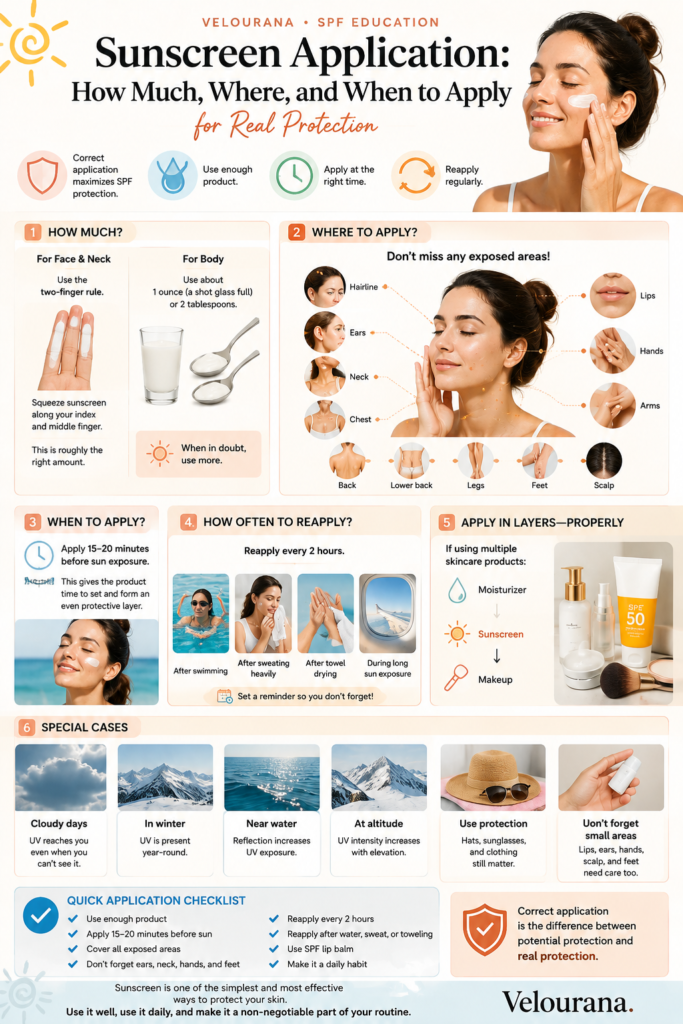
CATEGORY: Sunscreen Application
Sunscreen is one of the most important products in a sun-care routine, but choosing a high SPF is only the beginning. The protection stated on the bottle depends heavily on how the sunscreen is actually applied.
A broad-spectrum SPF 50 sunscreen used incorrectly can provide considerably less real-world protection than expected. Applying too little, missing exposed areas, rubbing the product away, or failing to reapply during prolonged outdoor exposure can all reduce its effectiveness.
Correct sunscreen application does not need to be complicated.
The objective is simple: use an adequate amount, distribute it evenly across exposed skin, allow the product to form a consistent protective layer, and restore that layer when circumstances disturb it.
Once these principles become part of a routine, sunscreen application becomes almost automatic.
Why Sunscreen Application Matters
SPF ratings are established under standardized testing conditions.
The sunscreen is applied in a controlled amount and distributed across the test area.
Real life is considerably less controlled.
People hurry.
They apply a small amount.
They miss the ears.
They stop at the jawline.
They forget the neck.
They swim.
They perspire.
They dry themselves with towels.
They touch their faces.
They apply makeup over sunscreen.
All of these factors can influence the protective layer.
This is why sunscreen application deserves as much attention as sunscreen selection.
Start With Clean or Normally Prepared Skin
Sunscreen does not require an elaborate skincare routine underneath it.
Your normal morning skincare can be used.
For many people, this means cleansing if necessary, applying any preferred serum or treatment, using moisturizer when needed, and finishing the skincare portion of the routine with sunscreen.
The routine should remain practical.
Too many products underneath sunscreen can sometimes make application more difficult.
Sunscreen Usually Comes After Moisturizer
If you use a separate moisturizer, it is generally applied before sunscreen.
Allow the moisturizer to settle sufficiently so that the skin is not excessively wet or slippery.
Then apply the sunscreen as its own layer.
This helps avoid accidentally diluting the sunscreen with moisturizer.
Do Not Mix Sunscreen Into Moisturizer
Mixing sunscreen and moisturizer together may seem like an efficient shortcut.
It is not a reliable application method.
Sunscreens are formulated to create a particular protective film across the skin.
Mixing the product with another formula changes the way it is distributed.
The resulting mixture has not been tested to provide the SPF stated on the sunscreen bottle.
Apply the moisturizer first.
Apply sunscreen separately.
Do Not Mix Sunscreen With Foundation
The same principle applies to makeup.
Mixing foundation directly into sunscreen creates an untested combination.
Even if both products look attractive when mixed together, the protective film may no longer behave as intended.
Apply sunscreen first.
Allow it to settle.
Then apply foundation.
Apply Sunscreen Generously
One of the most common sunscreen mistakes is simply using too little.
A tiny drop may spread surprisingly far, particularly with modern fluid sunscreens.
The fact that a product can be spread across the entire face does not necessarily mean enough sunscreen has been applied.
Follow the application instructions supplied with the sunscreen.
Adequate quantity is necessary to approach the protection represented by the SPF rating.
Why Underapplication Is Such a Problem
People sometimes assume that applying half the amount of SPF 50 simply produces SPF 25 protection.
The relationship is not that predictable.
Protection can fall significantly when sunscreen is underapplied.
There is no reliable household calculation that allows you to determine the resulting SPF.
The practical solution is much simpler.
Use enough sunscreen.
The Popular Two-Finger Method
A commonly discussed practical method involves dispensing sunscreen along the length of two fingers for the face and neck.
This can serve as a useful visual reminder that sunscreen requires more than a tiny cosmetic dab.
However, it should not be considered a universally exact measurement.
Finger sizes differ.
Product dispensers differ.
Sunscreen densities differ.
The surface area being covered differs.
Manufacturer instructions remain the primary guide.
Apply Sunscreen in Sections
Applying sunscreen systematically can help improve coverage.
Instead of placing one large amount in the center of the face and trying to stretch it everywhere, distribute the product across several areas.
Forehead.
Cheeks.
Nose.
Chin.
Sides of the face.
Neck.
Then spread the sunscreen evenly.
This makes missed areas easier to notice.
Do Not Forget the Hairline
The hairline is a common gap in facial sunscreen application.
People often stop just before reaching the hair because they do not want sunscreen touching it.
This can leave a narrow exposed border around the forehead.
Apply carefully around the hairline while avoiding unnecessary product buildup in the hair itself.
Protect the Temples
The temples can also be missed, particularly when sunscreen is concentrated on the central face.
Glasses and sunglasses can make this area even easier to overlook.
Include the temples deliberately.
Protect the Ears
Ears are among the most frequently forgotten areas.
Apply sunscreen to exposed portions of the ears.
Remember that hairstyles can change during the day.
Hair that covers the ears in the morning may later be tied back.
Do Not Stop at the Jaw
The jawline should not become an artificial sunscreen boundary.
If the neck is exposed, extend protection downward.
This is particularly important when wearing open-neck clothing.
Apply Sunscreen to the Neck
The front and sides of the neck receive regular sunlight.
The back of the neck can receive substantial exposure during outdoor activities.
Cover whichever areas are exposed.
Remember the Upper Chest
Low-neck tops can expose the upper chest.
This area is frequently forgotten during facial skincare routines.
If exposed, include it in sunscreen application.
Protect the Hands
Hands receive repeated incidental sunlight.
They also lose sunscreen quickly because of washing.
Apply sunscreen to exposed hands when appropriate and restore it after washing if significant outdoor exposure continues.
Protect the Lips
Lips can also be affected by ultraviolet exposure.
Use a suitable lip product with SPF.
Reapply after eating, drinking, swimming, or wiping the mouth.
Consider the Scalp
People with shaved heads, thinning hair, or exposed hair parts should consider scalp protection.
A hat provides excellent physical protection.
Suitable sunscreen can also be applied to exposed areas according to product instructions.
Body Application Requires Enough Product
The body has a much larger surface area than the face.
A few small drops cannot adequately cover exposed arms, shoulders, chest, back, and legs.
Use enough sunscreen to create consistent coverage across every exposed area.
Apply Before You Become Distracted
Sunscreen is easier to apply thoroughly before outdoor activity begins.
At the beach, for example, waiting until you are already sitting in the sun can create several problems.
You may hurry.
Sand may stick to the skin.
You may already be perspiring.
Children may want to enter the water.
Applying sunscreen as part of preparation makes thorough coverage easier.
Follow the Product's Timing Instructions
Different sunscreen formulations and regulatory guidance may provide specific instructions regarding application before sun exposure.
Follow the directions printed on the product.
The important principle is that sunscreen should be properly applied before significant exposure rather than after the skin has already begun to redden.
Do Not Wait for the Skin to Feel Hot
Heat is not a reliable indicator of UV exposure.
Wind can keep skin cool.
Water can keep the body cool.
Cold mountain air can feel comfortable.
Ultraviolet radiation can still be significant.
Sunscreen should be preventive.
Apply an Even Layer
Sunscreen protection should not consist of thick islands surrounded by untreated skin.
Spread the product carefully.
Check edges.
Look around the nose.
Check the hairline.
Check the jaw.
Check the ears.
Uniformity matters.
Applying in Two Passes Can Help
Some people find it easier to divide their sunscreen amount into two applications.
Apply one layer.
Distribute it.
Then apply the remaining portion.
This can make a generous quantity easier to manage and may help identify missed areas.
The objective is not to create a special SPF multiplication effect.
It is simply an application technique.
Two Layers Do Not Double the SPF
Applying SPF 50 twice does not create SPF 100.
SPF ratings do not add together.
The benefit of careful layering is improved coverage, not mathematical multiplication.
Allow Sunscreen to Set
After application, give the sunscreen an opportunity to settle before aggressively applying makeup or rubbing the face.
The exact setting behavior varies among products.
Some fluids dry quickly.
Rich creams may require longer.
Observe how your sunscreen behaves.
Avoid Excessive Rubbing After Application
Sunscreen needs to be spread evenly, but endless rubbing is unnecessary.
Once the product begins forming its film, repeatedly manipulating the skin can disturb the layer.
Apply deliberately and then allow it to settle.
Makeup Should Be Applied Gently
Makeup can be worn over sunscreen.
The challenge is avoiding unnecessary disruption of the protective layer.
Heavy buffing with a dense brush may move the sunscreen underneath.
Gentle application techniques can help preserve coverage.
Pressing Makeup Can Be Useful
Some people prefer pressing or lightly tapping foundation over sunscreen rather than repeatedly dragging it across the skin.
The ideal technique depends on the products being used.
The goal is simply to avoid disturbing the sunscreen unnecessarily.
Primer Goes Over Sunscreen
If you use a separate makeup primer, sunscreen generally remains the final skincare protection layer before makeup products.
Apply sunscreen.
Allow it to settle.
Then use primer if desired.
SPF Makeup Is Not a Substitute for Correct Sunscreen Application
Foundation, tinted moisturizer, concealer, and powder may contain SPF.
This is useful supplementary protection.
However, makeup is usually applied in much smaller quantities than dedicated sunscreen.
Using a separate sunscreen underneath provides a more reliable protective foundation.
Do Not Add SPF Numbers
SPF 50 sunscreen beneath SPF 20 foundation does not equal SPF 70.
The ratings cannot simply be added together.
Treat your sunscreen as the primary protection.
Reapplication Is Part of Application
Applying sunscreen correctly in the morning is important.
Maintaining protection during significant exposure is the next step.
The sunscreen layer can change throughout the day.
Swimming can disturb it.
Perspiration can disturb it.
Towels can remove it.
Clothing can rub against it.
Hands can wipe it away.
Reapplication restores coverage.
Follow Reapplication Instructions
Follow the directions provided with the sunscreen.
For prolonged outdoor exposure, reapplication is commonly necessary.
Do not assume a high SPF eliminates this requirement.
Reapply After Swimming
Even water-resistant sunscreen is not permanently waterproof.
After swimming, restore sunscreen according to product directions.
This is particularly important if you remain outdoors afterward.
Reapply After Towel Drying
A towel physically rubs sunscreen from the skin.
Drying after swimming can therefore reduce protection substantially.
Reapply before returning to prolonged exposure.
Reapply After Heavy Perspiration
Exercise and hot conditions can affect the sunscreen layer.
If you have perspired heavily, particularly if you have wiped the skin repeatedly, reapplication may be necessary.
Water Resistance Is Important for Sport
For swimming and heavy outdoor exercise, choose a sunscreen specifically labeled as water resistant according to the applicable standards.
A normal facial sunscreen may not be designed for those conditions.
Water Resistant Does Not Mean Waterproof
This distinction matters.
Water-resistant sunscreen retains protection during a specified period of water exposure under standardized testing.
It does not remain unchanged indefinitely.
Reapplication Over Makeup
This is one of the most challenging aspects of daily sunscreen use.
Applying a normal cream over finished makeup can disturb cosmetics.
Several formats may make touch-ups easier.
Sunscreen sticks.
Cushion-style products.
Sprays designed for appropriate use.
Fluid sunscreen applied carefully.
Powder SPF products.
Each has advantages and limitations.
Be Careful With Powder SPF
Powder sunscreen is convenient.
The challenge is applying enough product evenly to reproduce the labeled SPF.
For this reason, powder can be more useful as supplementary protection rather than the sole sunscreen layer.
Sunscreen Sticks Need Multiple Passes
Sticks can be excellent for targeted reapplication.
However, one quick swipe may leave too little product.
Follow the manufacturer's directions.
Make several deliberate passes when instructed and ensure the entire area is covered.
Spray Sunscreen Needs Thorough Coverage
Spray sunscreen can make body application easier.
Do not simply create a cloud of mist around yourself.
The product needs to reach the skin.
Apply according to directions and ensure consistent coverage.
Avoid Spraying Into Strong Wind
Wind can carry sunscreen away before it reaches the body.
Move to a sheltered location when possible.
This also reduces unnecessary inhalation of airborne product.
Sunscreen Application at the Beach
Beach application deserves particular attention because the environment is demanding.
Use a broad-spectrum sunscreen suitable for strong exposure.
Choose water resistance if swimming.
Apply thoroughly.
Remember the ears, feet, shoulders, back, and backs of the legs.
Reapply after swimming and towel drying.
Do Not Forget the Feet
Sandals and bare feet expose areas that are normally covered.
The tops of the feet can burn.
Apply sunscreen when they are exposed.
Protect the Shoulders
Shoulders receive strong direct sunlight and are easy to miss.
Swimwear leaves them particularly exposed.
Cover them thoroughly.
Protect the Back
The back is difficult to reach alone.
Ask someone to help if necessary.
Sprays can also make application easier, but coverage must still be complete.
Protect the Backs of the Legs
People often concentrate sunscreen on the fronts of their legs.
The calves and backs of the thighs may remain exposed.
Apply systematically around the entire leg.
Protect Around Swimwear Edges
Swimwear can shift during movement.
Applying sunscreen carefully around the edges helps reduce exposed gaps.
Do not deliberately apply sunscreen beneath large areas of clothing unless needed, but account for movement.
Sunscreen Application for Outdoor Sport
Exercise creates several challenges.
Perspiration.
Repeated wiping.
Movement.
Long exposure.
Choose an appropriate water-resistant sunscreen.
Apply before activity.
Carry the product when the activity will last for an extended period.
Sunscreen for Running
Runners should pay particular attention to the face, ears, neck, shoulders, arms, and legs.
A cap can protect the scalp and provide some facial shade.
Sunscreen remains necessary on exposed areas.
Sunscreen for Cycling
Cyclists may spend hours outdoors.
The face, ears, neck, arms, hands, and legs can receive prolonged exposure.
Perspiration and wind can make the exposure feel less intense than it actually is.
Sunscreen for Hiking
Hiking combines prolonged exposure with perspiration and sometimes increased altitude.
Carry sunscreen where it can be accessed easily.
If it is buried at the bottom of a backpack, reapplication becomes less likely.
Sunscreen for Skiing
High altitude and reflected UV from snow can produce significant exposure.
Apply high broad-spectrum protection to exposed skin.
Pay attention to the nose, cheeks, lips, and areas around eyewear.
Sunscreen Application While Driving
Drivers can experience repeated exposure through vehicle windows, particularly UVA.
Apply broad-spectrum sunscreen to exposed areas.
Face.
Hands.
Arms.
Long journeys may justify additional attention.
Sunscreen Near Windows
If you spend prolonged periods directly beside bright windows, broad-spectrum protection may be relevant.
The amount of exposure depends on the type of glass and your position.
Sunscreen Application on Cloudy Days
Cloud cover does not necessarily eliminate UV.
Do not judge the need for protection only by visible sunshine.
The UV Index provides better environmental information.
Sunscreen Application in Winter
Winter sunscreen follows the same fundamental principles.
Apply enough.
Cover exposed areas.
Use broad-spectrum protection.
Mountain and snow environments can require particularly careful application.
Sunscreen and Facial Hair
Facial hair creates an application challenge.
Areas with sparse hair may still receive substantial UV exposure.
Apply sunscreen carefully to exposed skin.
For dense facial hair, hats and other physical protection can complement sunscreen where direct skin application is difficult.
Sunscreen Around the Eyes
The skin around the eyes also receives UV exposure.
Use a sunscreen suitable for the facial area and apply carefully according to its directions.
Avoid direct contact with the eyes.
Sunglasses provide additional protection.
What If Sunscreen Stings Your Eyes?
Some formulations migrate more easily during perspiration or simply do not suit a particular person.
Try a different facial sunscreen.
A stick formulation around the eye area may work better for some people.
Do not abandon sun protection entirely because one product is uncomfortable.
Sunscreen for Sensitive Skin
Sensitive skin benefits from a simple routine.
Choose a sunscreen the skin tolerates.
Avoid unnecessary layering if it causes irritation.
If repeated reactions occur, seek dermatological advice.
Sunscreen for Oily Skin
Oily skin may prefer fluids or gels.
The important point is not to reduce the amount simply because the product feels rich.
If adequate application feels uncomfortable, change the formula.
Sunscreen for Dry Skin
Dry skin may prefer moisturizing sunscreen.
A rich sunscreen can sometimes replace a separate morning moisturizer.
This can simplify the routine while maintaining adequate application.
Sunscreen for Acne-Prone Skin
Choose a formula compatible with your skin.
Lightweight sunscreens can reduce the feeling of heaviness.
Do not assume all high-SPF products are pore-clogging.
Formulation matters.
Sunscreen for Deeper Skin Tones
White cast can discourage adequate application.
Choose transparent or tinted formulations that remain cosmetically acceptable when used in the correct quantity.
Do not solve white cast by applying dramatically less product.
Tinted Sunscreen
Tinted sunscreen can combine high protection with cosmetic coverage.
It must still be applied in an adequate amount.
If the correct amount creates too much color, choose a better shade rather than reducing the quantity.
Sunscreen and Hyperpigmentation
People concerned about pigmentation often benefit from careful broad-spectrum application.
UVA protection is particularly important.
Some tinted sunscreens can also provide additional protection against visible light depending on their formulation.
Sunscreen Application for Children
Children require age-appropriate sun protection.
Parents and caregivers should follow pediatric and public-health guidance.
Shade, clothing, hats, and sunscreen work together.
Thorough application is particularly important because children may not notice missed areas themselves.
Do Not Turn Application Into a Battle
For children old enough to use sunscreen, choosing comfortable formats can make application easier.
Sticks, lotions, and sprays each have practical advantages.
The priority is adequate, safe coverage according to the product instructions.
Babies Require Specific Guidance
Very young babies should not simply follow adult sunscreen routines.
Shade and protective clothing are particularly important.
Follow pediatric recommendations for sunscreen use according to age.
Sunscreen Application and Medication
Certain medications can increase photosensitivity.
If you use such medication, follow healthcare advice regarding sun exposure and protection.
More rigorous sunscreen application may be required.
Sunscreen After Cosmetic Procedures
Some cosmetic and dermatological procedures can temporarily make skin more sensitive to sunlight.
Follow professional aftercare instructions.
Do not assume your normal routine is automatically sufficient.
Sunscreen and Retinoid Routines
People using retinoids commonly incorporate daily sunscreen into their routine.
Apply skincare products according to their directions and maintain consistent broad-spectrum protection.
Sunscreen and Exfoliating Products
Acids and exfoliating treatments can influence skin sensitivity depending on the product.
Sun protection becomes an important companion to these routines.
Do Not Apply Sunscreen Only When You Expect to Burn
Sunburn is not the only consequence of UV exposure.
UVA exposure may occur without obvious redness.
Broad-spectrum sunscreen is about reducing cumulative exposure as well as preventing immediate burning.
Do Not Use Sunscreen Only on Sunny Holidays
Daily exposure occurs during normal life.
Walking.
Driving.
Shopping.
Outdoor lunches.
Gardening.
Commuting.
A regular routine reduces the need to make a new sunscreen decision every time you step outside.
Make Sunscreen Easy to Remember
Place facial sunscreen near the products you use every morning.
Keep body sunscreen with outdoor essentials.
Carry a reapplication product during long outdoor days.
Habit design can improve consistency.
Keep Sunscreen Accessible
If reapplication requires returning home or searching through luggage, it is less likely to happen.
A practical sunscreen should travel with you when significant exposure is expected.
Check the Expiration Date
Correct application cannot compensate for an unreliable expired product.
Check the sunscreen's expiration information and period-after-opening guidance.
Replace it when necessary.
Store Sunscreen Properly
Follow manufacturer storage instructions.
Avoid prolonged exposure to extreme heat where possible.
A closed vehicle in summer can become exceptionally hot.
Buy Authentic Sunscreen
Application technique means little if the product itself is counterfeit.
Purchase sunscreen from reputable retailers and suppliers.
A fake product displaying SPF 50 may provide unknown protection.
Never Make DIY Sunscreen
Homemade sunscreen cannot reliably reproduce professional formulation and standardized SPF testing.
UV filters must be distributed correctly throughout the formula.
Stability and film formation matter.
Use legitimate tested sunscreen.
Do Not Add UV Filters to Moisturizer
Adding zinc oxide or another ingredient to ordinary moisturizer does not create predictable SPF.
The resulting mixture has not been tested.
Sunscreen Application Should Not Create Anxiety
Correct sunscreen use is important, but the routine does not need to become obsessive.
The basic principles are manageable.
Choose suitable protection.
Apply enough.
Cover exposed skin.
Reapply when necessary.
Use physical protection.
Shade Makes Sunscreen's Job Easier
Shade reduces direct exposure.
Use umbrellas, trees, canopies, and covered areas when practical.
Sunscreen and shade complement each other.
Clothing Reduces Exposed Surface Area
Protective clothing can cover large areas without requiring sunscreen reapplication.
This is particularly useful during long outdoor activities.
Hats Protect Difficult Areas
A broad-brimmed hat helps protect the scalp, ears, face, and neck.
These areas are frequently missed during application.
Sunglasses Add Eye Protection
Choose sunglasses designed to provide appropriate UV protection.
They also shade some of the delicate skin around the eyes.
Build a Simple Morning Application Routine
A reliable sunscreen routine can be straightforward.
Complete necessary skincare.
Apply sunscreen generously to exposed areas.
Check the hairline.
Check the ears.
Check the neck.
Allow the sunscreen to settle.
Apply makeup if desired.
Then continue with the day.
Build a Simple Outdoor Reapplication Routine
During prolonged exposure, periodically assess what has happened.
Have you been swimming?
Have you towel-dried?
Have you perspired heavily?
Has clothing rubbed against the skin?
Have you washed your hands?
Restore sunscreen where necessary according to the product directions.
Learn Your Personal Missed Areas
Everyone develops application habits.
Perhaps you always miss your ears.
Perhaps you forget the hands.
Perhaps the neck receives only whatever sunscreen remains after the face.
Identify the pattern.
Correct it deliberately.
Do Not Save the Neck for Leftovers
The neck deserves an adequate amount of sunscreen of its own.
The small amount remaining on your fingertips after facial application may not provide sufficient coverage.
Do Not Save the Hands for Leftovers Either
Apply intentionally.
Sunscreen protection should not depend on whatever product happens to remain after another area is finished.
Application Is More Important Than Perfection
A good sunscreen routine does not require laboratory precision every morning.
It requires sensible consistency.
Use an adequate amount.
Spread it carefully.
Correct obvious gaps.
Reapply when circumstances require it.
The Sunscreen You Enjoy Using Has an Advantage
If two sunscreens provide suitable protection but one feels much better on your skin, the comfortable product may be the better practical choice.
You are more likely to apply it generously.
You are more likely to use it every day.
You are more likely to reapply it.
High SPF Cannot Rescue Bad Application
An SPF 50 or SPF 50+ label cannot protect skin where the sunscreen was never applied.
It cannot maintain a layer that has been rubbed away.
It cannot replace a product washed from the skin.
It cannot compensate indefinitely for extreme underapplication.
Correct Application Turns SPF Into Real Protection
The SPF number represents tested potential.
Application turns that potential into a protective layer on the skin.
This is why technique matters.
The difference between owning sunscreen and actually being protected by sunscreen is application.
A Practical Sunscreen Application Checklist
Before significant exposure, make sure the sunscreen is appropriate for the activity.
Apply enough.
Cover the face completely.
Include the hairline.
Include the ears.
Cover the neck.
Cover the chest if exposed.
Protect the hands.
Protect exposed body areas.
Use lip SPF.
Consider the scalp.
Reapply when necessary.
The Most Important Application Mistakes to Avoid
Do not apply a tiny amount.
Do not mix sunscreen into moisturizer.
Do not mix sunscreen into foundation.
Do not forget the ears.
Do not stop at the jawline.
Do not assume water-resistant means waterproof.
Do not rely on one morning application during an entire beach day.
Do not assume high SPF means you can apply less.
The Final Principle
Correct sunscreen application is not about creating a complicated ritual.
It is about making sure the product has the opportunity to provide the protection stated on its label.
Use an adequate amount.
Apply it evenly.
Cover all exposed areas.
Let it settle appropriately.
Avoid unnecessarily disturbing the layer.
Reapply after circumstances such as swimming, towel drying, or heavy perspiration according to product directions.
Choose a formula comfortable enough to use properly.
Combine sunscreen with shade, clothing, hats, and sunglasses.
The SPF rating tells you what the sunscreen can achieve under standardized conditions.
Application determines how effectively that protection is translated into everyday life.
A carefully applied sunscreen is not simply another skincare layer.
It is the foundation of a practical sun-protection routine.
The End
Velourana.
 Discover More From Our Family of Websites
 ZodiacBearing (Astrology, Tarot, Numerology, Angel Numbers & Spiritual Guidance)
 Velourana (Beauty, Makeup, Hair Care, Skincare & Beauty Tips)
 HavenBearing (Home, Living, Organization, Décor & Everyday Inspiration)
 PawBearing (Pet Care, Dog Breeds, Animal Health, Training & Pet Products)
 PsyCatherine (Notes From the Journal of a Psychologist on Real Life)