CATEGORY: Hot Brushes
A hot brush can look deceptively universal. It has bristles, it produces heat, and its basic movement resembles ordinary brushing, so it is tempting to assume that the same technique should work on every head of hair. Yet the experience of using one can be dramatically different depending on natural texture, strand thickness, density, length, haircut and the amount of processing the hair has experienced.
On naturally straight hair, a hot brush may function primarily as a shaping tool. There may be relatively little texture to smooth, allowing most of the styling effort to concentrate on root lift, face-framing movement and the direction of the ends.
On wavy hair, the same tool can perform a greater transformation. It can stretch irregular bends into broader movement while preserving enough natural body to create a relaxed blowout effect.
Fine hair introduces another consideration. The hair may respond quickly, but maintaining volume and avoiding excessive product weight can become more important than achieving maximum smoothness.
Dense hair creates almost the opposite challenge. There may be so much hair that sectioning becomes essential if the tool is expected to influence more than the visible surface.
Curly and coily textures can involve a much larger change of shape, and the appropriate technique depends heavily on the type of hot brush being used and the intended final result. A hot-air brush designed to participate in drying is not the same as a heated styling brush intended for use on appropriately prepared dry hair.
This distinction matters throughout hot-brush styling.
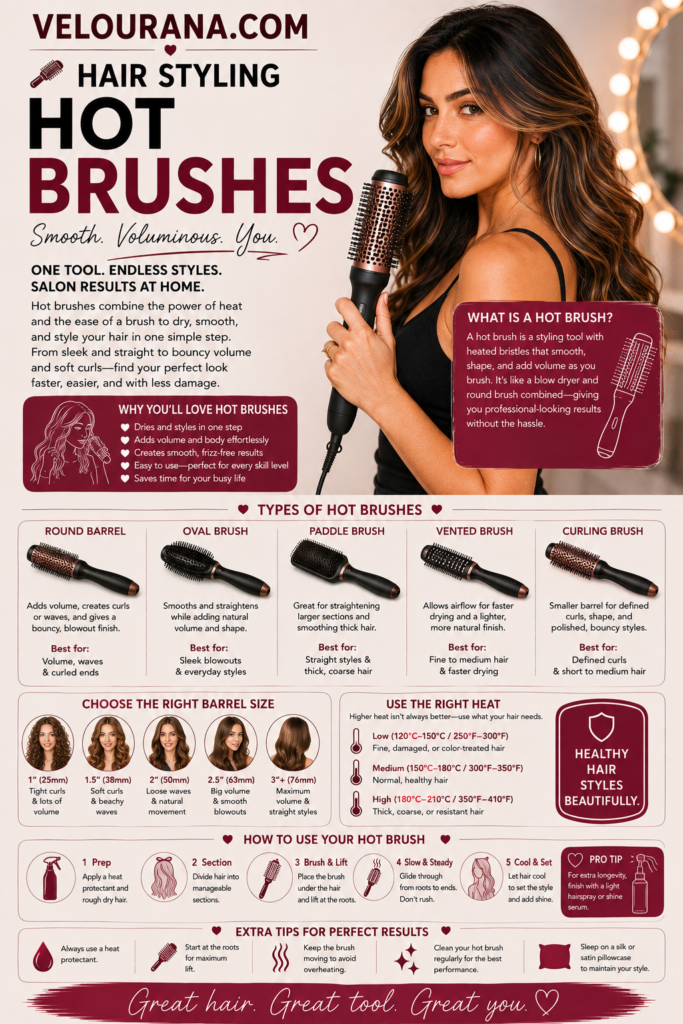
The term “hot brush” describes a family of tools rather than one identical appliance. Some are primarily smoothing brushes. Some are round or cylindrical heated brushes designed to create curvature. Others combine airflow and a brush-shaped attachment to dry and style simultaneously.
The manufacturer's instructions should therefore determine how a particular device is used, especially regarding whether the hair should be dry, damp or prepared in another specified way.
Once that foundation is understood, the technique can be adapted to the hair rather than forcing the hair to adapt to one universal method.
That is where hot brushes become genuinely versatile.
Natural Texture Determines the Starting Point, Not the Final Possibility
Hair type is useful because it tells us something about the shape from which styling begins.
It does not dictate the only hairstyle that can be created.
Straight hair can remain straight but become more voluminous. It can develop curved ends, sweeping layers or a blowout-inspired silhouette.
Wavy hair can retain some of its natural movement while becoming smoother and more organized.
Curly hair can be stretched into a softer, broader shape when the appropriate tool and technique are used.
Fine hair can be lifted so that it appears considerably fuller.
Thick hair can be shaped so that its natural abundance becomes controlled volume rather than an undifferentiated mass.
The important question is how much transformation is actually required.
If the starting texture is already close to the intended result, aggressive styling is unnecessary. Naturally straight hair does not need to be treated as though it must first be completely reconstructed before the ends can be curved.
Similarly, naturally wavy hair may already contain much of the body required for a voluminous style. Removing every trace of that texture before rebuilding volume can create more work than simply refining what is already present.
Hot-brush styling often looks most natural when it preserves useful characteristics of the original hair.
The tool can polish rather than erase.
It can organize rather than flatten.
It can redirect rather than completely reconstruct.
This philosophy becomes especially important because the characteristic finish of a hot brush is often softer than that produced by more concentrated styling tools.
A straightener can create very precise sleekness.
A curling iron can create clearly defined curls.
A hot brush frequently works in the middle territory, where natural texture and deliberate styling can coexist.
Straight Hair Can Be Shaped Rather Than Simply Straightened Again
Naturally straight hair may appear to have little need for a heated smoothing brush, but smoothing is only one of the things these tools can accomplish.
Straight hair can lack visible movement, particularly when it is long, fine or cut with subtle layers. The hair may fall beautifully but travel almost entirely downward.
A hot brush can change that direction.
The roots can be lifted away from the scalp.
The front sections can sweep backward.
The ends can turn inward or outward.
Long layers can gain broad curvature that separates them visually from the longest sections underneath.
These changes can make an enormous difference without substantially altering the natural straight character of the hair.
For someone who normally uses a flat iron on naturally straight hair, a hot brush can also provide a softer alternative when absolute sleekness is unnecessary.
Instead of pressing the hair flat, the brush can organize the strands while preserving more space between them.
That space contributes to movement.
Fine straight hair can appear fuller.
Dense straight hair can become more controlled without losing all of its natural volume.
The key is avoiding the assumption that every section needs repeated smoothing.
If the hair is already naturally straight and polished through the middle lengths, those areas may require very little work. The styling effort can be concentrated where it creates visible change.
The roots can receive elevation.
The front can receive direction.
The ends can receive shape.
The haircut becomes the focus rather than straightness itself.
Fine Hair Needs a Hot Brush Routine Built Around Lightness
Fine hair responds visibly to relatively small changes in direction.
A few centimeters of root elevation can make the entire hairstyle appear fuller. A gentle curve through the ends can create the impression of more body. Face-framing pieces swept outward can prevent the hair from lying close against the cheeks.
This makes hot brushes potentially very effective for fine hair.
The challenge is that fine hair can also lose its newly created volume when the preparation or technique becomes too heavy.
Product layering deserves particular attention.
Heat protection remains important when using a heated styling tool, but the chosen formula should work with the hair rather than making it difficult to style. Fine hair may respond better to lighter products when the desired finish depends on bounce and movement.
Applying several rich smoothing products can create a beautifully conditioned feel while simultaneously reducing the volume the hot brush is supposed to create.
The complete routine should therefore be judged by the finished result rather than by the number of products involved.
Section size also matters.
Because the hair is fine, it can be tempting to take very large sections. If overall density is low, that may sometimes be workable. If the hair is fine but dense, however, large sections can prevent the heated surface from influencing the interior consistently.
Fine does not necessarily mean sparse.
Strand diameter and total density are separate characteristics.
The tool should be matched to both.
Once a manageable section is chosen, the movement can remain deliberate.
Lift at the root if volume is desired.
Smooth through the length.
Introduce the intended curve.
Then stop.
Repeatedly brushing a successful section with heat can eventually work against the airy finish.
Fine hair often looks best when it is allowed to remain slightly buoyant rather than polished into complete uniformity.
Fine Hair and Flat Roots Require Direction More Than More Heat
When fine hair falls flat, increasing the temperature is rarely the most intelligent first response.
The problem is often directional.
Hair that has been dried and styled downward tends to continue lying downward. The root needs to be encouraged away from its natural resting position if greater lift is desired.
A suitable hot brush can help by supporting the section upward or away from the scalp while shaping it.
The crown can be treated separately from the sides because those areas contribute differently to the silhouette.
The top may benefit from vertical or backward elevation.
The sides may need less lift so that the hairstyle retains balance.
The front can be directed according to the part and haircut.
This creates volume through geometry rather than through aggressive heat.
Cooling can help preserve that geometry.
A newly lifted section should not immediately be pressed flat under other hair if the intention is to maintain height.
Allowing the shape to settle before final arrangement can make the styling more effective without additional heated passes.
This principle is particularly valuable for fine hair because preserving the volume already created is often easier than repeatedly recreating it.
Thick Hair Needs Access to the Interior, Not Just a Polished Surface
Dense hair can appear transformed after a few hot-brush passes over the outer layer, but the visible result may hide a very different interior.
If the objective is only quick surface refinement, this may be perfectly acceptable.
If the goal is a consistent blowout or smoother overall texture, the internal sections need access to the tool as well.
This is where sectioning becomes essential.
The lower hair can be separated from the upper layers so that the brush works through manageable amounts. As each section is completed, another can be released.
This systematic approach has two advantages.
First, it allows the tool to influence the hair more consistently.
Second, it reduces accidental repetition because completed sections remain distinguishable from unfinished ones.
Dense hair can otherwise encourage endless surface brushing. The outside looks increasingly polished while the internal hair remains comparatively untouched, so the stylist continues making passes without resolving the underlying inconsistency.
Smaller sections solve the problem more effectively than simply increasing heat.
The amount of root lift should also be considered carefully.
Dense hair already occupies substantial space. Maximum elevation through every layer can create more volume than the hairstyle needs.
The upper sections can receive deliberate lift while lower layers remain more controlled.
This creates shape rather than uncontrolled expansion.
The density becomes an advantage because it provides a rich foundation for broad movement.
Wavy Hair Can Keep Some of the Texture That Makes It Beautiful
Wavy hair is particularly well suited to the softer styling language of a hot brush.
Its natural texture already creates movement and body.
The styling process can therefore focus on organization.
A section with an attractive broad wave may need almost no correction.
Another section may bend in an awkward direction and benefit from smoothing.
The front may need more deliberate shaping.
The ends can be brought into a coherent pattern without removing every natural variation through the middle lengths.
This selective approach often creates a more convincing result than attempting to make every strand identical.
Wavy hair rarely behaves with perfect uniformity naturally, and preserving a controlled amount of that variation can make a hot-brush style look effortless.
For a relaxed blowout, the natural body can remain underneath the polished surface.
The brush stretches tighter or irregular bends into broader curves.
The hair becomes smoother without becoming completely flat.
This is one of the clearest situations in which a hot brush can occupy a useful space between natural styling and complete straightening.
The hair still looks like it has movement of its own.
It has simply been directed.
Stronger Waves Need Sectioning Before They Need Repetition
When the natural wave pattern is stronger, one casual brush through a large section may not create the intended transformation.
This does not necessarily mean the tool is ineffective.
The section may simply contain too much hair.
Dividing the hair allows the heated surface to interact more consistently with the strands.
The amount of tension and the speed of the movement can then be controlled according to the particular device and the desired result.
The objective should be an effective pass rather than a large number of superficial ones.
If a section repeatedly returns to its original pattern immediately after styling, the entire process deserves examination.
Is the tool appropriate for the intended transformation?
Is the hair in the correct condition for that particular device?
Is the section too large?
Is the natural texture stronger than the result the tool is designed to produce?
Would a different preparation stage make the process more efficient?
These questions are more useful than simply continuing to brush the same hair with heat.
A hot brush has capabilities, but it also has limits.
Understanding both leads to better styling.
Curly Hair Requires a Clear Distinction Between Dry Styling and Hot-Air Styling
Curly hair makes the difference between types of hot brushes particularly important.
A hot-air brush designed to dry and shape hair can participate in stretching the curl pattern as moisture is removed.
A heated brush intended for use on dry hair belongs at another stage of the process.
These tools should not be treated as interchangeable simply because both contain bristles and heat.
The instructions of the specific device should determine how it is used.
When the desired result is a stretched, voluminous finish rather than pin-straight hair, the natural fullness of curly hair can become an asset.
The goal does not have to be complete elimination of texture.
The roots can retain body.
The lengths can become broader and smoother.
The ends can be shaped into deliberate curves.
This can produce a large, flowing blowout effect that differs significantly from flat-ironed hair.
If a sleeker finish is desired, the hot brush may become one stage in a larger styling process depending on the hair and tool.
The important point is that each stage should contribute something necessary.
There is little benefit in repeatedly using several heated tools to create and then undo different shapes.
Planning the final result first can reduce this inefficiency.
Coily Hair Benefits From Organization and Realistic Expectations of the Tool
Coily hair can involve an even greater degree of transformation when a smooth or stretched style is desired.
Density can also be substantial, making clean sectioning particularly important.
A hot brush should be selected and used according to the type of styling it is actually designed to perform. A device capable of contributing to drying and stretching has a different role from a dry-hair heated smoothing brush.
The natural texture should not be treated as a problem that must be defeated through repeated passes.
Instead, the styling process can be divided into logical stages.
The hair is prepared.
Sections are organized.
The appropriate tool performs the transformation for which it was designed.
The final shape is then assessed before more heat is introduced.
If the goal is a broad, voluminous stretched style, retaining some natural fullness can make the finished result more impressive.
If a very sleek result is wanted, another technique may be required after the initial stretching depending on the hair and chosen tools.
What matters is avoiding unnecessary duplication.
Every heated stage should move the hair closer to the final hairstyle.
Short Hair Needs a Smaller Styling Vocabulary, Not Less Thought
Short hair cannot always wrap around a large hot brush in the same way long hair can, but it can still respond beautifully to heated brushing.
The movements simply become smaller.
A short bob can gain root lift and a rounded perimeter.
A pixie can develop direction through the top.
A short layered cut can be smoothed while selected pieces are encouraged outward or upward.
The size and design of the brush become particularly important.
A very large cylindrical or oval tool may not provide enough contact or curvature for short sections. A more appropriately scaled device can create movement more efficiently.
Short hair also reveals direction immediately.
Moving one front section backward rather than downward can alter the entire silhouette.
Lifting the crown can make the haircut appear longer and more structured.
Turning the ends of a bob inward can create a polished classic shape, while a slight outward movement changes its personality completely.
The tool does not need to perform dramatic transformations.
Small directional choices are enough.
Medium-Length Hair Is Particularly Responsive to Hot-Brush Styling
Medium hair occupies an advantageous position.
It is long enough to develop broad curvature but short enough that its own weight does not immediately pull every movement downward.
This makes it especially responsive to hot-brush blowout techniques.
The roots can lift visibly.
Layers can separate.
The ends can turn inward or outward.
Face-framing sections can sweep away from the features.
The movement can remain noticeable for longer because the hair is not carrying the same weight as very long lengths.
This also means the initial shape does not necessarily need to be exaggerated.
A moderate curve can remain visible after the hair settles.
Trying to create an extremely strong bend in anticipation of rapid relaxation may produce more styling than the hair actually needs.
Medium hair often rewards restraint.
A few well-directed sections can create the impression of a complete blowout without requiring every strand to be intensely shaped.
Long Hair Requires More Attention to Weight and the Ends
Very long hair behaves differently because weight influences almost every styled movement.
Root lift can gradually soften.
Broad curves can stretch.
The longest sections may fall more vertically than shorter layers even when they receive similar styling.
Rather than fighting this constantly, the technique can anticipate it.
The crown can receive deliberate elevation.
Shorter layers can be shaped more strongly because they are less affected by the weight below.
The longest hair can remain softer, providing a flowing foundation.
The ends deserve particular attention because they are the oldest part of the hair and can receive heat during every full-length pass.
If the upper portion of a long section needs additional smoothing but the end already sits correctly, the brush does not need to keep repeating the same complete journey automatically.
The area that needs refinement can receive it.
This makes hot-brush styling more precise.
Long hair can also become difficult to organize simply because there is so much length. Keeping finished sections separate prevents them from becoming mixed with hair that still needs styling.
Organization reduces accidental repetition.
It also makes the final shape easier to construct because the stylist can see which layers have already been directed.
Layered Hair Should Not Be Styled as One Continuous Length
Layers exist to create differences in movement, weight and shape.
Hot-brush styling can either reveal those differences or erase them.
If every section is pulled straight downward and given exactly the same curve at the bottom, much of the haircut's architecture disappears.
A better approach considers where each layer ends.
Shorter crown layers can gain more elevation.
Face-framing pieces can travel away from the face.
Middle layers can develop broad outward or inward movement.
The longest sections can remain softer.
The hairstyle then becomes dimensional.
This is especially effective on fine hair because visible separation between layers creates an impression of fullness.
On dense hair, it helps organize volume.
On wavy hair, it allows some natural movement to participate in the style.
The haircut provides the structure.
The hot brush simply makes that structure more visible.
Color-Treated and Lightened Hair Need a Condition-Based Technique
Natural texture is only one part of how hair responds to a hot brush.
Chemical history can change the experience considerably.
Hair that has been lightened or repeatedly colored may behave differently from untreated hair of the same apparent type. The ends may feel more fragile or porous. Certain sections may respond to heat more quickly. The newest growth may require different handling from older lengths.
The styling routine should respond to these differences.
A person who has always used a particular technique does not need to continue using it unchanged after the condition of the hair changes.
This is especially important with long color-treated hair because several different histories can exist along one strand.
The newest section near the scalp may have experienced relatively little processing.
The middle lengths may have undergone several services.
The ends may have years of accumulated chemical, mechanical and heat exposure.
Treating all three areas identically simply because they are attached to the same strand ignores that history.
A hot brush allows some flexibility because individual areas can be addressed selectively.
The roots can be lifted.
The middle can be smoothed.
The ends can receive only the shaping they actually need.
The tool should follow the hair rather than force the hair to follow a rigid routine.
The Same Person May Need Different Techniques on Different Days
Hair does not behave identically every day.
Humidity changes it.
The amount of time since washing changes it.
Product accumulation changes it.
Sleeping changes the direction of the roots and front sections.
A fresh haircut changes how layers fall.
Growing length changes the effect of weight.
This means a successful hot-brush routine should not become mechanical.
On wash day, a complete style may be appropriate.
The following morning, only the front may need attention.
Another day, the crown may have flattened while the lengths remain beautifully shaped.
After several days, the hair may work better in a ponytail or bun than as a refreshed blowout.
The tool should be used according to what the hair currently needs.
This prevents convenience from turning into unnecessary repetition.
Because a hot brush resembles an ordinary brush, it is especially easy to keep passing it through the hair without considering whether heat is still contributing anything.
The question should remain simple: what is this pass supposed to change?
If there is no clear answer, it may not be needed.
Second-Day Styling Is Where Texture-Specific Technique Becomes Especially Useful
Different textures evolve differently after hot-brush styling.
Fine straight hair may retain smooth lengths while losing root lift.
Wavy hair may begin recovering some of its natural pattern underneath while the surface remains polished.
Dense hair may keep substantial volume but lose the deliberate direction of the front.
Curly or coily hair that has been stretched may begin changing first around areas exposed to moisture or friction.
These differences make selective refreshing more useful than complete restyling.
Fine hair can concentrate on the crown.
Wavy hair can allow some returning texture to become part of the style.
Dense hair may need only a few visible sections reorganized.
The front of stretched textured hair can be addressed according to the condition and intended finish without automatically reheating all of the lengths.
This approach also allows the hairstyle to evolve.
A perfectly polished first-day blowout can become a softer second-day style.
That softer style can become a voluminous ponytail.
The remaining movement can later contribute to an updo.
One styling session can therefore support several different looks.
The Best Hot Brush Technique Begins With the Hair You Actually Have
Hair categories are useful, but they are only starting points.
Not all fine hair behaves the same way.
Not all straight hair is low-density.
Not all wavy hair has the same pattern.
Not all curls respond identically to stretching.
Not all thick hair contains coarse strands.
Not all long hair is equally healthy through its ends.
A successful hot-brush routine becomes more precise when it responds to these realities.
Observe how quickly the hair changes shape.
Notice whether the roots need more lift than the lengths need smoothing.
Look at how the layers fall after the first section is completed.
Notice whether the ends respond faster than the upper hair.
Pay attention to whether a product supports movement or makes the hair heavy.
Consider whether a second pass is genuinely changing the section or merely repeating what has already been accomplished.
These observations gradually produce a technique more useful than any universal formula.
Straight hair can be given movement rather than unnecessarily straightened again.
Fine hair can be lifted without being overloaded.
Dense hair can be organized without having its volume erased.
Wavy hair can retain enough natural character to make the finish believable.
Curly and coily textures can be approached according to the intended transformation and the actual type of hot brush being used.
Short hair can be shaped through small changes of direction.
Medium hair can take advantage of its natural responsiveness to broad movement.
Long hair can use layers and selective styling to work with its weight rather than constantly fighting it.
Processed hair can be treated according to its current condition rather than its historical routine.
The hot brush itself does not determine the hairstyle.
The hair does.
The tool provides heat, organization and direction, but the best results come from deciding where each of those qualities is actually needed.
That may mean a complete smoothing session one day and three refreshed sections the next.
It may mean stronger curvature around the face and almost none through the longest lengths.
It may mean preserving a natural wave because it already contributes beautifully to the final shape.
It may mean stopping after one effective pass rather than continuing simply because the tool makes repetition easy.
When technique adapts to texture in this way, hot-brush styling becomes less about forcing every head of hair toward the same polished finish.
Instead, it becomes a way of refining what is already there.
Natural straightness gains dimension.
Fine hair gains space.
Density gains structure.
Waves gain coherence.
Curls can gain broad, stretched movement when that transformation is desired.
Layers gain visibility.
The haircut gains shape.
And the finished hairstyle remains connected to the character of the hair underneath it.
That is ultimately what makes a hot brush versatile. Not that it produces exactly the same result on everyone, but that it can be used differently enough to create a result that makes sense for each texture.
The most successful technique does not erase those differences.
It uses them.
The End
Velourana.
 Discover More From Our Family of Websites
 ZodiacBearing (Astrology, Tarot, Numerology, Angel Numbers & Spiritual Guidance)
 Velourana (Beauty, Makeup, Hair Care, Skincare & Beauty Tips)
 HavenBearing (Home, Living, Organization, Décor & Everyday Inspiration)
 PawBearing (Pet Care, Dog Breeds, Animal Health, Training & Pet Products)
 PsyCatherine (Notes From the Journal of a Psychologist on Real Life)