
CATEGORY: Hot Brushes
A polished hairstyle rarely disappears all at once. More often, it changes unevenly. The roots lose lift before the lengths lose smoothness. Face-framing pieces flatten because they are touched more often. One side may develop an awkward bend after sleeping, while the other still looks almost exactly as it did the day before. The ends may lose some of their curve but retain enough movement to look attractive. This is where hot brushes become especially useful.
A hot brush can be more than a tool for creating a complete style from the beginning. It can also be used as a precise refreshing tool, restoring movement only where the hairstyle has changed. That selective approach is often more efficient than recreating an entire blowout, and it can preserve the softer, more natural character that develops as a style settles.
The ability to refresh rather than restart is especially valuable for people who enjoy polished hair but do not want to repeat a full styling routine every morning. A few strategically chosen sections can make the entire hairstyle look renewed. The crown can regain lift, the front can recover its sweep, and the ends can be redirected without reheating every strand.
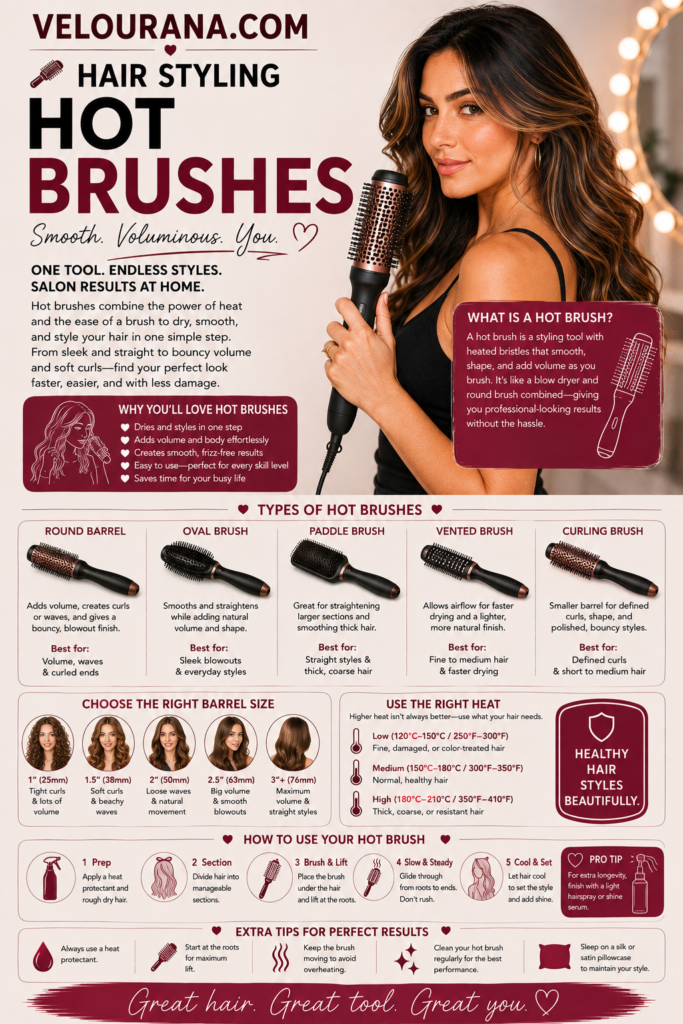
This is also where the design of the hot brush becomes important. A round or oval hot-air brush may be used differently from a heated smoothing brush intended for dry hair. The manufacturer's instructions should always determine whether the tool is appropriate for dry, damp or otherwise prepared hair. Once that is clear, the refresh can be built around the areas that genuinely need attention.
The key principle is simple: second-day styling should be diagnostic. Look first, style second. The tool should not be used simply because it is available.
Why Second-Day Hair Often Needs Less Than You Think
Hair usually changes in patterns rather than uniformly. Sleeping compresses the crown and one side more than the other. Clothing and movement affect the lower lengths. Humidity may alter the hairline before it changes the rest of the style. Fine hair may lose root lift while staying smooth, whereas dense hair may keep plenty of volume but lose definition in the front.
Because the changes are localized, the refresh should usually be localized too.
This matters aesthetically as well as practically. A first-day blowout often looks more precise. By the next morning, the sections have blended and the movement has softened. That can create a more relaxed and natural result. Rebuilding every section with heat may remove that softness and return the style to something more controlled than necessary.
A better approach is to preserve what still works.
If the lengths remain smooth, leave them alone. If the ends still curve well, do not restyle them automatically. If only the crown has flattened, address the crown. If the front pieces have lost their direction, reshape the front.
A hot brush is particularly well suited to this because its movement can be localized. A few sections can be lifted, smoothed or curved without committing to a complete restyle.
The process becomes less about recreating yesterday and more about restoring the visual balance of today.
Refreshing the Crown Without Flattening the Rest
The crown is often the first area to lose volume. Hair that looked lifted after styling can settle closer to the scalp overnight, especially when the head rests against a pillow for several hours. This can make the entire hairstyle feel flatter even when the lengths still look polished.
The solution is not necessarily to brush through all of the hair again.
A few crown sections can be isolated and lifted away from their natural resting position. With a suitable hot brush used according to its design, those sections can be encouraged upward or backward so that they regain some root movement.
The technique should focus on the root and upper length rather than automatically pulling the brush through to the ends every time. If the ends already look good, there is little reason to repeatedly expose them simply because the root needs more elevation.
This is an important distinction in second-day styling. The goal is correction, not complete repetition.
The same principle works with a side part. The heavier side may lose its sweep and begin lying flat. Instead of restyling the entire side, one or two upper sections can be lifted and redirected. The part can regain movement while the lower hair remains untouched.
Fine hair often responds quickly to this kind of targeted refresh. A relatively small amount of root lift can make the entire style appear fuller again. Dense hair may need fewer corrections because it naturally retains more volume, but the upper surface can still benefit from strategic shaping.
Cooling matters here too. A newly lifted crown section should not be pressed immediately back into the shape that caused it to flatten. Allowing it to settle before blending it with the rest of the hair can help preserve the movement.
The result should not look freshly rebuilt. It should simply look revived.
Restoring Face-Framing Pieces and Curtain Bangs
The front sections are often the most fragile part of a polished hairstyle because they are exposed to more handling than any other area. They are tucked behind the ears, moved away from the eyes, touched while speaking or working, and affected by the skin and weather around the face.
Curtain bangs may lose their outward sweep. Long front layers may begin turning inward or falling straight down. A side fringe can flatten against the forehead. These changes are small, but because the front frames the face, they can make the entire hairstyle feel less finished.
A hot brush can be particularly effective here because broad movement is usually more useful than a tight curl.
For curtain bangs, the goal is often to recreate lift at the root and direction away from the center. A suitable brush can elevate the section and guide it outward, creating a broad curve that reconnects with the longer side layers.
Long face-framing sections can be treated similarly, but the movement should usually become softer as the hair gets longer. A short section requires less curvature to look visibly styled, while a longer piece can carry a broader sweep.
The important thing is not to overcorrect.
Front pieces respond quickly because they are shorter and lighter. Repeated passes can make them too curved compared with the rest of the hairstyle. The refresh should therefore be gradual.
One controlled movement may be enough.
The section can then cool briefly before being blended back into the sides.
This is where hot-brush styling can feel especially natural. Instead of creating a visible curl, the tool restores the direction that made the haircut flattering in the first place.
The front becomes polished again without looking newly styled from zero.
Reviving the Ends Without Making Them Overly Curled
The ends often lose their shape before the middle lengths lose their smoothness. A blowout that originally had soft inward curves may become straighter at the bottom. Outward flips can soften. Long layers can begin blending into one another.
The instinct may be to restyle the entire length, but often the only thing missing is the final bend.
A hot brush can restore that bend directly.
On a bob, the perimeter can be turned inward again to recover a rounded shape. On medium layered hair, selected ends can be directed outward to bring back separation. Long hair can receive a broad curve through the bottom few inches without reworking the upper lengths.
The movement should remain proportional to the haircut.
A short section responds quickly, so a small turn may be enough. Long hair can tolerate a broader motion without becoming obviously curled.
The refresh should also preserve variation when variation is part of the original style. If some upper layers turn outward while the lower hair turns inward, those directions can be restored selectively instead of forcing everything into one uniform pattern.
The ends should look intentional, not overworked.
This is one of the advantages of hot-brush styling compared with conventional curling. The tool can create a bend without creating a complete spiral. It can return shape to the perimeter while preserving the natural softness of the rest of the hair.
The goal is not to make the ends look freshly curled. It is to make them look as though they still belong to the hairstyle.
How Different Hair Types Benefit From Selective Refreshing
Fine hair often changes most dramatically at the roots. The lengths can remain smooth and attractive while the crown collapses closer to the scalp. In this case, second-day styling should concentrate primarily on volume.
A lightweight routine becomes useful. The crown can be lifted, the front redirected and perhaps a few ends reshaped. The rest can remain untouched.
This preserves air in the hairstyle and avoids making fine hair look increasingly coated or flattened over several days.
Dense hair behaves differently. It may retain volume extremely well but lose the polished direction of the upper layers. The front can become less controlled while the interior remains full.
A selective refresh can focus on the visible surface and face-framing pieces. There is rarely a need to restyle every internal section simply because the top has become less polished.
Naturally straight hair can benefit from minimal shaping. Often, the surface remains smooth while the ends or roots lose their deliberate direction. A hot brush can restore just enough movement to make the hairstyle look styled again.
Wavy hair may evolve in a more interesting way. Some natural wave can return as the original hot-brush style relaxes. Instead of immediately erasing that texture, the refresh can incorporate it. A few irregular sections can be smoothed or redirected while the attractive returning wave remains.
This can produce a softer second-day blowout than the original style.
Curly and coily hair that has been stretched with an appropriate hot-air brush or other technique may begin changing first around the hairline or roots. The exact refresh method depends on the tool and the intended finish. The important principle is the same: do not assume that the entire length needs to be reheated simply because the most exposed areas have changed.
Processed or lightened hair can benefit particularly from targeted refreshing because the ends may have a different styling history from the roots. Repeating complete heated passes when only a small section has changed can add unnecessary work to older lengths.
Selective styling respects those differences.
It treats the hairstyle as a collection of areas with different needs rather than one object that must be reset completely.
Hot Brush Refreshing as Part of a Multi-Day Styling Strategy
The most useful way to think about a hot brush may be not as a one-day styling tool but as part of a multi-day routine.
A complete style can be created after washing. The first day may be smooth, full and carefully shaped. By the second day, only the crown and front may need refreshing. By the third day, the movement can become softer and more relaxed. Rather than forcing the hair back to its first-day appearance, the style can evolve.
This evolution creates opportunities.
A softened blowout can become a voluminous ponytail. Curved ends can give a half-up hairstyle more movement. Hair that has lost some root lift can be gathered into a low bun while the front remains softly shaped. Long layers that have relaxed can still create texture through an updo.
The original styling work continues to contribute even after the exact blowout shape has changed.
This approach reduces the pressure to use heat every time the hair looks slightly different.
It also makes styling more creative.
Instead of one perfect look that must be preserved, the hair moves through several related styles.
A hot brush becomes valuable because it can make small corrections during that evolution without requiring a full restart.
The crown can be revived before a ponytail.
The front can be reshaped before a bun.
The ends can be curved before wearing the hair loose again.
The tool becomes a precision instrument rather than an automatic first step every morning.
This is also where the difference between a heated brush and a hot-air brush matters. The correct tool should always be used in the condition and manner intended by its manufacturer. A refresh on dry hair belongs to a tool designed for dry use, while a hot-air brush may have different instructions and purposes.
Convenience should never override the intended use of the device.
Once the correct tool is chosen, the rest of the routine can remain simple.
Assess.
Select.
Shape.
Stop.
That sequence prevents second-day styling from becoming a complete restyle by accident.
Refreshing Without Turning a Multi-Day Style Into Product Buildup
A second-day refresh can fail even when the hot-brush technique is good if the hair has accumulated more product than it needs. The original styling session may already have included leave-in care, heat protectant, smoothing product, volumizing product or finishing product. Adding another full layer of everything the next morning can change how the hair behaves.
Fine hair may begin to look separated and heavy. Roots that originally held volume can become flatter. Dense hair can feel coated and less responsive to the brush. Wavy hair may lose some of the natural movement that made the second-day style attractive.
This does not mean product should never be used during a refresh. It means the application should be purposeful and compatible with the instructions of the products involved.
Some heat-protective products are designed for particular application conditions. Some belong on damp hair before blow-drying, while others are formulated for dry styling. The manufacturer's directions should guide whether and how a product is reapplied before the hot brush is used.
The broader point is that a refresh is not wash day repeated on dry hair.
The foundation already exists.
If the hair feels smooth and manageable, the styling correction may require very little additional product. If one area needs support, it can be treated according to the appropriate product instructions without automatically coating the rest of the head.
This becomes increasingly important over several styling days. Each additional layer changes the surface of the hair. A section that suddenly seems harder to smooth may not necessarily require more heat. It may be responding to product accumulation, humidity or ordinary wear.
Increasing the number of heated passes without considering those factors can turn a simple refresh into an unnecessarily intensive session.
The same observational approach should be used with weather.
Humidity can alter the hairline and front pieces long before the entire hairstyle changes. Rather than immediately smoothing every length, the most affected sections can be addressed. Naturally wavy hair may develop attractive movement as humidity returns some texture, while other areas simply need a little more direction.
A refresh should work with the current state of the hair.
It should not demand that the hair pretend the previous twenty-four hours never happened.
That mindset keeps the style lighter and makes the hot brush more effective. Instead of piling new styling on top of old styling, the person using the tool can preserve the parts that still look good and intervene only where the hairstyle has genuinely lost its shape.
Knowing When Not to Use the Hot Brush
One of the most useful hot-brush techniques is deciding when the tool is unnecessary.
If the hair still looks good, it does not need heat simply because another day has begun.
If the ends have softened attractively, they can remain that way.
If the natural wave is returning in a way that improves the hairstyle, there is no need to erase it.
If the crown has enough movement, it does not need to be lifted again for reassurance.
This restraint is especially important because hot brushes can feel less intimidating than straighteners or curling irons. The brushing motion is familiar, which can make repeated heated passes feel ordinary.
They are still heated styling tools.
Every pass should have a clear visual purpose.
A section that already looks polished should be left alone.
A style that has evolved attractively should be allowed to evolve.
A day when the hair works better in a ponytail or updo does not require a complete loose-hair refresh first.
This creates a more efficient relationship with styling in general. The tool is available when it adds something useful, but it is not compulsory.
The same logic improves efficiency. Less time is spent styling hair that did not need correction. More attention can be directed toward the sections that actually determine the finished appearance.
For many people, that means the front and crown.
These areas can transform the perceived quality of the entire hairstyle even when only a small amount of hair is involved.
A few well-chosen movements can therefore create more visual impact than brushing through the whole head repeatedly.
The Best Refresh Preserves What Is Already Working
Second-day hot-brush styling is ultimately an exercise in restraint.
The first-day hairstyle already created a foundation. The lengths have been smoothed. The roots have been shaped. The ends have been directed. The haircut has been revealed through movement.
The following day does not erase all of that work.
It simply changes parts of it.
The best refresh identifies those changes and corrects only what needs correction.
Fine hair can regain root lift without losing the softness through its lengths. Dense hair can recover surface polish without having every internal section restyled. Straight hair can regain shape at the ends. Wavy hair can combine returning natural texture with selective smoothing. Curly and coily hair can be approached according to the specific stretched or styled finish and the tool appropriate to that method.
The crown can be lifted.
Curtain bangs can be reopened.
Face-framing layers can be swept backward again.
A bob can recover its rounded perimeter.
Long layers can regain a little separation.
Then the tool can be put away.
That final step matters.
A hot brush is most useful when its convenience leads to precision rather than repetition.
The aim is not to make the hair look as though it has been freshly heat styled every morning. It is to maintain a polished silhouette while allowing the hairstyle to become softer and more natural over time.
This makes the hot brush especially valuable as a bridge between complete styling sessions.
It can refresh without rebuilding.
It can polish without flattening.
It can restore movement without creating new curls.
It can preserve the identity of the original hairstyle while allowing the hair to continue changing naturally.
And that is often the most sophisticated use of the tool.
Not creating more styling, but knowing exactly how little styling is needed to make the hair look beautifully finished again.
The End
Velourana.
 Discover More From Our Family of Websites
 ZodiacBearing (Astrology, Tarot, Numerology, Angel Numbers & Spiritual Guidance)
 Velourana (Beauty, Makeup, Hair Care, Skincare & Beauty Tips)
 HavenBearing (Home, Living, Organization, Décor & Everyday Inspiration)
 PawBearing (Pet Care, Dog Breeds, Animal Health, Training & Pet Products)
 PsyCatherine (Notes From the Journal of a Psychologist on Real Life)

