
CATEGORY: Hot Brushes
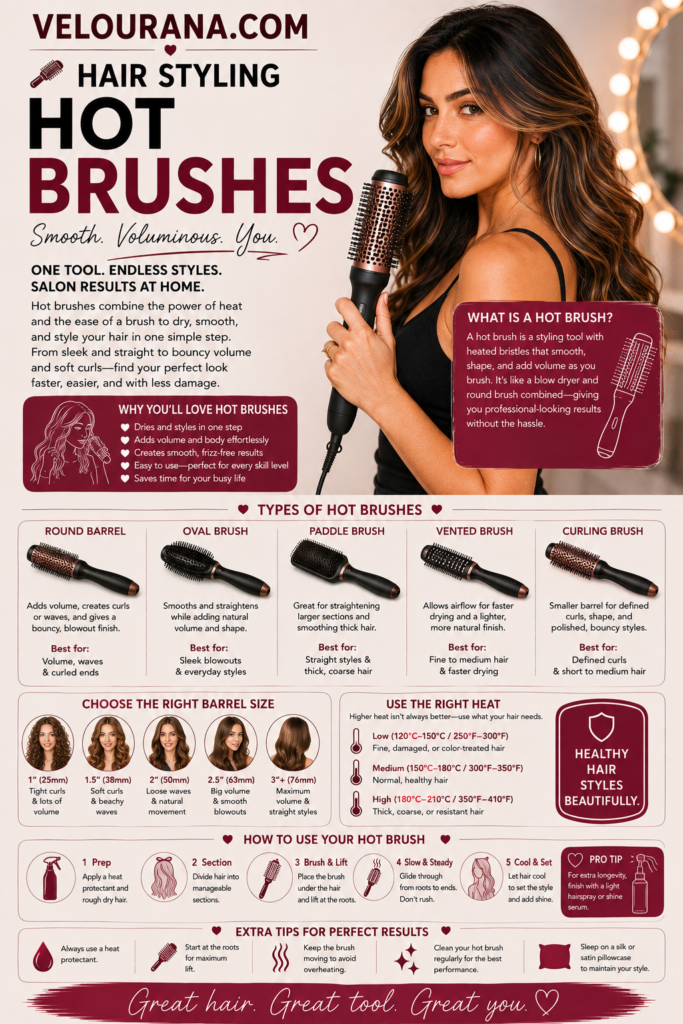
Hot brushes occupy an interesting place between traditional hairbrushes and conventional heated styling tools. They are designed to combine brushing with heat, allowing the hair to be smoothed, shaped, lifted or curved while it passes through or around a heated brush surface. Depending on the design, a hot brush may resemble a paddle brush, a round brush, an oval volumizing brush or a cylindrical styling tool, and those differences strongly influence the result it can create.
Their appeal is easy to understand. A straightener can produce an exceptionally sleek finish, but it can also remove more volume than someone wants. A curling iron creates deliberate curls, but it may be unnecessary when the goal is simply soft movement through the ends. Traditional blow-drying with a separate brush and dryer can create beautiful volume, although coordinating two tools at once requires practice.
A hot brush can offer a middle ground.
It can smooth without necessarily making the hair completely flat. It can create broad bends without producing obvious ringlets. It can lift the crown, direct face-framing layers and give the ends a polished shape. For many hairstyles, this combination creates a finish that looks less intensely styled than flat-ironed hair and less deliberately curled than hair shaped with a curling iron.
That does not mean every hot brush performs the same job.
One of the most important distinctions is between heated brushes intended primarily for use on dry hair and hot-air brushes that combine heated airflow with a brush attachment. Although the names are sometimes used loosely, the styling processes are different. A dry-hair heated brush reshapes hair through direct heated contact, while a hot-air brush participates in drying and shaping at the same time.
Understanding which type of tool is being used is essential because preparation, technique and expectations should follow the manufacturer's instructions for that particular device.
What both categories share is the ability to create shape through brushing rather than through clamping or wrapping every section into a conventional curl. This gives hot-brush styling its characteristic softness.
The finished hair can look polished while retaining movement.
And when the tool is used thoughtfully, that movement is where the hot brush becomes particularly valuable.
Why Hot Brushes Create a Different Finish From Straighteners and Curling Irons
The visual difference begins with the way the hair interacts with the tool.
A flat iron presses a relatively thin section between two heated plates. This can create a highly controlled, sleek result because the hair is compressed and directed as it travels through the plates.
A curling iron or wand creates shape by positioning the hair around a heated barrel. The resulting movement can range from tight curls to broad waves depending on the barrel, section size and technique.
A hot brush approaches the hair differently.
The bristles organize and separate the strands while the heated surface influences their shape. Because the hair is being brushed rather than completely compressed, some natural body can remain. Depending on the design, the tool can also elevate the roots or introduce a broad curve through the lengths.
This makes hot brushes particularly suited to styles that need polish without extreme sleekness.
Someone with relatively straight hair may use one to smooth irregular texture and create a more finished appearance while preserving natural volume. Wavy hair can be stretched into a softer, straighter shape without necessarily becoming completely flat. A layered haircut can gain curvature that makes the individual lengths more visible.
The ends can be directed inward, outward or allowed to remain comparatively straight.
That flexibility is central to the tool's appeal.
A hot brush is often most convincing when it is used to refine the natural architecture of the haircut rather than attempting to imitate another tool exactly.
Trying to make a smoothing brush behave like a small curling iron can be frustrating. Expecting an oval volumizing brush to produce the same pin-straight finish as a flat iron may also lead to unnecessary repetition.
The tool performs best when the desired result matches its strengths.
Those strengths are usually smoothness, broad movement, volume and controlled shape.
The Foundation Determines How Easily the Brush Can Work
As with other forms of heat styling, preparation has a major influence on the final result.
For heated brushes intended for dry-hair styling, the hair should be prepared according to the manufacturer's directions and be in the appropriate dry condition before the tool is used. Hot-air brushes designed specifically to participate in drying have different requirements, so their instructions should determine how damp the hair should be when styling begins.
This distinction should never be guessed from appearance alone.
Two tools can look remarkably similar while being designed for different methods.
Heat protection should also form part of the routine when appropriate for the tool and styling process. A suitable heat-protective product can be applied according to its own directions, with enough attention to distribution that the hair is prepared consistently rather than heavily coated in isolated areas.
Fine hair often benefits from a lighter preparation because the finished style usually depends on maintaining air and movement. Dense or coarse-feeling hair may prefer more smoothing support, but excessive product can still make the brush move less freely.
Detangling before detailed styling is particularly useful.
The hot brush is supposed to move through or around controlled sections. If it repeatedly encounters knots, the styling motion becomes interrupted and the temptation to revisit the same area increases.
A cleanly detangled foundation makes each pass more purposeful.
The hair should then be divided according to density.
This is where many disappointing hot-brush results begin. Because the tool resembles a normal brush, it can be tempting to take enormous amounts of hair and simply brush through them.
That may create superficial smoothing, but the heated surface cannot necessarily influence the interior of a very dense section effectively.
Smaller, manageable sections allow the brush to shape the hair rather than merely skim its surface.
This does not mean the sections need to become tiny.
Hot brushes are generally valued for creating broader, softer results.
The goal is simply to give the tool enough control to do its work once rather than repeatedly passing through an oversized section.
Smoothness Comes From Controlled Movement, Not Endless Brushing
A hot brush can make smoothing feel deceptively simple because the motion resembles ordinary brushing.
That familiarity can encourage unnecessary repetition.
If one pass creates the desired smoothness, repeatedly brushing the same section with heat does not make the result proportionally better. It simply adds more exposure to hair that has already been styled.
A more deliberate technique treats each heated pass as a styling action.
The section is controlled.
The brush is positioned according to the desired shape.
The hair travels through the tool smoothly.
Then the result is assessed.
If the section is sufficiently polished, it can be left alone.
This is particularly important at the ends. The ends are repeatedly exposed during ordinary hair care because almost every full-length brushing motion reaches them. When a heated brush is involved, they can also receive heat during every repeated pass even if the actual styling problem exists higher in the section.
The brush does not always need to travel identically from roots to tips.
If the upper length needs refinement while the end already sits correctly, the technique can focus on the area that needs work.
This creates a more precise routine and helps prevent hot-brush styling from becoming an automatic sequence of heated brushing simply because the tool feels easy to use.
Root Lift Is One of the Hot Brush's Most Useful Strengths
One of the clearest advantages of many hot brushes is their ability to preserve or create volume while smoothing the hair.
A straightener used close to the scalp can make the roots lie very flat. A brush-shaped tool can instead lift the section away from its natural resting position before directing it into the lengths.
That small change can transform the silhouette.
Fine hair can appear fuller because the roots occupy more space.
Medium and long layers can gain a softer, more buoyant appearance.
A side part can become more sweeping.
The crown can look lifted without requiring tightly curled roots.
The technique should still be appropriate to the particular tool. A round or oval brush design naturally lends itself to elevation and curvature, while a paddle-style heated brush may be more focused on smoothing.
With a suitable tool, the section can be lifted at the root and directed away from the scalp before continuing through the length.
The objective is not extreme height.
Natural-looking volume usually comes from creating enough elevation that the hair does not immediately collapse against the head.
The front sections can be treated separately.
Rather than brushing them straight downward, they can be directed upward, backward or outward depending on the haircut. This can create the sweeping movement associated with a blowout without requiring a traditional round brush and separate dryer.
Face-framing layers particularly benefit from this kind of directional styling because their purpose is often to interact with the face rather than simply fall vertically beside it.
A hot brush can exaggerate that design gently.
The haircut remains recognizable, but its movement becomes more visible.
Creating Curved Ends Without Turning Them Into Curls
The ends are one of the areas where hot brushes can produce especially elegant results.
A completely straight end creates a clean, modern finish.
A slight inward curve makes the perimeter appear softer and more polished.
An outward turn creates a livelier, more retro-influenced shape.
Long layers can be directed in different ways so that the haircut develops dimension.
These effects do not require the hair to become conventionally curled.
Instead, the brush introduces broad curvature.
With a round or oval design, the end of a section can be guided around the tool sufficiently to establish the desired direction. The movement can remain subtle, especially when the goal is simply preventing the ends from appearing rigid.
The amount of curvature should relate to the haircut.
A blunt bob can look dramatically different with its ends turned inward. The same degree of curvature on very long layered hair may appear only as a soft finish at the bottom.
Shorter face-framing sections can sweep backward while longer layers curve more gently.
This variation creates depth.
It also demonstrates why identical styling on every section is not always desirable.
Different lengths have different jobs within the haircut.
The hot brush can emphasize those differences rather than forcing them into one uniform shape.
Hot Brushes Can Make Layers More Visible
Layered hair often looks dramatically different after broad heat styling because the sections stop falling into one undifferentiated mass.
A hot brush can lift shorter upper layers, smooth the middle lengths and curve the ends so that each level of the haircut becomes more visible.
This is particularly effective with long layers.
When very long hair is completely straight and flat, subtle layers can disappear visually. Adding broad movement causes the shorter sections to sit away from the longest lengths, creating shadows, separation and dimension.
The hair appears fuller even though no additional hair exists.
Medium layered cuts can become even more responsive because their shorter length allows the movement to remain buoyant.
The crown can lift.
The sides can curve outward.
The lower sections can remain smoother.
This creates a shape closer to a traditional blowout than to conventional curling.
Curtain bangs and long face-framing layers are especially compatible with this technique. They can be directed away from the face and encouraged to connect with the side layers rather than falling separately.
The resulting hairstyle can appear polished without looking excessively precise.
That softness is one of the reasons hot brushes work so naturally with layered cuts.
Fine Hair Needs Volume Without Excess Product or Repetition
Fine hair can be an excellent candidate for hot-brush styling because relatively modest changes in root direction and curvature can create a significant visual increase in fullness.
The challenge is preserving that lightness.
Heavy preparation can make the roots collapse, while repeated heated passes can remove some of the airy quality the style is intended to create.
A lightweight approach often works best when appropriate for the individual hair.
The roots can be lifted deliberately rather than repeatedly brushed flat.
The middle lengths can be smoothed without being compressed.
The ends can receive enough curvature to create movement.
Once the shape is established, the section can be left to settle.
Fine hair also illustrates why tool size matters.
A very large brush on relatively short fine hair may struggle to create visible curvature because the section cannot travel sufficiently around the tool. A more appropriately scaled design can create movement without requiring repeated attempts.
Long fine hair can work beautifully with larger brushes because there is enough length to develop broad curves.
The finished style should retain space between the strands.
That space is what creates much of the impression of volume.
The objective is therefore not maximum smoothness at any cost.
It is smoothness with air.
Thick and Dense Hair Require Systematic Sectioning
Dense hair can produce beautiful results with a hot brush, particularly when the goal is to organize volume rather than eliminate it.
The main challenge is reaching the hair consistently.
Brushing only the visible surface can create an attractive outer finish while leaving the internal sections comparatively unchanged. Depending on the desired hairstyle, that may or may not be sufficient.
For a more uniform result, the hair can be divided progressively.
Lower sections are styled first.
Middle sections follow.
The upper layers and face-framing pieces are finished last.
This method allows the brush to work through manageable amounts of hair and makes it easier to identify which sections have already received heat.
The process may appear more time-consuming than simply brushing through the entire head, but it can reduce repetition.
Each section receives deliberate attention once rather than superficial attention several times.
Dense hair also does not necessarily need maximum root lift everywhere. It already possesses substantial physical volume.
The crown can be shaped strategically while internal sections remain more controlled.
The result is volume with architecture rather than expansion in every direction.
A hot brush is particularly useful here because it can smooth and shape simultaneously.
The natural fullness remains part of the hairstyle instead of being completely flattened and then artificially rebuilt.
Straight, Wavy and Curly Hair Will Use the Tool Differently
Naturally straight hair often requires relatively little transformation from a hot brush.
The tool can polish the surface, create root lift and add movement to otherwise straight lengths. This can make it an appealing alternative to a straightener when complete flatness is not desired.
A few passes through carefully chosen sections may be enough.
Wavy hair can undergo a more noticeable change.
A hot brush can stretch the wave into a smoother pattern while retaining more body than a very sleek flat-ironed finish. Depending on the strength of the natural texture and the particular brush, the result may resemble a relaxed blowout.
Some natural movement can also be preserved deliberately.
There is no requirement to remove every wave.
If the hair already has attractive texture through certain areas, the brush can focus on the sections that need refinement.
Curly and coily hair require more consideration because the degree of transformation can be substantial.
A heated brush designed for dry styling is not automatically a replacement for every stage of stretching curly hair. A hot-air brush designed for drying and styling performs another function again.
The manufacturer's directions should determine how the particular tool is incorporated into the routine.
When a smoother finish is desired, preparation can reduce the amount of correction required later. When natural texture is being preserved, a hot brush may have a much smaller or entirely different role.
The tool should serve the intended hairstyle rather than dictate it.
Heated Brushes and Hot-Air Brushes Should Not Be Confused
The similarity in appearance between heated brushes and hot-air brushes can obscure an important difference.
A heated smoothing or styling brush generally relies on a heated surface to influence hair that has already been brought to the appropriate condition for the tool.
A hot-air brush combines airflow with brushing and can participate in drying as well as shaping.
Because these mechanisms are different, the correct preparation is different.
A person should not assume that a tool can be used on wet or damp hair merely because it has bristles.
The instructions for the specific device determine its intended use.
This is particularly important because the convenience of brush-shaped tools can create the impression that they are interchangeable.
They are not.
A paddle-style heated brush may excel at smoothing.
A round heated brush may specialize in broad curvature.
An oval hot-air brush may create volume while drying.
Another device may have interchangeable attachments designed for several finishes.
Understanding the mechanism makes it easier to choose realistic styling goals.
It also reduces the temptation to compensate for a mismatch between tool and hairstyle through excessive heat or repeated passes.
Hot Brushes Can Create a Blowout Effect Without Perfect Blow-Drying Technique
Traditional round-brush blow-drying can create exceptional volume and polish, but it requires coordination.
One hand controls the dryer.
The other controls the brush.
The airflow needs to follow the section.
Tension and direction need to remain consistent.
For someone styling their own hair, particularly at the back of the head, this can take practice.
Certain hot brushes simplify part of that coordination by combining shaping and heat into one handheld action.
This does not mean they reproduce every professional blowout exactly.
What they can do very effectively is create the visual language of a blowout: smooth lengths, lifted roots, broad curvature and moving ends.
The finish can be particularly convincing on medium and long layered hair.
The front sections can sweep backward.
The crown can rise slightly.
The lengths can remain polished without becoming flat.
The ends can curve enough to complete the shape.
The result is not a head of curls.
It is a hairstyle built from large changes of direction.
That is precisely where a hot brush often performs at its best.
Cooling and Finishing Help Preserve the Shape
Heat creates the movement, but immediately disturbing a warm section can weaken the shape before it has settled.
This is particularly relevant when the hot brush is being used to create volume or curvature rather than simple smoothing.
A newly lifted root can be allowed to cool without being immediately flattened.
A curved section can settle before it is aggressively brushed again.
Face-framing pieces can retain their direction while the rest of the hair is completed.
This reduces the need to recreate movement later.
Once the hair has settled, finishing should remain appropriate to the desired style.
A polished blowout effect may benefit from gentle brushing so the sections blend.
A more voluminous finish may need only finger arrangement.
If the ends have been deliberately directed in different ways, excessive brushing can remove some of that distinction.
The finishing stage should therefore reveal the shape created by the hot brush rather than automatically erase it.
Product can be used when desired, but the hair should ideally retain flexibility.
One of the advantages of this styling method is movement.
Making the hair excessively rigid undermines that advantage.
A Hot Brush Can Be Especially Useful for Refreshing Hair
One of the most practical uses of a hot brush is selective second-day styling.
A full blowout may still look good through most of the lengths while the crown has become flat.
The front pieces may have lost their sweep.
One side may have developed a bend during sleep.
The ends may need a little more direction.
A hot brush can address these areas without requiring the entire hairstyle to be recreated.
This selective approach is both efficient and visually effective.
The front can be lifted again.
The crown can regain some volume.
A few lengths can be smoothed.
The ends can be redirected.
Everything else remains untouched.
The same principle applies to naturally straight hair that needs only minor polishing before leaving the house. There is little reason to style the entire head when a handful of visible sections determine the overall impression.
A brush-shaped tool encourages this kind of localized refinement because it feels intuitive to move through selected areas.
The important point is remembering that it is still a heated styling tool.
A refresh should remain a refresh, not gradually turn into dozens of repeated heated passes simply because brushing feels familiar.
The Best Hot-Brush Results Preserve the Character of the Haircut
A hot brush becomes most interesting when it is used for more than generic smoothing.
The haircut provides a map.
A bob has a perimeter that can be emphasized through controlled curvature.
A long bob can gain movement around the front while retaining a strong lower line.
Long layers can be lifted and separated so that their different lengths become visible.
Curtain bangs can sweep outward.
Shorter crown layers can gain volume while the longest hair remains relatively smooth.
Instead of treating the entire head identically, the tool can follow these structural differences.
This creates a hairstyle that looks designed rather than merely brushed.
It also reduces unnecessary work.
If an internal section already falls correctly, it does not need repeated refinement.
If the front requires more movement, it can receive more attention.
If the ends need only a subtle curve, there is no reason to force them into a stronger shape.
The finished result becomes more natural because variation remains.
Haircuts are rarely composed of identical strands performing identical jobs.
Styling should not pretend otherwise.
Hot Brushes Are Most Effective When Their Simplicity Does Not Lead to Overuse
The greatest strength of a hot brush can also become its weakness.
It feels easy.
There is no clamp to open.
There may be no complicated wrapping technique.
The movement resembles something people already do every day.
Brush through the hair.
Smooth it.
Turn the ends.
Lift the roots.
Because the action feels ordinary, it is easy to forget that heat is involved.
This is why deliberate use matters.
A heated pass should accomplish something.
If the section is already smooth, it can be left alone.
If the root has enough lift, repeated elevation is unnecessary.
If the end already curves correctly, it does not need another round simply because the rest of the hairstyle is unfinished.
The same heat-protection principles that apply to other hot tools remain relevant: suitable preparation, appropriate use according to the device instructions, manageable sections, purposeful temperature and avoidance of unnecessary repetition.
What changes is the style of movement the tool can create.
A hot brush does not have to produce perfectly straight hair.
It does not have to create obvious curls.
Its most attractive territory often lies between those extremes.
The hair can become smoother while remaining full.
The roots can lift without becoming tightly curled.
The lengths can gain broad movement.
The ends can curve.
Layers can separate.
Face-framing sections can sweep naturally around the features.
The finished hairstyle can look polished without advertising every step used to create it.
That is the real versatility of the hot brush.
It offers a way to shape hair rather than simply straighten or curl it.
Used with attention to the haircut, texture and condition of the hair, it can create a finish that feels deliberately styled but still soft enough to move naturally.
And when that balance is achieved, the tool becomes more than a convenient alternative to a straightener or traditional blow-dry.
It becomes a styling category of its own—one built around smoothness, volume, broad shape and the kind of movement that makes freshly styled hair look effortlessly finished.
The End
Velourana.
 Discover More From Our Family of Websites
 ZodiacBearing (Astrology, Tarot, Numerology, Angel Numbers & Spiritual Guidance)
 Velourana (Beauty, Makeup, Hair Care, Skincare & Beauty Tips)
 HavenBearing (Home, Living, Organization, Décor & Everyday Inspiration)
 PawBearing (Pet Care, Dog Breeds, Animal Health, Training & Pet Products)
 PsyCatherine (Notes From the Journal of a Psychologist on Real Life)

