
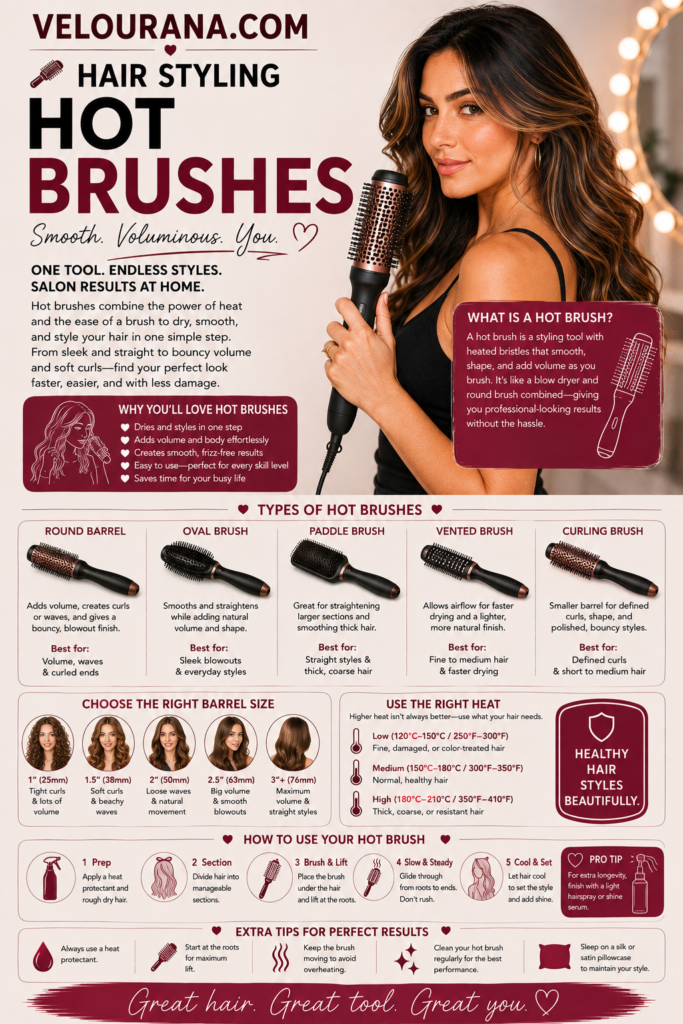
CATEGORY: Hot Brushes
A hot brush can change the character of a hairstyle with surprisingly little movement. One deliberate pass can smooth an uneven section. A few seconds of root elevation can create visible lift. A gentle turn through the ends can make a blunt cut look softer, while directing the front layers backward can open the face and give the entire hairstyle a more polished silhouette.
What makes the tool useful is not simply that it combines heat with brushing. It is that it can create shape without forcing the hair into the extreme finish associated with other tools. A straightener can produce highly compressed sleekness. A curling iron can create obvious curvature and defined curls. A hot brush often works best between those two extremes, where the hair remains smooth but still full, and curved without becoming tightly curled.
That middle ground is especially valuable for people who want their haircut to remain visible. Layers can keep their separation. Natural volume can remain present. The ends can be polished without appearing rigid. The hair can still move normally after styling rather than behaving like a fixed shape.
The technique, however, depends on more than simply brushing until the hair looks smooth.
Volume, smoothing and curved ends require different movements. The root needs elevation rather than downward pressure. The middle lengths need enough tension to organize the strands without flattening every trace of body. The ends need controlled direction. Face-framing pieces often need to be treated differently from the back, and shorter layers require a different scale of movement from very long sections.
The most convincing hot-brush styles are therefore built intentionally.
The tool may be simple to use, but the finished hairstyle becomes much better when each pass has a clear purpose.
Root Volume Comes From Direction Before It Comes From Heat
The roots determine the foundation of the entire hairstyle. If they are styled flat against the scalp, the lengths may still look beautifully smooth, but the overall shape can feel compressed. When the roots are given a little space, even relatively straight hair can appear fuller and more balanced.
This is one of the areas where a hot brush can be especially effective.
Instead of placing the brush at the root and immediately pulling downward, the section can be lifted away from the scalp first. The direction can be vertical, backward or slightly opposite the position in which the hair will eventually fall. That temporary overdirection creates space.
When the section returns to its natural position, some of that elevation remains.
This does not require dramatic lifting throughout the entire head. In fact, maximum volume everywhere can create a silhouette that feels wider rather than more flattering. The crown usually benefits from the strongest lift, while the lower sides can remain more controlled.
The front should be considered separately.
A center part may need symmetrical lift on both sides. A side part often benefits from more movement through the heavier section so that it sweeps rather than collapses. Curtain bangs can be elevated briefly before being directed outward, which gives them enough root movement to open naturally around the face.
The important point is that volume begins before the brush travels through the lengths.
If the root is flattened first and the stylist then tries to create lift at the ends, the hairstyle can become bottom-heavy. The upper hair looks close to the scalp while the lower sections expand.
A well-shaped hot-brush style avoids that imbalance by building the silhouette from the top downward.
Smoothing Should Organize the Hair Without Erasing All Its Body
Smoothing is one of the most obvious strengths of a hot brush, but it is easy to confuse smoothness with flatness.
The two are not the same.
Smoothness describes the surface. The strands lie in a more consistent direction, the hair looks polished, and irregular bends are reduced. Flatness describes the amount of space the hair occupies.
A hot brush can create one without necessarily creating the other.
The way the section is held makes the difference. If the hair is pulled tightly downward from root to tip, the result becomes sleeker but may also lose volume. If the root is lifted first and the brush then follows through the length, the surface can become polished while the upper silhouette remains fuller.
This distinction is especially valuable on fine hair, where even a small amount of root compression can make the entire hairstyle look significantly flatter. It also matters on layered hair, because excessive smoothing can cause the layers to fall into one another and become less visible.
The middle lengths usually need enough tension to remain controlled, but not so much that the hair is stretched unnecessarily.
The goal is to allow the heated surface and bristles to organize the section.
If one controlled pass creates the desired finish, repeated passes may offer little additional benefit. The brush should not be used like an ordinary brush simply because the movement feels familiar. Each heated pass is a styling action.
This becomes particularly important with the ends, which can receive heat during every complete brush stroke even when the styling problem exists higher in the section.
A more precise technique focuses on what actually needs to change.
Curved Ends Can Change the Personality of a Haircut
The final few centimeters of hair have a disproportionate effect on how a hairstyle feels.
A completely straight end creates a sharper, more modern finish.
An inward curve produces softness and polish.
An outward flick creates movement and can make layers appear lighter.
The same haircut can therefore look dramatically different depending on how the ends are styled.
A hot brush is particularly well suited to this kind of broad directional shaping because it does not need to create a full curl. The section can simply be guided around the brush enough to establish a bend.
On a bob, the curve may be concentrated almost entirely at the perimeter. The roots and middle lengths remain relatively smooth while the ends turn inward or outward.
On medium layered hair, different sections can carry different movements. The lower hair may turn inward while upper layers move outward. This creates depth and helps the haircut feel more dimensional.
On long hair, the curvature can be broader and softer. The ends may not look obviously curled at all. They simply fall with more intention.
This subtlety is one of the reasons hot-brush styling often looks natural.
The hair does not appear to have been curled section by section. It appears to have developed movement as part of the cut.
That illusion becomes stronger when the stylist avoids forcing every end into exactly the same direction.
Variation can make the result more believable.
Face-Framing Layers Deserve More Attention Than Hidden Internal Sections
The front of the hairstyle is usually the first area people notice, which means the face-framing pieces have more visual importance than many internal sections.
They also tend to be shorter.
That makes them more responsive to heat and easier to overstyle.
A front layer ending near the cheekbone can develop a strong curve with relatively little movement around the brush. A section reaching the chest requires a larger motion to create a similar visual effect.
Using identical technique on both can make the shorter piece look excessively curled.
Instead, the front should be styled according to its role.
Curtain bangs usually need lift at the root and an outward sweep through the ends. Long side layers can continue that direction more broadly. The movement should grow softer as the sections become longer.
This creates continuity.
The front does not look like a separate curled element attached to otherwise smooth hair. It becomes the beginning of the shape that continues through the sides and lengths.
A hot brush can be particularly useful here because it allows gradual adjustment. The section can be lifted, smoothed and curved in one movement rather than being clamped into a fixed shape.
Once the front looks right, it often needs less additional styling than people assume.
Repeatedly revisiting it can remove the softness that made it flattering in the first place.
Layered Hair Benefits From Different Movements at Different Heights
Layers are designed to create variation in length, weight and movement, so styling every layer identically can obscure the haircut.
Hot brushes can reveal layers beautifully when each section is given a movement that suits its position.
Shorter crown layers can be lifted more strongly because they contribute to height.
Mid-length layers can carry broad curvature.
Long lower sections can remain smoother and act as the visual foundation.
Face-framing layers can move outward.
The overall result becomes dimensional without looking excessively curled.
This is especially effective on long layered hair. When the hair is worn completely straight, subtle layers may blend almost invisibly. Once the shorter sections are lifted and curved, the haircut becomes much easier to see.
Fine layered hair can appear fuller because the sections no longer lie directly on top of one another.
Dense layered hair can become more organized because the volume is distributed into recognizable shapes rather than expanding uniformly.
The key is hierarchy.
Not every section needs equal volume.
Not every end needs the same curve.
Not every root needs the same elevation.
The hairstyle looks more sophisticated when the strongest movement occurs where it contributes most.
Fine Hair Needs Precision Because It Responds Quickly
Fine hair often shows the effect of a hot brush after relatively little styling.
A root can gain visible lift quickly.
A smooth section can become polished after one effective pass.
A curved end can hold enough movement to change the silhouette.
This responsiveness is an advantage, but it also means overworking can happen easily.
Repeated passes can make the hair feel flatter simply because the roots are being brushed downward again and again. Heavy product can reduce movement. Excessive finishing can cause the sections to group together and lose the airy separation that created volume in the first place.
For fine hair, the most effective technique is often the least complicated.
Prepare appropriately.
Use manageable sections.
Lift where lift is wanted.
Smooth once the section is controlled.
Shape the end.
Then stop.
The tool should not be used continuously simply because the hair can tolerate more brushing.
The objective is to preserve the volume created during the process.
Fine hair also benefits from choosing a brush size that matches the length. Very large tools can fail to create enough curvature on shorter fine hair, while a more appropriately scaled brush can produce visible movement without requiring repeated attempts.
Long fine hair can support broader tools because the length allows the section to travel farther around the brush.
The principle remains proportionality.
The tool and movement should match the hair.
Thick Hair Needs Structure More Than Extra Volume
Thick and dense hair already contains substantial physical fullness, so hot-brush styling often works best when it organizes that volume rather than trying to maximize it.
The most important step is usually sectioning.
A brush can smooth the visible surface of a dense head of hair quickly, but that does not mean the internal sections have been styled consistently. If a complete blowout-like finish is wanted, lower and middle sections need access to the tool.
Working progressively prevents the outer hair from receiving repeated heat while hidden areas remain untouched.
This also makes the final shape easier to control.
The lower sections can remain relatively smooth.
The upper layers can receive more lift.
The crown can be elevated where height is useful.
The face-framing pieces can be shaped deliberately.
The result is full but not shapeless.
Dense hair can also hold broad curves beautifully because the amount of hair creates substantial visual movement. The mistake is often using too much curvature through every section, which can make the hairstyle expand excessively.
Larger, softer bends can be more effective.
They organize the density into flowing shapes while preserving the richness of the hair.
Straight Hair Can Use a Hot Brush as a Shaping Tool Rather Than a Smoothing Tool
When hair is already naturally straight, repeatedly smoothing every centimeter may provide little visual benefit.
The more interesting use of the hot brush is shaping.
The roots can gain lift.
The part can become more deliberate.
The front can sweep away from the face.
Layers can separate.
The ends can curve.
This can transform the hairstyle without making it look as though the natural texture has been replaced.
Straight hair can therefore retain its fluid character while becoming much more dimensional.
This is especially attractive on long hair that normally falls in one continuous line. Broad movement through selected sections interrupts that line without turning the style into curls.
The same principle applies to straight bobs. The brush can emphasize the perimeter rather than flattening the entire cut.
The hair remains straight in identity.
It simply becomes styled.
Wavy Hair Can Be Refined Without Being Completely Rebuilt
Naturally wavy hair often already contains the kind of movement that hot brushes are designed to create.
The task is therefore frequently refinement rather than replacement.
Some sections may already fall beautifully and require no heat at all.
Others may bend in an irregular direction or become frizzy around the surface.
The front may need more control.
The ends may need a clearer shape.
A hot brush can focus on these areas selectively.
This preserves natural texture and reduces unnecessary repetition.
The finished style can look smoother and more deliberate while still containing slight variation from one section to another.
That variation can make the hairstyle feel natural.
Trying to make every wave identical often creates a more artificial result than simply organizing the existing pattern into a coherent silhouette.
For stronger waves, preparation becomes more important. A hot-air brush designed to dry and stretch hair may have a different role from a heated dry-hair brush.
The device should be used according to its intended function.
If a particular tool cannot realistically create the desired transformation on the hair, repeated passes are not an elegant solution.
Choosing the right tool matters as much as technique.
Curly and Coily Hair Need a Clear End Goal Before Styling Begins
For curly and coily textures, hot-brush styling can involve a substantial transformation, so the intended finish should be defined before the process begins.
Is the goal a stretched, voluminous blowout?
A smoother style with some natural body?
A foundation for later straightening?
A polished shape that still retains visible texture?
These are different goals.
The preparation and tool choice should follow accordingly.
A hot-air brush designed for drying and stretching can participate earlier in the process. A heated brush intended for dry styling belongs at another stage. Neither should be used outside the manufacturer's instructions simply because it resembles a conventional brush.
When the objective is a broad blowout, natural volume can become part of the final result rather than something that needs to be eliminated.
The roots can remain full.
The lengths can become smoother and more elongated.
The ends can be shaped.
This can create a rich, soft finish that looks very different from flat-ironed hair.
If a sleeker result is desired afterward, another tool may be used according to the styling plan, but the first stage should already have reduced the amount of work required later.
Heat styling becomes more efficient when each tool performs a distinct job.
A Hot Brush Can Create a Polished Bob Without Making It Stiff
Bobs respond particularly well to hot-brush styling because relatively small directional changes affect the entire silhouette.
The roots can be lifted slightly to prevent the cut from looking flat.
The middle lengths can remain smooth.
The perimeter can curve inward for a classic rounded finish or outward for something lighter and more playful.
A long bob can carry more movement through the sides.
Face-framing sections can sweep backward, especially when the cut contains layers or a softer front.
Because the perimeter is so visible, the ends need deliberate attention.
If one section turns inward while another bends unpredictably outward, the haircut can look less precise. The hot brush can create enough consistency to make the shape feel intentional without making every strand rigid.
The result should still move.
A bob looks most polished when the perimeter appears controlled but not frozen.
Medium Hair Is Ideal for Broad Hot-Brush Movement
Medium hair often holds broad shape particularly well because it has enough length to curve but not so much weight that every movement immediately relaxes.
This makes it excellent for blowout-inspired hot-brush styling.
The crown can retain lift.
The front can sweep.
The ends can curve.
Layers can separate visibly.
The entire style can feel buoyant without becoming excessively large.
Because the movement holds relatively easily, medium hair often needs less aggressive styling than very long hair.
A moderate bend may be enough.
The temptation to create a stronger shape than necessary can lead to an overdone result.
The best approach is to build gradually.
Style one section.
Observe how it settles.
Then decide how much movement the neighboring sections need.
This creates a more natural rhythm through the hairstyle.
Long Hair Requires Stronger Shape at the Top and Softer Treatment at the Bottom
Long hair introduces weight, and weight changes everything.
Root lift can soften quickly.
Curved sections can stretch.
The longest ends can fall more vertically than shorter layers.
A successful hot-brush style should anticipate this rather than constantly fight it.
The crown can receive more deliberate lift because some of that height will relax.
Shorter upper layers can carry stronger curvature.
The longest sections can remain broader and softer.
This creates a natural cascade.
The ends should also be treated with restraint. They are the oldest part of the hair and can receive heat during every complete brush stroke. If they already sit correctly, there is little reason to keep styling them simply because another area of the section needs work.
A precise technique recognizes completion.
This is particularly important on long hair because the styling process is already time-consuming.
Efficiency protects both the hair and the stylist's patience.
The Front, Crown and Ends Should Be Finished Separately
A complete hairstyle often becomes more polished when its most visible areas are considered independently at the end.
The front determines the frame.
The crown determines the profile.
The ends determine the finish.
These three areas do not always need the same treatment.
The front may need an outward sweep.
The crown may need more lift.
The ends may need only slight curvature.
A final pass through the entire head can flatten or disturb sections that were already successful.
Targeted finishing is usually better.
The stylist can look at the silhouette and ask what is missing.
Perhaps the crown is too flat.
Perhaps one side of the front is turning inward when it should sweep back.
Perhaps the lower ends are too straight relative to the movement above them.
Correct those areas.
Leave everything else alone.
This is what turns hot-brush styling from repetitive brushing into actual hairstyling.
Cooling Helps the Shape Remain Without More Heat
When the hot brush has created lift or curvature, the section should be given a moment to settle.
Warm hair can be easy to reshape.
If a freshly lifted crown section is immediately pressed flat under the rest of the hair, some of the volume can disappear.
If a curved face-framing piece is pulled straight while still warm, the movement can weaken.
Allowing the section to cool in or near its intended position helps preserve the work that has already been done.
This is a simple way to improve longevity without increasing temperature or repeating the pass.
The same principle is familiar in curling and blow-drying.
Shape is created under heat.
Then it settles.
Only afterward should the hairstyle be blended and adjusted.
This sequencing is particularly useful when the hot brush is being used for blowout-style movement rather than simple smoothing.
Second-Day Styling Should Be Selective
One of the best uses of a hot brush is refreshing a hairstyle that is mostly intact.
A full style rarely disappears evenly overnight.
The front may lose direction.
The crown may flatten.
One side may develop an unwanted bend.
The ends may soften while the middle lengths remain smooth.
There is no need to restart.
The hot brush can focus on the sections that have changed.
This keeps the second-day style softer and more natural while restoring its structure.
Fine hair may need only root lift.
Wavy hair may need a few polished surface sections.
Dense hair may need only the front and crown.
Long layered hair may need the shortest pieces reshaped while the longest movement remains untouched.
This approach reduces unnecessary heat and preserves the relaxed evolution of the style.
The second-day hairstyle does not need to look exactly like the first-day version to remain beautiful.
The Best Hot-Brush Technique Is the One That Knows What Each Pass Is Supposed to Do
A hot brush is easy to overuse because it feels so familiar.
Brushing is an automatic movement.
Heated brushing should not be.
Every pass should answer a styling need.
Is the root being lifted?
Is the section being smoothed?
Is the layer being directed?
Is the end being curved?
Is the front being reshaped?
If none of these things is happening, the pass may be unnecessary.
This simple awareness improves both the finish and the efficiency of the routine.
The tool becomes a shaping instrument rather than a heated version of an everyday brush.
That distinction is what allows the hairstyle to remain soft.
The roots can be full without being exaggerated.
The lengths can be smooth without becoming flat.
The ends can curve without becoming curls.
Layers can separate without becoming messy.
The front can frame the face without looking overly styled.
Fine hair gains air.
Dense hair gains organization.
Straight hair gains movement.
Wavy hair gains refinement.
Curly and coily hair can gain broad stretched shape when that is the intended result and the appropriate tool is used correctly.
Short hair can gain direction.
Medium hair can gain bounce.
Long hair can gain dimensional movement without requiring every section to become heavily styled.
The strongest hot-brush results come from this balance.
Heat is present, but it does not dominate the appearance.
The tool has clearly influenced the hair, but the final hairstyle still looks natural enough to move freely.
That is what makes the technique useful.
It does not create one fixed finish.
It creates control over direction.
And once direction is controlled, volume, smoothness and curvature can be placed exactly where the haircut needs them most.
The End
Velourana.
 Discover More From Our Family of Websites
 ZodiacBearing (Astrology, Tarot, Numerology, Angel Numbers & Spiritual Guidance)
 Velourana (Beauty, Makeup, Hair Care, Skincare & Beauty Tips)
 HavenBearing (Home, Living, Organization, Décor & Everyday Inspiration)
 PawBearing (Pet Care, Dog Breeds, Animal Health, Training & Pet Products)
 PsyCatherine (Notes From the Journal of a Psychologist on Real Life)

