CATEGORY: Hot Brushes
A polished blowout has a distinctive kind of movement. The roots appear lifted without looking artificially raised, the lengths are smooth but not completely flat, and the ends curve with enough softness to make the entire haircut feel lighter and more dimensional. Layers that can disappear when hair is worn straight suddenly become visible, while face-framing pieces sweep away from the features and connect naturally with the rest of the style.
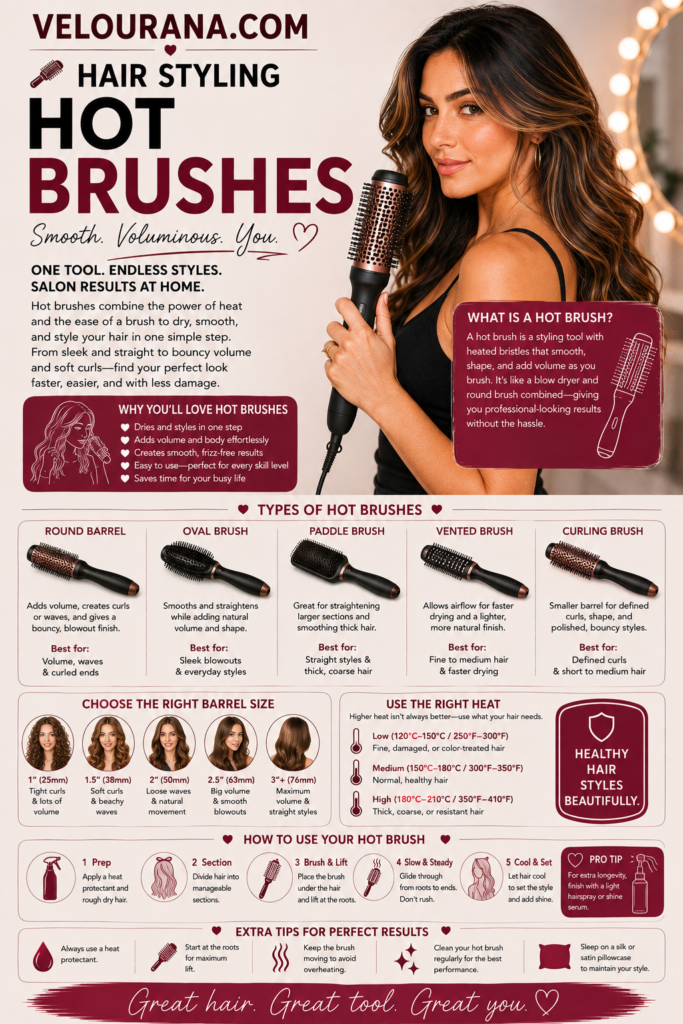
Traditionally, achieving this effect has meant coordinating a round brush and a blow-dryer at the same time. That technique can create beautiful results, but styling one's own hair—particularly the sections at the back—requires practice. Hot brushes offer another route to the same broad aesthetic.
Depending on the type of tool, they can combine heat and brushing or heated airflow and brushing in one movement. This makes it possible to smooth, lift and shape the hair without handling a separate dryer and brush simultaneously. The result is not necessarily identical to a professional round-brush blowout, nor should it be expected to be. A hot brush has its own strengths, and the most successful styles take advantage of them rather than forcing the tool to imitate something else exactly.
Those strengths are particularly visible when the goal is broad movement.
A hot brush can create a sweeping curve rather than a defined curl. It can raise a root rather than tightly curl it. It can polish the surface while allowing the hair underneath to retain body. The ends can turn inward, flick outward or fall into a loose rounded shape.
The hairstyle is created through direction.
That is the key to a convincing hot-brush blowout. The tool does not simply make hair smoother. It changes where the hair wants to travel.
When the roots, layers, front sections and ends are each given an intentional direction, the finished result develops the flowing shape associated with a blowout rather than looking like hair that has merely been brushed with heat.
The Blowout Begins With Shape, Not Maximum Smoothness
A hot-brush blowout is different from a pin-straight finish.
With straightening, the objective may be to remove most visible bends and create a sleek surface from roots through ends. With a blowout, some curvature is desirable. The hair needs enough smoothness to look polished, but it also needs enough shape to remain buoyant.
Flattening every section before attempting to create volume can therefore be counterproductive.
The roots should retain space.
The upper lengths should transition smoothly into broader curves.
The ends should complete the movement rather than hanging beneath it without direction.
This means the final silhouette should be considered before styling begins.
Someone with long layers may want substantial movement around the face and through the shorter upper sections while keeping the longest hair softer. A medium layered haircut may benefit from more uniform bounce throughout. A blunt bob may need only root lift and controlled curvature through the lower half.
The haircut determines where movement will have the greatest visual effect.
Preparation should support that objective.
The exact starting condition depends on the specific type of hot brush. A heated brush designed for use on dry hair should be used according to those instructions. A hot-air brush designed to participate in drying follows a different process. The appearance of the tool is not enough to determine which method is appropriate.
Once the hair is in the correct condition for the device, it should be manageable and detangled.
A suitable heat-protective product can be incorporated according to its instructions. The amount and texture should suit the hair rather than overwhelm it.
Fine hair often needs to retain lightness because much of the blowout effect depends on air between the strands. Dense or coarse-feeling hair may benefit from more smoothing support, particularly if the natural texture is being transformed substantially.
The goal is not to make the hair slippery or heavily coated.
It is to create a foundation that can move cleanly through the brush.
Root Direction Creates the Architecture of the Blowout
Volume begins with the direction in which the roots are styled.
Hair that is repeatedly pulled straight downward while warm is encouraged to lie closer to the scalp. Hair that is lifted away from its resting position can develop more space at the root.
A hot brush can make this relatively intuitive.
Instead of beginning every section by dragging the tool downward, the section can first be elevated. The brush supports the hair away from the scalp before continuing into the lengths.
The amount of elevation should suit the hairstyle.
Extreme vertical lift is not necessary for a natural blowout. Often, a moderate change in root direction is enough to prevent the crown from looking flat.
The crown deserves particular attention because it affects the balance of the entire hairstyle.
Large movement through the ends combined with completely flat roots can make the hair appear bottom-heavy. A little height above creates continuity between the scalp and the fuller lower sections.
Fine hair can benefit dramatically from this adjustment. The actual amount of hair has not changed, but the roots occupy more space, which makes the entire hairstyle appear fuller.
Dense hair may need a more selective approach. Because the hair already contains considerable physical volume, lifting every internal section aggressively can create more expansion than desired. The visible upper sections can receive deliberate elevation while the lower hair remains more controlled.
This is where styling becomes architectural.
Volume is placed rather than simply maximized.
The part also influences the shape. A center part distributes the hair relatively evenly, while a side part creates greater volume and movement on one side. A softer part can allow the roots to shift more naturally.
The hot brush can reinforce whichever structure is chosen.
What matters is that the root direction is intentional before the lengths are shaped.
Face-Framing Layers Need Their Own Styling Logic
The sections around the face often determine whether a blowout looks convincing.
They are highly visible, usually shorter than the rest of the hair and responsible for creating the transition between the haircut and the features.
Treating them exactly like the longest sections can waste their potential.
Curtain bangs, for example, generally need broad outward movement rather than a tight curl. Their purpose is to open from the center and sweep into the sides.
A hot brush can create this by lifting the section and directing it away from the face while introducing enough curvature for the hair to fall naturally.
Longer face-framing layers can follow the same general direction but with a broader movement.
The shorter the section, the less wrapping or turning may be required to create a visible curve.
This difference is important.
If a short front layer receives exactly the same technique as a section reaching far below the shoulders, it may become much more strongly curved.
The objective should be visual harmony rather than mechanical repetition.
The front pieces should appear related to the rest of the blowout while retaining enough individuality to frame the face.
Once they have been shaped, they can be allowed to cool without being immediately pulled straight.
That brief period of settling can help preserve the sweep.
Later, the sections can be gently integrated into the sides without removing their direction.
Layers Create the Movement That Makes a Blowout Look Expensive
Layered hair and hot-brush styling work particularly well together because the brush can emphasize the differences already built into the haircut.
When layered hair is worn completely straight, the individual lengths may blend into one another. This can be elegant, but it does not always display the architecture of the cut.
Broad movement changes that.
Shorter layers rise away from the longer sections.
Curved ends create separation.
Face-framing pieces sweep in a different direction.
The crown develops dimension.
The haircut suddenly becomes more visible.
Long layers can be styled so that the upper sections carry stronger curvature while the longest hair remains softer. This prevents very long hair from becoming excessively round while still creating the impression of a full blowout.
Medium layers can tolerate more bounce because they carry less weight. The movement may remain stronger through the entire hairstyle.
Short layered hair needs another interpretation. It may require only root lift and strategically directed pieces rather than the broad rolling movement associated with long hair.
The important point is to follow the haircut rather than impose one identical curve on every section.
A layer ending near the cheekbone has a different visual purpose from one ending at the chest.
The brush can acknowledge that.
When each length is shaped according to where it falls, the finished hairstyle develops natural depth rather than mechanical uniformity.
The Ends Decide Whether the Blowout Looks Modern, Classic or Playful
The direction of the ends has a surprisingly strong influence on the personality of the hairstyle.
Ends turned inward create softness and polish. On a bob, this can emphasize the perimeter and produce a beautifully controlled rounded shape. On long hair, inward movement can create a flowing, glamorous finish.
Outward ends introduce more energy.
They can give medium layered hair a playful quality or emphasize shorter face-framing pieces. A subtle outward flick can also make layers appear more separated.
Some blowouts combine directions.
The lower hair may curve inward while selected upper layers sweep outward. Face-framing sections can travel backward while the longest ends remain relatively neutral.
This variation can make the style look more dimensional.
A hot brush is well suited to these broad changes because the section can be guided around or across the brush according to the tool's design.
The movement does not need to become a complete curl.
Often, the most convincing end shape is simply a controlled bend.
The amount of time and manipulation required should correspond to the desired effect. If the end already curves correctly after one deliberate movement, repeated heated brushing is unnecessary.
The finished end should look intentional but still flexible.
When the hair moves, the curve should move with it.
Fine Hair Needs Lift More Than It Needs Aggressive Styling
A hot-brush blowout can transform fine hair because volume is created primarily through direction and separation.
Roots that normally lie close to the scalp can be elevated.
Straight lengths can gain broad curvature.
Layers can separate enough to create visual depth.
The hairstyle appears fuller without requiring tight curls.
The danger is overworking the hair in pursuit of even more volume.
Repeated passes can eventually smooth away some of the texture that creates fullness. Heavy product can make the roots collapse. Excessive finishing can cause strands to group together.
A lighter approach often produces the better blowout.
The root is lifted once effectively.
The length is smoothed.
The end receives its curve.
The section is then allowed to cool and settle.
Fine hair also benefits from careful brush sizing. A tool that is excessively large relative to the hair length may create little visible curvature. A suitably scaled brush can provide enough movement without requiring repeated attempts.
Long fine hair can accommodate larger tools because there is more length available to travel around the brush.
Shorter fine hair may respond better to a smaller shape.
The desired result remains the same: broad movement rather than compact curls.
Once the hair has been styled, excessive touching can reduce volume. The finished sections should therefore be allowed to exist without constant rearrangement.
A good fine-hair blowout should feel airy.
That quality is worth protecting.
Dense Hair Needs Controlled Volume Rather Than Maximum Expansion
Thick hair already possesses volume, so the purpose of a hot-brush blowout is often to organize that volume into a deliberate silhouette.
Sectioning becomes especially important.
Trying to style a large mass of dense hair at once may smooth only the visible surface while leaving the interior comparatively unaffected. If the objective is a consistent blowout, working progressively provides better control.
The lower sections can establish the foundation.
Middle layers can create body.
The upper layers and front can provide the visible movement.
This does not mean every section requires the same amount of styling.
Internal hair may need primarily smoothing and direction, while the upper layers receive more pronounced curvature.
The crown can be lifted selectively rather than aggressively.
This keeps the hairstyle full without allowing it to expand equally in every direction.
Dense hair can look particularly luxurious when large movements are used because the volume supports broad shapes naturally.
The objective is not to reduce the hair until it resembles fine hair.
Its density is an asset.
The hot brush simply gives that density organization.
Straight Hair Can Gain Movement Without Losing Its Natural Character
Naturally straight hair is often an ideal canvas for a hot-brush blowout because relatively small changes become immediately visible.
The hair may already be smooth enough that extensive correction is unnecessary.
The brush can concentrate on shape.
Roots can be lifted.
The front can be directed.
The ends can be curved.
Layers can be separated.
This creates a significant visual transformation without requiring the hair to become something completely different.
A straightener might make already-straight hair even sleeker, but a hot brush can take it in another direction by preserving more volume.
That can be particularly flattering on long straight hair that tends to fall into one continuous vertical line.
A few broad curves interrupt that line.
The hair begins moving outward and inward rather than simply downward.
The result remains recognizably straight in character, but it becomes more dimensional.
Wavy Hair Can Become a Naturally Full Blowout
Wavy hair already contains movement, which can become an advantage during hot-brush styling.
The natural texture does not always need to be completely removed.
If the objective is a relaxed blowout, some of the existing wave can contribute to the final body. The brush can smooth areas that appear irregular while directing the overall pattern into broader movement.
This often creates a result that looks especially natural because slight variation remains.
A section that already curves attractively may need very little attention.
Another section may require more smoothing.
The front can be shaped deliberately.
The ends can be brought into a more coherent direction.
The finished hair does not need every strand to behave identically.
That would often remove the organic quality that makes a blowout feel effortless.
For stronger waves, the amount of transformation will depend on the tool and desired finish. A hot-air brush designed for drying and shaping can participate earlier in the process, while a heated dry-hair brush has a different role.
The tool's instructions should determine how it is incorporated.
The aesthetic principle remains the same: preserve useful natural movement rather than automatically erasing it.
Curly and Coily Hair Require a Clear Styling Destination
Curly and coily hair can also be styled into a broad blowout shape, but the transformation is greater and the preparation becomes particularly important.
The first decision is what kind of finish is actually desired.
A completely straight result is different from a stretched, voluminous blowout.
If the objective is body and broad movement, there may be no need to eliminate every trace of natural texture.
The hair can be elongated and organized while retaining enough fullness to support the final shape.
The exact method depends strongly on the type of hot brush being used. A hot-air styling brush designed to participate in drying has different requirements from a heated brush intended for appropriately prepared dry hair.
The device instructions should guide the process.
Sectioning is particularly valuable because it allows dense texture to be styled consistently without repeatedly working the same outer surface.
The roots, lengths and ends can then be addressed according to their needs.
A broad blowout can celebrate the volume of curly and coily hair rather than treating it as something that must be completely removed.
The final result can be smooth enough to look polished while retaining substantial body.
That balance is often more compatible with a hot brush than an ultra-flat finish would be.
Cooling Helps the Blowout Keep Its Shape
A hot-brush blowout should not be judged only while the hair is warm.
Heat creates the movement, but the section continues settling after it leaves the tool.
If a newly curved section is immediately pulled straight, much of the intended shape can be weakened.
Allowing it to cool in or near its styled position gives the movement a stronger opportunity to remain.
This can be particularly useful at the crown and around the face.
A lifted crown section can cool without being flattened under the rest of the hair.
A face-framing piece can retain its outward sweep.
A curved end can be left alone while the next section is styled.
The technique does not need to become elaborate.
The important principle is simply avoiding immediate destruction of the shape that has just been created.
Once the hair has cooled, the sections can be blended.
A broad blowout often benefits from some gentle brushing or finger arrangement so that the individual sections stop looking separate.
The amount of blending depends on the desired finish.
More brushing creates a smoother, more unified shape.
Less brushing preserves greater separation and volume.
The finished style should look cohesive without becoming flat.
The Blowout Can Continue Evolving After the First Day
One of the advantages of broad hot-brush styling is that the hairstyle can remain attractive as it relaxes.
The first day may contain stronger root lift and more obvious curvature.
The second day may become softer.
The ends can lose some of their bend while retaining enough direction to look polished.
The front may need refreshing sooner because it is touched more frequently and affected by sleep.
This does not mean the entire hairstyle needs to be recreated.
A hot brush can be particularly useful for selective refreshing because the tool naturally lends itself to working through visible sections.
The crown can regain lift.
The face-framing pieces can be redirected.
A few ends can recover their curve.
The rest of the hair can remain untouched.
This preserves the softer second-day character while restoring the areas that make the greatest visual difference.
As the style continues to relax, it can become the foundation for other hairstyles.
A voluminous ponytail can use the remaining movement.
A half-up style can preserve the shaped lengths.
A loose bun can benefit from the curved ends and lifted crown.
The original blowout does not need to survive unchanged in order to remain useful.
A Convincing Hot-Brush Blowout Is Built on Variation
The most natural-looking blowouts are rarely completely uniform.
The front moves differently from the back.
The crown has more elevation than the lower layers.
Shorter pieces can have stronger curvature.
The longest hair may remain softer.
Some ends turn inward.
Others may sweep outward.
These differences create movement.
If every section is styled with precisely the same angle and curve, the result can become repetitive. It may still look polished, but it loses some of the fluidity associated with a professional blowout.
Controlled variation is more convincing.
The variation should follow the haircut.
A shorter layer can be encouraged outward because that direction makes it visible.
A longer section underneath can remain smoother because its role is to support the silhouette.
The front can be given more drama because it frames the face.
The crown can be lifted because it balances the volume below.
This is not random styling.
It is styling according to visual purpose.
The Best Hot-Brush Blowout Makes the Technique Disappear
A beautiful blowout should not make the viewer think first about the tool that created it.
The eye should see movement.
It should see lifted roots flowing into smooth lengths.
It should see layers separating and returning as the hair moves.
It should see face-framing pieces opening naturally around the features.
It should see ends that complete the hairstyle rather than appearing like an afterthought.
The hot brush is simply the mechanism used to create those relationships.
Its convenience can make the process easier, particularly for someone who finds simultaneous round-brush and blow-dryer styling difficult. But convenience should not become mindless repetition.
Each heated movement should have a purpose.
Lift the root.
Smooth the length.
Shape the layer.
Direct the front.
Curve the end.
Then allow the section to settle.
That approach produces more than smooth hair.
It produces architecture.
Fine hair can gain apparent fullness without becoming overloaded.
Dense hair can retain its natural abundance while gaining control.
Straight hair can develop dimension.
Wavy hair can preserve some of its organic movement.
Curly and coily hair can be transformed into a broad, voluminous finish when that is the desired style and the appropriate tool is used correctly.
Short hair can gain direction.
Medium hair can develop bounce.
Long hair can reveal layers that were previously hidden within its length.
The result can be glamorous without becoming formal and polished without becoming rigid.
That is where the hot-brush blowout earns its place among modern styling techniques.
It does not need to reproduce a curling iron, straightener or professional round-brush blow-dry perfectly.
Its strength lies in the territory between them.
It can create hair that is smooth but not flat, curved but not tightly curled, voluminous but not uncontrolled, and styled without looking overly constructed.
When the roots, layers, face-framing pieces and ends are all considered as parts of one silhouette, the finished hairstyle begins to flow.
And when that flow looks natural enough that the technique itself disappears, the hot brush has achieved exactly what a great blowout should: movement that looks effortless, even when every direction was chosen deliberately.
The End
Velourana.
 Discover More From Our Family of Websites
 ZodiacBearing (Astrology, Tarot, Numerology, Angel Numbers & Spiritual Guidance)
 Velourana (Beauty, Makeup, Hair Care, Skincare & Beauty Tips)
 HavenBearing (Home, Living, Organization, Décor & Everyday Inspiration)
 PawBearing (Pet Care, Dog Breeds, Animal Health, Training & Pet Products)
 PsyCatherine (Notes From the Journal of a Psychologist on Real Life)