
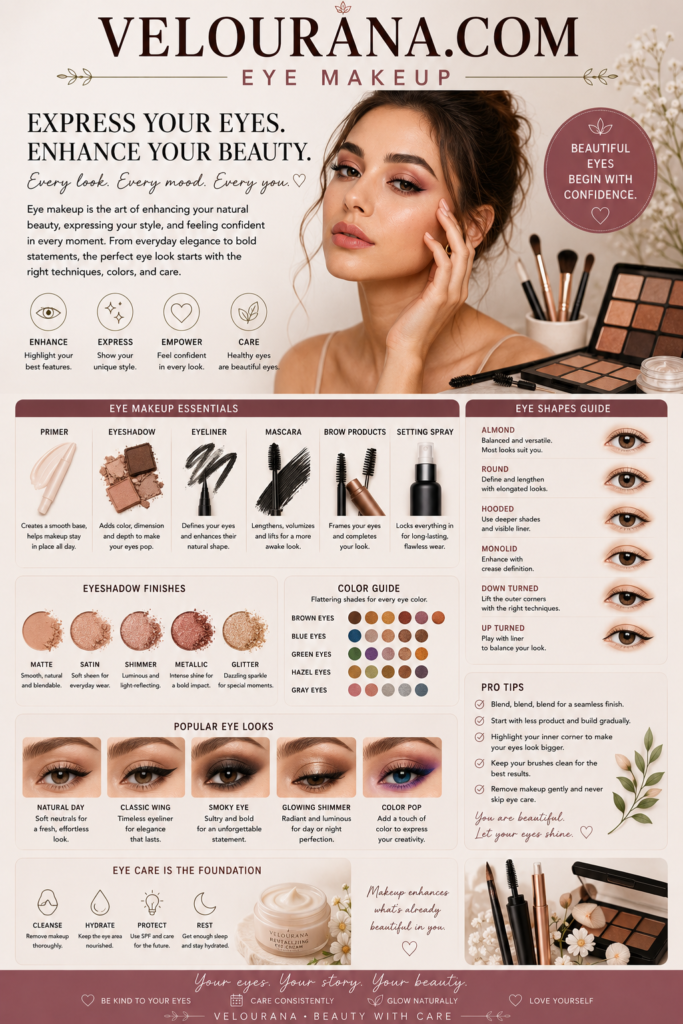
CATEGORY: Hooded Eye Makeup
Eyeshadow is often taught as though the eyelid were a fixed canvas. The crease is identified, color is placed inside it, the lid is brightened, and the outer corner is deepened. Yet a hooded eye demonstrates why makeup cannot truly be understood as painting on a flat surface. The eyelid changes shape every time the eye opens. Areas that appear spacious when closed can disappear beneath the fold, while colors positioned only a few millimeters higher may suddenly become central to the entire look.
This movement gives hooded eye makeup its particular character. The technique is not fundamentally about disguising skin or attempting to manufacture a different eye shape. It is about visibility. Where does shadow appear when the wearer is looking forward? Where does eyeliner disappear? Which parts of the lid touch each other? Where does reflected light remain visible? Once those questions replace rigid instructions, hooded-eye makeup becomes considerably more intuitive.
There is also freedom in abandoning the assumption that the natural crease must dictate the design. Makeup can create its own architecture. A transition shade can establish depth above the anatomical fold, an outer shadow can redirect the silhouette, and a point of light can be placed precisely where the eye reveals it. These choices can subtly reshape the visual proportions without erasing the qualities that make hooded eyes distinctive.
The Open Eye Is the Real Canvas
The most useful view of hooded-eye makeup is the view other people actually see: the eye open, the brows relaxed, and the face in a natural expression. Closing the eye remains necessary for blending and precise application, but it should not be the only position in which the makeup is designed.
When the eye is closed, the natural crease can tempt the brush into a placement that later becomes concealed. A beautifully blended transition may sit entirely underneath the hood. The wearer opens the eye and wonders where the makeup went. The solution is not necessarily stronger pigment. More pigment placed in the same hidden location simply creates a darker invisible crease.
Instead, the visible boundary should be established first. Looking straight into a mirror, a small amount of transition color can be positioned slightly above the fold where it remains visible. Once that location has been identified, the eye can be lowered and the shade blended through the surrounding area. The resulting placement may seem higher than conventional crease makeup when the eye is closed, but with the eye open it creates precisely the depth that was intended.
This technique is particularly effective because human vision interprets shadow as recession. A carefully diffused midtone above the natural fold can suggest a deeper crease in a location that remains visible. The eye has not physically changed, but the distribution of light and shade changes how its proportions are perceived.
The effect does not need to be obvious. A soft taupe, muted brown, dusty rose, terracotta, mauve, or another appropriately chosen midtone can create almost imperceptible structure. More dramatic makeup can intensify the same principle with richer pigments. What changes is the strength of the illusion, not the underlying logic.
Depth Without Weight
Hooded eyes can accommodate considerable depth, but the location and concentration of that depth are important. Covering the entire hood with a very dark shade may create an intentionally dramatic smoky eye, yet when the goal is dimension rather than overall darkness, more selective placement tends to preserve shape.
A useful visual hierarchy begins with the deepest pigment occupying the smallest area. Medium depth surrounds it, and the softest transition occupies the broadest area. This creates a gradient that remains readable even when part of the eyelid disappears beneath the fold. The darkest shade can sit near the outer lash line and outer visible crease, while progressively softer tones move outward and upward.
The outer third of the eye often provides the strongest opportunity for sculpting. Depth placed there can create contrast with a brighter inner or central lid and can visually extend the eye. The upper boundary of that darkness should be diffused enough to avoid creating an abrupt patch, but diffusion should not mean spreading pigment everywhere. Controlled blending preserves the architecture.
Brush size has a significant influence on this control. A large fluffy brush naturally distributes color over a broad area and can be excellent for the final transition. It is less suitable for placing the deepest pigment when visible space is limited. Beginning with a smaller brush allows the shape to be constructed intentionally before the edges are softened.
The pressure of the brush matters as well. Pressing or gently placing pigment establishes saturation, while light sweeping motions soften edges. Constant vigorous blending can remove the distinction between the deepest and lightest areas until the entire eye becomes one uniform haze. Hooded-eye makeup often benefits from preserving that distinction because visible space is precious and contrast communicates structure efficiently.
Darkness should also be evaluated from normal viewing distance. Makeup examined only centimetres from a magnifying mirror can encourage excessive correction. From conversational distance, tiny irregularities disappear while the overall silhouette becomes much more important. The question is not whether every millimetre is perfectly blended under magnification, but whether the eye reads as balanced, dimensional, and intentional.
Rethinking the Traditional Lid
The mobile lid occupies an interesting position on hooded eyes because its visibility can change dramatically between an open and closed eye. Some people retain a narrow strip of visible lid above the lashes. Others reveal more space at the inner or central area while the outer lid disappears almost completely. Makeup becomes more effective when the visible portion is treated as a focal area rather than when the entire anatomical lid is given equal attention.
A light or reflective shade can make this visible area appear more prominent. Instead of applying shimmer automatically from the inner corner to the outer corner, it can be concentrated where it contributes most to the open-eye composition. A metallic accent at the center may catch light each time the wearer blinks. A satin inner lid can brighten the eye without requiring a large exposed surface.
For a more sculpted effect, the boundary between the bright lid and deeper crease can be positioned slightly above the natural fold. This is the logic behind many cut-crease adaptations for hooded eyes. The created lid space is designed according to what remains visible rather than according to where the anatomical crease happens to sit.
A formal cut crease is not necessary to use the principle. The edge can remain diffused, producing a soft halo of brightness that rises just high enough to be seen. This can be particularly flattering for everyday makeup because it creates openness without looking highly graphic.
Matte shades can accomplish the same structural work. A pale matte lid contrasted against a deeper artificial crease can produce clean definition without reflection. This may appeal to someone who prefers restrained makeup or wants texture to remain understated. The relationship between light and dark matters more than whether either shade contains shimmer.
The visible lid can also be intentionally dark. A smoky eye built from deep color at the lash line can look exceptionally rich on hooded eyes because the hood naturally helps create a sense of depth. The shadow can graduate upward from near-black, charcoal, espresso, plum, navy, or another deep shade into softer tones above the fold. Rather than fighting the structure, the technique allows the fold to become part of the smoke.
The Outer Corner as a Structural Decision
The outer corner can change the perceived direction of the entire eye. When deep shadow extends below the outer corner, the eye may appear more downward-facing. When the blend moves horizontally outward, the shape can appear longer. When it rises gently toward the temple, the eye may appear more lifted. None of these outcomes is universally correct; each represents a different aesthetic decision.
Hooding at the outer eye makes this placement particularly important because the fold can distort a shape that was created with the eye closed. The outer edge should therefore be checked repeatedly from the front. A softly lifted shadow can be mapped while looking straight ahead and then blended with the eye lowered.
The eyebrow provides a useful visual reference, but it should not become an inflexible ruler. Following the lower brow angle can sometimes produce a harmonious extension, yet brow shapes vary considerably. A sharply descending brow tail may lead the eyeshadow lower than desired, while a highly lifted brow may encourage an exaggerated angle. The relationship should be judged visually rather than copied mechanically.
Leaving a small amount of clean space between the outer eyeshadow and brow can help preserve definition. If pigment spreads continuously from lash line to eyebrow, the architecture can become indistinct. Controlled negative space gives the darker shape a boundary and allows the eye makeup to feel deliberate.
Softness at the outer edge can be created without sacrificing direction. The deepest pigment can stop within a defined area while only its transition shade extends farther. This produces the impression of an elongated eye without requiring a hard edge. For more graphic makeup, the same underlying placement can be sharpened deliberately.
Why Eyeliner Behaves Differently
Eyeliner exposes the three-dimensional nature of hooded eyes more dramatically than almost any other eye product. A line that appears perfectly straight on a closed lid can bend, disappear, or become thicker in sections when the eye opens. A wing can be swallowed by the fold or develop an apparent break where the skin overlaps.
Trying repeatedly to correct the open-eye shape while working only with the eye closed can lead to increasingly thick liner. Eventually, much of the visible eyelid may be covered. This is not necessarily undesirable when a bold liner look is intended, but it can be frustrating when the original goal was a fine, elegant line.
The more reliable approach is to establish the important visible points while the eye is open. The wing direction can be mapped from the frontal view, taking account of where the hood ends and where the fold crosses the intended line. The eye can then be lowered to connect the sections.
Depending on the anatomy, the finished wing may contain small angles or steps when viewed on the closed eyelid. When the eye opens, those sections align visually. This technique demonstrates an important principle of hooded-eye makeup: the makeup does not have to look geometrically conventional on a stretched or closed surface if its intended presentation occurs on a relaxed, open eye.
For subtle definition, keeping liner exceptionally close to the upper lashes preserves more visible lid. A fine dark line can make the lash roots appear denser without dominating the eyeshadow. Deep brown, charcoal, plum, navy, and other alternatives to black can create definition with varying degrees of softness.
Eyeshadow used as liner offers even greater flexibility. Because its edge can be diffused, slight changes caused by the fold are less noticeable. A pencil softened with shadow can create a similarly forgiving result. These approaches work particularly well when the overall makeup is smoky or understated.
A dramatic wing remains entirely possible. The difference is that its architecture may need to be customized. Hooded eyes do not prohibit graphic liner; they simply reveal why graphic liner must sometimes be designed for a moving surface.
Texture, Reflection, and the Hood
Texture has visual consequences wherever light hits the eye. Matte shadow absorbs more light and tends to create the impression of depth. Shimmer, satin, metallic, and glitter finishes reflect light and bring an area visually forward. Hooded-eye makeup can use this contrast strategically.
A matte transition above the fold can establish recession, while a luminous shade on the visible lid creates projection. The combination strengthens the impression of dimension. When the reflective shade extends slightly above the natural crease at the center, it can remain visible even when the eye is fully open.
This does not mean every hooded-eye look should reserve shimmer for a tiny portion of the lid. A wash of shimmer across the hood can be striking, particularly in monochromatic makeup where texture rather than strong color contrast provides the interest. The traditional recommendation to keep hooded areas entirely matte is an aesthetic option rather than an absolute law.
Highly reflective products do, however, reveal surface texture more readily because light catches every contour. Someone seeking an exceptionally smooth visual effect may prefer fine satin or softly metallic finishes over coarse glitter. Someone who enjoys obvious sparkle may consider that texture part of the desired effect rather than something to conceal.
The physical behavior of the formula also matters. Because folded skin can touch the lid repeatedly, very creamy or slow-setting products may transfer. Long-wearing formulas, thin application, and appropriate priming can reduce this movement. Loose glitter requires particularly secure adhesion because migration toward the eye can cause discomfort.
A sophisticated hooded-eye look therefore considers both optical texture and physical texture. The finish should create the desired interaction with light while the formula should remain stable enough for the moving eyelid.
Brows, Lashes, and the Space Around the Shadow
Eyeshadow does not exist independently of the surrounding features. Brow shape changes the amount of apparent upper-eye space, while lashes alter the visibility of the lid and the strength of the lash line. Hooded-eye makeup becomes more cohesive when these elements are considered together.
A heavily defined brow combined with very high, dark eyeshadow can compress the space between the eye and brow. A softer transition near the upper edge may provide balance. Conversely, a relatively light eye look can support stronger brows without making the area feel crowded. There is no fixed formula, but visual density should be distributed intentionally.
Mascara can create significant definition without consuming lid space. Concentrating lift through the upper lashes can make the eye appear more open, while emphasizing the outer lashes can reinforce an elongated eyeshadow shape. Lash curl can also expose a little more of the eye visually, although the effect depends on natural lash direction.
False lashes require proportion. Very dense, uniformly long lashes can conceal carefully placed eyeshadow, especially when the visible lid is already narrow. Styles with strategic spacing or controlled length may allow more of the makeup to remain visible. On the other hand, someone deliberately seeking dramatic lash dominance may prefer precisely the opposite. The desired hierarchy should decide whether eyeshadow or lashes become the primary feature.
The lower lashes contribute another line of definition. Heavy mascara beneath the eye can create a strong framed effect, while minimal lower-lash emphasis keeps visual attention upward. This becomes particularly relevant when the upper makeup has been designed to create lift.
The entire eye area works as one composition. Brow, shadow, liner, lashes, and lower-eye definition either reinforce the same direction or compete with one another. Hooded-eye makeup feels polished when these elements share a coherent visual intention.
From Natural Definition to Full Drama
The same structural principles can support very different levels of makeup. A minimal hooded-eye look may require only a softly diffused midtone placed above the fold, subtle depth near the outer lashes, and mascara. Because the placement remains visible, even restrained color can provide meaningful definition.
A classic neutral eye can build additional depth through the outer third and introduce a satin or softly metallic lid. The effect remains wearable while giving the eye more dimensional contrast. The created crease does not need to be obvious; it simply gives the visible shadow somewhere to exist.
For evening makeup, deeper tones can spread farther across the lid and outer eye. A smoky gradient can deliberately use the limited mobile-lid visibility, allowing darkness to emerge strongly around the lashes before fading above the hood. Metallic accents can be introduced at the center or inner lid to create movement when the eyes blink.
Colorful makeup follows exactly the same principles. A vivid blue, emerald, violet, burgundy, copper, or another saturated shade does not become unsuitable because the eye is hooded. What matters is whether enough of the color remains visible in the intended position. Raising a colorful transition slightly above the fold can prevent an elaborate look from disappearing.
Graphic makeup can go further by treating the fold itself as part of the design. Lines can travel above, around, or deliberately across the hood. Negative space can be positioned where it remains visible. Instead of attempting to reproduce a graphic shape designed for a different eye structure, the artist can create one specifically for the eye in front of them.
This adaptability is what makes understanding structure more valuable than memorizing individual looks. Once visibility, depth, direction, and texture are understood, almost any aesthetic can be translated to a hooded eye.
Makeup That Moves With the Face
Perhaps the most important distinction in hooded-eye technique is that the finished makeup must survive movement visually as well as physically. Eyes blink, brows rise, expressions change, and skin folds shift throughout the day. A design that works only when the wearer holds one particular expression is not fully adapted to the face.
Checking the makeup periodically during application solves much of this problem. Looking forward reveals the normal composition. Looking slightly downward shows how the lid transitions into the hood. A gentle smile or natural facial movement can reveal whether outer placement shifts unexpectedly. None of these observations requires obsessive precision; they simply keep the makeup connected to the living face rather than an imaginary flat diagram.
The same philosophy applies to symmetry. Human eyes are rarely perfectly identical. One hood may sit lower, one eyebrow may be higher, or one eye may reveal more mobile lid than the other. Applying shadow at exactly the same anatomical height on both sides can sometimes emphasize these differences. Adjusting the visible placement independently can create greater visual balance.
This is makeup as optical design rather than mechanical repetition. The left and right eyes do not need identical brush coordinates; they need to look harmonious when viewed together. Small differences in placement may be what creates that harmony.
Over time, the wearer learns the particular geography of their own eyes. They discover where liner tends to transfer, how high a transition shade must rise before it becomes visible, where shimmer catches light most effectively, and which outer angle feels most flattering. Techniques that initially require deliberate observation gradually become instinctive.
Hooded eye makeup ultimately rewards this familiarity. The fold ceases to feel like a limitation because its behavior becomes predictable. The artist knows what will disappear, what will remain visible, and how a few millimetres of placement can change the entire composition.
The objective is not to imitate an eyelid that does not exist. It is to make deliberate use of the eyelid that does. Once the open eye becomes the primary canvas, conventional rules become flexible tools rather than restrictions. Crease color can move higher, liner can adapt to the fold, shimmer can appear wherever light is wanted, and the outer silhouette can be shaped according to the desired expression.
Hooded eyes are not difficult eyes on which to apply makeup. They are moving, dimensional eyes that make placement particularly important. When technique respects that movement, the possibilities are as broad as they are for any other eye structure. Natural definition, elegant neutrals, saturated color, smoky intensity, metallic brilliance, and graphic experimentation can all belong comfortably within hooded eye makeup.
THE END VELOURANA
 Discover More From Our Family of Websites
 ZodiacBearing (Astrology, Tarot, Numerology, Angel Numbers & Spiritual Guidance)
 Velourana (Beauty, Makeup, Hair Care, Skincare & Beauty Tips)
 HavenBearing (Home, Living, Organization, Décor & Everyday Inspiration)
 PawBearing (Pet Care, Dog Breeds, Animal Health, Training & Pet Products)
 PsyCatherine (Notes From the Journal of a Psychologist on Real Life)

