
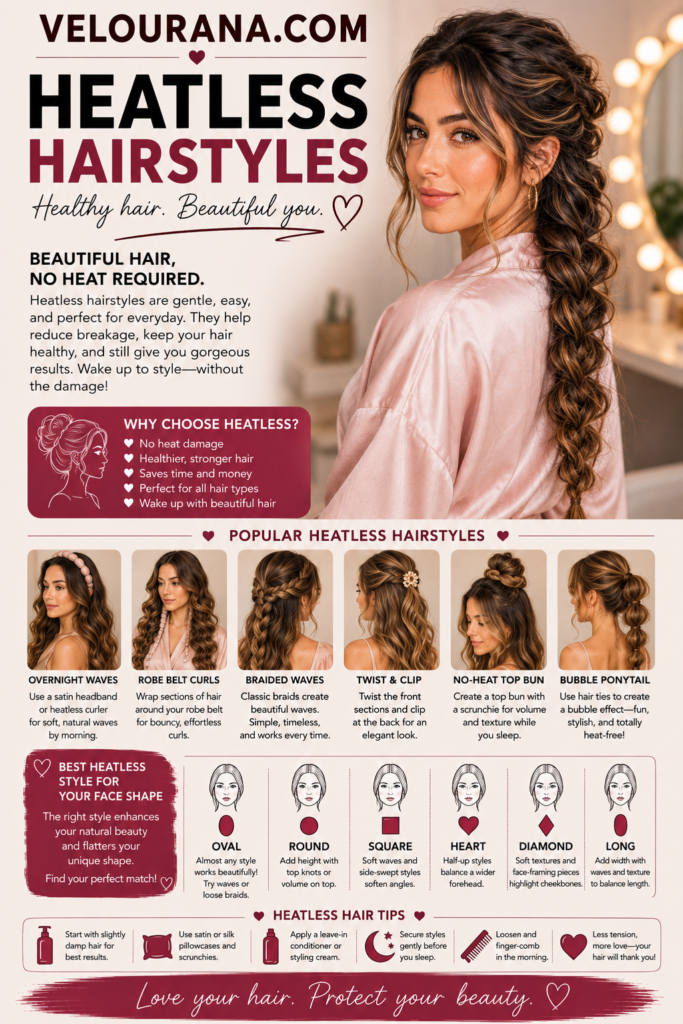
CATEGORY: Heatless Hairstyles
Heatless hairstyling is often described as though it were simply a gentler substitute for curling irons, straighteners and heated brushes. That description misses much of what makes it useful. Working without heat is not merely about reproducing hot-tool results through slower methods. It is a different approach to shaping hair—one that uses tension, moisture, positioning, wrapping, braiding, twisting and time to encourage the hair into a temporary form.
The possibilities extend far beyond overnight curls.
Braids can create anything from broad beach-like movement to small, highly defined waves. Twists can produce softer bends. Buns can encourage large curves through the lengths. Rollers can create volume, rounded ends or structured curls. Wrapping techniques can smooth the hair and redirect its shape. Flexi rods can form spirals. Foam rollers can create classic rounded movement. Even a carefully positioned ponytail or series of loose ties can alter how the hair falls once it is released.
The important principle is that hair does not always need intense heat to change its temporary appearance.
Hair is flexible. When it is arranged into a particular shape and given enough time to settle, especially when its moisture level is appropriate for the method, it can retain some of that new pattern after being released.
How strongly it holds depends on many variables.
Natural texture matters. So does density, strand thickness, length, porosity, humidity, the amount of moisture present during styling and the size of the sections being manipulated. A method that produces pronounced waves on one person may create only subtle movement on another.
For that reason, successful heatless styling is less about finding one universally perfect technique and more about understanding how different methods influence shape.
Heatless Styling Is About Setting Hair Into a Temporary Pattern
Most heatless techniques begin by reorganizing the hair physically.
A straight section is wrapped around a roller.
Loose hair is divided and braided.
Lengths are twisted into ropes.
Hair is wound around fabric.
A ponytail is divided into sections and curled around soft supports.
The hair is then left in that arrangement long enough for the pattern to influence its final appearance.
Once released, some of the imposed shape remains.
The size of the structure matters enormously.
Large rollers usually encourage broader curves.
Small rollers can produce tighter curls.
A thick braid creates larger bends.
Several narrow braids produce smaller, more frequent waves.
A loose bun may create only gentle movement through the lengths.
The styling tool may therefore be nothing more than the hair itself.
Moisture Changes How Strongly the Hair Sets
Many heatless methods work particularly well when the hair is slightly damp rather than completely dry.
This does not mean soaking wet.
Hair wrapped tightly while very wet can take an extremely long time to dry, particularly when it is thick, long or low in porosity. Releasing the style before the hair has dried sufficiently may cause the new pattern to collapse quickly.
Slight dampness can be more manageable.
The hair has enough moisture to respond to the shape while still having a realistic chance of drying before release.
Other techniques work well on dry hair, especially when the objective is subtle movement rather than a strong set.
The ideal moisture level therefore depends on both the hair and the desired result.
Drying Completely Before Release Matters
One of the most common frustrations with overnight styling occurs when the hair looks promising immediately after being released but loses its shape rapidly.
Incomplete drying can be one reason.
If the inner sections remain damp, the hair has not fully settled into the imposed pattern.
Dense hair is particularly vulnerable because the outer surface may feel dry while the hair wrapped underneath remains moist.
Larger sections also take longer to dry.
This is why using more hair in each roller or wrap does not always save time overall.
The style may be faster to construct but slower to set.
Braids Are Among the Most Versatile Heatless Methods
Braiding creates a repeated wave pattern by forcing sections of hair to cross over one another.
Once released, the hair often retains bends corresponding to those crossings.
The number and size of braids influence the result dramatically.
One large loose braid usually produces broad movement.
Two braids can create more consistent waves across both sides.
Several smaller braids produce tighter texture.
Very narrow braids can create pronounced crimp-like definition.
The braid can begin near the roots when movement is desired higher on the head, or lower down when the roots should remain relatively smooth.
This makes braiding highly adjustable.
One Loose Braid Creates Gentle Movement
A single braid is one of the easiest overnight options for long hair.
The hair is gathered and braided without excessive tension.
Once released, the lengths may contain broad bends.
The roots usually remain relatively smooth because the braid begins farther from the scalp.
This can be useful when the goal is simply to prevent the hair from remaining completely straight without creating highly defined curls.
The effect tends to become more pronounced toward the lower lengths where the braid is more compact.
Two Braids Can Create Better Symmetry
Dividing the hair into two sections allows each side to be shaped independently.
The braids can begin relatively high or low.
Their size can remain consistent.
This often produces more balanced movement than one braid positioned entirely down the back.
The front sections can also be directed deliberately, which influences how the waves frame the face after release.
French and Dutch Braids Can Bring Texture Closer to the Roots
Traditional loose braids often leave the upper hair relatively straight.
French and Dutch braiding can change that because hair is incorporated progressively from the scalp.
The woven pattern begins much higher.
Once released, texture can appear closer to the roots.
This creates fuller overall movement.
The result will still depend on section size and natural texture, but the technique offers much greater control over where the wave begins.
Twists Produce a Different Pattern From Braids
Braids create repeated angular bends.
Twists create more continuous curves.
A section of hair can be rotated and secured, or two sections can be twisted around one another.
When released, the resulting texture often feels softer and more spiral-like than braid waves.
This can be useful when a highly repetitive wave pattern is not desired.
The size of the twist determines the scale of the movement.
Large twists create broad curves.
Smaller twists can produce more definition.
Two-Strand Twists Can Work Beautifully With Natural Texture
Two-strand twists are particularly versatile because they can organize textured hair while encouraging definition.
The hair is divided into two sections that wrap around one another repeatedly.
Once released, the resulting pattern can reflect both the natural texture and the imposed twist.
The method can be adapted through section size.
Larger twists create broader definition.
Smaller twists create more numerous, tighter sections.
The technique should be comfortable at the roots and should not depend on excessive tension.
Buns Can Create Broad Curves
A bun does more than put the hair up.
It wraps the lengths around a central shape.
When the hair remains in that position for sufficient time, it can develop broad bends.
A low bun may create movement primarily through the mid-lengths and ends.
A higher bun changes the direction from which the hair is gathered.
Two buns divide the hair and can produce more balanced movement on either side.
The exact result varies significantly according to natural texture and how tightly the bun is wrapped.
A Loose Low Bun Can Create Subtle Movement
For someone who does not want obvious curls, a low bun can provide a very gentle heatless set.
The hair is directed backward and wrapped loosely.
After release, the lengths may develop broad curves rather than defined waves.
The technique is particularly useful when the desired finish should remain understated.
It also doubles as a wearable hairstyle while the hair is setting.
Two Buns Can Produce More Defined Shape
Dividing the hair into two sections reduces the amount wrapped into each bun.
This can create stronger curves.
The buns can sit low, high or around the sides depending on where the movement is wanted.
Direction matters.
Wrapping both buns identically may cause the resulting movement to travel similarly on both sides.
Wrapping them in opposite directions can create a more mirrored effect around the face.
Multiple Small Buns Increase Texture
Several smaller sections can be twisted into individual buns.
Once released, the hair may contain much more pronounced movement.
This is essentially the same principle used by one large bun but applied at a smaller scale.
More sections mean more curves.
The technique can create significant volume, particularly on hair that responds strongly to setting.
Rollers Offer More Control Over Curl Size
Rollers are among the most established heatless styling tools because their diameter provides a predictable structural guide.
Large rollers encourage large curves and volume.
Medium rollers can create more obvious curls.
Small rollers produce tighter shapes.
The direction in which the hair is wrapped influences where the curl moves after release.
Rollers around the crown can create lift.
Sections around the face can be directed backward or inward depending on the desired frame.
Large Rollers Can Create Volume Rather Than Curls
Not every roller set is intended to produce ringlets.
Very large rollers can lift the roots and round the lengths.
The result may resemble a smooth, voluminous blowout more than traditionally curled hair.
This can be particularly useful for medium and long hair when the goal is body rather than obvious curl definition.
The ends can gain a polished curve while the overall length remains relatively smooth.
Smaller Rollers Create More Defined Movement
Reducing roller diameter increases the curvature imposed on the hair.
The resulting curls may become more noticeable.
Section size still matters.
Placing too much hair around one small roller can prevent the section from drying evenly and may create inconsistent results.
A balanced amount of hair allows the roller to influence the entire section more effectively.
Foam Rollers Can Be Comfortable for Overnight Styling
Soft foam rollers are designed to reduce the hardness associated with traditional rigid rollers.
They can be useful when the hair needs to remain wrapped for several hours or overnight.
Comfort still depends on placement.
A roller positioned directly where the head rests against the pillow can become uncomfortable regardless of how soft it is.
Strategic placement can therefore matter almost as much as roller type.
Flexi Rods Create Spiral Shapes
Flexi rods allow sections to be wrapped around a long flexible cylinder.
The hair travels in a spiral rather than simply winding directly over itself.
This can create more defined curl patterns.
Rod diameter influences curl size.
The amount of hair used per section affects definition.
The angle of wrapping influences direction.
Because the rods bend to secure themselves, they can be arranged in several positions across the head.
Fabric Can Replace Traditional Curling Tools
One of the reasons heatless curling has become so accessible is that the shaping object does not always need to be a specialized hair tool.
Soft fabric can provide a structure around which the hair is wrapped.
Long fabric curling rods are specifically designed for this purpose, but similar principles can be achieved with other soft materials when used safely and comfortably.
The hair is divided into sections and wrapped progressively around the fabric.
Once secured, the structure remains in place while the hair sets.
After release, the sections can form broad spirals or waves depending on the diameter of the support and the wrapping technique.
Robe-Belt Curls Demonstrate the Basic Wrapping Principle
A soft belt positioned across the head can provide two long sections around which the hair is wrapped.
Hair from each side is wound around the fabric and secured near the ends.
The technique creates a spiral pathway without heat.
Its popularity comes partly from simplicity.
The belt provides a large, soft structure.
The resulting movement tends to be broader than what would be created with very small rollers.
The exact result varies according to hair length, dampness, wrapping tension and the amount of hair added at each stage.
Dedicated Heatless Curling Rods Can Be Easier to Position
Purpose-made soft curling rods generally use the same wrapping principle but are designed specifically to remain around the head.
Their shape may make sectioning and securing easier.
The rod diameter influences the scale of the curl.
A thicker rod creates broader movement.
A narrower one can create more pronounced spirals.
As with every heatless method, the result should be judged according to the individual hair rather than assuming one tool will create identical curls on everyone.
Socks Can Function as Soft Curling Supports
Sock curls use fabric cylinders around which sections are wrapped.
The technique can be adapted according to the number of socks used.
Fewer large sections create broader curls.
More sections can increase definition.
The softness of the fabric can make the method relatively comfortable, although bulky knots should be positioned so they do not interfere with sleep.
The principle is not fundamentally different from rollers or fabric rods.
The hair is simply being encouraged to dry or rest around a temporary shape.
Headband Curls Create Movement Around the Head
A soft headband can act as an anchor.
Sections are wrapped around it progressively until the lengths are contained.
Because the hair follows the circumference of the head, the resulting movement can be broad and continuous.
The method can also keep the hair relatively contained while setting.
The headband should remain comfortable rather than creating unnecessary pressure across the forehead or scalp.
Pin Curls Create Classic Structured Shapes
Pin curls require no cylindrical roller.
A section of hair is wound into a flat curl and secured against the head.
The diameter of the curl determines the eventual shape.
The direction of the curl can be controlled precisely.
This technique offers considerable flexibility because each section can be positioned independently.
It can create more structured results than simply sleeping in a braid or bun.
The trade-off is that sectioning and placement require more time.
Pin Curl Direction Influences the Final Movement
Hair curled toward the face behaves differently from hair directed away from it.
Alternating directions can create a more varied texture.
Using consistent direction can produce a more uniform pattern.
Sections around the face deserve particular attention because they influence the visible frame more strongly than those hidden underneath.
Heatless styling becomes much more predictable once direction is treated as an intentional choice.
Hair Wrapping Can Encourage Smoothness
Not every heatless technique aims to create curls.
Wrapping hair around the head can help encourage a smoother shape while reducing the bends that might develop from leaving it loose overnight.
The hair is directed around the head and secured so that it lies relatively flat.
Once released, the result depends strongly on natural texture and the starting condition of the hair.
This should not be expected to reproduce the effect of a flat iron on every texture.
It is better understood as a way of encouraging smoother alignment without applying direct heat.
Heatless Styling Should Work With Natural Texture
One of the most useful principles is choosing a method that complements rather than fights the hair.
Naturally straight hair may respond well to braids, rollers and wrapping techniques that introduce temporary movement.
Wavy hair may need only a few twists or a loose bun to strengthen its existing pattern.
Curly hair can use twists, braids and rods to reorganize curl shape.
Coily hair can use twisting, braiding and stretching techniques in ways that work with its natural structure.
The objective does not need to be transforming one texture into another.
Heatless styling can simply refine or redirect what already exists.
Fine Hair May Set Quickly but Lose Shape More Easily
Fine strands can respond rapidly to small changes in shape.
A braid may leave visible waves after only several hours.
Rollers can create noticeable volume.
However, the resulting pattern may also relax quickly depending on the hair.
Using smaller sections can increase definition.
Starting with the appropriate moisture level can improve the set.
The method should avoid excessive tension because fine strands do not need aggressive pulling to take shape.
Thick Hair Often Needs More Time
Dense hair creates another challenge.
Large sections can contain moisture internally for much longer than expected.
A braid may feel dry on the outside while remaining damp inside.
Rollers wrapped with too much hair can behave similarly.
Dividing the hair into more manageable sections can improve consistency.
This requires more construction initially but may produce a more reliable final result.
Long Hair Offers More Wrapping Possibilities
Length creates opportunities.
Hair can wrap around large rods several times.
Long braids create repeated wave patterns.
Buns can contain multiple turns.
Fabric curling methods have enough length to form broad spirals.
But long hair also creates more weight.
That weight can stretch curls after release.
The final result may therefore appear looser than it did immediately after the hair was unwrapped.
Medium Hair Can Be Particularly Easy to Set
Medium lengths often provide enough hair for braids, rollers, buns and fabric methods without creating excessive weight.
The curls may retain more bounce because there is less length pulling them downward.
A smaller number of rollers may also be required.
The exact technique should still be adapted to layers and natural texture.
Layered Hair Needs Thoughtful Sectioning
Layers can produce beautiful heatless texture because different lengths create movement.
They can also escape from large braids or wraps.
Smaller sections may capture them more effectively.
Face-framing layers can be set separately.
Shorter crown layers may benefit from smaller rollers than the longer hair beneath.
Treating every length identically is not always necessary.
The haircut itself can guide the sectioning strategy.
Face-Framing Sections Deserve Separate Attention
The pieces closest to the face are among the most visible after release.
Their direction can influence the entire hairstyle.
Wrapping them away from the face can create an open frame.
Directing them inward creates a different shape.
They can be rolled separately from the rest of the hair.
This allows the front to be controlled even when the remaining lengths use a simpler method such as braiding.
Heatless Styling Can Begin With a Wearable Hairstyle
One of the most practical aspects is that the setting process can itself look intentional.
Braids are hairstyles.
Buns are hairstyles.
Twists are hairstyles.
A scarf wrap can be styled deliberately.
The hair can therefore spend several hours setting while still looking presentable.
This makes heatless methods useful beyond overnight routines.
A daytime braid can be released in the evening.
A low bun worn through the afternoon can create movement for later.
The preparation becomes part of the styling rather than dead time.
Overnight Styling Is Convenient but Not Mandatory
Heatless hairstyles are often associated with sleep because several uninterrupted hours provide convenient setting time.
But sleeping in the style is not a requirement.
The hair can set during the day.
This can be preferable for anyone who finds rollers, rods or wrapped fabric uncomfortable overnight.
The essential factor is sufficient setting time, not whether that time occurs while sleeping.
Comfort Matters More Than Following a Trend Exactly
A heatless method that causes poor sleep is not automatically a good method simply because it produces attractive curls.
Placement can often be modified.
A large rod can sit farther back.
Rollers can be positioned away from pressure points.
Braids can replace bulky tools.
A loose bun may provide enough movement without any added equipment.
The best method is one that fits both the desired hairstyle and the practical reality of wearing it for several hours.
Tension Should Remain Comfortable
Heatless does not automatically mean stress-free for the hair.
A style can avoid heat while still being unnecessarily tight.
Braids pulled aggressively at the scalp can create discomfort.
Tightly wrapped sections can place tension around the hairline.
Elastic bands can compress the same areas repeatedly.
Gentle, secure construction is preferable.
The objective is to shape the lengths, not test how tightly the roots can be pulled.
Soft Securing Methods Can Reduce Unnecessary Marks
The object used to secure the hair can influence the final pattern.
A very tight elastic may leave a noticeable indentation.
A softer tie can reduce that effect.
Pins can secure certain structures without creating one compressed point.
Fabric ties can be useful where appropriate.
The securing method should support the intended shape rather than introduce an unwanted one.
Section Size Is One of the Most Powerful Controls
Regardless of technique, section size repeatedly influences the result.
Large sections generally create larger, softer movement.
Small sections tend to create tighter, more numerous curls or waves.
This principle applies to braids, rollers, rods, twists and pin curls.
Changing section size can therefore transform a familiar method without buying another tool or learning another technique.
Someone who finds braid waves too tight may simply need fewer, larger braids.
Someone whose roller set is too loose may need smaller sections or smaller rollers.
Direction Is Equally Important
Two identical rollers can create different results if the hair is wrapped in opposite directions.
The same applies to twists and fabric curls.
Direction determines how the hair moves after release.
Around the face, this becomes particularly visible.
Across the back, alternating direction can prevent the curls from combining into one uniform mass.
Consistent direction can create a more coordinated pattern.
Neither is universally correct.
The choice depends on the intended finish.
The Release Is Part of the Styling Process
Heatless styling does not end when the braid, roller or rod is removed.
The way the hair is released affects the final appearance.
Pulling aggressively through newly formed curls can destroy definition immediately.
Separating every section excessively can create unwanted expansion.
Leaving everything completely untouched may preserve definition but produce obvious section boundaries.
The hair usually needs some degree of finishing.
Fingers Can Separate Without Completely Erasing the Pattern
Using the fingers allows selective separation.
Large curls can be divided into smaller pieces.
Braid waves can be softened.
The roots can be adjusted.
The goal is often to make the sections look like one hairstyle rather than several independent sets.
How much separation is appropriate depends on the desired finish.
Defined curls need less.
Soft waves can tolerate more.
Gentle Shaking Can Add Natural Movement
The hair can be allowed to fall naturally after release.
A gentle movement at the roots can help remove obvious section lines.
The lengths begin interacting with one another.
This can make the result feel less constructed.
Excessive handling, however, may weaken the pattern, especially on hair that does not hold heatless texture strongly.
Brushing Changes the Result Dramatically
A heatless curl set can transform once brushed.
Individual curls may merge into broad waves.
Volume can increase.
The surface can become softer.
This can be desirable when a classic flowing finish is wanted.
It can also destroy the definition someone intended to preserve.
Brushing should therefore be treated as a styling choice rather than an automatic final step.
Humidity Can Influence Longevity
Hair that responds readily to environmental moisture may change after leaving the controlled indoor environment.
Heatless curls can loosen.
Natural texture can begin reasserting itself.
The degree varies enormously between individuals.
This is another reason identical techniques do not produce identical longevity.
Heatless styling should be evaluated in the context in which the hairstyle will actually be worn.
The Goal Does Not Have to Be Perfect Curls
Some of the most useful heatless results are deliberately subtle.
A low bun can remove the flatness from long straight hair.
Large rollers can create root lift.
One braid can introduce texture through the ends.
A twist can reinforce natural waves.
The hair may not emerge looking as though it was styled with a curling iron.
That does not make the method unsuccessful.
The purpose can simply be encouraging movement.
Heatless Styling Can Reduce Dependence on Daily Hot Tools
Someone who enjoys styled texture frequently may find heatless techniques useful as part of a broader routine.
They can create alternative ways to change the hair without reaching for a hot tool every time.
That does not require abandoning heated styling completely.
The two approaches can coexist.
Heatless methods may be used when time allows the hair to set naturally, while hot tools remain an option when rapid styling is required.
The value lies in having more than one method available.
Different Nights Can Produce Different Results
Heatless styling contains variables that are easy to underestimate.
The hair may be slightly wetter one evening.
The braid may be tighter.
The room may be more humid.
One section may contain more hair.
The style may remain in place two hours longer.
These differences can affect the result.
Consistency improves through repetition.
Once someone learns how their own hair responds, the technique becomes far more predictable.
Experimentation Should Be Controlled Rather Than Random
When a method is not working, changing everything simultaneously makes it difficult to understand why.
It is more useful to adjust one variable.
Use smaller sections.
Try slightly drier hair.
Increase setting time.
Change the wrapping direction.
Use a larger roller.
This makes the process informative.
The next attempt is based on what happened previously rather than beginning again from zero.
The Best Heatless Method Is the One the Hair Actually Responds To
There is no universal winner.
Some hair responds beautifully to braids.
Some develops better movement from rollers.
Some prefers twists.
Some holds fabric curls extremely well.
Some loses most heatless texture quickly regardless of the technique.
Natural texture, density, strand characteristics and environment all influence the outcome.
The right method is therefore discovered through the relationship between technique and individual hair.
Heatless Hair Is About More Than Avoiding Heat
Removing hot tools from the process is only the starting point.
The deeper idea is learning how physical arrangement changes hair.
A braid creates repeated bends.
A twist creates rotation.
A bun creates broad curves.
A roller imposes a circular form.
A rod encourages spirals.
A wrap redirects the hair around the head.
Each technique speaks a different geometric language.
Once those differences are understood, heatless styling stops being a collection of internet tricks and becomes much more predictable.
The size of the structure controls the scale.
The direction controls the movement.
The section size controls the definition.
The moisture level and setting time influence how strongly the hair retains the pattern.
The natural texture determines how all of those variables ultimately appear.
That is what makes heatless hairstyling so versatile.
It does not offer one result.
It offers a set of methods for working with the hair's flexibility—allowing straight lengths to gain movement, waves to become more defined, curls to be reorganized and textured hair to take on new shapes without requiring direct heat for every transformation.
Sometimes the result is a dramatic curl.
Sometimes it is simply better volume, softer ends or a gentle wave.
Both can be successful.
The purpose is not to prove that heat is never useful.
It is to recognize that hair can be shaped in more ways than one.
The End
Velourana.
 Discover More From Our Family of Websites
 ZodiacBearing (Astrology, Tarot, Numerology, Angel Numbers & Spiritual Guidance)
 Velourana (Beauty, Makeup, Hair Care, Skincare & Beauty Tips)
 HavenBearing (Home, Living, Organization, Décor & Everyday Inspiration)
 PawBearing (Pet Care, Dog Breeds, Animal Health, Training & Pet Products)
 PsyCatherine (Notes From the Journal of a Psychologist on Real Life)

