
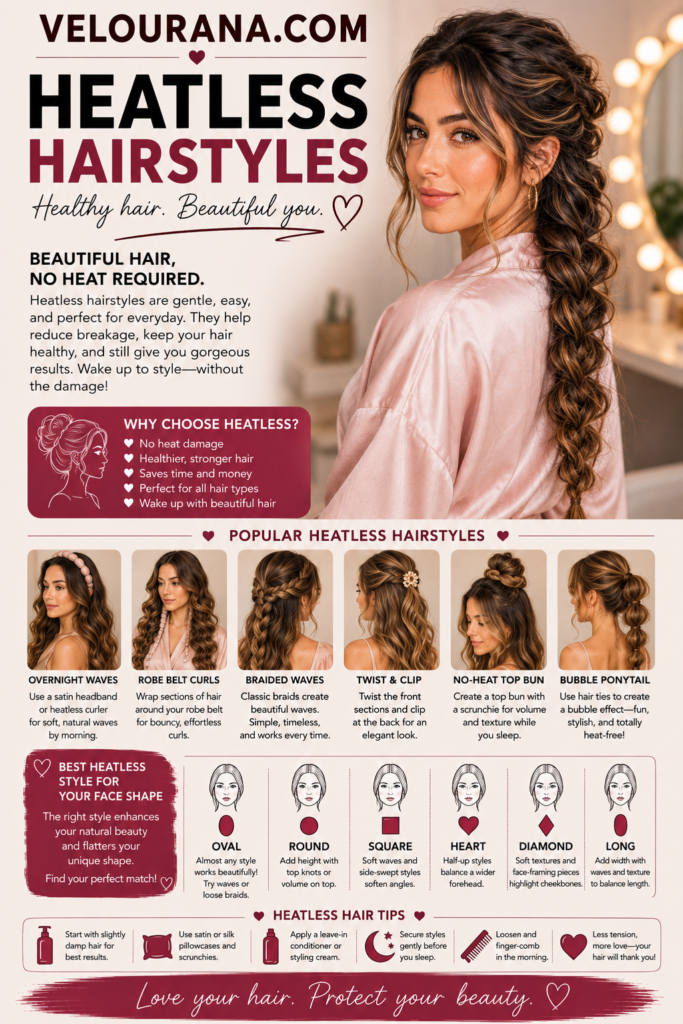
CATEGORY: Heatless Hairstyles
Heatless styling becomes especially useful when it is treated not simply as an alternative to hot tools, but as a way of moving part of the morning routine into the night before.
The idea is simple.
Instead of waking up with completely unshaped hair and then beginning from zero, the hair is arranged in advance. A braid can create waves while sleeping. A loose bun can encourage broad bends. Large rollers can create volume and rounded ends. A soft fabric wrap can shape the front and lengths. Twists can organize natural texture. By morning, much of the work has already happened.
This changes the role of time.
Traditional hot styling compresses the process. Heat creates shape quickly, but the shaping itself has to happen while getting ready. Heatless styling stretches the process across several hours, but many of those hours occur while sleeping, working at home or doing something completely unrelated to hair.
For busy mornings, this can be a major advantage.
The final routine may involve nothing more than releasing the set, separating a few sections, adjusting the front and deciding whether the hair should remain loose or become part of another hairstyle.
Not every heatless set will produce salon-perfect results every time. The outcome still depends on the hair's natural texture, density, section size, moisture level, environment and how securely the style remained in place. But once a reliable method is found, heatless preparation can turn the morning from a full styling session into a finishing session.
That difference is what makes the approach so practical.
The Best Morning Hair Often Starts the Night Before
Many morning styling problems are predictable.
Straight hair may wake up flat.
Wavy hair may lose definition overnight.
Long hair can develop random bends from sleeping.
Face-framing sections may point in different directions.
Curly hair may need reshaping.
The ends can become compressed.
These problems are not necessarily caused by poor hair condition. They are often simply the result of sleeping on unstructured hair.
Heatless styling changes the conditions before sleep.
Instead of allowing the hair to settle randomly, it is placed into a deliberate position.
The braid decides where the bends will form.
The roller decides how the front will curve.
The bun decides whether the ends remain straight or gain movement.
The wrap determines the direction of the sections around the face.
The night is then used as setting time.
The morning begins with a shape already present.
A Good Heatless Routine Should Be Simple Enough to Repeat
A method can produce beautiful results and still be impractical if it takes forty minutes to prepare every evening.
For everyday use, simplicity matters.
The goal is not creating the most elaborate heatless hairstyle possible.
It is finding the smallest amount of preparation that produces a useful result.
One or two braids may be enough.
A single loose bun may provide the movement required.
A few large rollers can transform the front and crown without setting every strand.
Two twists may organize natural texture.
A soft rod may replace an entire curling routine the following morning.
The best routine is the one that creates more value than effort.
If preparation becomes another exhausting task, the time-saving advantage disappears.
The Night-Before Braid Is One of the Easiest Options
Braiding remains one of the simplest ways to prepare hair for the next morning.
The hair is divided, braided and left alone.
No additional tool is required.
The style is usually secure.
The hair remains contained while sleeping.
The morning result depends largely on how many braids are used.
One large braid creates gentle movement.
Two braids usually create more balanced waves.
Several smaller braids increase definition.
For a busy routine, one or two braids often provide the best balance between preparation time and visible result.
The braids do not need to be extremely tight.
A comfortable structure is enough to influence the lengths.
Two Braids Can Create Predictable Morning Waves
Two side braids are particularly useful because each half of the hair can be shaped independently.
The front can be directed away from the face.
The braid can begin higher or lower depending on where the movement should start.
The ends can be secured carefully.
By morning, the hair usually has enough pattern to avoid looking completely flat or random.
The braids are released.
The sections are separated with the fingers.
The roots are adjusted.
The hair is ready to remain loose or be incorporated into another style.
This routine can replace a much longer morning curling session for someone who is satisfied with soft waves rather than highly controlled curls.
A Single Low Bun Can Be Enough for Gentle Movement
Not every morning hairstyle needs obvious waves.
Sometimes the objective is simply waking up with smoother, more curved lengths rather than completely flat hair.
A loose low bun can help create that effect.
The hair is gathered near the nape and wrapped broadly.
The structure should remain comfortable and should not pull tightly at the scalp.
By morning, the lengths may have developed a broad bend.
The ends can appear less rigid.
The upper hair remains relatively smooth.
This can be particularly useful on long straight or slightly wavy hair.
The result is subtle, but subtle may be exactly what saves time.
There is no need to spend the morning creating curls that were never actually desired.
Two Buns Create More Noticeable Movement
When one bun produces too little shape, dividing the hair into two sections can strengthen the result.
Each side is twisted and wrapped separately.
The sections are smaller.
The hair follows more curvature.
The final movement becomes more visible.
The buns can sit low for smoother roots or higher for additional lift.
The direction can be mirrored so that the front sections move naturally away from the face after release.
The technique takes only slightly longer than one bun but provides greater control.
A Soft Fabric Wrap Can Replace Morning Curling
A padded heatless curling rod or similar soft wrap can create broader curls overnight.
For someone who normally spends the morning curling the hair section by section, this can be one of the most direct time-saving substitutions.
The hair is wrapped during the evening.
The shape develops while sleeping.
In the morning, the rod is removed and the curls are separated.
The front can be adjusted.
The hairstyle may require only a few minutes of finishing.
The method is particularly useful when a person already knows they want visible movement rather than simply volume.
The larger the wrapping structure, the broader the resulting curls tend to be.
The Front Should Receive More Attention Than the Back
When time is limited, not every section needs equal effort.
The hair around the face has much greater visual influence than many sections hidden underneath.
This means a heatless routine can often be simplified by focusing on the front.
Curtain bangs can be rolled separately.
Face-framing layers can be wrapped around a small roller or fabric section.
The remaining hair can go into one or two simple braids.
By morning, the front appears styled deliberately while the back contains enough movement to support it.
This targeted approach can create a polished impression without an elaborate full-head set.
Large Rollers Can Save Time for Blowout-Style Mornings
Someone who prefers volume and rounded movement rather than curls may benefit more from large rollers than from braids.
A few rollers can be placed through the crown and front.
The rest of the hair can remain loose, be wrapped lightly or placed in a low bun.
The crown gains lift.
The front gains direction.
The ends may gain curve.
This can create a blowout-inspired effect without spending the morning with a dryer and round brush.
The routine is especially efficient when the main objective is preventing the roots from looking flat.
Roll Only the Sections That Actually Need Styling
A full roller set is not always necessary.
If the crown naturally has volume but the front falls flat, roll only the front.
If the face framing behaves well but the ends need shape, use rollers only through the lower sections.
If the top looks compressed after sleep, place two or three rollers through the crown.
Heatless styling becomes much more practical when it responds to specific problems rather than treating the entire head identically.
Slight Dampness Can Improve the Set, but Too Much Can Ruin the Morning
Starting with a little moisture can help some hair hold its heatless shape more effectively.
But a busy morning routine depends on the hair being ready when the set is removed.
Hair that remains damp internally creates exactly the opposite situation.
Instead of saving time, the person is suddenly dealing with half-dry curls or waves that collapse quickly.
This is particularly important for thick or low-porosity hair.
Slight dampness may be enough.
For some people, completely dry hair works better because it eliminates uncertainty.
The correct approach is the one that reliably produces ready-to-wear hair by morning.
Thick Hair Needs More Drying Time Than the Clock May Allow
Dense hair can remain damp inside braids, rollers and wraps for many hours.
This is one reason a method that works perfectly on fine hair may be frustrating on thick hair.
The solution may be starting earlier in the evening.
The hair can be set several hours before sleep.
Alternatively, the starting moisture can be reduced.
More sections can also improve drying because each section contains less hair.
The routine should be designed around the actual drying behavior of the hair rather than assuming that eight hours automatically guarantees a complete set.
Fine Hair Can Usually Use Fewer Sections
Fine hair often responds to shape relatively quickly.
A few larger sections may be enough.
Too many small braids or rollers can create more texture than intended and make the morning finishing stage longer.
If the goal is efficiency, broad movement is often more useful.
One braid.
Two braids.
Two large twists.
Several strategic rollers.
The routine can remain minimal.
Fine Hair Can Benefit From Overnight Root Direction
Hair that tends to lie flat at the crown can be influenced by the way it is positioned during the night.
A high loose bun redirects the roots upward.
Large rollers can lift crown sections.
A high half-up arrangement can keep the upper hair from being pressed entirely flat.
The objective is not creating extreme volume.
It is simply preventing the roots from settling in the least flattering position for several hours.
Straight Hair Can Use Heatless Styling for Movement Rather Than Curl
Naturally straight hair often looks polished already, so the morning problem may not be texture itself.
It may be lack of movement.
A single braid can change that.
A low bun can curve the ends.
Large rollers can lift the front.
The entire routine may focus on giving the hair a little more dimension rather than transforming it dramatically.
This can be far quicker than creating deliberate curls every morning.
Wavy Hair Can Be Organized Instead of Restyled
Naturally wavy hair may wake up with some sections still defined and others flattened.
Starting from zero every morning is inefficient.
A few large twists before bed can reorganize the pattern.
Braids can make the waves more uniform.
A loose pineapple-style arrangement or other suitable positioning can help preserve volume depending on the texture and length.
The objective is not replacing the natural wave.
It is protecting or redirecting it so that less correction is needed later.
Curly Hair Can Benefit From Strategic Resetting
Curly hair does not necessarily need a complete overnight restyle.
Some sections may simply need better organization.
Large twists can preserve or reshape areas that tend to flatten.
Flexi rods can be used only on face-framing curls that lose definition.
The rest can remain largely untouched.
The morning then becomes a process of releasing and arranging rather than redoing the entire head.
This targeted approach can save substantial time.
Coily Hair Can Use Braids and Twists as Both Style and Preparation
Braids and twists can serve two purposes at once.
During the evening and night, they keep the hair organized.
After release, they can create a braid-out or twist-out pattern.
The preparation is therefore not separate from the styling process.
It is the styling process.
The number and size of sections can be adjusted according to how much definition is wanted and how much preparation time is realistic.
Larger sections are faster.
Smaller sections create more detailed results.
The best routine balances both.
The Morning Release Should Be Efficient, Not Aggressive
A time-saving heatless routine can lose its advantage if the hair is handled excessively after release.
The goal is usually not to manipulate every section.
The braid is opened.
The rod is unwound.
The rollers are removed.
Then the hair is allowed to fall.
Only obvious section lines need attention.
The roots can be loosened.
The front can be positioned.
Large curls can be divided once or twice.
The more the hair is handled, the more time the finishing stage requires and the more likely the pattern is to weaken.
Fingers Are Usually Faster Than Full Restyling
For many heatless results, finger separation is enough.
The hands can lift the roots.
Separate obvious sections.
Move the front away from the face.
Blend the back.
This preserves the movement created overnight while keeping the morning simple.
A brush can be used when a softer blowout-like result is desired, but it should be used deliberately.
The objective is not to erase the set and then rebuild it.
The Front Can Be Refined in Under a Minute
Even when the overnight result is imperfect, adjusting the front can dramatically improve the overall appearance.
The part can be reset.
Curtain bangs can be moved outward.
One face-framing section can be tucked behind the ear.
The crown can be lifted slightly.
These changes take very little time but influence the way the entire hairstyle is perceived.
A useful morning routine prioritizes the areas that matter most visually.
A Heatless Wave Can Become a Half-Up Style Immediately
Not every morning needs the hair worn fully loose.
Heatless texture provides an excellent foundation for quick secondary styles.
After releasing braids or twists, the upper sections can be gathered into a half-up ponytail.
The lower waves remain visible.
The hairstyle looks more elaborate than the actual effort required.
The night created the texture.
The morning adds only the structure.
Heatless Texture Makes Buns Look More Dimensional
If the hair is released from a braid or wrap but the morning calls for an updo, the texture is not wasted.
A low bun created from pre-waved hair often has more movement and visible detail than one created from completely straight lengths.
A messy bun becomes easier because the hair already contains bends.
A braided bun gains dimension.
The overnight set therefore remains useful even when the final hairstyle is not worn down.
A Ponytail Gains Instant Movement
A ponytail made from heatless waves can look styled without additional curling.
The lengths already contain movement.
The front can remain smooth or softly textured.
A high ponytail can create more volume.
A low ponytail can preserve broad waves.
This can turn a two-minute morning hairstyle into something that looks more considered.
Claw Clips Work Better When the Hair Already Has Texture
A quick claw-clip style can look much more dimensional when the hair has been braided or wrapped overnight.
The ends curve naturally around the clip.
Face-framing sections already have movement.
The hairstyle feels less purely functional.
Again, the evening preparation increases the value of an extremely simple morning technique.
Heatless Preparation Can Support Several Possible Morning Hairstyles
One of the strongest reasons to set hair overnight is flexibility.
The final choice does not need to be made the evening before.
The hair can be released in the morning and evaluated.
If the waves look excellent, wear them loose.
If one side behaves differently, create a half-up style.
If the weather is warm, put the pre-textured hair into a bun.
If time becomes extremely limited, use a ponytail or clip.
The set creates a better starting point regardless of the final decision.
The Night Routine Should Match the Morning Goal
Preparation becomes more effective when the likely morning style is considered.
If the hair will probably be worn in a low ponytail, there may be no need for strong root curls.
If the goal is a half-up hairstyle, the lower lengths need movement while the upper hair can remain easier to gather.
If the hair will be worn loose, the face framing deserves extra attention.
If a bun is likely, broad texture may be enough.
This prevents unnecessary evening work.
A Five-Minute Evening Routine Can Be Better Than a Twenty-Minute Morning Routine
The practical advantage of heatless styling often comes from redistribution rather than total elimination of effort.
Perhaps the evening requires five minutes of braiding.
The morning requires three minutes of release and adjustment.
That is still far less rushed than a twenty-minute curling session immediately before leaving.
The work has been moved to a calmer part of the day.
This can make the routine feel easier even when the total styling time is not reduced to zero.
Heatless Styling Can Reduce Decision Fatigue
Morning styling often involves repeated choices.
Should the hair be curled?
Should it be straightened?
Should the front be fixed first?
Is there enough time?
When the hair has already been prepared, many of those decisions disappear.
The texture exists.
The shape exists.
The remaining question is simply how to wear it.
This can be an underrated advantage for anyone with a demanding morning schedule.
Overnight Styles Should Be Comfortable Enough to Forget About
A routine cannot save time effectively if it destroys sleep.
A large hard roller set may create beautiful volume but be unrealistic for someone who sleeps on their side.
A thick central rod may bother someone who moves frequently during the night.
Braids may be much easier.
A loose bun may be simpler still.
The correct method is not the one that theoretically creates the most impressive result.
It is the one that can be worn repeatedly without turning bedtime into another styling challenge.
Positioning Can Solve Many Comfort Problems
A roller can be moved.
A bun can sit higher.
A braid can be divided differently.
A soft rod can be positioned farther back.
Small changes can remove pressure points.
The method should adapt to the sleeping position.
There is no reason to reproduce one tutorial exactly if the placement does not suit the person wearing it.
Morning Time Savings Depend on Reliability
A method that works beautifully one morning and fails completely the next may not actually be useful for a busy schedule.
Reliability matters.
This comes from learning the variables.
How damp should the hair be?
How many sections work best?
How tight should the braid be?
Where should the front be wrapped?
How long does the hair need to set?
The routine becomes faster because fewer surprises remain.
Change One Variable When the Result Fails
If the hair is too curly, use larger sections.
If it is too flat, use smaller sections or more root elevation.
If it is still damp, start drier or earlier.
If the front falls incorrectly, change only the direction of those sections.
If the ends kink, adjust the securing method.
This controlled experimentation turns a generic heatless technique into a personal routine.
The Hair Does Not Need to Look Perfect Immediately After Release
A freshly opened braid may create overly defined bends.
Fabric curls can look too spiral-shaped.
Roller sections may appear separated.
Give the hair a moment.
It often relaxes.
Long hair begins stretching slightly.
Sections merge.
Natural texture reappears.
A busy morning routine should avoid panicking and overcorrecting too early.
Some Imperfection Can Save Time and Look Better
Heatless hairstyles do not need to reproduce the exact symmetry of a hot-tool curl set.
One side can move slightly differently.
The back can remain softer.
The ends can vary.
These differences often make the final result look more natural.
Trying to correct every tiny inconsistency adds time and can reduce the effortless character of the style.
The goal is wearable hair, not mathematical uniformity.
Weather Should Influence the Final Choice
If humidity is high, a heatless set may evolve more quickly.
Natural texture can return.
Straight hair may lose some wave.
Wavy or curly hair may become more pronounced.
Instead of fighting the weather with a long morning restyle, the heatless texture can become the foundation for a ponytail, braid, bun or half-up style.
A flexible routine works with changing conditions.
Heatless Mornings Are Especially Useful for Layered Hair
Layers often benefit from having some shape already present.
Shorter face-framing pieces can sweep outward.
Longer layers can develop broader waves.
The haircut becomes more visible.
Without movement, layers may fall into one flatter surface.
A night set can help reveal them without requiring a full morning blowout.
The Ends Can Look More Finished With Very Little Work
One of the simplest heatless benefits is shaping the ends.
A loose bun can curve them.
Large rollers can round them.
A fabric wrap can prevent them from remaining completely straight.
This small change can make the entire hairstyle appear more polished even when nothing dramatic happens through the mid-lengths.
Heatless Styling Can Be Combined With a Minimal Morning Routine
The morning does not need to become another elaborate process.
Release.
Shake gently.
Adjust the part.
Arrange the front.
Choose loose, half-up, ponytail or bun.
That can be enough.
The evening created the base.
The morning simply decides how to present it.
The Best Routine Is the One That Removes Stress, Not Just Heat
Avoiding hot tools can be useful, but the deeper advantage for busy mornings is reducing the amount of urgent styling that has to happen at once.
The person is not racing against the clock with a curling iron.
The hair has already spent hours developing shape.
There is something to work with immediately.
That is what makes the technique valuable as a routine rather than merely a trend.
When Tomorrow's Hairstyle Begins Tonight
Heatless styling changes the timetable of hairstyling.
Instead of asking what can be done quickly after waking, it asks what can be prepared before sleep so that the morning starts ahead.
A braid can become waves.
A bun can become broad movement.
A roller can become crown lift.
A soft wrap can become face-framing curls.
Twists can become definition.
The method works slowly, but the person does not need to stand there while it works.
That is the essential advantage.
Time passes anyway.
The hair simply uses some of it.
By morning, the task is no longer to create an entire hairstyle from the beginning.
It is to release, refine and choose.
For someone with limited time, that shift can be more useful than any promise of a complicated overnight transformation.
The hairstyle does not need to be perfect.
It needs to be ready enough that the morning becomes easier.
And when the right heatless routine is matched to the actual hair, a few minutes of evening preparation can turn into a much calmer, faster start the next day.
The End
Velourana.
 Discover More From Our Family of Websites
 ZodiacBearing (Astrology, Tarot, Numerology, Angel Numbers & Spiritual Guidance)
 Velourana (Beauty, Makeup, Hair Care, Skincare & Beauty Tips)
 HavenBearing (Home, Living, Organization, Décor & Everyday Inspiration)
 PawBearing (Pet Care, Dog Breeds, Animal Health, Training & Pet Products)
 PsyCatherine (Notes From the Journal of a Psychologist on Real Life)

