
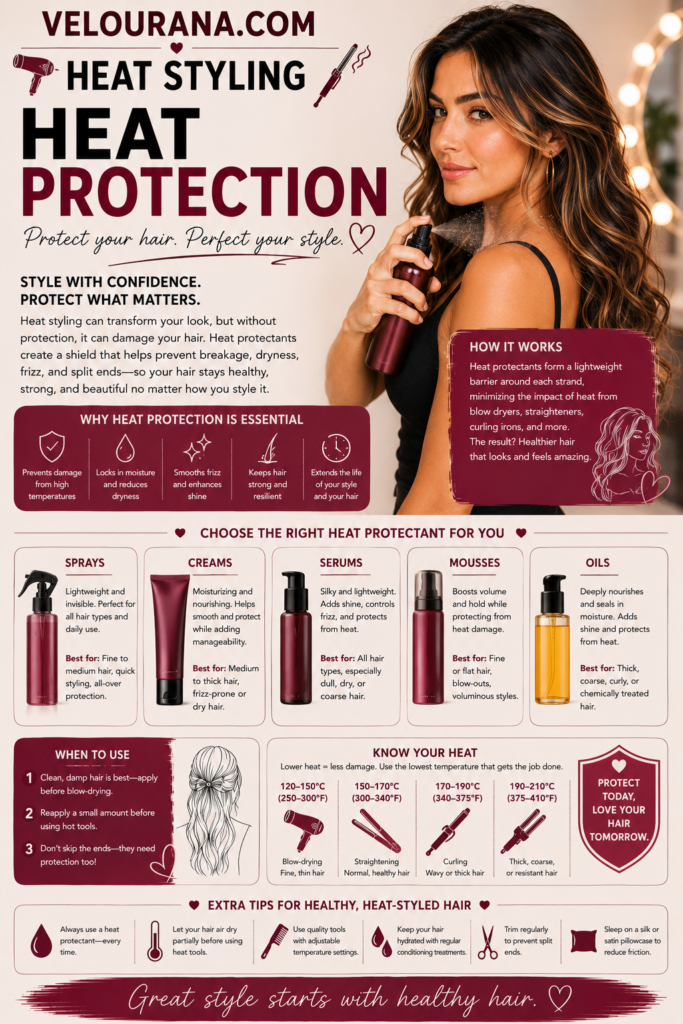
CATEGORY: Heat Protection
Heat styling has become an ordinary part of modern hair care. Blow-dryers can transform damp hair into a polished style, curling tools can create everything from soft bends to defined spirals, and straighteners can produce sleek lengths or carefully shaped waves. These tools make it possible to change the appearance of hair quickly, but they also introduce something the hair would not otherwise encounter in the same concentrated way: heat.
Heat protection exists to make that relationship more manageable.
A heat protectant should not be thought of as an invisible shield that makes temperature irrelevant. Applying one does not mean the hair can then be exposed indefinitely to the hottest possible setting without consequence. Its role is more realistic and more useful. A suitable product can help reduce the severity of heat exposure while also improving manageability, smoothing the surface and helping the hair move through styling with less unnecessary repetition.
The most effective approach therefore combines protection with technique.
Temperature matters. So does the amount of time a tool remains in contact with the hair. The number of repeated passes matters. The condition of the hair before styling matters. The distance of a blow-dryer from the hair and the way airflow is directed matter as well.
When these factors are considered together, heat styling becomes less about using a protective product and hoping for the best and more about creating the desired result efficiently.
That distinction is important because beautiful heat-styled hair should not merely look polished immediately after styling. It should continue to feel flexible, responsive and capable of moving naturally. The objective is not simply achieving today's hairstyle. It is styling in a way that respects the condition of the hair that will be styled again tomorrow, next week and months from now.
What Heat Actually Changes During Styling
Hair responds to heat because temperature can temporarily influence the bonds and moisture relationships that help determine its shape. This is what makes styling possible. Damp hair can be blow-dried into a smoother direction. Straight hair can be curled around a heated barrel. Wavy or curly hair can be stretched into a straighter form. A straightener can also be rotated through a section to create bends and waves.
The transformation feels immediate, but the amount of heat involved varies dramatically between methods.
A blow-dryer transfers heat through moving air. The dryer can remain at a distance from the hair, and the airflow is constantly moving when the technique is controlled. A curling iron or straightener works differently because the heated surface comes into direct contact with the hair.
That direct contact makes temperature, duration and repetition particularly important.
The temptation is often to focus only on the number displayed on the tool. Yet heat exposure is not determined by temperature alone. A relatively moderate setting used repeatedly on the same section can still create substantial cumulative exposure. A hotter tool moved efficiently through a suitable section creates another type of exposure. Neither should be judged by temperature in isolation.
The condition of the hair changes the equation further.
Hair that has been chemically treated, lightened, frequently heat styled or otherwise sensitized may not respond like hair that has experienced little processing. Fine strands can behave differently from coarse strands. Dense hair may require different sectioning from sparse hair even when individual strands are similar.
This is why universal rules such as assuming that every person should use one exact temperature can be misleading.
The styling method should respond to the hair in front of the mirror.
A useful principle is to use only the level of heat and repetition necessary to create the intended result. If the hair can be styled successfully without moving to a more aggressive setting, there is no styling advantage in increasing exposure simply because the tool is capable of becoming hotter.
Heat should accomplish a purpose.
Once that purpose has been achieved, continuing to apply it does not make the section more successfully styled.
Heat Protectant Is Part of a System, Not Permission for Unlimited Heat
Heat-protective products come in many forms. Sprays are common because they can be distributed relatively easily, particularly through fine or straight hair. Creams and lotions may provide additional smoothing or conditioning qualities and can suit other textures and styling goals. Some products combine heat protection with detangling, smoothing, frizz control or hold.
The right format depends on the hair and the styling method.
Fine hair may benefit from a lightweight formula that does not compromise movement. Thick, coarse-feeling or highly textured hair may have different preferences. Someone preparing for a blowout may want different handling qualities from someone preparing dry hair for curling.
What matters is that the product is actually designed for the intended purpose and is used according to its directions.
Application is as important as selection.
A small amount concentrated on one visible section cannot provide the same distribution as an application worked appropriately through the hair. At the same time, saturating the hair with excessive product is not automatically more protective.
Too much product can make some hair feel heavy, sticky or difficult to style. That can indirectly encourage additional passes with a tool because the hair is not moving or responding as expected.
The objective is appropriate coverage rather than maximum quantity.
It is also important to distinguish heat protection from the idea of heat immunity.
No cosmetic styling product turns the hair into a material that cannot be affected by temperature. Protection should therefore exist alongside sensible tool use.
This changes the question from, “I used heat protectant, so how hot can I make the tool?” to, “What combination of preparation, temperature and technique will create this style effectively?”
That second question produces a much more sustainable approach.
A smooth blow-dry, for example, becomes easier when the hair has already lost excess water before detailed brush work begins. The dryer does not then need to spend an unnecessarily long time removing moisture while the brush repeatedly tensions the same section.
Curling becomes more efficient when sections are appropriately sized. A section that is too large may fail to form consistently, leading to repeated attempts. Reducing the amount of hair can sometimes solve the problem without increasing temperature.
Straightening follows the same logic. A controlled section that can be smoothed efficiently is preferable to repeatedly passing a straightener over a large, poorly controlled piece.
Heat protectant supports these processes.
It does not replace them.
Blow-Drying Deserves Heat Protection Too
Because blow-dryers do not usually clamp hair between heated plates, blow-drying can sometimes be mentally separated from other forms of heat styling. It still involves heat exposure.
The difference is that airflow provides more opportunities for control.
The dryer can be kept moving. Distance can be maintained. Temperature can be adjusted. A concentrator nozzle can direct the airflow toward the section being styled rather than scattering hot air unpredictably across the head.
These details matter.
Hair does not need to be dripping wet when detailed blow-drying begins. Excess water can first be removed gently, and some moisture can be reduced using less intensive drying before brushes are used to create the final shape.
This makes the styling stage more purposeful.
The brush can establish direction while the dryer follows. The airflow can generally travel along the section rather than repeatedly disturbing the surface from different angles.
When the section is dry and shaped, the dryer can move on.
Continuing to heat already-dry lengths while waiting for another part of the section to respond is inefficient. This is especially relevant with long hair, where the ends can dry much sooner than the roots.
Heat protection therefore involves observation.
Where is the remaining moisture?
Which area actually needs heat?
Has the section already reached its intended shape?
Those questions can reduce unnecessary exposure without compromising the hairstyle.
The roots and ends may need completely different treatment. Dense hair can remain damp near the scalp after the outer lengths appear dry. Fine ends may require very little additional drying once most moisture has disappeared.
A good blow-dry responds to those differences.
It does not treat every centimeter of hair as though it has identical needs.
Curling and Straightening Require Deliberate Contact With Heat
Hot tools that touch the hair directly demand a different kind of attention.
The hair should be dry before conventional curling irons, wands or straighteners are used unless a particular tool has been specifically designed and instructed for another method. Applying a standard direct-contact hot tool to wet hair is not the same process as blow-drying.
Once the hair is prepared, sectioning becomes one of the most effective ways to improve efficiency.
A manageable section allows the tool to influence the hair consistently. When too much hair is placed into a curling iron or between straightening plates, the outer strands may receive the strongest contact while the interior responds less effectively. The natural reaction can be to repeat the process.
Better sectioning can reduce that need.
With curling, the aim is to create the desired shape and then allow the section to leave the tool. Holding it there indefinitely does not create a better curl simply because the hair becomes hotter.
Cooling plays an important role afterward. A newly created curl can be allowed to settle before it is pulled apart or brushed. This means longevity does not have to be pursued exclusively through stronger heat.
Straightening similarly benefits from preparation and control.
A section that has already been blow-dried smoothly may require less correction than hair that was dried without direction. The straightener is then refining the result rather than being expected to perform every stage of the transformation.
This illustrates an important relationship between different forms of heat styling.
One technique can reduce the work demanded from another.
If blow-drying creates a controlled foundation, subsequent curling or straightening may become more efficient. If the hair is allowed to become tangled and irregular before a hot tool is introduced, additional passes may be needed simply to restore order.
Heat protection is therefore not confined to the moment a protective spray is applied.
It extends through the entire styling sequence.
Hair Type, Texture and Condition Change the Protection Strategy
There is no single heat-styling routine that behaves identically on every head of hair.
Fine hair can respond quickly to heat because individual strands are smaller, although the exact response varies. It can also lose body when overloaded with rich styling products. A lightweight protective approach combined with controlled temperature and minimal repetition can therefore be particularly useful.
The goal is to protect the hair without making it so heavy that styling becomes more difficult.
Thick hair creates a different challenge. Density can encourage oversized sections, especially when someone is trying to finish quickly. Yet large sections can actually prolong the process if the tool cannot shape them consistently.
Dividing dense hair into manageable sections may appear slower at first but can make each styling action more effective.
Coarse strands should not automatically be treated as indestructible. The fact that hair feels substantial does not mean unlimited temperature is necessary or desirable.
Straight hair often shows the visual effects of heat styling clearly. Curling creates an obvious transformation, while straightening may be used primarily for additional polish. If the hair is already naturally straight, repeatedly applying high heat to achieve a difference that is relatively small may be unnecessary.
Wavy hair offers opportunities for selective styling. A blow-dryer can stretch the pattern into a smoother shape, a diffuser can preserve it, or a curling tool can refine only selected sections. Choosing the least intensive method capable of creating the desired style can reduce unnecessary work.
Curly and coily hair present another range of possibilities.
If the natural texture is being preserved, diffusing can dry the hair while maintaining its pattern. If a stretched style is desired, controlled blow-drying can elongate the texture before additional styling. The amount of manipulation and heat required will depend on the final goal.
It is particularly useful to decide that goal before beginning.
Drying curly hair naturally with a diffuser and then deciding to straighten it immediately afterward creates a different sequence of exposure from preparing it deliberately for a smooth finish from the beginning.
Planning can therefore be protective.
Chemically treated and lightened hair deserves particular consideration because its condition may differ substantially from untreated hair. The styling routine should respond to the actual state of the strands rather than assuming that a technique used in the past remains appropriate indefinitely.
Hair changes.
Length changes.
Color treatments change.
Previous styling accumulates.
A heat-protection routine should be capable of changing with them.
The Ends Often Need More Restraint Than the Roots
The ends of the hair have a different history from the newest growth near the scalp.
On long hair, the ends have existed for much longer. They have experienced more washing, brushing, environmental exposure and previous styling simply because they are older.
They also tend to dry faster during blow-drying.
This makes them an important area for restraint.
When the roots remain damp, it is easy to continue moving the dryer through the entire length automatically. Yet the ends may no longer need the same amount of heat.
The airflow can be redirected toward the areas that actually remain damp.
A similar principle applies to hot-tool styling. If the desired curl is concentrated through the middle of the hair, the ends do not always need to spend the same amount of time wrapped around the tool. Modern loose-wave styles often deliberately leave the final centimeters less curled, which can also reduce the need to concentrate heat there.
When straightening, repeatedly passing over the ends because the roots or middle lengths require additional work is equally unnecessary.
Each part of the section can be treated according to its condition and the intended style.
This creates a more precise form of heat styling.
Instead of thinking of one strand as a single unit that must receive identical treatment from root to tip, the stylist responds to what different areas actually need.
Repetition Is One of the Most Overlooked Forms of Heat Exposure
A common styling pattern begins with a section that does not look quite right.
It is curled again.
Then perhaps once more.
A straightener is passed over a stubborn piece repeatedly.
A blow-dryer continues working the same length long after the hair feels dry.
Individually, each action may seem minor. Together, they create cumulative exposure.
This is why improving technique can be as important as changing temperature.
If a curl repeatedly fails, the section may be too large. The tool diameter may not suit the desired result. The hair may be overloaded with product. The technique may need adjustment.
If a section does not straighten efficiently, preparation or sectioning may be the issue.
Repeating the identical action without identifying the reason it failed is rarely the most elegant solution.
A useful heat-styling routine becomes more efficient over time because fewer corrective passes are needed.
The person styling the hair begins recognizing how much hair a tool can handle, how quickly particular sections respond and where less heat is sufficient.
That knowledge is part of heat protection.
It reduces unnecessary exposure through better judgment.
Frequency Matters Beyond a Single Styling Session
Heat protection should also be considered across time rather than only during one morning.
A carefully controlled styling session is different from repeated restyling of the same lengths throughout the day. Hair that is curled in the morning, straightened later and then curled again in the evening has experienced multiple rounds of direct heat even if protective product was applied.
Refreshing selectively can reduce this repetition.
If a curled hairstyle has relaxed only around the face, those sections can be addressed rather than recreating the entire head. If a smooth blow-dry remains intact through most of the lengths, only the areas that changed overnight may need attention.
Second-day styling can therefore become more targeted.
The same idea applies when choosing hairstyles across several days. A polished blowout may gradually become a softer style rather than being completely reconstructed every morning. Large curls can relax into waves. Straightened hair can be incorporated into a ponytail or updo as the roots change.
Heatless styling can also provide alternatives between heat-styling sessions.
Braids can introduce waves. Rollers can create volume and curvature. Twists and wrapped techniques can create other forms of movement. These methods do not reproduce every hot-tool result exactly, but they broaden the available styling vocabulary.
Heat protection is not about declaring heat styling undesirable.
It is about avoiding unnecessary heat when another method can create a result the wearer genuinely likes.
A Protective Routine Should Still Allow Creative Styling
It would be easy to turn heat protection into a restrictive set of warnings, but that misses the reason people use styling tools in the first place.
Hair is expressive.
Someone may want sleek, reflective lengths one day and large curls the next. A short haircut can be lifted and textured. Long layers can be shaped into a blowout. Naturally curly hair can be diffused to emphasize its pattern or stretched when a completely different look is desired.
Protection should make that creativity more thoughtful, not eliminate it.
The key is matching the technique to the result.
A blow-dryer should not do more work than necessary.
A curling iron should create a curl efficiently rather than repeatedly reheating it.
A straightener should move through manageable sections instead of being used as a universal correction tool for poorly prepared hair.
Heat protectant should be distributed appropriately rather than treated as a magical coating.
The finished hairstyle should still feel alive.
Smooth hair should move.
Curls should bounce.
Waves should soften.
Volume should come from shape rather than stiffness.
When hair has to be heavily fixed simply to survive the styling process, the technique may deserve reconsideration.
Heat Protection Is Ultimately About Styling With Intention
The most useful heat-protection routine is not built around fear of styling tools. It is built around eliminating waste.
Wasted heat.
Wasted passes.
Wasted time spent repeatedly correcting oversized sections.
Wasted exposure on ends that are already dry.
Wasted product that weighs the hair down and makes styling more difficult.
Once those inefficiencies are removed, heat styling becomes more controlled.
Preparation gives the hair a manageable foundation. An appropriate protective product supports the styling process. The hair is divided according to its density rather than according to an arbitrary number of sections. Temperature is chosen because it works for the hair and tool, not simply because a higher setting exists.
The blow-dryer moves.
The curling tool creates the shape and releases it.
The straightener performs the necessary work without repeatedly revisiting successful sections.
Finished curls are allowed to cool rather than being immediately destroyed and recreated.
The ends receive only the attention they actually need.
The following day, the hairstyle is assessed before heat is introduced again.
These decisions may appear small individually, but together they change the nature of heat styling.
The process becomes less aggressive because it becomes more precise.
That precision is especially valuable for people who enjoy changing their hairstyle frequently. Heat protection should not be an emergency measure used only after the hair begins feeling different. It works best as part of the normal styling routine from the beginning.
The objective is not perfect preservation. Hair experiences washing, weather, friction, chemical services, mechanical handling and ordinary aging in addition to styling. No single product or technique can remove every influence.
What heat protection can do is help make one major influence more deliberate.
That begins by recognizing that the protective product and the styling technique belong together.
One without the other is incomplete.
A bottle labelled for heat protection does not justify endless exposure. Equally, careful temperature choices do not make appropriate preparation irrelevant.
The strongest routine combines both.
Hair is prepared according to its texture and condition. Protection is applied appropriately. The tool is used efficiently. Sections are styled once when possible. The result is allowed to settle naturally.
And when the hairstyle is finished, it should not merely look as though it survived the process.
It should look like hair at its best: smooth where smoothness was intended, curved where movement was created, full where volume was wanted and flexible enough to continue moving naturally.
That is the real purpose of heat protection.
Not to make heat meaningless, but to make every use of it more considered.
The End
Velourana.
 Discover More From Our Family of Websites
 ZodiacBearing (Astrology, Tarot, Numerology, Angel Numbers & Spiritual Guidance)
 Velourana (Beauty, Makeup, Hair Care, Skincare & Beauty Tips)
 HavenBearing (Home, Living, Organization, Décor & Everyday Inspiration)
 PawBearing (Pet Care, Dog Breeds, Animal Health, Training & Pet Products)
 PsyCatherine (Notes From the Journal of a Psychologist on Real Life)

