
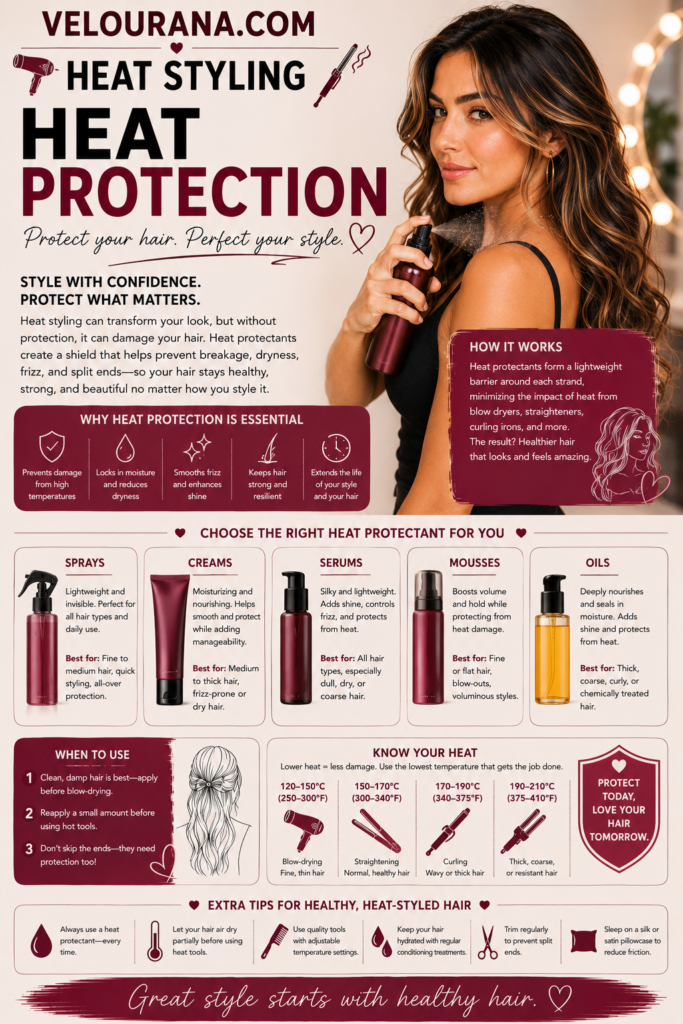
CATEGORY: Heat Protection
Straightened hair can appear remarkably simple when the finished result is viewed from the outside. The surface looks smooth, the lengths fall cleanly, the ends appear controlled and the entire hairstyle may seem to have required little more than passing a straightener through the hair. In reality, the quality of a straightened finish is often determined before the straightener ever touches a strand.
Preparation matters because a flat iron is most effective when it is refining hair rather than being asked to correct every problem created earlier in the styling process. Hair that has been dried without direction, left tangled or divided into sections too large for the tool can require repeated passes before it appears smooth. Those repeated passes increase heat exposure without necessarily improving the quality of the finished style.
Heat protection before straightening is therefore not simply a matter of applying a product.
A suitable heat-protective formula is an important part of the routine, but protection also comes from using the tool efficiently. The hair should be properly prepared, completely dry when using a conventional straightener, divided into manageable sections and styled with enough control that successful areas do not need to be revisited unnecessarily.
This approach produces another benefit: the result often looks better.
Hair that has been straightened efficiently can retain movement. It can fall naturally around the shoulders rather than appearing rigid. Layers remain visible. The ends can be shaped instead of being pressed into an unnaturally flat line. Face-framing pieces can be directed deliberately rather than simply hanging downward.
The objective is not to flatten the hair as aggressively as possible.
It is to create a smooth, coherent hairstyle while using heat only where it contributes something useful.
The Foundation Determines How Much Work the Straightener Must Do
Straightening should begin with an understanding of the hairstyle that exists before direct heat is introduced.
If naturally straight or lightly wavy hair has already been blow-dried smoothly, a straightener may need to perform only minor refinement. A few sections may require additional polish, the ends may need shaping, and areas around the face may benefit from more deliberate direction.
That is very different from starting with hair that has been dried into a highly irregular shape.
The more correction demanded from the straightener, the greater the temptation to use repeated passes.
For naturally curly or coily hair being transformed into a straighter style, the preparation stage becomes even more influential. A controlled blow-dry can stretch and organize the texture before the straightener is introduced. The flat iron can then refine the foundation rather than being expected to perform the entire transformation alone.
This does not mean the blow-dry itself should become unnecessarily aggressive. The objective is to distribute the styling work intelligently between stages.
The dryer creates direction.
The straightener provides refinement.
When each tool performs the task it handles effectively, the complete process can become more efficient.
The hair should also be detangled before straightening. Passing a hot tool through knots or repeatedly stopping in the middle of a section makes controlled movement difficult. Smooth, manageable sections allow the plates to travel consistently.
Conventional straighteners should be used on dry hair unless a particular appliance is specifically designed and instructed for another method. A standard flat iron should not be treated as a device for completing the drying process.
Heat protectant can then be incorporated according to the instructions of the chosen product. Some formulas are designed for damp hair before blow-drying, some for dry styling, and some may be suitable at different stages. The product's directions matter because application methods are not identical across every formula.
The amount also needs to suit the hair.
Fine hair can become heavy when overloaded. Dense or coarse-feeling hair may respond comfortably to richer formulas, but excessive product can still interfere with clean movement through the tool.
Appropriate distribution is more useful than simply applying as much as possible.
The purpose is to prepare the hair for styling, not to create a visible coating around it.
Sectioning Is One of the Most Effective Forms of Heat Control
Straightening very large pieces of hair may appear to save time, but it often produces the opposite result.
When too much hair is placed between the plates, the outer strands can receive stronger contact while the interior remains less affected. The section may emerge looking partially straightened, encouraging another pass and perhaps another after that.
A manageable section allows the tool to work more consistently.
This is particularly important with dense hair. Thick hair may require many sections, but each one can then be treated efficiently. The process becomes systematic rather than repetitive.
Fine hair may need fewer divisions, although sectioning still helps prevent accidental reheating. Completed hair can be kept away from areas that have not yet been styled.
Organization becomes protection because it reduces uncertainty.
If someone cannot remember whether a section has already been straightened, it can easily receive another pass simply because it has become mixed with unfinished hair.
Working progressively through the head avoids this.
The lower hair can be styled first while the upper sections remain clipped away. Additional layers can then be released as the process continues.
This also provides an opportunity to observe the developing silhouette.
Not every layer necessarily needs identical treatment.
A lower internal section may already be smooth enough after blow-drying. A visible upper layer may need more refinement. Face-framing pieces may require deliberate shaping rather than simple straightening.
The tool can therefore be used according to what each area contributes to the finished hairstyle.
That is more sophisticated than automatically straightening every strand in exactly the same way.
Temperature Is Only One Part of Heat Exposure
Straightener temperature receives considerable attention because it is easy to see and adjust, but the number on the tool does not describe the entire styling process.
Duration matters.
Repetition matters.
Section size matters.
The condition of the hair matters.
A section repeatedly passed through a tool experiences cumulative exposure even if the temperature itself has not changed.
This is why a higher setting should not automatically be used simply because the first attempt was unsuccessful. The underlying reason should be considered.
Was the section too large?
Was the hair sufficiently prepared?
Was it completely dry?
Was the tool moving consistently?
Was product buildup interfering with the finish?
Could better tension or sectioning solve the problem?
Technique should be examined before temperature becomes the default solution.
The appropriate setting varies according to the tool and the hair being styled. Fine, processed or sensitized hair may not have the same needs as resistant, coarse-feeling strands. Even within one head of hair, the condition of the ends can differ from the newer growth near the scalp.
The useful principle is to use the amount of heat required to achieve the intended result without assuming that more heat automatically produces better straightening.
Once the section is smooth, another pass does not make it more successfully straight.
It simply exposes already-styled hair again.
Straightening Should Create Shape, Not Merely Remove Texture
A common misconception is that straightening means making every strand travel vertically downward in the flattest possible line.
That is one possible aesthetic, but it is not the only one.
A polished straight hairstyle can still contain volume at the roots, movement through the lengths and curvature at the ends. Face-framing layers can sweep away from the features. A bob can turn gently inward. Long layers can fall in different directions rather than collapsing into one flat sheet.
The way the straightener moves through the section influences this.
Pulling every section firmly downward from the root can reduce volume. If the intended result is sleek but not flat, the roots can retain some elevation while the tool focuses on smoothing the lengths.
The ends can also be shaped rather than simply pressed.
A subtle inward curve can soften a blunt perimeter. A slight outward movement can create another character entirely. Long face-framing sections can be directed backward so they connect naturally with the rest of the haircut.
This matters for heat protection because a clear styling intention reduces correction.
If the desired direction is established during the first controlled pass, there is less reason to return repeatedly to reshape the same section.
Straightening becomes styling rather than simply flattening.
Fine Hair Benefits From Precision and Restraint
Fine hair can become visibly sleek very quickly, particularly when its natural texture is already straight or lightly wavy.
This makes repeated straightening particularly unnecessary.
A smooth blow-dry may already create most of the desired finish. The flat iron can then be reserved for areas that need additional refinement.
This selective approach also helps preserve volume.
Fine hair can look extremely flat when every section is pressed tightly from the scalp. If some natural root elevation is retained, the finished style can remain polished while appearing fuller.
The protective product should support that lightness.
A formula that is too rich for the individual hair can cause strands to group together and reduce movement. Layering several products with similar smoothing effects can intensify this.
The routine should therefore be considered as a whole.
A leave-in product, heat protectant and finishing product may each work beautifully individually but behave differently when combined.
If the hair feels increasingly heavy during styling, adding more product is unlikely to solve the problem.
The ends of fine hair deserve particular restraint. They can be older, more exposed and quicker to respond to direct heat than the stronger-looking hair near the roots.
If they become smooth during the first controlled movement of the tool, they do not need to be repeatedly revisited.
The finished hair should remain fluid.
Straight does not have to mean motionless.
Thick Hair Needs Better Organization, Not Automatic Maximum Heat
Dense hair can make straightening feel laborious because the volume of hair increases the number of sections required.
Large sections may seem like an obvious shortcut, but they often create inconsistent results.
Working with manageable pieces allows the plates to contact the hair more evenly. The tool can travel through the section once effectively rather than several times unsuccessfully.
The blow-drying stage can also remove much of the difficulty.
Dense wavy or curly hair that has been organized and stretched during drying presents a very different foundation from hair that has been allowed to dry into a more irregular pattern before straightening.
This does not mean every trace of texture must disappear during blow-drying. It means the hair can be prepared enough that the straightener performs refinement rather than rescue.
Thick hair also does not necessarily need to become completely flat.
Its natural density can create a luxurious straightened finish when controlled rather than eliminated. Some volume at the roots can remain, while the lengths become smooth and organized.
Internal sections may require less cosmetic perfection than the visible surface, depending on the intended hairstyle.
The top layers, perimeter and face-framing sections usually contribute most strongly to the visible finish.
Heat can be distributed according to that visual importance rather than applied with identical intensity everywhere.
Curly and Coily Hair Can Be Straightened Without Ignoring Their Natural Structure
Transforming curly or coily hair into a straightened style involves a substantial change in shape, and the process benefits from planning.
The first question is not how many times the straightener should be passed over the hair.
It is how the hair can be prepared so that fewer corrective passes are necessary.
A controlled blow-dry can elongate the natural texture and organize the strands. Sectioning allows the roots and internal layers to dry consistently. Appropriate protective products can support manageability and smoothing.
By the time the straightener is introduced, the hair can already be significantly closer to the intended result.
The direct-contact tool then refines.
This division of work can make the complete styling process more controlled.
It also allows the person styling the hair to observe how individual areas respond. The hairline may contain finer strands than other areas. The ends may have a different history from the roots. Sections that have been chemically treated may not behave identically to untreated growth.
Treating every area with exactly the same amount of heat ignores these differences.
A condition-based approach is more useful.
The natural texture will also influence what happens after styling. Humidity and moisture can encourage curls and coils to move back toward their original pattern. This should be considered part of the temporary nature of heat styling rather than a reason to repeatedly straighten the hair throughout the day.
Constant correction can substantially increase cumulative exposure.
A straightened style should be allowed to behave like a temporary style.
Its longevity can be supported, but the hair does not need to be forced into permanent obedience.
Color-Treated Hair Requires Attention to Its Current Condition
Hair that has been colored or lightened can have different styling needs from untreated hair, particularly after repeated chemical services.
The important factor is not simply whether the hair has color in it.
It is how the hair currently behaves.
Does it feel more fragile?
Do the ends respond differently from the roots?
Does it tangle more easily?
Has it become more porous or dry-feeling?
Does a section straighten much faster than it once did?
The heat routine should adapt when these answers change.
Continuing to use the same temperature and number of passes simply because they were appropriate years earlier ignores the present condition of the hair.
Long highlighted or lightened hair can contain several different histories on the same strand. The newest growth may have experienced relatively little processing while the oldest ends have been colored, washed, brushed and heated repeatedly.
A straightener does not need to treat those areas identically.
If the ends smooth quickly, the tool can continue through them efficiently rather than pausing or repeating.
If a resistant area closer to the roots needs additional attention, that does not automatically mean the ends should receive the same additional exposure.
Precision becomes particularly valuable when hair has a complex history.
The Ends Should Be Finished, Not Punished
Straightening the ends repeatedly is common because they are visually prominent.
If the ends look irregular, the entire hairstyle can seem unfinished.
Yet they are also often among the oldest parts of the hair and can respond very quickly to heat.
A better approach is to decide what the ends should actually look like.
For a sleek long style, they may simply need to fall smoothly.
For a bob, they may curve inward.
For a layered haircut, different lengths may need slightly different directions.
For a modern straight style, the ends may remain relatively direct without being rigid.
Once that shape is achieved, the section is finished.
Continuing to press the ends because the tool happens to travel through them during repeated root correction is unnecessary.
This is another reason clean sectioning helps.
The tool can be placed where work is required and removed when that work is complete.
Straightening does not have to mean repeatedly moving from the scalp all the way to the tip regardless of which area actually needs attention.
Humidity and Longevity Should Not Lead to Constant Re-Straightening
A straightened hairstyle will interact with the environment.
Humidity can influence natural texture. Exercise, weather and ordinary moisture can affect the roots and hairline. Sleeping can introduce bends. Tucking hair behind the ears can change its direction.
These changes do not necessarily mean the entire hairstyle has failed.
The next step should be assessment rather than automatic re-straightening.
If only the front has changed, the front can be addressed.
If a single section has developed a bend overnight, that section may need attention while the remainder stays untouched.
If the roots have begun returning toward their natural texture but the lengths remain smooth, the styling decision can focus on the roots.
This selective refreshing dramatically changes the amount of cumulative heat involved.
It also preserves some of the softness that develops after the first day.
Freshly straightened hair can sometimes appear very precise. As it settles, it may develop a more natural amount of movement while remaining polished.
That evolution can be attractive.
There is no requirement to return the hair to its exact first-hour appearance every morning.
Straight Hair Can Often Skip the Straightener Entirely
Naturally straight hair deserves special consideration because the presence of a straightener in a routine can become habitual.
If the hair is already straight and a controlled blow-dry creates the desired smoothness, a flat iron may add very little.
Perhaps the front needs refinement.
Perhaps a few ends require direction.
Perhaps one irregular section needs smoothing.
Those areas can be addressed individually.
Using a direct-contact heated tool over the entire head simply because straightening is part of the usual routine is not necessary when the intended result already exists.
This is one of the clearest examples of heat protection through elimination of redundant steps.
The best pass with a straightener is sometimes the one that does not need to happen.
Straightened Hair Can Become the Foundation for Other Styles
A smooth hairstyle does not have to be recreated every day to remain useful.
As the roots begin losing their original finish, the straightened lengths can become the foundation for other hairstyles.
A low ponytail can use the smooth texture.
A bun can preserve the polished lengths while disguising changes at the roots.
A half-up style can create another silhouette.
Large heatless rollers can introduce movement without requiring the entire head to be curled with another hot tool.
Braids can transform straightened hair into softer waves for the following day.
This approach extends the value of the original styling session.
Instead of thinking of straight hair as a finish that must remain perfectly straight until the next wash, it can become the first stage in several different looks.
That flexibility can reduce the temptation to apply heat repeatedly simply to preserve one exact appearance.
Heat Protectant Works Best When Technique Does Most of the Work
A heat-protective product is useful because direct-contact tools expose hair to concentrated temperature.
But the product should not carry the entire responsibility for the styling routine.
Good technique reduces the amount of work the product needs to support.
The hair is prepared and dried appropriately.
Sections are controlled.
The tool is used at a setting suitable for the hair and appliance rather than automatically at its maximum.
Each pass has a purpose.
The direction of the section is considered.
The roots retain volume when volume is wanted.
The ends are shaped rather than repeatedly flattened.
Completed areas are left alone.
The following day, only the sections that genuinely need refreshing are revisited.
This combination makes straightening more efficient and often creates a more sophisticated result.
Hair that has been aggressively flattened can appear lifeless even when it is technically smooth. Hair that has been straightened with attention to shape can retain movement and dimension.
The haircut remains visible.
Layers fall at different levels.
Face-framing sections interact with the features.
The crown does not necessarily collapse.
The ends complete the silhouette.
Straightening becomes part of hairstyling rather than simply the removal of texture.
The Best Straightening Routine Knows When to Stop
Perhaps the most valuable heat-protection skill is recognizing completion.
A smooth section does not need another pass for reassurance.
An end that already falls correctly does not need to be pressed again.
A naturally straight area does not need to be styled merely because neighboring hair required correction.
A second-day hairstyle does not need to be reconstructed when only two sections have changed.
These decisions may seem insignificant during a single styling session, but repeated over months they can substantially alter how much unnecessary heat is used.
The same principle applies to temperature.
Once an effective level has been found for the particular hair and tool, increasing it without a reason offers little benefit.
Heat styling should remain responsive.
If the hair's condition changes, the routine changes.
If the haircut becomes shorter, section size and styling time may change.
If the hair is lightened, the approach may need reconsideration.
If a smoother blow-dry begins producing most of the desired result, the straightener can play a smaller role.
There is no virtue in maintaining a complicated heat routine simply because it has become familiar.
The most refined routine is often the one that gradually becomes more efficient.
It uses the protective product appropriately but does not mistake product for technique.
It understands that temperature is only one part of exposure.
It recognizes repetition as something worth controlling.
It treats roots, lengths and ends according to what they need rather than assuming that every part of the strand requires identical treatment.
And it preserves the qualities that make straightened hair beautiful in the first place.
Smoothness should not eliminate movement.
Polish should not eliminate volume.
Control should not make the hair appear rigid.
A sleek hairstyle can still swing across the shoulders, curve gently around the face and reveal the structure of the haircut underneath.
When straightening achieves that result efficiently, heat protection stops being an additional step performed before styling and becomes part of the logic of the entire process.
The protectant contributes.
The preparation contributes.
The temperature contributes.
The sectioning contributes.
The restraint to stop when the hair is already finished contributes perhaps most of all.
Together, those choices allow heat to perform its purpose without being used simply because more heat is available.
That is the foundation of intelligent straightening: create the smoothness you want, preserve the movement that makes it beautiful, and do no more to the hair than the finished style actually requires.
The End
Velourana.
 Discover More From Our Family of Websites
 ZodiacBearing (Astrology, Tarot, Numerology, Angel Numbers & Spiritual Guidance)
 Velourana (Beauty, Makeup, Hair Care, Skincare & Beauty Tips)
 HavenBearing (Home, Living, Organization, Décor & Everyday Inspiration)
 PawBearing (Pet Care, Dog Breeds, Animal Health, Training & Pet Products)
 PsyCatherine (Notes From the Journal of a Psychologist on Real Life)

