
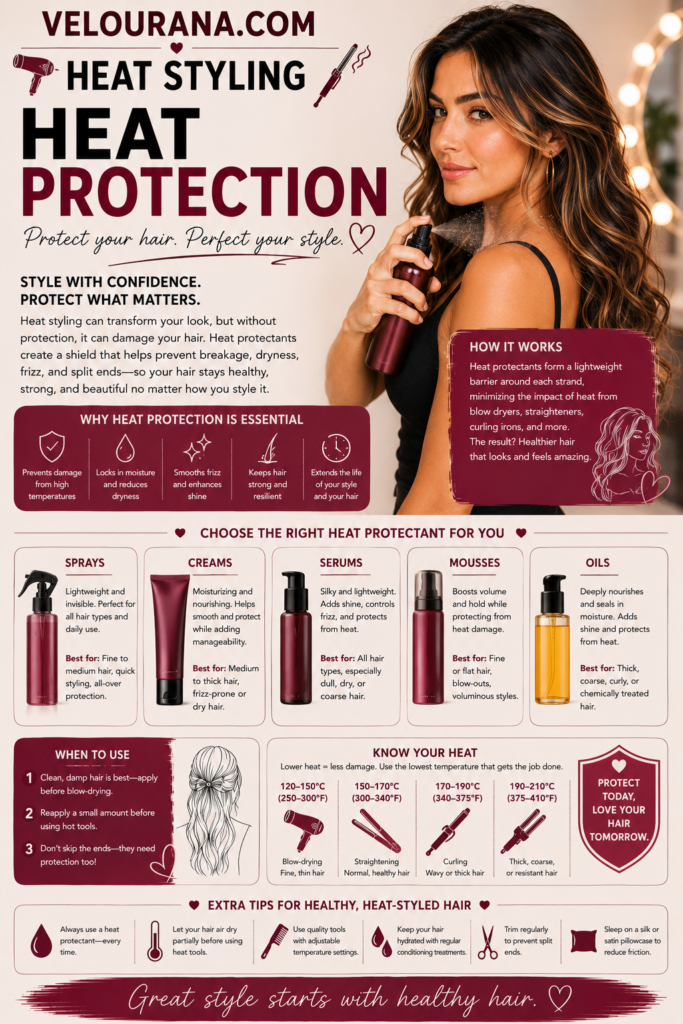
CATEGORY: Heat Protection
Blow-drying is so familiar that it is easy to forget it is a form of heat styling. Unlike a curling iron or straightener, a dryer does not usually press hair directly between heated surfaces, and the warmth is carried through moving air rather than concentrated metal or ceramic plates. That difference gives the person styling the hair considerable control, but it does not make heat protection irrelevant.
A good blow-dry begins long before the brush starts shaping the hair.
The amount of water remaining in the hair, the way excess moisture is removed, the protective products used, the direction and temperature of the airflow, the distance between dryer and hair, and the amount of time spent repeatedly working the same section all influence the process. When these elements are managed well, blow-drying becomes more efficient. The hair reaches the desired shape without being exposed to more heat or manipulation than necessary.
This matters because the best blowout is not simply the one that looks polished for the first hour. Hair should still feel flexible. The lengths should move rather than appear rigid. The ends should look finished without seeming overworked. Volume should come from deliberate shaping, and smoothness should result from controlled airflow rather than endless passes over the same strands.
Heat protectant has an important place in that process, but it is not the entire process.
A protective spray, cream, lotion or other suitable product can form part of the preparation before heated airflow is introduced. It should be used according to its instructions and chosen with the hair's texture and styling needs in mind. Yet the product works most sensibly when the technique surrounding it is equally thoughtful.
The goal is not to create a barrier and then forget about heat.
The goal is to make every stage of the blow-dry purposeful.
Preparing Damp Hair for a More Controlled Blow-Dry
Hair does not need to move directly from soaking wet to intensive brush styling.
Removing excess water first can make the detailed blow-drying stage considerably more efficient. The important point is that moisture should be reduced gently rather than through aggressive friction. Wet hair does not need vigorous rubbing simply because the aim is to make it dry faster.
Once excess water has been removed, the hair can be detangled carefully and prepared for styling. This is an appropriate point to apply a heat-protective product designed for use on damp hair, following its specific directions.
Distribution matters.
Concentrating most of the product on one visible surface while leaving other areas untouched does not create an even preparation. At the same time, applying excessive quantities simply because more seems safer can interfere with the final style, particularly on fine hair.
The product should become part of the hair's preparation rather than the dominant feature of it.
Fine hair often needs to preserve lightness. If the intended result is a voluminous blowout, a heavy combination of products can work against the desired lift before the dryer has even been switched on.
Dense or coarse-feeling hair may have different needs. A richer formula may contribute useful smoothing and manageability, particularly when the objective is a polished finish. Even then, the hair should remain workable rather than coated to the point that brush movement becomes difficult.
Curly, coily and strongly textured hair can require another approach depending on whether the natural pattern is being preserved or stretched. A diffused curly style and a smooth high-tension blowout are not simply two versions of the same technique. They have different goals, different handling and potentially different product needs.
The protective routine should therefore begin with a clear idea of the intended finish.
Someone creating natural curl definition needs the airflow to support that texture.
Someone creating a sleek blowout needs controlled direction and tension.
Someone creating large, bouncy movement needs root lift and curvature.
The more clearly the destination is understood, the less unnecessary work is likely to occur along the way.
Airflow, Distance and Direction Matter as Much as Temperature
A blow-dryer is unusually adaptable because the heat source does not have to remain fixed against the hair.
It can move.
It can be brought closer or farther away.
Its temperature can be changed.
Its speed can be adjusted.
Attachments can alter the way air reaches the hair.
These variables make technique particularly important.
Holding concentrated hot airflow on one small area for an unnecessarily long period is very different from keeping the dryer moving through a section. The latter allows heat to perform its styling function without continuously focusing on the same strands.
Distance matters for the same reason. The dryer does not need to be pressed against the hair to work effectively. Appropriate spacing allows the airflow to remain useful while avoiding needless concentration of heat.
A concentrator nozzle can make the airflow more precise during smoothing. Instead of hot air scattering across neighboring sections, it can be directed along the portion currently being styled.
Direction then becomes part of the finish.
When the goal is smoothness, airflow can follow the direction in which the hair is being guided rather than repeatedly striking the section from opposing angles. The brush and dryer work together.
The brush establishes tension and shape.
The dryer supports that direction.
This coordination can produce a smoother result with less repeated correction.
If the airflow is constantly disrupting the section while the brush attempts to smooth it, the process becomes inefficient. The same hair may need to be worked again and again.
Heat protection therefore includes organization.
The dryer should be doing something specific each time it passes through a section.
It may be removing remaining moisture.
It may be smoothing the surface.
It may be lifting the roots.
It may be creating curvature through the ends.
When that purpose has been achieved, the dryer can move elsewhere.
The Roots, Mid-Lengths and Ends Do Not Dry at the Same Rate
One of the most useful observations during blow-drying is that a section of hair does not necessarily need the same treatment from root to tip.
The roots can remain damp after the ends feel dry.
Dense hair may retain moisture underneath while the visible surface appears finished.
Fine ends may dry rapidly even when the middle lengths still require attention.
Long hair makes these differences particularly obvious.
If the dryer continues traveling over the entire length simply because the roots are not yet dry, the ends receive repeated heat without gaining any styling benefit from it.
A more precise approach follows the moisture.
As the ends become dry, attention can shift upward.
If the roots need additional drying or lift, they can receive it without automatically reheating every centimeter below them.
This becomes especially important when a blow-dry is followed by another heated styling method. If the lengths are going to be curled afterward, there is little value in overworking them during the drying stage merely to create a shape that will immediately be changed.
The blow-dry can establish a clean, manageable foundation.
The curling stage can create the final movement.
The same principle applies before straightening. A smooth blow-dry can reduce the amount of correction required from a straightener, but there is no need to chase absolute perfection with the dryer if a subsequent tool will perform the final refinement.
Each stage should do enough.
It does not need to do everything.
This is one of the simplest ways to make a heat-styling routine more efficient.
Brush Technique Can Reduce the Need for Repeated Heat
The brush is often treated as a secondary part of blow-drying, yet it has enormous influence over how much work the dryer must perform.
A brush can create tension, direct the roots, smooth the lengths and establish curvature at the ends. When the section is controlled properly, the dryer can follow that shape rather than attempting to create it through heat alone.
Section size is central to this.
A section that is too large for the brush and dryer to control can remain damp internally or develop an inconsistent finish. The natural response is often to repeat the process.
Smaller, manageable sections can therefore reduce total styling effort even though there are more of them.
Dense hair particularly benefits from this organization.
Dividing it into clean working areas makes it possible to reach the roots and hidden interior layers rather than repeatedly heating the surface.
Fine hair may need fewer sections, but control remains important. If too much hair slips away from the brush, repeated attempts can create more handling than necessary.
Tension should also have a purpose.
For a sleek finish, controlled tension can help elongate and smooth the section.
For volume, the roots can be elevated away from their natural resting position.
For curved ends, the brush can guide the hair into the desired shape while the airflow follows.
The hair does not need to be pulled aggressively simply because a brush is involved.
The amount of tension should correspond to the style and texture.
This becomes particularly important around the hairline and shorter face-framing pieces, where sections can be finer and more difficult to control.
A polished blowout is created through coordination, not force.
Heat Protection Changes With the Blow-Dry You Are Creating
A smooth blowout, a voluminous blowout and a diffused natural texture all involve a blow-dryer, but they should not be approached identically.
For a sleek finish, the emphasis is usually on controlled directional airflow and progressive smoothing. The hair can be divided systematically, with each section dried and shaped before moving to the next.
The roots need enough attention to become dry and controlled, while the lengths are guided into a smooth direction. The ends can be finished according to the haircut—straight, softly curved inward or given a more noticeable bend.
A voluminous blowout introduces elevation.
The roots may be directed upward or away from their usual position so that the finished hair does not collapse close to the scalp. Round-brush work can create broad curvature through the lengths and ends.
This type of style often benefits from allowing the newly created shape to cool before it is heavily disturbed.
Heat creates the movement, but cooling helps establish it.
The same principle that matters in curling applies here: immediately stretching or flattening a warm section can weaken the shape before the hairstyle has settled.
Diffusing works differently because the intention is usually to preserve or enhance existing texture rather than stretch it into a smooth form.
The diffuser distributes airflow across a broader area and can reduce the disruption associated with a concentrated stream of air. The hair is handled according to its curl or wave pattern rather than repeatedly brushed straight.
Heat protection remains relevant, but the styling philosophy changes.
There is less emphasis on tension and more emphasis on drying while maintaining the natural arrangement of the strands.
These differences demonstrate why heat protection cannot be separated from styling technique.
The same protective product does not make three completely different blow-drying methods equivalent.
How the heat is delivered still matters.
Fine Hair Needs a Blow-Dry That Preserves Air and Movement
Fine hair can gain remarkable volume from blow-drying because the roots can be lifted and the lengths directed away from their naturally flat position.
The challenge is keeping that volume once it has been created.
Heavy preparation can reduce it. Excessive moisture left in the roots can cause them to settle quickly. Repeated brushing after the style is finished can remove some of the carefully created lift.
Heat protection should therefore fit into a lightweight routine whenever that suits the individual hair.
The dryer can first reduce moisture efficiently before detailed styling begins. The roots can then receive focused attention, with sections lifted according to the desired shape.
The ends often require less heat than expected.
Because fine ends can dry quickly, repeatedly running the dryer over them while working the roots may leave them feeling overworked.
The styling sequence can adapt as different areas become dry.
Volume does not require maximum temperature.
It requires direction.
A root dried upward will behave differently from one dried flat against the scalp. A front section directed away from the face will fall differently from one dried straight downward.
These changes in direction can create much of the visual effect without requiring prolonged exposure.
Once the style is complete, it should remain light enough to move.
That movement is part of what makes fine hair appear fuller.
Thick Hair Requires Patience More Than Aggression
Dense hair can make blow-drying feel time-consuming because there is simply more material to dry.
Trying to solve this by increasing heat while working enormous sections can be counterproductive.
The surface may become hot and dry while moisture remains underneath. The section then needs additional passes, and the already-dry hair continues receiving heat.
Systematic sectioning provides a more controlled solution.
Working from the lower layers upward makes it easier to see which hair has been completed. Each section can be dried at the roots and through the lengths before the next is released.
The result may actually be faster because less time is spent revisiting areas that were never fully dried in the first place.
Thick hair can also retain considerable natural volume. A smooth blowout does not necessarily need maximum lift everywhere.
The roots can be controlled where excessive expansion is unwanted, while selected areas receive elevation for shape.
This creates a more sophisticated silhouette than simply making the entire hairstyle larger.
The protective product can support manageability, but again, it should not be expected to compensate for poor sectioning.
Technique does most of the organizational work.
Long Hair Makes Heat Distribution Especially Important
The greater the length, the more important it becomes to recognize that different areas of the hair have different histories and drying times.
The newest growth near the scalp may be in very different condition from ends that have existed for years.
The ends also tend to lose water sooner during blow-drying.
This creates a strong reason to avoid automatically directing every pass from scalp to tip long after the lower lengths are dry.
Once the ends have reached the desired state, the dryer can concentrate on the areas that still require work.
Long hair also creates practical challenges because finished sections can easily become mixed with damp ones.
Keeping the hair organized prevents accidental repetition.
A completed section can be moved aside while the next is dried. This makes the styling process easier to track and reduces the likelihood of repeatedly reheating hair simply because it has become mixed into an unfinished area.
Long layers add another dimension.
Shorter sections around the face and crown can dry more quickly than the longest hair, yet they may also require more detailed shaping because they influence the silhouette so strongly.
The styling routine can therefore prioritize them differently.
Face-framing layers can be given direction.
The crown can receive lift.
The longest hair can be dried efficiently without requiring the same degree of intricate brush work in every internal section.
A beautiful blowout is not created by giving every strand identical attention.
It is created by giving the right attention to the areas that determine the final shape.
Short and Medium Hair Benefit From Precision
Shorter hair takes less time to dry, but small changes in direction have a large visual impact.
A bob can look sleek, rounded, airy or deliberately tousled depending on how the roots and ends are shaped.
Medium hair can develop substantial volume because it has enough length for curvature without the weight of very long hair pulling that movement downward.
In both cases, the blow-dry can be highly targeted.
A short front section may need only a brief amount of directional styling to fall correctly.
The crown can be lifted without aggressively drying every section underneath.
A medium layered haircut can be shaped so that upper layers gain bounce while the lower hair remains smoother.
Because the styling time is often shorter, there can be a temptation to rush and use unnecessarily high heat. Precision is a better advantage.
The dryer can remain moving, sections can be kept manageable, and each area can be considered finished once it is dry and correctly shaped.
Shorter length does not eliminate the need for protection.
It simply changes where efficiency can be found.
Knowing When a Section Is Finished Is a Heat-Protection Skill
One of the least glamorous but most important aspects of blow-drying is knowing when to stop.
A section that is dry, smooth and correctly shaped has completed its styling process.
Continuing to work it because the rest of the head is unfinished does not improve it.
This sounds obvious, yet blow-drying often becomes repetitive because the same brush movements are performed automatically. The dryer follows, even when no further change is occurring.
A more attentive technique watches the hair.
Is the root still damp?
Has the section become smooth enough for the intended style?
Has the curve formed?
Does the end already sit correctly?
If the answer is yes, the section can be left alone.
This is particularly useful when learning to blow-dry one's own hair. The back can be difficult to see, so organization and touch become important. Completed sections can be separated from damp ones, reducing confusion.
The ability to stop is part of efficiency.
Heat styling does not become better simply because it lasts longer.
Cooling Can Help Preserve the Shape Without Additional Heat
A voluminous blowout often depends on more than the hot stage.
Once a section has been shaped, allowing it to cool in a supportive position can help preserve its movement. A large curved section can settle around a brush or roller rather than being immediately pulled straight.
The crown can retain more elevation if the newly created lift is not flattened while still warm.
This offers a valuable alternative to repeatedly reheating sections in pursuit of longevity.
The shape is created with heat.
It is supported while cooling.
Then it is released.
The final hair can subsequently be arranged with the fingers or gently brushed according to the desired finish.
This is especially useful for large, bouncy styles where the initial curvature may appear stronger than the eventual result.
The hair can be allowed to soften naturally rather than being deliberately weakened before it has settled.
Second-Day Blow-Dried Hair Rarely Needs a Complete Restart
A well-created blowout can evolve attractively.
The first day may be polished and voluminous. By the following morning, the roots may be slightly flatter while the lengths remain smooth. The ends may lose some curvature, or the face-framing pieces may fall differently after sleeping.
None of this automatically requires washing and recreating the entire style.
The hair can first be assessed.
If most of the lengths remain attractive, they do not need additional heat.
The front can be refreshed.
The crown can be reshaped.
A few ends can regain their bend.
Large rollers or other heatless techniques may also restore some volume without repeating the entire blow-drying process.
This selective approach reduces cumulative styling while preserving the original work.
It can also create a more natural second-day finish.
A blowout does not need to remain identical to remain beautiful.
Heat Protection Works Best When Blow-Drying Becomes Efficient
The most protective blow-drying routine is not necessarily the slowest, the coolest or the one involving the greatest number of products.
It is the one in which unnecessary work has been removed.
Excess water is reduced before detailed styling.
The hair is detangled and prepared appropriately.
A suitable heat protectant is applied according to its instructions.
The dryer remains controlled rather than being held indefinitely over one area.
Airflow follows the intended direction of the style.
Sections are small enough to be managed effectively.
Roots, middle lengths and ends are treated according to what they actually need.
Completed sections are allowed to remain completed.
The hair is not repeatedly reheated simply because another part of the head is still being styled.
That efficiency becomes particularly valuable when blow-drying is only the first stage of a larger hairstyle.
If curling will follow, the blow-dry can create the appropriate foundation without unnecessarily perfecting a shape that will immediately change.
If straightening will follow, controlled smoothing during drying can reduce the amount of work required from the straightener.
If the blowout itself is the finished style, cooling and careful finishing can preserve volume without relying on repeated heat.
The process becomes interconnected.
Heat protectant supports the hair.
Good sectioning supports the tool.
Good brush technique supports the desired shape.
Cooling supports longevity.
Selective refreshing supports the style on subsequent days.
None of these steps needs to become excessive.
That is ultimately the advantage of thinking about heat protection before blow-drying rather than treating it as a product applied automatically and then forgotten.
Protection becomes part of the technique.
The dryer is still free to create sleek hair, large volume, soft curves, stretched texture or defined natural movement. The creative possibilities remain intact.
What changes is the precision with which the heat is used.
The hair is exposed because the heat is accomplishing something, not simply because the dryer happens to be running.
When the section is dry, the heat moves on.
When the shape is complete, the brush moves on.
When the hairstyle is finished, the hair is allowed to settle.
The result should look polished without appearing exhausted by the process: roots with the intended amount of lift, lengths that feel smooth and flexible, ends that retain movement and a finished shape that can evolve naturally after the dryer has been put away.
That is what effective heat protection during blow-drying should support—not the elimination of heat styling, but a better, more deliberate way of doing it.
The End
Velourana.
 Discover More From Our Family of Websites
 ZodiacBearing (Astrology, Tarot, Numerology, Angel Numbers & Spiritual Guidance)
 Velourana (Beauty, Makeup, Hair Care, Skincare & Beauty Tips)
 HavenBearing (Home, Living, Organization, Décor & Everyday Inspiration)
 PawBearing (Pet Care, Dog Breeds, Animal Health, Training & Pet Products)
 PsyCatherine (Notes From the Journal of a Psychologist on Real Life)

