
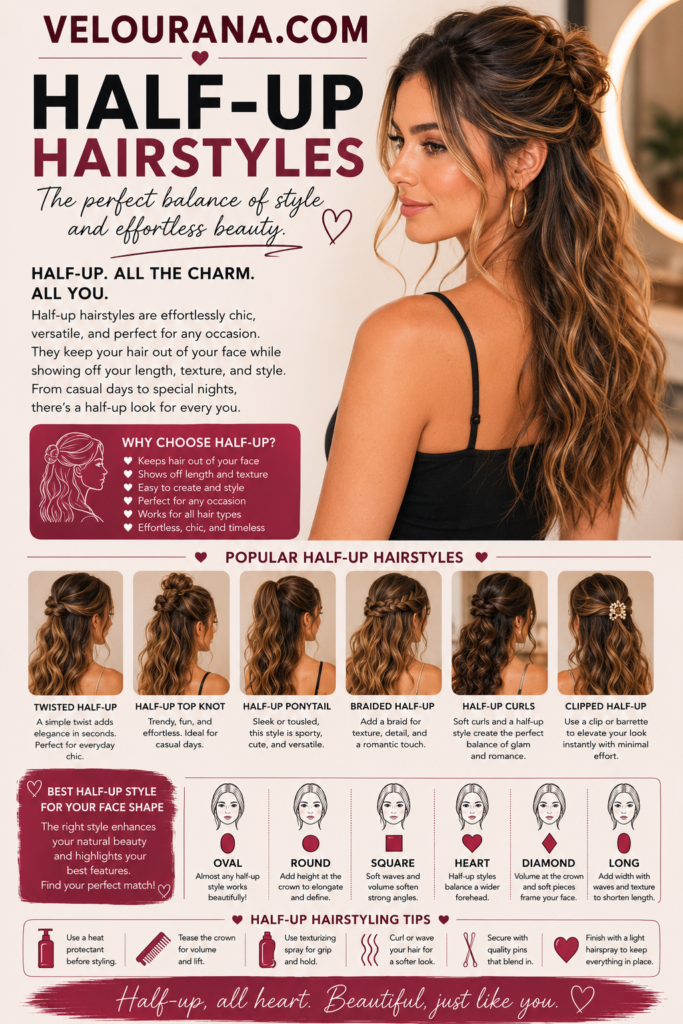
CATEGORY: Half-Up Hairstyles
Half-up hairstyles do not always need a ponytail, bun or braid to feel complete. Sometimes the most elegant versions are built from something simpler: two sections twisted away from the face, crossed behind the head, knotted together or layered so that the securing point almost disappears.
These styles are understated by design.
They do not depend on one large focal element. Instead, they create movement through the way the upper hair travels from the temples toward the back. The eye follows those lines across the sides of the head before returning to the loose lengths beneath them.
This makes twists and knots particularly useful when the goal is to style the hair without making it look heavily constructed.
The lower lengths remain visible.
The haircut remains recognizable.
Natural texture can continue moving through the shoulders and back.
Only the upper section changes direction.
This simplicity also allows surprisingly small adjustments to have a large effect. A tight twist creates a clean line. A loose twist becomes broader and softer. Two symmetrical sections create balance, while an off-center knot introduces asymmetry. A low gathering point feels quiet and romantic, while a higher one adds lift through the crown.
The hairstyle may require only a few sections of hair, but the way those sections are arranged determines whether the finished result feels casual, polished, soft or deliberately architectural.
Twists Create Movement Without a Traditional Braid
A twist works differently from a braid because there is no repeated over-and-under pattern.
The hair simply rotates.
A section near the temple can be turned backward while remaining relatively compact. As it travels toward the back of the head, the twist creates visible direction without producing a highly detailed surface.
This makes it ideal when the hairstyle needs structure but should remain visually quiet.
Two matching twists can meet at the back.
One can overlap the other.
They can be pinned invisibly, joined with a small elastic or crossed before being secured.
The lower hair remains loose beneath them.
This simple construction can look completely different according to tension.
A tightly formed twist creates a narrow, defined line.
A softer one spreads slightly and allows the natural texture to remain visible.
Both versions use exactly the same basic movement.
A Temple Twist Can Change the Front Immediately
One of the easiest half-up styles begins with a section close to each temple.
Those sections are directed away from the face and twisted backward.
The effect at the front is immediate.
Hair that previously fell beside the cheeks is moved away, opening the face while preserving most of the length.
Face-framing layers can remain outside.
Bangs can stay completely untouched.
The hairstyle therefore changes the front without requiring the wearer to abandon the familiar shape of their haircut.
This is particularly useful for layered hair, where not every front section needs to reach the same point.
Longer pieces can form the twist.
Shorter ones can remain free.
The result feels integrated rather than forced.
Two Twists Create Natural Symmetry
When the same amount of hair is taken from both sides, the hairstyle gains balance.
Each twist travels backward at a similar height.
They meet around the central back of the head.
A center part can reinforce this symmetry, especially when the front is kept relatively smooth.
Curtain bangs can remain loose and frame both sides.
The overall hairstyle feels calm and organized even when the lower lengths remain naturally textured.
The symmetry does not need to be mathematically perfect.
Hair density often differs slightly from one side to the other.
Visual balance matters more than exact section size.
Asymmetry Makes the Style More Directional
The two sides do not need to mirror one another.
One twist can begin higher.
Another can start farther back.
A single twist can travel across the head while the opposite side remains relatively loose.
The securing point can sit slightly off-center.
These changes introduce direction and make the hairstyle feel less formal.
A side part works particularly well with this approach because the upper hair already has unequal distribution.
The twist can follow the natural movement established by the part rather than fighting it.
A Low Twist Feels Soft and Understated
When the upper sections meet around the lower back of the head, the hairstyle remains subtle.
The crown experiences little lift.
The sides move backward gently rather than upward.
The securing point may almost disappear beneath the loose hair.
This can be particularly elegant on straight or softly waved lengths because the structure is visible only when the head turns.
From the front, the hairstyle may simply appear more open around the face.
From the back, the twists reveal the actual construction.
This quiet contrast is part of the appeal.
A Higher Twist Adds Crown Lift
Moving the meeting point upward changes the silhouette.
The upper sections travel at a steeper angle.
The crown can retain more volume.
The hairstyle becomes more visible from the side.
This works especially well when the lower hair has substantial movement because the lifted upper section creates another level above it.
The twist itself does not need to become larger.
Changing its direction is enough to alter the whole composition.
Soft Twists Work Beautifully With Waves
Wavy hair has a natural relationship with twisting because both involve curved movement.
The hair does not need to be straightened or smoothed completely.
Small bends can remain visible inside the twist.
The lower lengths continue the same texture beneath it.
This creates continuity.
The hairstyle feels like one expression of the natural wave rather than a structured upper section sitting above unrelated loose hair.
A little irregularity often improves the effect.
One section may be slightly wider.
A small piece may escape near the temple.
The style can remain refined without becoming rigid.
Straight Hair Makes the Direction Easy to See
Straight hair reveals the twist clearly.
The section begins near the front.
It rotates.
It travels backward.
The movement becomes part of the hairstyle.
Because the lower hair remains smooth, even a very simple twist can create enough contrast to make the style feel deliberate.
The ends do not need curls or waves.
The upper direction itself provides visual interest.
A polished straight half-up twist can therefore be extremely minimal while still looking finished.
Curly Hair Gives Twists Dimension
Curly hair creates a different surface.
The twist does not necessarily form one smooth rope.
Natural curves remain visible.
Some curls can become part of the structure while others sit loosely around it.
The lower hair retains full movement.
This creates a dimensional result in which the hairstyle organizes the curls without attempting to erase them.
The sections can also remain larger than they might on fine straight hair because natural volume helps the twist appear substantial.
Face-framing curls can remain free and connect the front with the texture below.
Coily Hair Can Create Strong Sculptural Twists
Coily textures can give half-up twists significant presence.
The upper sections may create visible rope-like structures while the lower hair remains expansive.
Two twists can meet at the back.
Several smaller twists can create repeated lines.
The upper hair can even move into a small knot or bun while the lower texture remains loose.
The hairstyle can provide structure without requiring the entire head to be smoothed.
The hairline and temples should remain comfortable.
Secure styling does not depend on aggressive pulling.
Fine Hair Benefits From Using Smaller Sections
Half-up twists can be particularly useful for fine hair because they do not require large quantities of hair to create visible detail.
A relatively narrow section from each side may be enough.
Most of the density remains in the lower lengths.
This helps the loose section stay full.
The twists themselves can be softened slightly after securing, which increases their apparent width without requiring more hair.
The crown can also retain a small amount of lift.
The result feels balanced rather than divided into two sparse sections.
Thick Hair Can Support Broader Twists
Dense hair provides more freedom.
Larger sections can be taken from the sides while substantial volume remains below.
The twists can become broad enough to serve as major visual features.
Several sections can overlap without making the lower hair look thin.
The practical benefit can be significant as well.
Removing some of the upper density reduces bulk around the face without gathering the entire head.
This makes half-up twists useful for thick hair even when the desired appearance is relatively simple.
The Twist Can Be Loosened After Securing
A tightly constructed twist can be softened gradually.
Once the section is anchored, the outer edges can be adjusted slightly.
This creates more width.
The twist becomes less rope-like and more relaxed.
The process should be controlled.
Pulling too much can destroy the direction or cause shorter layers to escape.
Small adjustments usually create enough softness.
This is especially effective when the lower hair is already wavy or curly.
The Twist Can Disappear Into the Hair
Not every half-up hairstyle needs an obvious central fastening point.
The two twists can overlap.
The first is pinned.
The second crosses over it and conceals the pin.
The securing hardware disappears beneath the hair.
The hairstyle appears almost self-supporting.
This creates an especially polished result because there is no visible elastic interrupting the movement.
Straight and softly waved hair can show this construction particularly clearly.
Knots Create a Different Kind of Texture
Twists create continuous movement.
Knots interrupt that movement.
Two sections meet, cross and become locked together at one point.
This creates a small focal feature at the back.
A single knot can be extremely subtle.
Several consecutive knots create a more visible vertical structure.
The ends may remain loose and blend into the lower hair.
The hairstyle feels decorative without becoming as intricate as a braid.
A Simple Half-Up Knot Can Replace a Ponytail
Instead of securing two side sections directly with an elastic, they can be tied together first.
The knot itself becomes the center of the hairstyle.
Pins can hold it in position.
The loose ends continue downward and blend with the rest of the hair.
This eliminates the visual appearance of a standard half-up ponytail.
The structure feels more organic.
Because the knot occupies very little space, most of the hair remains visually dominant.
Double Knots Add More Detail
The same sections can be tied again if enough length remains.
This creates a second point of structure beneath the first.
The result becomes more visible while staying relatively compact.
The two knots can remain tight and polished or be softened slightly.
The loose ends beneath them can disappear into waves, curls or straight lengths.
The technique is particularly useful when the hairstyle needs more interest without introducing a full braid.
Stacked Knots Can Create a Vertical Pattern
Several upper sections can be gathered sequentially.
One pair forms a knot.
Another pair beneath it forms a second.
The pattern continues down the back while the remaining hair stays loose.
This produces a half-up hairstyle with visible vertical structure.
The effect can resemble an elaborate braid from a distance, yet the construction remains based on separate knots.
Dimensional color can make the pattern even more obvious as different tones cross through each section.
Twists and Knots Can Be Combined
There is no need to choose only one technique.
Two temple sections can be twisted backward and then tied together.
A twist can lead into a small knot.
Several twists can overlap around one central securing point.
The combination creates more detail without requiring the entire upper section to become complex.
The key is maintaining visual hierarchy.
If every section twists, knots, braids and overlaps simultaneously, the style can become difficult to read.
A few well-chosen movements usually create a stronger result.
A Twist Can Lead Into a Half-Up Ponytail
The side sections can twist toward the back before joining a small central ponytail.
This preserves visible direction through the sides while adding movement at the gathering point.
The ponytail may remain small and blend with the lower hair.
It can also be wrapped with a section of hair to conceal the elastic.
This version is practical because the ponytail provides a strong anchor while the twists create the decorative element.
A Twist Can Lead Into a Half-Up Bun
Once the sections meet, the gathered upper hair can be twisted again into a small bun.
This creates several stages of movement.
The side sections travel backward.
They meet.
The remaining length becomes shape.
The lower hair continues freely beneath everything.
A high version creates more lift.
A lower one feels softer.
This can look especially attractive on textured hair because the twists, bun and loose lengths all contain different forms of movement.
A Knot Can Sit Beneath a Small Bun
The upper sections can first create a central knot.
The remaining ends can then be wrapped into a small bun beneath or over it.
This creates a more elaborate focal point without requiring a large amount of hair.
Fine hair can use a very compact version.
Dense hair can create a broader structure.
The lower lengths remain untouched.
Face-Framing Layers Can Stay Free
Half-up twists are particularly forgiving of face-framing pieces.
There is no reason to force every layer into the structure.
Shorter sections around the cheekbones can remain loose.
Longer pieces near the jaw can connect naturally with the lower lengths.
Curtain bangs can frame the forehead while the twist begins behind them.
This creates softness and preserves the identity of the haircut.
The hairstyle should work with the layers rather than treating them as obstacles.
Full Bangs Create Strong Contrast
A blunt fringe can sit against a very soft twisted half-up style beautifully.
The front remains structured.
The back becomes relaxed.
The contrast creates interest.
The fringe does not need to participate.
The twists can begin immediately behind it, leaving the entire front unchanged.
This allows someone with a strong bang shape to experiment with the rest of the hairstyle without altering the most recognizable part of their haircut.
A Center Part Reinforces Symmetry
When two matching twists are used, a center part can create a particularly balanced composition.
The front divides clearly.
The twists begin at similar positions.
They travel backward toward one central point.
The lower hair continues beneath them.
This organization can make even a relaxed finish feel deliberate.
The hairstyle does not need to be sleek.
The part provides enough structure for natural texture to remain visible elsewhere.
A Side Part Can Make One Twist More Important
With a side part, the heavier side contains more hair.
This can create a broader twist or stronger sweep.
The opposite side can remain smaller.
The asymmetry may continue toward an off-center knot.
This makes the style more directional and less predictable.
It can be especially effective with natural waves because the hair already contains movement.
No Visible Part Creates a Continuous Flow
The upper hair can also be directed backward without one obvious division.
Sections are taken from the temples or crown while the front remains softly lifted.
This creates a flowing movement into the twists.
The result can appear more relaxed than a center-parted version.
It works particularly well with a higher gathering point where some crown lift is desired.
Crown Volume Can Be Preserved Easily
Because twists are usually created from the sides, the central crown does not necessarily need to be pulled tightly.
It can remain slightly lifted.
This creates a softer profile.
The twists then frame that volume rather than flattening it.
A small amount of lift is often enough.
The objective is not to create exaggerated height but to prevent the upper silhouette from becoming overly compressed.
A Sleek Crown Creates a Cleaner Contrast
The opposite approach keeps the crown smooth.
The twists become the only visible texture above the loose lengths.
This can create a sophisticated minimalism.
Straight hair shows the effect particularly well.
The style may involve only two twists and a hidden pin, yet the controlled surface makes the design clear.
Clips Can Replace Hidden Pins
A decorative clip can secure the twists where they meet.
This makes the fastening point part of the hairstyle.
A small metallic clip creates subtle detail.
A larger decorative piece can become the focal point.
The amount of hair being held should determine the size and strength of the clip.
The accessory should support the structure rather than merely sit on top of it.
Barrettes Work Well With Flat Twists
When the twists lie relatively close to the head, a barrette can span across both of them.
This creates a clean horizontal finish.
The lower hair begins directly beneath the accessory.
The style can feel polished without requiring a visible ponytail.
It is particularly effective on medium and straight hair where the shape remains compact.
Ribbons Can Soften the Meeting Point
A ribbon can be tied around the secured upper section.
Its ends fall into the loose hair.
This extends the focal point downward and introduces another moving element.
The twists themselves can remain simple.
The ribbon provides the decoration.
This works particularly well when the hairstyle is intended to feel soft rather than highly constructed.
Small Pins Can Create Invisible Architecture
Several hidden pins can allow sections to overlap without a visible central accessory.
One twist is anchored.
Another crosses it.
A third section can cover the ends.
The hairstyle appears continuous.
This type of invisible construction is particularly effective when the hair itself is meant to remain the main visual element.
Hair Color Can Make Twists More Visible
Twisting reorganizes color.
Highlights that normally fall vertically begin curving backward.
Lighter strands wrap around darker ones.
The movement becomes easier to read.
Balayage can create changing brightness through the twist and lower lengths.
Natural gray hair can look especially dimensional because silver strands form visible lines within the rotation.
Knots Can Showcase Color Even More Strongly
A knot causes sections to cross directly over one another.
Different tones meet at the same point.
This can make dimensional color particularly noticeable.
The structure becomes easier to see without requiring larger sections.
The hair color itself helps describe the knot.
Straight Lower Lengths Create a Modern Contrast
A half-up twist does not need waves to look finished.
Straight lower hair can make the upper structure stand out more clearly.
The twists move horizontally.
The lengths fall vertically.
These opposing directions create enough visual interest.
The hairstyle can feel clean and contemporary without additional texture.
Waves Create a Softer Overall Composition
When the lower hair is waved, the difference between structure and freedom becomes gentler.
The twist contains curved movement.
The loose lengths contain larger curves.
The hairstyle feels continuous.
This is one reason soft twists are so often paired naturally with wavy hair.
The technique and texture speak the same visual language.
Curls Allow the Structure to Blend Into Volume
On curly hair, the twist may become partly hidden within the surrounding volume.
This can create a beautiful subtlety.
The front becomes more open.
The upper curls gain direction.
The lower curls remain full.
The hairstyle is present without needing to dominate.
A few visible curl loops can escape from the twist and make the structure even more integrated.
Coils Can Turn Twists Into the Main Feature
On tightly textured hair, twists can be highly visible and sculptural.
They may have enough structure to hold their form strongly.
Several twists can meet at the crown.
The lower hair can remain fully textured.
The contrast between organized upper sections and natural lower volume can become striking.
The style should still respect comfort and the hairline.
Strong structure does not require excessive tension.
Medium Hair Is Particularly Suitable for Twisted Half-Up Styles
Medium lengths usually provide enough hair for the side sections to reach the back easily.
There is enough remaining length underneath to preserve movement.
The hairstyle does not become excessively heavy.
Small knots and buns can also be formed from the upper section.
This makes medium hair highly versatile within the category.
Long Hair Creates Stronger Contrast
On long hair, the upper twist occupies a relatively small portion of the overall hairstyle.
The lower lengths continue far beneath it.
This makes the structural detail feel delicate against the abundance of loose hair.
A small knot can become enough of a focal point because the long lengths provide a dramatic background.
Layered Hair Can Make Twists More Textured
Shorter sections may emerge from the twist.
This can create natural softness.
The structure appears less uniform.
For a polished version, those pieces can be secured selectively.
For a relaxed style, some can remain visible.
Layering therefore changes the surface without preventing the hairstyle from working.
Half-Up Twists Can Be More Comfortable Than Full Updos
Only a small portion of the hair is redirected.
The lower hair remains in its natural position.
There is less weight at the securing point than in a full ponytail or bun.
This can make the style comfortable for long, dense hair.
The temples still deserve care.
The sections should be secure without being pulled aggressively.
Tightness Does Not Make the Twist Better
A twist can be clearly defined without causing scalp tension.
The section itself provides structure through rotation.
Pulling harder does not necessarily improve it.
The strongest styles maintain enough control to stay secure while allowing the roots to remain comfortable.
This matters especially when the hairstyle is worn repeatedly.
The Style Can Soften Naturally During Wear
A twist may loosen slightly through the day.
Small hairs can emerge.
The crown gains movement.
The lower texture changes as the hair moves.
For soft styles, this often improves the result.
The hairstyle becomes more natural.
A polished version requires more initial control if the exact shape needs to remain unchanged.
Rebuilding Is Usually Simple
Because the structure involves relatively little hair, it can often be adjusted quickly.
A twist can be retightened.
A knot can be repinned.
A clip can replace hidden pins.
The lower hair does not need to be disturbed.
This practicality makes the style useful for everyday wear as well as more decorative occasions.
A Twist Can Become a Braid Later
The gathered sections can be changed without rebuilding the entire hairstyle.
Twists can be released and braided.
A knot can become a small ponytail.
A ponytail can become a bun.
The half-up foundation remains flexible.
This allows the hairstyle to evolve according to the needs of the day.
Simplicity Is Often the Strongest Choice
It is easy to assume that a half-up hairstyle needs several techniques to look finished.
It does not.
Two beautifully positioned twists may be enough.
One clean knot can create the focal point.
A hidden pin can make the structure appear effortless.
The lower hair already provides movement, texture and length.
The upper section does not need to compete with it.
The Hairstyle Should Have One Clear Idea
If the primary idea is twisting, let the twists be visible.
If the knot is the focal point, the surrounding sections can remain simpler.
If the accessory matters most, the twist can function only as a pathway toward it.
This hierarchy prevents the hairstyle from becoming cluttered.
A simple concept executed clearly often feels more sophisticated than several decorative ideas used simultaneously.
Why Twists and Knots Remain So Useful
They require very little hair.
They adapt to different densities.
They work with straight, wavy, curly and coily textures.
They preserve the lower lengths.
They can be minimal or decorative.
They can be finished with hidden pins or obvious accessories.
Most importantly, they create structure without requiring the hair to become something completely different from its natural state.
That makes them exceptionally versatile within the half-up category.
When Small Movements Create the Entire Hairstyle
A twist is a small action.
A section of hair turns.
A knot is equally simple.
Two sections cross and lock together.
Yet those small movements can reshape the front, create direction through the sides and introduce a focal point at the back while leaving almost all of the hair loose.
That is the strength of the half-up twist or knot.
It does not need to transform every strand.
It only needs to organize the right ones.
Fine hair can use narrow sections and preserve fullness below. Thick hair can create broader structures while remaining abundant. Straight hair reveals clean directional lines. Waves soften them. Curls and coils allow the structure to blend naturally into texture.
The upper hair becomes movement with intention.
The lower hair remains movement with freedom.
And where those two ideas meet, a few simple twists or one carefully placed knot can create a hairstyle that feels complete without ever becoming complicated.
The End
Velourana.
 Discover More From Our Family of Websites
 ZodiacBearing (Astrology, Tarot, Numerology, Angel Numbers & Spiritual Guidance)
 Velourana (Beauty, Makeup, Hair Care, Skincare & Beauty Tips)
 HavenBearing (Home, Living, Organization, Décor & Everyday Inspiration)
 PawBearing (Pet Care, Dog Breeds, Animal Health, Training & Pet Products)
 PsyCatherine (Notes From the Journal of a Psychologist on Real Life)

