
CATEGORY: Half-Up Hairstyles
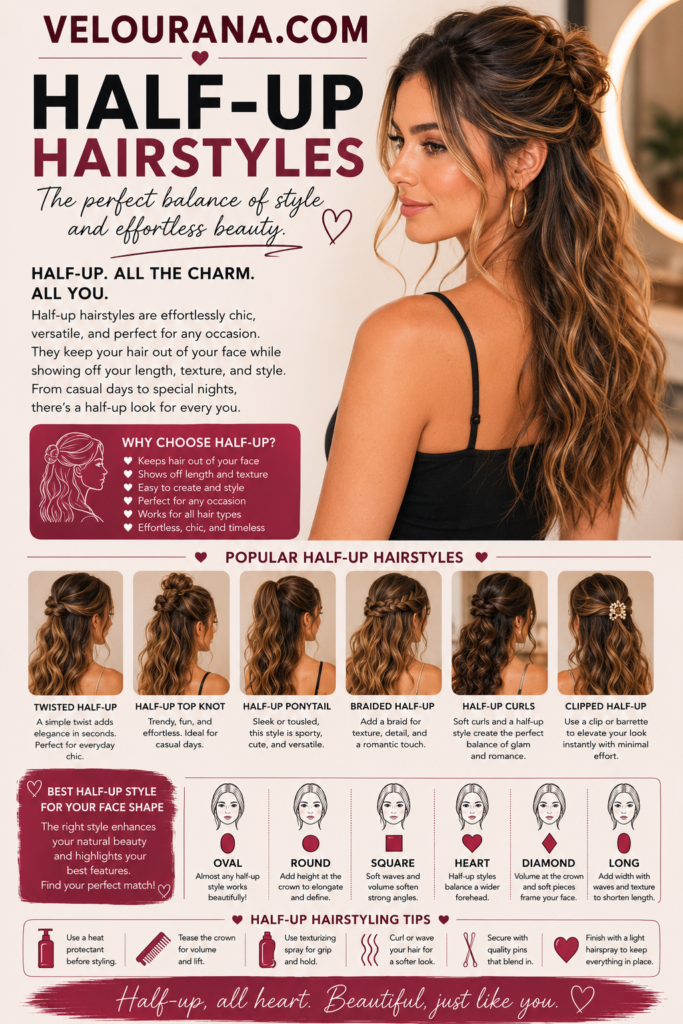
There is a particular reason half-up half-down hairstyles remain relevant regardless of how dramatically hair trends change. They solve a problem that almost everyone with medium or long hair encounters: sometimes the beauty of the hair lies in seeing its length and movement, yet wearing every strand completely loose is not always practical.
The half-up half-down hairstyle offers a compromise without looking like one.
The hair around the face and upper head can be gathered, lifted, braided, twisted or pinned, while the lower lengths remain visible. Instead of concealing the hair inside a complete updo, the style reorganizes only part of it. The result can feel polished without becoming rigid and relaxed without appearing unfinished.
Its apparent simplicity also makes it unusually responsive to small changes.
Gather the upper hair high and the crown gains lift. Secure it lower and the effect becomes softer. Pull the sides tightly backward and the face becomes more exposed. Preserve volume around the temples and crown and the style feels less controlled. Add a braid and the upper section becomes decorative. Replace the braid with a twist and the same hairstyle becomes quieter.
Even the lower half participates in the design.
Straight lengths create a clean, modern contrast against a structured upper section. Waves produce softness. Defined curls make the hairstyle more dimensional. Natural coils can create extraordinary volume above and below the gathering point.
A half-up half-down hairstyle is therefore not simply a way of pinning back the front.
It is a way of dividing the hair into two visual roles.
The upper portion provides structure.
The lower portion preserves movement.
The Division Determines the Hairstyle
Before anything is tied, braided or twisted, the most important decision is how much hair will actually be gathered.
There is no standard halfway point.
The term “half-up” describes the appearance rather than requiring exactly fifty percent of the hair to be secured.
A small section taken from around the temples can create a delicate half-up effect while leaving almost all the density loose. A larger section extending through the crown creates considerably more control and may make the hairstyle appear almost fully gathered when viewed from the front.
This distinction matters particularly with different hair densities.
Fine hair may benefit from leaving more of the length down. If too much is removed from the lower section, the remaining hair can appear unnecessarily sparse.
Dense hair can support a much larger gathered section while still leaving substantial fullness beneath it.
The division should therefore be designed around the hair itself.
A Clean Horizontal Section Creates a Polished Result
When the upper and lower portions are separated clearly, the hairstyle gains structure.
The section may travel from temple to temple around the back of the head.
Once the upper hair is gathered, the lower section falls independently beneath it.
This works particularly well with sleek half-up ponytails and polished styles where clean organization is part of the appearance.
The separation does not necessarily need to remain visible once the hair is finished.
It simply provides a controlled foundation.
A Softer Section Creates a More Natural Transition
For relaxed styles, the division can be less exact.
Instead of creating one perfectly straight line, sections can be gathered naturally from the sides and crown.
Some hair remains near the temples.
Some shorter layers stay loose.
The boundary between the upper and lower sections becomes less obvious.
This can be particularly flattering with waves, curls and heavily layered hair because the texture naturally disguises the transition.
The Classic Half-Up Half-Down Ponytail
Perhaps the most recognizable version gathers the upper section into a ponytail.
The lower hair remains loose beneath it.
This immediately creates two levels of movement.
The ponytail falls from a higher position while the lower hair begins directly from the scalp.
When the two layers overlap, the hair can appear fuller through the back.
This effect is especially noticeable with waves and curls because the upper ponytail adds another layer of volume over the lower lengths.
The hairstyle can remain extremely simple or become polished through careful finishing.
High Placement Creates Energy
A high half-up ponytail sits around the crown or upper back of the head.
This lifts the upper hair away from the face and creates vertical movement.
The ponytail itself may fall over the lower lengths, producing additional apparent volume.
The effect can feel youthful and energetic without requiring the entire hair to be pulled into a high ponytail.
Because only part of the hair is lifted, the style may also feel lighter than gathering all the length at the crown.
Lower Placement Creates Softness
Move the gathering point downward and the character changes.
The sides travel backward rather than strongly upward.
Less crown height is created.
The ponytail blends more quietly into the loose lengths.
A low half-up half-down style can be so subtle that the securing point almost disappears when viewed from the front.
This makes it useful when the primary goal is simply to keep hair away from the face while preserving the appearance of wearing it down.
Concealing the Elastic Creates a More Finished Appearance
A small section of hair can be wrapped around the ponytail base to hide the elastic.
This simple detail changes the finish without altering the structure.
The securing point appears cleaner.
The upper ponytail seems to emerge directly from the gathered hair.
This works particularly well with sleek styles where a visible elastic might interrupt the otherwise continuous surface.
The Half-Up Bun Replaces Movement With Shape
Instead of leaving the upper section loose as a ponytail, it can be twisted into a bun.
The hairstyle then contains two completely different forms at once.
The upper hair becomes compact.
The lower hair remains flowing.
This contrast can be subtle when the bun is small and low or dramatic when it sits high on the crown.
A half-up bun is naturally smaller than a full bun because only part of the hair contributes to its volume.
That smaller scale often creates attractive proportions against the loose lengths beneath it.
A Half-Up Top Knot Creates Height Without Hiding the Hair
Positioning the bun very high produces a half-up top knot.
The knot becomes visible from the front.
The lower lengths remain fully displayed.
This creates a distinctive silhouette in which volume exists both above and below the face.
The bun can be tightly wrapped for a clean result or left irregular for a more casual appearance.
Fine hair may create a small compact knot.
Dense hair can produce a much larger shape.
Both can work because the scale of the bun should reflect the available upper section rather than imitate the proportions of a full top knot.
The Messy Half-Up Bun Works Through Controlled Softness
A relaxed half-up bun can look spontaneous, but the same principle that applies to full messy buns remains important: the foundation should still be secure.
Once the upper section is gathered, the bun can be looped or twisted loosely.
Selected areas can be widened.
A few ends may remain visible.
The crown can be softened.
Face-framing sections can remain outside.
The lower hair then provides additional natural movement.
Because so much hair is already loose, the bun itself does not need excessive irregularity to create a relaxed effect.
Twisted Half-Up Styles Create Gentle Direction
Twisting is one of the easiest ways to introduce detail without creating an obvious central ponytail.
A section from each temple can be directed backward and twisted.
The two sections meet behind the head.
They can be pinned together, secured with a small elastic or crossed over one another.
The twists create visible movement through the sides.
Instead of simply pulling the hair backward, the style shows how it travels.
This can make a very simple construction appear considerably more deliberate.
Loose Twists Work Beautifully With Waves
Wavy hair naturally blends into twists because both contain curved movement.
The sections do not need to become perfectly smooth.
Small irregularities actually help connect the upper structure with the lower texture.
The waves beneath continue the movement established above.
This creates a cohesive hairstyle rather than making the upper and lower sections appear unrelated.
Defined Twists Can Give Straight Hair More Texture
On straight hair, the edges of a twist are often easier to see.
The sections can create clean directional lines from the temples toward the back.
This provides texture even when the lower lengths remain completely straight.
The contrast between the twisted upper hair and smooth lower hair can be enough to make the hairstyle feel finished without curls or additional decoration.
Braided Half-Up Half-Down Hair Creates Immediate Detail
Braiding changes the character more dramatically.
A braid introduces repeated crossings that remain visible above the loose lengths.
Two small braids can travel backward from the temples.
A French braid can begin near the forehead and finish at the crown.
A Dutch braid can create raised texture.
A fishtail can extend from the gathering point.
The braid can be the primary feature while the rest of the hairstyle remains simple.
Small Temple Braids Keep Most of the Hair Loose
Narrow braids beginning near the temples use very little hair.
This makes them particularly useful when the goal is maintaining maximum density through the lower lengths.
The braids travel backward and meet behind the head.
They can disappear into the loose hair or remain visibly secured.
The result creates detail without significantly changing the overall impression of long flowing hair.
Larger Braids Create a Stronger Upper Structure
Increasing the size of the braided sections changes the balance.
The upper hairstyle becomes more prominent.
A broad Dutch braid can occupy much of the crown.
Two substantial side braids can create an almost crown-like structure before meeting behind the head.
This works particularly well with dense hair because enough volume remains loose underneath.
On fine hair, the braid size should be chosen carefully so the lower lengths do not lose too much fullness.
A Waterfall Braid Uses the Loose Hair as Part of the Design
The waterfall braid is particularly suited to half-up styling because it deliberately allows sections to fall through the braid.
Instead of containing every strand, the structure releases pieces into the lower hair as it travels.
This creates a woven line across the upper portion while preserving vertical movement beneath it.
The technique visually connects the structured and loose sections.
The braid does not merely sit on top of the lower hair.
It interacts with it.
A Fishtail Can Begin Where the Side Sections Meet
Another variation gathers two side sections at the back and turns the combined length into a fishtail braid.
The braid can remain relatively narrow while the majority of the hair stays loose.
This creates a central decorative element.
Loosening the fishtail slightly can make the pattern more visible.
The hairstyle works particularly well when the lower lengths contain soft waves because the fine woven texture contrasts with the broader movement beneath.
A Partial Crown Braid Frames the Upper Head
Braids can also travel around the head rather than directly backward.
A braid beginning near one temple can move toward the opposite side.
Two braids can approach one another around the back.
The lower hair remains completely loose.
This creates a partial crown effect without turning the hairstyle into a full braided updo.
The structure frames the upper head while the length remains the dominant feature below.
Knots Offer an Alternative to Braids and Twists
Two sections can be tied together rather than woven.
A simple knot at the back creates a small central feature.
The ends can blend into the loose hair.
Several sections can form consecutive knots.
The result is less obviously decorative than a braid but more structured than simply pinning the sides backward.
Knots work especially well when a hairstyle needs visual interest without appearing highly elaborate.
Overlapping Sections Can Hide the Securing Point
The upper hair can be arranged so that one side crosses over the other.
Pins remain hidden underneath.
Another section can overlap from the opposite direction.
This creates a seamless appearance with no obvious ponytail or accessory.
The hairstyle seems to hold itself together.
The technique can remain minimal or develop into several layers of overlapping hair.
Crown Volume Changes the Profile
Half-up styling provides an opportunity to preserve or deliberately create height through the crown.
The upper section can be lifted slightly before it is secured.
This produces a gentle curve from the forehead toward the gathering point.
The lower hair balances that volume by continuing downward.
A small amount of lift can make the hairstyle feel fuller without creating an exaggerated shape.
The amount should remain proportionate to the head and the volume of the lower lengths.
Flat Roots Create a More Graphic Appearance
The opposite approach keeps the upper hair close to the head.
A precise center part or smooth backward direction can create clean lines.
The gathered point then becomes more visible because there is little volume preceding it.
This works particularly well with straight hair and sleek half-up ponytails.
The hairstyle becomes about direction rather than softness.
A Center Part Creates Symmetry
A center part divides the front into two balanced sections.
Each side can travel backward toward the same securing point.
This creates a calm, organized appearance.
Curtain bangs can remain loose while the hair behind them is gathered.
Braids or twists can begin symmetrically on either side.
Even when the back is relaxed, the center part gives the front a clear structure.
A Side Part Makes the Style More Directional
A side part creates unequal distribution.
One side carries greater volume.
The hair may sweep across the forehead before joining the upper section.
This can make even a simple half-up ponytail feel more styled.
Braids and twists can follow the natural direction created by the part.
The back can remain centered or become slightly asymmetrical.
Brushing the Upper Hair Back Creates Openness
Removing the visible part exposes more of the face.
The upper hair travels backward as one continuous shape.
This can create lift when the roots are not flattened completely.
The style works particularly well with high gathering points.
The face becomes open while the lower hair still frames the shoulders.
Bangs Do Not Need to Join the Upper Section
A fringe can remain completely independent.
Full bangs can provide strong structure at the front.
Curtain bangs can remain loose around the temples.
Wispy bangs can soften a sleek upper section.
Long side bangs can either remain free or blend gradually backward.
This means half-up styling can work with almost any fringe without requiring the front of the haircut to change.
Face-Framing Layers Create a Softer Boundary
Releasing a few layers around the face prevents the sides from appearing completely pulled away.
The sections can fall near the cheekbones, jaw or chin depending on the haircut.
These pieces provide movement at the front while the rest of the upper hair remains controlled.
The lower lengths then continue that movement around the shoulders.
This creates continuity from front to back.
Fine Hair Requires Thoughtful Distribution
Fine hair can look beautiful half-up, but dividing it carelessly can reduce the apparent density of the lower section.
A smaller upper section is often sufficient.
Narrow temple pieces can create structure without removing much hair.
A small half-up ponytail can add lift.
A delicate braid can provide detail.
Crown volume can make the upper section appear fuller.
The lower hair can remain abundant relative to the overall density.
The hairstyle should enhance the available hair rather than divide it into two sections that both appear unnecessarily small.
Waves Can Increase the Appearance of Fullness
On fine hair, broad waves can create more visible movement through the lower lengths.
The upper ponytail may fall over them, adding another layer.
The combination can make the hairstyle appear fuller from behind.
The objective is not to manufacture enormous volume but to use overlapping movement effectively.
Thick Hair Can Be Partially Controlled Without Losing Its Impact
Dense hair is particularly well suited to half-up styling because a substantial upper section can be removed while the lower hair remains full.
This reduces bulk around the face.
It can make the hair easier to manage.
The gathered section can support larger braids, buns and twists naturally.
The lower lengths still retain enough density to remain visually strong.
Half-up styling therefore provides control without requiring thick hair to be completely contained.
Very Thick Hair May Need Stronger Support
A large upper section can still carry considerable weight.
The securing method should be appropriate to that amount of hair.
A small decorative clip that works beautifully on fine hair may not support a dense section securely.
The structure should hold the hair comfortably without requiring excessive tension.
Several pins can distribute support when necessary.
Straight Hair Makes the Division Visible
On straight hair, the difference between the gathered and loose sections is particularly clear.
The upper hair moves in one direction.
The lower hair falls directly downward.
This can create an elegant minimalist appearance.
The ends can remain straight.
A small bun, barrette or concealed ponytail can provide enough detail.
The hairstyle does not need waves to appear complete.
Waves Blur the Boundary
Wavy hair creates a softer transition.
The upper ponytail or twists merge visually with the movement beneath them.
The exact dividing line becomes less noticeable.
This can make the style appear especially natural.
Loose waves also respond well to small irregularities around the crown and temples, allowing the hairstyle to remain polished without becoming rigid.
Curls Create Layered Volume
Curly half-up hair can become particularly full because the gathered curls fall over curls that remain loose.
This creates multiple layers of volume.
A high gathering point can lift the upper curls significantly.
A low one creates a softer shape.
The curls themselves provide enough texture that the securing method can remain very simple.
A plain half-up ponytail may already look highly dimensional.
Curly Buns Create Contrast Above Loose Curls
The upper section can also become a small curly bun.
Some curls are contained while others remain flowing.
The bun does not need to become smooth.
Individual curl shapes can remain visible.
This preserves the texture throughout the hairstyle while changing its form in the upper section.
Coily Hair Can Create Dramatic Half-Up Volume
Coily hair can produce strong silhouettes because both the gathered and loose sections retain natural volume.
A high half-up puff can create height.
The lower coils remain full.
Twists or braids can control the sides.
A small bun can provide compact contrast against expansive texture.
The hairstyle can celebrate volume rather than trying to suppress it.
Half-Up Puffs Can Transform the Shape Without Hiding Texture
A puff gathers the upper hair while allowing its texture to remain open.
This is different from twisting the section into a bun.
The hair becomes elevated but not concealed.
The lower texture remains visible beneath it.
The result creates volume at multiple heights and can be adjusted according to length and density.
Layered Hair Naturally Suits the Style
Half-up hairstyles do not require every strand to reach one destination.
This makes them particularly forgiving on layered cuts.
Short front pieces can remain free.
Upper layers can be gathered.
Longer lower layers continue falling.
The haircut's movement remains visible rather than being hidden inside an updo.
This can make the hairstyle an effective way to showcase layering.
Shorter Pieces Around the Nape Stay Undisturbed
Unlike a high full ponytail, the half-up style does not need the lower nape hair to travel upward.
Those shorter pieces simply remain down.
This reduces the need for excessive pinning and tension.
It is one reason medium and heavily layered lengths can adapt easily to half-up styling.
Medium-Length Hair Has Enough Room for Variety
Medium hair can create ponytails, small buns, braids and twists in the upper section while retaining visible length underneath.
The proportions often feel naturally balanced.
The gathered section does not become excessively heavy.
The loose hair still has enough length to move.
This makes medium cuts particularly versatile for the category.
Long Hair Makes the Two-Part Structure Dramatic
Long hair emphasizes the contrast.
A relatively small structure can sit near the crown while a large amount of length continues downward.
The upper bun or braid becomes a focal point against the flowing background.
This allows someone to create a visibly styled appearance without sacrificing the impact of long hair.
Accessories Can Replace Complex Construction
A beautiful accessory can turn the simplest half-up arrangement into a complete hairstyle.
A barrette can secure the sides.
A bow can surround a ponytail.
A ribbon can fall through the lower lengths.
A decorative clip can hold a twist.
The accessory occupies a natural focal point where the upper sections meet.
This means the hair itself does not always need complicated braiding or knotting.
Claw Clips Create a Practical Version
The upper hair can be gathered and twisted once before being held with a claw clip.
The lower lengths remain free.
The ends of the upper section may fall over the clip or project slightly above it.
This creates a casual style that can be adjusted quickly.
The clip size should correspond to the density of the gathered section so that the hairstyle remains secure without excessive pressure.
Barrettes Create a Flatter Silhouette
Unlike an elastic, which creates a ponytail extending outward from the head, a barrette can hold the upper sections relatively flat.
The hair then falls immediately beneath it.
This can produce a particularly elegant shape on straight or softly waved hair.
The accessory itself becomes the principal detail.
Ribbons Extend the Upper Structure Into the Length
A ribbon tied at the gathering point can fall through the loose hair.
This creates a visual connection between the upper and lower portions.
The ribbon moves with the lengths.
A narrow ribbon creates subtle detail.
A wider bow can become the dominant feature.
The underlying hairstyle can remain extremely simple.
Dimensional Hair Color Becomes More Visible
Half-up styling rearranges the relationship between highlights, roots and ends.
Upper highlighted sections move backward and overlap the lower hair.
Balayage can create strong tonal variation through the ponytail and loose lengths.
Natural gray strands may become more visible when separated from the surrounding hair.
Because most of the length remains exposed, the hairstyle can showcase color particularly effectively.
Braids Make Highlight Placement Easy to See
When highlighted hair is braided, lighter strands cross through darker ones.
The pattern becomes more obvious.
A small half-up braid can therefore reveal color variation that may be less noticeable when the hair simply hangs loose.
The braid acts almost like a frame for the color.
The Lower Lengths Remain an Important Part of the Finish
A complete updo can conceal dry ends, uneven movement or much of the haircut.
A half-up hairstyle cannot.
The lower lengths remain visible.
Their texture contributes significantly to the final result.
They can be straight and smooth.
They can contain broad waves.
They can remain naturally curly or coily.
The upper structure and lower finish should feel intentionally related even when they contrast.
The Style Can Change During the Day
One practical advantage of half-up hair is how easily it can evolve.
A ponytail can become a bun.
A bun can be released.
A clip can replace an elastic.
The upper section can be taken down completely.
Alternatively, the lower hair can later be gathered into the existing structure to create a full ponytail or bun.
The hairstyle can respond to changing needs without requiring a complete restart.
A Half-Up Style Can Become More Relaxed Naturally
Movement may loosen the crown.
Small strands can escape.
Waves and curls may shift.
In softer versions, these changes often improve the hairstyle rather than damaging it.
The style becomes more integrated and less freshly constructed.
A sleek version requires more control if the exact finish needs to remain unchanged.
Comfort Is One of the Style's Quiet Advantages
Because only part of the hair is gathered, less weight is usually concentrated at the securing point than in a full high ponytail or bun.
This can make crown placement more comfortable for long or dense hair.
The lower hair remains in its natural direction.
The nape is not being pulled upward.
The hairline can also remain softer.
The practical benefits exist without making the hairstyle look purely functional.
The Upper Section Should Not Need Painful Tension
A sleek appearance does not require extreme pulling.
The smaller amount of gathered hair can be smoothed carefully.
The temples can remain comfortable.
Face-framing pieces can stay outside if necessary.
The style should feel secure rather than tight.
This distinction becomes particularly important when half-up hairstyles are worn frequently.
The Hairstyle Can Be Almost Invisible or Highly Decorative
At one extreme, two tiny sections are pinned discreetly behind the head.
From the front, the hair simply appears slightly more open around the face.
At the other extreme, broad braids, crown volume, a high bun and decorative accessories can transform the entire upper half of the hairstyle.
Both belong to the same category.
This enormous range is what gives half-up half-down styling its longevity.
Structure Does Not Need to Dominate
One of the strongest versions may be the one in which the gathering point is barely noticed.
The sides are simply directed backward.
The lower hair remains the main feature.
The hairstyle feels controlled without obviously displaying its construction.
This works particularly well when the haircut, texture or color deserves to remain central.
Decoration Can Become the Main Feature When Desired
The opposite is equally possible.
A broad braid can dominate the crown.
A sculptural knot can become the focal point.
A statement bow can transform the silhouette.
The loose lengths then act almost as a background for the upper design.
The same basic division supports both minimalism and ornamentation.
Why Half-Up Half-Down Hair Rarely Feels Completely Outdated
Individual versions certainly move in and out of fashion.
Accessories change.
Braid techniques become popular and then quieter.
Very high ponytails alternate with lower placements.
Sleek finishes compete with deliberately relaxed texture.
Yet the underlying half-up structure survives because it is not dependent on one aesthetic.
It solves a practical problem while leaving enormous room for interpretation.
Hair can remain visible and still be controlled.
That usefulness does not disappear when a trend changes.
When Two Opposite Hairstyles Become One
A half-up half-down hairstyle works because it combines two ideas that would normally appear mutually exclusive.
The hair is up.
And the hair is down.
The upper section can create height, expose the face and provide structure. The lower section can preserve length, texture and movement. Neither needs to surrender completely to the other.
A small ponytail can provide just enough control. A bun can introduce shape. Twists can create direction. Braids can add intricate texture. Accessories can become the focal point without requiring complex construction.
Fine hair can preserve density by gathering only a small amount. Thick hair can reduce bulk while remaining visibly abundant. Straight hair creates clean separation, waves soften the transition, and curls and coils can produce extraordinary layered volume.
The hairstyle can be nearly invisible or deliberately elaborate.
That is its defining freedom.
Rather than deciding whether the hair should be worn loose or put up, the half-up half-down style simply asks a more useful question:
Which parts should remain free, and which parts should become structure?
Once that decision is made, the possibilities are almost endless.
The End
Velourana.
 Discover More From Our Family of Websites
 ZodiacBearing (Astrology, Tarot, Numerology, Angel Numbers & Spiritual Guidance)
 Velourana (Beauty, Makeup, Hair Care, Skincare & Beauty Tips)
 HavenBearing (Home, Living, Organization, Décor & Everyday Inspiration)
 PawBearing (Pet Care, Dog Breeds, Animal Health, Training & Pet Products)
 PsyCatherine (Notes From the Journal of a Psychologist on Real Life)

