
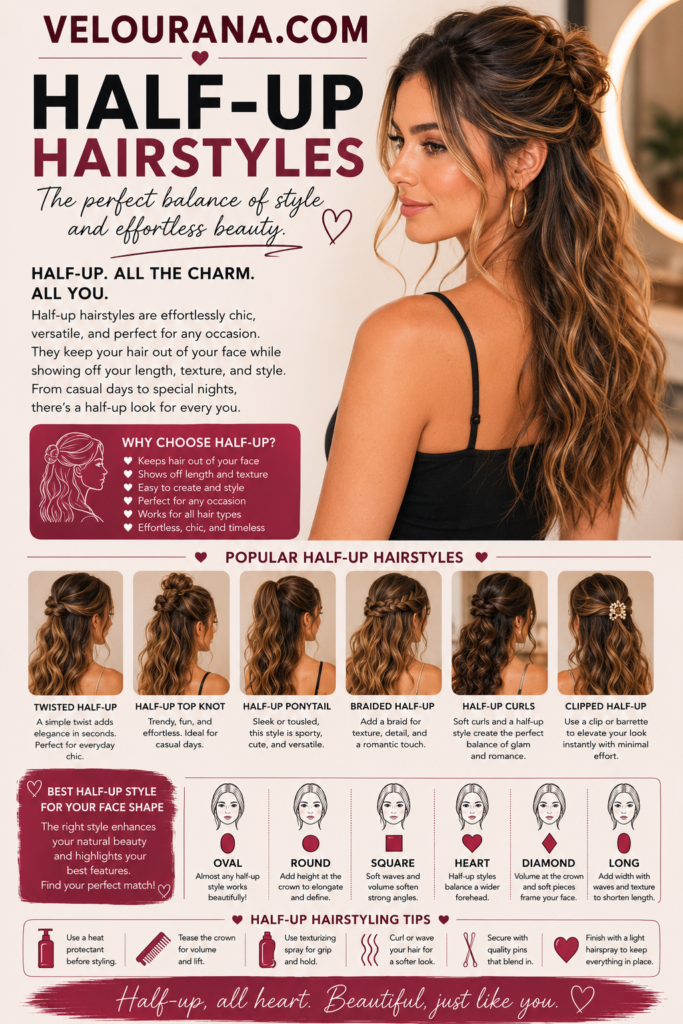
CATEGORY: Half-Up Hairstyles
Half-up hairstyles occupy a particularly useful space between wearing the hair completely loose and gathering it into a full updo. They preserve visible length, movement and natural texture while removing selected sections from around the face. That combination makes the style practical without sacrificing the appearance of flowing hair.
The basic principle is simple.
Part of the hair remains down.
Part of it is gathered.
Yet within that simple division exists an enormous range of possibilities. The upper section can become a ponytail, bun, knot, twist or braid. It can sit high at the crown or low toward the back of the head. The sides can be sleek and controlled or gently loosened. Bangs and face-framing layers can remain free. The lower lengths can stay straight, wavy, curly or coily.
Even the amount of hair gathered changes the result dramatically.
Taking only two narrow sections from the temples creates a delicate half-up detail while leaving almost all the density loose. Gathering a much larger portion from the crown creates stronger structure and makes the hairstyle resemble an updo from the front while preserving length at the back.
This flexibility is the defining strength of half-up styling.
It does not require choosing completely between structure and movement.
It allows both.
Why Half-Up Hair Feels So Different From a Ponytail
A full ponytail gathers almost all the length into one point.
That immediately changes the silhouette.
The shoulders become clearer, and the loose movement begins from the ponytail base rather than from the entire head.
A half-up hairstyle behaves differently.
The lower hair continues falling naturally from the scalp.
Only the upper portion changes direction.
This means the wearer retains much of the visual effect of loose hair while gaining control around the face and crown.
From behind, the length remains substantial.
From the front, the hairstyle can appear much more organized.
This dual character explains why half-up styles can adapt so easily to casual, professional and more decorative settings.
The Amount of Hair Gathered Controls the Balance
There is no fixed rule determining how much hair belongs in the upper section.
A very small amount creates subtle detail.
The lower hair remains dominant.
Increase the upper section and the gathered structure becomes more noticeable.
A large half-up section can include much of the crown and sides, leaving primarily the lower back layers loose.
The right proportion depends on the desired appearance and the density of the hair.
On fine hair, gathering too much can leave the lower section looking unnecessarily sparse.
Using a smaller upper section may preserve more apparent fullness through the lengths.
Dense hair provides more freedom because substantial amounts can be gathered while plenty of volume remains below.
The division should therefore respond to the actual hair rather than following one universal ratio.
The Classic Half-Up Ponytail
The simplest version gathers the upper hair into a ponytail while leaving everything underneath loose.
Its appearance depends strongly on placement.
A high half-up ponytail creates lift through the crown and gives the style an energetic character.
A lower ponytail feels softer and more understated.
The sides can be pulled back tightly or allowed to retain natural volume.
The elastic can remain visible for a casual finish or be concealed with a small section of hair for a more polished appearance.
Despite its simplicity, this hairstyle demonstrates nearly every important principle of half-up styling.
Placement determines direction.
Section size determines balance.
Texture determines the surface.
The lower lengths determine movement.
A High Half-Up Ponytail Creates Lift
Gathering the upper section near the crown redirects the hair upward before allowing it to fall again.
This creates visible height.
The ponytail can add volume through the upper back of the hairstyle, especially when the hair is long or naturally textured.
From the front, the sides appear more open because hair has been removed from the temples.
The lower lengths still surround the shoulders.
This creates a distinctive combination of openness around the face and fullness through the back.
The style can be sleek or relaxed depending on how the roots are treated.
A Low Half-Up Ponytail Feels Softer
Move the gathering point toward the middle or lower back of the head and the hairstyle changes.
There is less vertical lift.
The upper sections travel backward rather than upward.
The result feels quieter.
This placement works particularly well when the objective is simply to keep the front hair away from the face while preserving a natural loose appearance.
The ponytail can be extremely small, almost disappearing into the lower lengths.
In this version, the securing point is less important visually than the movement created by bringing the sides together.
The Half-Up Bun Adds Shape
Instead of leaving the gathered section as a ponytail, it can be twisted or looped into a bun.
This creates a compact shape above the loose lengths.
A high half-up bun can become a visible focal point.
A smaller low bun creates subtle structure.
The contrast is especially interesting because the hairstyle displays length and compact volume simultaneously.
The lower hair moves freely.
The upper hair becomes form.
This makes the half-up bun one of the clearest examples of how the style combines characteristics of loose hair and an updo.
The Half-Up Top Knot Creates a Stronger Silhouette
When the gathered section sits high on the crown and becomes a bun, the result approaches a top knot while retaining loose hair underneath.
The knot may be compact and sleek or irregular and relaxed.
Because only part of the hair is involved, the bun is naturally smaller than a full top knot.
That smaller scale can look particularly balanced against long loose lengths.
The style creates height without removing the hair from the shoulders.
This can be useful for anyone who enjoys the silhouette of a high bun but still wants to display their length.
A Loose Half-Up Bun Can Look Effortless
A relaxed half-up bun often works best when the upper section is not overcontrolled.
Some root volume remains.
The bun can contain irregular loops.
A few shorter pieces may escape.
The lower hair retains its natural texture.
The key is maintaining enough structure that the bun appears intentional.
A secure base allows the surface to remain soft.
As with a full messy bun, the relaxed appearance works better when the underlying construction is stable.
Half-Up Twists Create Detail Without a Visible Ponytail
The upper hair does not need to be gathered directly backward.
Sections from each side can be twisted individually.
They can then meet at the back and be secured.
This creates directional movement through the sides.
The twists become the visible feature rather than a central ponytail.
The style can remain very simple with one twist from each temple, or several sections can be layered for additional texture.
Because the lower hair remains loose, the result can feel detailed without becoming heavy.
Twists Work Particularly Well With Natural Texture
Wavy and curly hair blends naturally into twisted sections.
The boundaries do not need to be perfectly smooth.
The twist can preserve the texture while redirecting it.
Loose waves below continue the same visual movement.
Curly face-framing pieces can remain free.
This creates continuity between the structured upper section and the loose lower hair.
Straight hair produces a cleaner, more clearly defined twist.
Each texture gives the same technique a different character.
Braids Transform the Upper Section
Braiding introduces another level of possibility.
Two small braids can begin near the temples and meet at the back.
A single braid can travel across the crown.
French or Dutch braids can gather additional hair as they move toward the securing point.
The gathered section can itself become a braid.
Each approach changes where the texture appears.
A narrow braid creates delicate detail.
A broad Dutch braid becomes a stronger focal point.
The lower lengths can remain completely untouched, allowing the braid to sit visibly above them.
Two Side Braids Create Natural Symmetry
One of the most wearable braided versions begins with matching sections on either side of the face.
Each section is braided backward.
The two braids meet behind the head.
They can be secured together, crossed, pinned or incorporated into another small braid.
This creates balance while keeping most of the hair loose.
The braids can remain tight and precise or be gently widened.
Their size should relate to the density of the lower hair.
Very large side braids can remove too much volume from fine hair, while dense hair can support much broader sections comfortably.
Dutch Braids Add Raised Texture
Because Dutch braids sit visibly on top of the surrounding hair, they can create particularly strong half-up details.
A braid can travel from one temple toward the back.
Two can meet near the crown.
A central Dutch braid can begin near the forehead and end in a half-up ponytail or bun.
The raised pattern remains visible even when relatively little hair is used.
This makes the technique effective when the upper structure is intended to become a focal point.
Fishtail Braids Create Delicate Detail
A small fishtail braid can make a half-up hairstyle look intricate without involving much hair.
Two side sections can meet at the back and become one fishtail.
Alternatively, narrow fishtails can travel independently from the temples.
The fine repeated pattern contrasts beautifully with loose waves beneath it.
Straight hair makes the weaving particularly clear.
Because the lower hair remains free, even a relatively small braid can attract attention without overwhelming the style.
A Braided Crown Can Become Half-Up Rather Than Fully Contained
Crown braiding does not always need to gather all the hair.
A braid can travel around the upper portion of the head while the lower lengths remain loose.
This creates the appearance of a braided headband or partial crown.
The hairstyle gains structure around the face and temples while retaining movement below.
The contrast can be especially effective on long hair because the loose length emphasizes how little of the total hair needed to be gathered to create the design.
Knotted Half-Up Styles Create Subtle Structure
The upper sections can also be tied into knots rather than braided or twisted.
Two side pieces can meet at the back and form a simple knot.
The remaining ends may disappear into the lower hair or continue into a small ponytail.
Several knots can be stacked vertically.
This creates texture without the recognizable pattern of a braid.
The result can look understated and slightly unusual.
Because the construction may rely heavily on pins, the knot should remain secure without pulling the surrounding hair unnecessarily.
The Half-Up Style Can Create Crown Volume
One reason half-up hairstyles are frequently used when volume is desired is that the upper section can be lifted before it is secured.
The crown does not need to lie flat.
A small amount of height can be preserved between the forehead and gathering point.
This changes the side profile.
The loose lower lengths then provide balance beneath that volume.
The amount of lift should remain proportionate to the hairstyle.
A subtle curve can be enough to make the crown appear fuller.
Fine Hair Benefits From Careful Section Size
When fine hair is divided into upper and lower sections, density distribution becomes particularly important.
Gathering too much into the top can leave the loose lengths looking thin.
A smaller section often creates a better balance.
The upper hair can still provide structure without removing too much material from below.
Gentle crown volume can make the top appear fuller.
Waves through the lower lengths can increase visible movement.
A narrow braid or small twist can provide detail without consuming large amounts of hair.
The goal is not to create the biggest possible upper section.
It is to preserve harmony between both halves.
Thick Hair Can Use Half-Up Styling to Reduce Bulk
Dense hair presents the opposite opportunity.
Removing a significant upper section can make the remaining loose hair feel easier to manage while still appearing abundant.
The gathered section can support a substantial bun, braid or ponytail.
Because plenty of density remains below, the hairstyle retains fullness.
This can make half-up styling particularly practical for very thick hair.
It controls some of the volume without containing everything.
Straight Hair Shows the Structure Clearly
Straight hair makes every division easy to see.
A clean half-up ponytail creates a precise line between gathered and loose sections.
Braids and twists remain clearly defined.
A sleek upper section can contrast strongly with flowing lengths beneath it.
The ends can remain straight for a minimalist appearance.
Alternatively, bends or waves can be introduced to the lower hair if more movement is desired.
The style does not depend on texture to work.
Its structure alone can create visual interest.
Wavy Hair Gives Half-Up Styles Natural Movement
Waves are particularly compatible with half-up hairstyles because gathering the upper hair does not remove the texture from view.
The lower lengths remain free to move.
The upper section can retain some wave rather than becoming completely smooth.
Twists and braids blend naturally into the surface.
Face-framing pieces can remain soft.
The result often feels cohesive because the same texture appears in both the controlled and loose portions of the hairstyle.
Curly Hair Creates Volume Above and Below
Curly hair can make half-up styling highly dimensional.
The gathered section creates lift at the crown.
The loose curls remain full through the lower hair.
A half-up ponytail can increase apparent volume because the upper curls fall over the curls beneath them.
A small bun creates another kind of contrast, placing a compact textured shape above flowing curls.
The roots do not need to be flattened.
Allowing natural volume to remain can make the style feel balanced and expressive.
Coily Hair Can Create Powerful Half-Up Shapes
Coily and tightly textured hair can produce striking half-up styles because the upper section can become a puff, bun, twist or braided structure while the lower texture remains visible.
A high half-up puff creates height and volume.
Braids can control the sides.
Twists can lead toward the gathering point.
The lower hair can remain fully textured.
The division between gathered and loose hair offers many possibilities without requiring the entire head to be manipulated in the same way.
Half-Up Puffs Celebrate Natural Volume
A half-up puff allows the upper texture to expand rather than compressing it into a tight bun.
The gathered point creates lift.
The curls or coils remain visible.
The lower hair provides additional volume beneath it.
This creates a layered silhouette in which texture remains the dominant feature.
The style can be adjusted according to density and length without needing one standardized shape.
Bangs Can Remain Completely Independent
Half-up hairstyles are particularly compatible with bangs because the front does not necessarily need to join the gathered section.
A full fringe can remain forward.
Curtain bangs can frame the face.
Wispy bangs can soften a sleek half-up ponytail.
Long side bangs can blend gradually into the upper section or remain loose.
This flexibility allows the hairstyle to preserve the identity of the haircut while changing the way the longer sections behave.
Face-Framing Layers Can Soften the Transition
Leaving selected layers around the face creates a gradual transition between the gathered upper section and loose lower hair.
Without them, the sides may appear completely exposed.
With them, some movement remains near the cheeks and jaw.
The amount can be subtle.
A few sections are often enough.
The goal is to complement the structure rather than undo the practical benefit of moving hair away from the face.
A Center Part Creates Balance
A half-up hairstyle can begin with a visible center part.
The two front sections remain symmetrical before moving backward.
This works particularly well with curtain bangs and soft twists.
The part gives the front structure even when the back is relaxed.
A center-parted half-up bun, for example, can combine clear geometry around the forehead with an irregular knot at the crown.
The contrast makes the softness appear intentional.
A Side Part Introduces Direction
A side part changes the distribution before the hair is gathered.
One side carries more volume.
The front may sweep across the forehead.
Braids or twists can follow that direction.
The securing point can remain central, or it can move slightly to reinforce the asymmetry.
This makes the hairstyle feel less static without requiring complicated construction.
No Visible Part Creates a Lifted Front
Bringing the upper hair backward without a defined part creates a continuous movement toward the crown.
This can add apparent height.
The style works especially well with high half-up ponytails and buns.
The roots can remain sleek for a controlled appearance or slightly lifted for softness.
Because the lower hair remains down, the result combines upward movement above with downward movement below.
The Hairline Does Not Need Excessive Tension
Half-up styling already provides control because only selected sections are being gathered.
There is rarely a reason to pull the hairline painfully tight.
A sleek result can be created through careful smoothing.
Small pieces around the temples can remain free when necessary.
This is especially important when the style is worn frequently.
Comfort should remain part of the design.
Half-Up Styles Can Be Easier on Heavy Hair
A full high ponytail or bun requires the scalp to support the weight of all the hair from one point.
A half-up style uses only part of that weight.
This can make high placement more comfortable for long, dense hair.
The remaining length continues resting naturally.
Someone who enjoys crown volume but finds full high styles uncomfortable may therefore find half-up versions easier to wear.
Accessories Can Define the Entire Hairstyle
Because the securing point remains visible, accessories can become an important feature.
A barrette can hold the two sides together.
A ribbon can surround a half-up ponytail.
A decorative clip can replace a visible elastic.
A bow can create a stronger focal point.
Small pins can decorate braids or twists.
The accessory occupies a natural central position, so even a relatively simple hairstyle can change dramatically according to what is used.
Claw Clips Create an Easy Half-Up Variation
A claw clip can gather the upper section without requiring a ponytail.
The hair is brought backward, twisted slightly and secured.
Some ends may remain visible above the clip.
The lower hair continues falling freely.
This creates a practical version with very little construction.
The clip itself becomes part of the appearance, so its size should correspond to the amount of hair being held.
Barrettes Suit Lower Half-Up Styles
A barrette positioned across the back can secure two side sections neatly.
This creates a flatter structure than a ponytail.
The hair continues downward immediately beneath the accessory.
The result can feel particularly polished on straight or softly waved hair.
Decorative barrettes can provide enough visual detail that no braid or twist is necessary.
Ribbons Add Movement
A ribbon tied around the gathered section creates another vertical element.
Its ends can fall into the loose hair.
This connects the securing point visually with the lengths beneath it.
The effect can be subtle or prominent depending on ribbon width and length.
Because the hair remains loose, the accessory becomes part of the movement rather than sitting only at the scalp.
Hair Color Becomes More Dimensional
Half-up styling changes how different tones overlap.
Highlights from the upper sections move backward and then fall over the lower hair.
Balayage can create visible contrast between darker gathered roots and brighter loose lengths.
Natural gray strands can become more noticeable as they cross the surface.
The hairstyle reorganizes color without hiding much of it.
This makes half-up styles particularly effective for displaying multidimensional color.
Highlights Can Emphasize Braids and Twists
When highlighted strands are incorporated into a braid, their movement becomes easier to see.
Light pieces cross darker ones.
The pattern gains depth.
Because the braid sits above loose hair, the contrast can be especially visible.
The color and structure reinforce one another.
Layered Hair Is Naturally Compatible With Half-Up Styling
Layers create different lengths, but a half-up style does not require every section to reach one common point.
Shorter front layers can remain loose.
Crown layers can be gathered.
Longer lower layers continue falling naturally.
This makes the hairstyle forgiving.
Instead of fighting the haircut, it can use each length differently.
Shorter Layers Can Create Useful Softness
Pieces that cannot reach the securing point may fall naturally around the temples or ears.
This can prevent the style from looking too severe.
If a cleaner finish is required, small sections can be pinned gently.
The hairstyle does not need excessive tension simply to capture every strand.
Medium Hair Can Create Excellent Half-Up Styles
Extreme length is unnecessary.
Medium hair often provides enough length for the upper section to reach the back while leaving substantial movement underneath.
A small bun can be formed.
Side braids can meet.
Twists can be pinned.
The proportions may actually feel particularly balanced because the gathered section does not become excessively heavy.
Long Hair Makes the Contrast More Dramatic
On long hair, the upper structure occupies a relatively small part of the overall length.
The lower hair can continue far beyond the shoulders.
This makes the contrast between gathered and loose sections especially clear.
A small bun or braid can sit above a large amount of flowing hair.
The hairstyle gains detail without sacrificing the visual impact of length.
Half-Up Styling Can Showcase a Fresh Haircut
When the lower lengths remain visible, layers, shape and movement are not hidden.
The upper section simply clears selected areas around the face.
This can make half-up styles useful for displaying long layered cuts.
The haircut remains recognizable while the styling adds structure.
The Ends Still Matter
Because much of the hair remains loose, the condition and shape of the ends continue influencing the hairstyle.
They may remain straight.
They can curve inward or outward.
Waves can continue through them.
Curls can remain fully defined.
Unlike a complete bun, the half-up style does not hide the lower lengths.
The finish of those lengths is part of the overall result.
A Half-Up Style Can Be Polished Without Becoming Formal
Smooth roots, a concealed elastic and controlled lower lengths can create a refined hairstyle.
Yet because the hair remains down, the result often feels less formal than a complete updo.
This makes half-up styling useful when a completely casual hairstyle feels insufficient but a full updo feels excessive.
The structure can be adjusted to sit precisely between those two extremes.
It Can Also Become Fully Formal
More elaborate braids, twists and accessories can transform the same foundation.
Several sections can overlap at the back.
A braided crown can feed into a decorative central point.
The lower lengths can be styled into controlled waves or curls.
The hairstyle retains its half-up identity while becoming considerably more elaborate.
The distinction is not whether the hair is half-up.
It is how much refinement is applied to the structure.
Half-Up Hairstyles Can Be Reworked Easily
Because the lower hair remains loose, changing the upper section does not necessarily require rebuilding everything.
A ponytail can become a bun.
A bun can be released back into a ponytail.
A barrette can replace an elastic.
The upper hair can be taken down entirely.
This flexibility makes the style practical over a long day.
A High Half-Up Style Can Become a Full Ponytail Later
If greater control becomes necessary, the remaining lower hair can simply be added to the existing gathered section.
The hairstyle transitions from half-up to fully up.
The reverse can also happen if the lower hair is released from a full style while the upper section remains secured.
This adaptability is useful when practical needs change.
The Style Can Soften Naturally During Wear
Small pieces may escape.
The crown may gain movement.
Braids can loosen slightly.
The lower lengths may change texture through movement.
For relaxed half-up hairstyles, this evolution often improves the result.
A highly polished version requires more initial control if the exact structure needs to remain unchanged.
Half-Up Hair Can Preserve More Natural Movement
A full ponytail redirects every strand toward one point.
A full bun removes the lengths from view.
A half-up style interferes with much less of the hair.
The lower section continues moving naturally.
This can make the hairstyle feel lighter and less restrictive.
The wearer receives some practical control without losing the sensory and visual experience of loose hair.
The Style Is Defined by Contrast
Every successful half-up hairstyle contains some kind of contrast.
Controlled hair sits above loose hair.
A compact bun appears against flowing lengths.
A structured braid rests over waves.
A sleek upper section meets natural texture below.
A high ponytail creates lift while the lower hair falls downward.
This contrast is not a problem that needs to be blended away.
It is the fundamental design principle of the hairstyle.
Balance Matters More Than Perfect Symmetry
The upper and lower sections do not need equal amounts of hair.
The two sides do not always need identical texture.
A braid can travel from only one side.
A knot can sit slightly off-center.
One face-framing section can be longer than the other.
What matters is that the overall composition feels balanced.
Intentional asymmetry can be more interesting than strict mirroring.
The Best Version Respects Natural Density
Half-up styling makes density distribution unusually visible.
The hair is literally being divided between two roles.
Fine hair often benefits from a smaller upper section so the lower lengths remain full.
Dense hair can devote more material to braids, buns or ponytails while retaining substantial volume beneath.
There is no ideal percentage.
The correct division is the one that allows both parts of the hairstyle to look intentional.
Why Half-Up Hairstyles Remain So Adaptable
The category survives changing trends because it does not prescribe one specific shape.
It describes a relationship.
Some hair is controlled.
Some remains free.
Everything else can change.
The gathering point can move.
The section size can increase or decrease.
The upper hair can become a ponytail, bun, braid, twist or knot.
The lower hair can be sleek, waved, curled or naturally textured.
Accessories can be minimal or decorative.
The hairstyle can take minutes or become an elaborate formal construction.
That flexibility prevents the category from becoming tied to one particular era or aesthetic.
When Loose Hair and an Updo Meet
The beauty of the half-up hairstyle lies in refusing to choose completely between two opposite ideas.
Loose hair celebrates length, texture and movement.
An updo creates control, shape and structure.
Half-up styling takes something from both.
It clears the face without removing all the hair from view. It can create crown height without lifting the entire length. It can introduce braiding without turning the whole hairstyle into a braid. It can form a bun while allowing the majority of the hair to continue moving across the shoulders.
Fine hair can use a delicate upper section to preserve fullness below. Thick hair can remove substantial volume from around the face while remaining abundant. Straight hair reveals clean structure. Waves soften the transition. Curls and coils create volume through both the gathered and loose sections.
The possibilities come from one simple division.
Part of the hair becomes structure.
The rest remains movement.
And it is the relationship between those two parts that makes half-up hairstyles one of the most versatile ways to transform the hair without completely putting it up.
The End
Velourana.
 Discover More From Our Family of Websites
 ZodiacBearing (Astrology, Tarot, Numerology, Angel Numbers & Spiritual Guidance)
 Velourana (Beauty, Makeup, Hair Care, Skincare & Beauty Tips)
 HavenBearing (Home, Living, Organization, Décor & Everyday Inspiration)
 PawBearing (Pet Care, Dog Breeds, Animal Health, Training & Pet Products)
 PsyCatherine (Notes From the Journal of a Psychologist on Real Life)

