
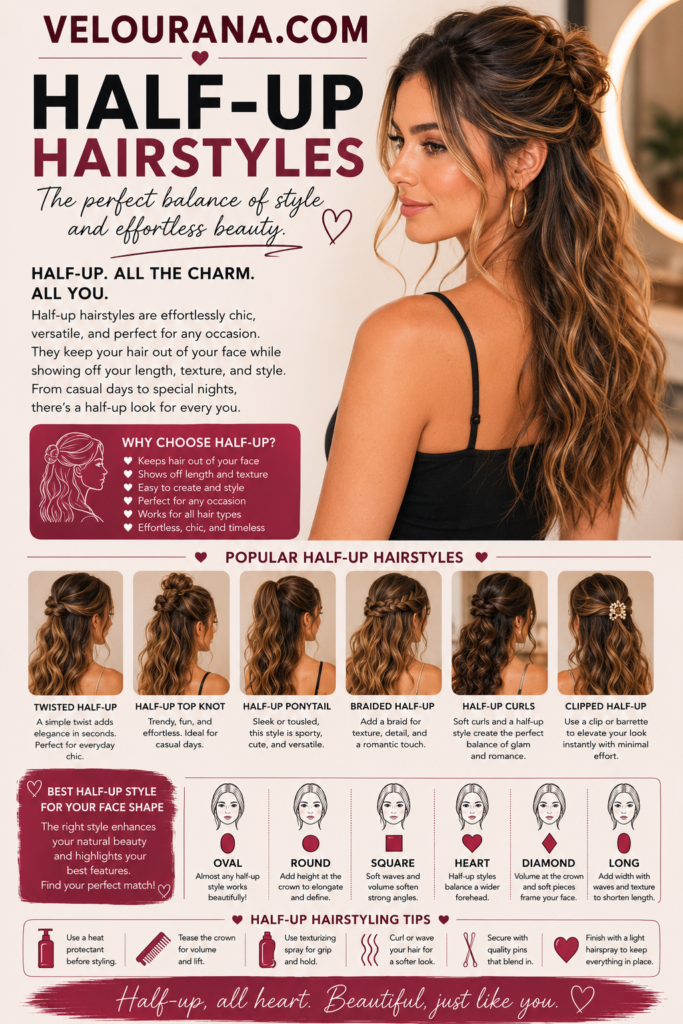
CATEGORY: Half-Up Hairstyles
The half-up bun is one of those hairstyles that seems almost too simple to deserve much analysis. Part of the hair is gathered, twisted into a bun, and the rest is left loose. Yet the result can change dramatically depending on how much hair is taken, where the bun sits, how tightly the roots are controlled and how the lower lengths are allowed to move.
That is precisely why the style works so well.
A full bun removes almost all of the hair from the shoulders and concentrates the length into one shape. A half-up bun does something more balanced. It creates a compact focal point while preserving the texture, movement and visible length below it.
This gives the hairstyle two identities at once.
The upper section behaves like an updo.
The lower section behaves like loose hair.
A high half-up bun can add height and energy. A lower version feels quieter and softer. A compact knot can look minimal and polished, while a looser bun with visible texture can create a much more relaxed impression. Straight hair emphasizes the contrast between the structured bun and the loose lengths. Waves make the transition softer. Curls and coils can create considerable volume both above and below the gathering point.
The appeal lies in this relationship between containment and freedom.
The hair is styled without disappearing.
Placement Determines the Entire Silhouette
The most important decision is where the bun should sit.
A high bun placed close to the crown creates the strongest vertical effect. It becomes visible from the front and adds height to the upper silhouette. The lower hair continues falling beneath it, creating movement around the shoulders and back.
Move the bun slightly lower and the hairstyle becomes more understated.
A bun positioned around the central back of the head still provides clear structure, but it does not dominate the silhouette as strongly. The lower placement allows the loose hair to remain the main feature.
An even lower half-up bun can sit close to the upper nape. In this position, the hairstyle becomes subtle enough that the bun may be visible primarily from the side and back.
These versions all use the same basic idea, yet they communicate different moods.
The placement should therefore be chosen before the hair is gathered rather than treated as something that simply happens according to where the hands meet.
The Amount of Hair Gathered Changes the Balance
Half-up does not mean exactly half the hair.
A small section from the crown can create a delicate bun while leaving almost all the density loose.
A larger section that includes much of the sides and upper back produces a more substantial bun and a more controlled front.
The correct proportion depends heavily on density.
Fine hair may look best when the upper section remains relatively small. Gathering too much can make the lower lengths appear sparse.
Thick hair can support a larger bun without losing visible fullness underneath.
The goal is for both sections to look intentional.
The bun should have enough hair to form a recognizable shape, while the loose lengths should retain enough density to continue looking complete.
A High Half-Up Bun Creates Energy
The high version is perhaps the most recognizable.
The upper section is lifted toward the crown and wrapped into a small top knot.
Because only part of the hair is involved, the bun remains smaller than a full top knot.
This smaller scale can work beautifully.
The bun creates height without becoming heavy.
The lower hair preserves length and movement.
From the front, the hairstyle feels open because much of the hair around the temples has been pulled upward.
From the back, the bun sits above the flowing lengths rather than replacing them.
The result can feel casual, youthful and dynamic, especially when the roots are left relatively soft.
A Lower Half-Up Bun Feels More Relaxed
Lowering the gathering point changes the personality immediately.
The hair travels backward rather than strongly upward.
There is less crown height.
The bun becomes less obvious from the front.
This can make the style feel calmer and more polished.
A low half-up bun works especially well when the lower hair is worn in soft waves or natural texture because the compact shape above provides just enough contrast.
It can also suit straight hair beautifully, particularly when the upper section is sleek and the bun remains small and controlled.
The hairstyle does not need to be dramatic to feel deliberate.
The Bun Can Be Compact or Loose
A tightly twisted upper section creates a small, defined bun.
The hair follows one clear direction around the base.
The ends are tucked away.
This works particularly well when the roots are also smooth.
A looser construction creates a completely different surface.
The bun can contain loops.
Some ends may remain visible.
One side may be slightly fuller than the other.
The crown can retain volume.
The result appears more relaxed even though the gathering point remains secure.
The difference is not simply neat versus messy.
It is about whether the bun is intended to act as a precise shape or a textured focal point.
A Loop Bun Is One of the Easiest Versions
The upper section does not need to be twisted repeatedly around itself.
It can be pulled only partway through the elastic during the final pass, creating a loop.
That loop becomes the bun.
The loose ends can wrap around the base, remain visible or be tucked beneath.
This construction is especially useful on medium lengths where the upper section may not be long enough to form several wraps.
It also creates natural softness.
The loop can be widened slightly after securing.
The shape becomes fuller without requiring much manipulation.
A Twisted Bun Creates Visible Direction
Twisting the upper ponytail before wrapping creates a more structured surface.
The strands begin moving together in one direction.
As the twist is wrapped around the base, it forms a spiral.
Straight hair makes this especially easy to see.
Waves and curls soften the pattern but still preserve the general movement.
The tighter the twist, the smaller and more compact the bun becomes.
A looser twist creates additional width and texture.
Braiding the Upper Section Adds Detail
The gathered section can also be braided before it becomes a bun.
A simple three-strand braid creates visible texture.
Once wrapped, the crossings remain partly visible within the circular shape.
A fishtail braid creates finer detail.
A rope braid produces a spiral.
Because the bun is relatively small, these textures become concentrated in one area rather than dominating the whole hairstyle.
This can make a simple half-up style look more elaborate without requiring significant additional hair.
Small Braids Can Lead Into the Bun
Braiding does not need to happen only inside the bun.
Two side braids can travel toward the crown and meet at the gathering point.
The remaining upper hair can then be twisted into a bun.
This creates detail through the sides while preserving the lower lengths.
A Dutch braid can produce a more raised, visible pathway.
A French braid blends more closely into the surrounding hair.
The bun then feels like the destination of the upper structure rather than an isolated knot.
Fine Hair Benefits From a Smaller Bun
One of the easiest mistakes with fine hair is trying to make the upper bun much larger than the available density naturally allows.
A small bun can look elegant and proportionate.
The lower lengths retain more fullness.
The upper section still provides clear structure.
If a little more volume is desired, the bun can be loosened gently rather than built from an unnecessarily large section.
A looped construction can also occupy more space than a tightly wrapped twist.
The objective should be balance rather than maximum size.
Thick Hair Can Create a More Substantial Upper Shape
Dense hair naturally produces a larger half-up bun.
This can become a strong focal point while plenty of fullness remains loose below.
The challenge is avoiding excessive bulk.
A very large upper section wrapped tightly may create more volume than desired.
Using a slightly smaller section can preserve the half-up balance.
The bun should look like one component of the hairstyle rather than swallowing the crown.
Thick hair has the advantage of choice.
There is enough material to create a compact bun, broad textured knot or braided structure without compromising the lower lengths.
Straight Hair Makes the Contrast Clear
Straight hair creates a distinct difference between the bun and the loose lengths.
The upper section becomes compact.
The lower hair falls smoothly beneath it.
This can produce a minimalist result even when the hairstyle itself is casual.
A center part can add symmetry.
A side part introduces direction.
No visible part creates a continuous movement toward the bun.
The lower lengths do not need to be waved or curled for the style to look complete.
Their smoothness can become part of the design.
Wavy Hair Blends the Two Sections Naturally
Waves soften the boundary between the gathered and loose portions.
The roots may retain a little movement.
The bun contains natural bends.
The lower lengths continue the same texture.
This makes the hairstyle feel cohesive.
A loose half-up bun often looks especially natural on wavy hair because the structure does not need to be perfect.
The waves already introduce controlled irregularity.
Curly Hair Creates Volume in Both Directions
Curly hair can make the half-up bun highly dimensional.
The upper section rises into a textured shape.
The lower curls remain full and mobile.
The bun does not need to become smooth.
Individual curls can remain visible.
Some can be tucked into the structure while others form the outer surface.
The lower section continues providing volume around the shoulders and back.
The hairstyle becomes a layered arrangement of curl rather than a contrast between sleek and loose hair.
Coily Hair Can Produce Powerful Half-Up Shapes
Coily textures can create strong volume at the crown while preserving natural fullness beneath.
The upper section can become a compact bun, a puff-like shape, a twist or a braided knot.
The lower hair can remain completely natural.
The contrast between the gathered upper texture and loose lower texture can become the main feature of the hairstyle.
The hairline does not need to be pulled aggressively for the style to look polished.
Comfort and secure placement matter more than extreme tightness.
The Crown Can Stay Sleek or Soft
The bun is only one part of the hairstyle.
The roots leading toward it determine the upper silhouette.
A sleek crown creates stronger contrast with the loose hair beneath.
The upper section appears controlled.
The bun looks clean.
The lower lengths provide movement.
A softer crown creates continuity instead.
Some root volume remains.
Small pieces may loosen near the temples.
The hairstyle feels more relaxed.
The correct choice depends on whether the bun is meant to appear polished or effortless.
A Center Part Creates Structure
Keeping a center part before gathering the upper section creates symmetry.
The two front sides move backward toward the same point.
Curtain bangs can remain free.
The bun can be sleek or messy without losing the organized front.
This contrast often works well because the part provides enough structure for the rest of the hairstyle to remain softer.
A Side Part Adds Movement
A side part changes how the upper hair travels toward the bun.
One side carries more volume.
The front may sweep across the forehead.
The bun can remain centered or move slightly toward one side.
The hairstyle becomes less symmetrical without requiring additional construction.
This can be particularly flattering when the lower hair also moves naturally toward one side.
No Visible Part Creates Lift
Bringing the upper section backward without dividing it can create more apparent height through the crown.
The roots can be lifted slightly before securing.
The bun then sits above a smooth or softly voluminous surface.
This approach works especially well with high half-up buns.
The front remains open and the eye travels upward toward the gathering point.
Bangs Can Stay Completely Free
Half-up buns work naturally with fringes because the front does not need to join the upper structure.
Blunt bangs can remain forward.
Curtain bangs can open around the temples.
Wispy pieces can soften a sleek style.
Long side bangs can sweep toward the back or remain partly loose.
This allows the hairstyle to transform the lengths without changing the identity of the haircut from the front.
Face-Framing Layers Create Continuity
Leaving a few front sections free can make the transition from bun to loose hair feel softer.
Cheekbone-length layers create movement close to the face.
Longer pieces near the jaw can blend naturally into the lower hair.
Natural waves or curls can make these sections particularly effective.
The idea is not to leave so much hair out that the upper structure loses its purpose.
A few selected pieces are usually enough.
The Lower Lengths Remain Half the Hairstyle
One of the most important things about the half-up bun is that the hair left down is not simply background.
Its finish matters.
Straight hair creates clean vertical movement.
Waves make the style softer.
Curls add volume.
The ends can be polished, textured or completely natural.
Because so much hair remains visible, the lower lengths contribute just as much as the bun itself.
The hairstyle should therefore be considered as a complete composition rather than one bun sitting above unrelated hair.
Layers Can Make the Style Easier
Layered cuts are particularly compatible with half-up buns.
Shorter front layers can remain free.
Crown layers are long enough to join the bun.
Lower layers continue moving naturally.
Unlike a full bun, the hairstyle does not require every piece to reach one common point.
This makes it forgiving on medium and heavily layered hair.
Medium Hair Can Create Excellent Proportions
Medium lengths often work beautifully because the upper bun remains compact while the lower hair still has enough length to move.
The hairstyle does not become too heavy.
A looped bun can be created easily.
Shorter layers can remain loose.
The result feels balanced.
The style can also make medium hair appear more complex without requiring additional length.
Long Hair Makes the Contrast More Dramatic
On very long hair, the bun occupies a small area while the loose lengths continue far below it.
This contrast can be striking.
A compact knot sits at the crown.
A large amount of hair remains flowing.
The hairstyle gains structure without losing the visual impact of length.
It is one of the easiest ways to make long hair feel styled while still allowing it to remain visibly long.
Accessories Can Become the Focal Point
Because the bun creates a natural central location, accessories can be added easily.
A ribbon can wrap around the base.
A decorative pin can sit beside the bun.
A small bow can emphasize a lower half-up knot.
A scarf can create a more casual effect.
The accessory does not need to be large.
The gathering point is already visually important.
Minimal Accessories Allow the Hair to Remain Central
No decoration may be necessary when the hair already contains enough visual interest.
Highlights moving through the bun can create detail.
Natural gray strands can become more visible as they wrap.
Waves and curls provide texture.
A braided bun supplies its own pattern.
In these cases, the strongest approach may be keeping the accessory hidden.
Half-Up Buns Showcase Dimensional Color
Gathering the upper hair changes how color overlaps.
Highlights travel upward toward the bun and then curve around it.
The lower lengths continue displaying the color vertically.
This creates two directions within the same hairstyle.
Balayage can look particularly interesting because the brighter ends may appear both inside the bun and through the loose hair.
The hairstyle reorganizes color without hiding it.
Comfort Is One of the Style's Advantages
Because only part of the hair is gathered, the bun carries less weight than a full bun.
This can make high placement more comfortable.
The lower hair remains in its natural direction.
The nape does not need to be pulled upward.
Dense hair can still create some weight, but the load is significantly smaller than gathering the entire head at the crown.
The Hairline Should Not Need Excessive Pulling
The style can look sleek without aggressive tension.
The upper section can be smoothed carefully.
Small hairline pieces can remain free when needed.
The temples should not need to hurt for the bun to feel secure.
The smaller amount of gathered hair makes comfortable styling easier.
This is one of the reasons half-up buns can work well for repeated wear.
The Bun Can Change During the Day
A tightly constructed bun may soften.
A loose bun may widen slightly.
Small pieces can escape.
The lower lengths can change texture through movement.
For casual styles, this evolution often improves the appearance.
The hairstyle becomes less freshly constructed while retaining its basic structure.
It Can Be Rebuilt Quickly
If the bun loosens too much, only the upper section needs attention.
The lower hair remains untouched.
The bun can be retwisted or looped again.
A ponytail can replace it.
A clip can take over from an elastic.
This makes the hairstyle easy to adjust without restarting everything.
The Bun Can Become a Ponytail in Seconds
Releasing the wrapped portion while leaving the upper section secured creates a half-up ponytail immediately.
The hairstyle changes from compact to flowing.
This flexibility can be useful when the same hair needs to move between different looks during the day.
Or the Whole Hairstyle Can Become Fully Up
The lower hair can later be added to the existing upper section.
The half-up bun becomes the starting point for a full bun or ponytail.
This gives the hairstyle practical adaptability.
It can begin decorative and become more functional if the situation changes.
A Half-Up Bun Should Not Be Judged by Maximum Volume
Large buns are frequently photographed because they are visually dramatic.
That does not mean every half-up bun needs to be large.
A small bun can be elegant.
A narrow knot can look deliberate.
Fine hair can create subtle structure.
Dense hair can create more volume naturally.
The correct scale is the one that allows the bun and loose hair to support each other.
The Best Shape Fits the Lower Hair
A broad bun above very sleek fine lengths creates one kind of contrast.
A small knot above highly voluminous curls creates another.
Neither needs to be corrected automatically.
The important question is whether the relationship appears intentional.
The upper and lower sections do not need equal volume.
They need visual balance.
Why Half-Up Buns Remain So Wearable
The style solves several practical and aesthetic problems simultaneously.
It removes hair from around the face.
It creates crown structure.
It preserves visible length.
It can display natural texture.
It can be completed quickly.
It can also be developed into a more elaborate style with braids, twists and accessories.
This flexibility allows the half-up bun to move between casual and polished styling without changing its fundamental structure.
When Length Becomes Shape Without Disappearing
The full bun transforms nearly all the hair into shape.
The half-up bun is more selective.
Only part of the length becomes form.
The rest remains free.
That is what gives the hairstyle its distinctive balance.
A compact knot can sit above straight hair. A loose bun can blend into waves. Curls can create texture both inside the bun and through the lengths beneath it. Coils can produce strong volume in both sections.
The bun can be high, low, sleek, braided, twisted or intentionally relaxed.
The lower hair can remain exactly as it naturally is.
Neither section needs to dominate.
The beauty comes from seeing both ideas at once.
The hair is gathered, but it is still flowing.
It becomes shape without surrendering length.
And that simple balance is what makes the half-up bun one of the most adaptable hairstyles within the entire half-up family.
The End
Velourana.
 Discover More From Our Family of Websites
 ZodiacBearing (Astrology, Tarot, Numerology, Angel Numbers & Spiritual Guidance)
 Velourana (Beauty, Makeup, Hair Care, Skincare & Beauty Tips)
 HavenBearing (Home, Living, Organization, Décor & Everyday Inspiration)
 PawBearing (Pet Care, Dog Breeds, Animal Health, Training & Pet Products)
 PsyCatherine (Notes From the Journal of a Psychologist on Real Life)

