
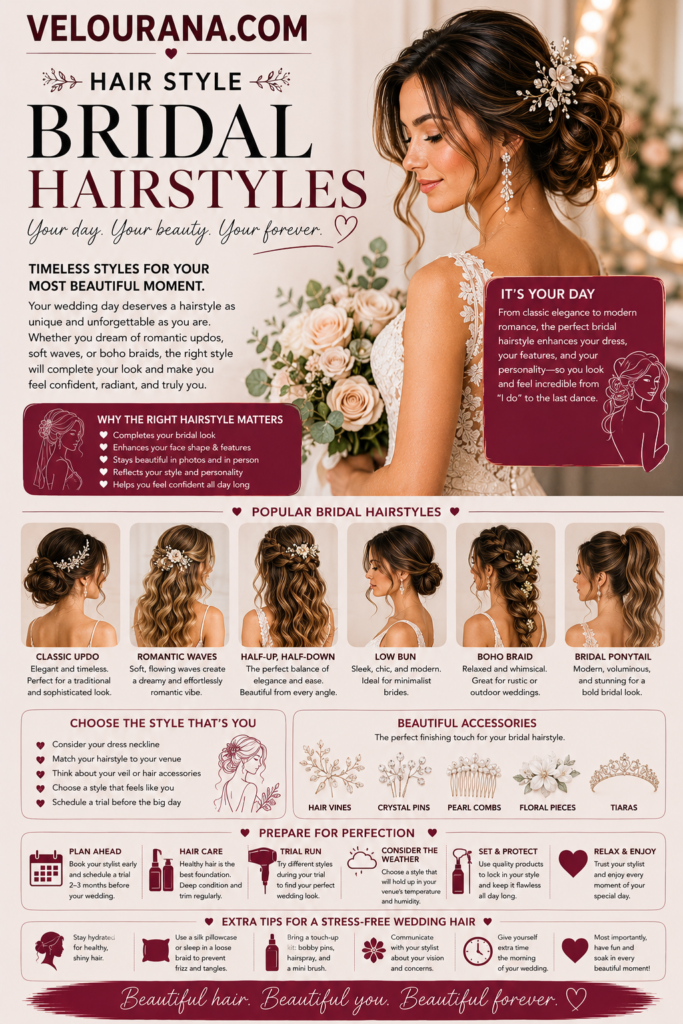
CATEGORY: Bridal Hairstyles
Half-up bridal hairstyles occupy a beautiful middle ground between wearing the hair completely loose and securing it into a full updo. They preserve movement through the lengths while creating structure around the crown and face, making them especially appealing to brides who want softness without sacrificing control.
The appeal is partly emotional.
A bride who normally wears her hair down may feel more recognizably herself when most of the length remains visible. At the same time, the upper sections can be styled away from the face so that the hairstyle feels polished, comfortable and appropriate for an event that may last from morning preparations until late-night dancing.
This balance is what makes the half-up style so adaptable.
It can be romantic, glamorous, bohemian, modern or classic depending on the finish. The secured section can be sleek or textured. The crown can be softly lifted or kept smooth. The lower hair can fall in waves, curls, natural texture or a straighter finish. Braids, twists, pearls, flowers and decorative combs can be incorporated without requiring the entire hairstyle to become elaborate.
A half-up style also works across many lengths and textures. Long hair creates dramatic movement through the lower sections. Medium hair can hold bounce particularly well. Curly and coily hair can keep natural texture central to the design while still gaining control around the face. Even shorter hair can sometimes support a partial secured style when there is enough length through the top and sides.
The key is proportion.
If too much hair is pulled upward, the result can begin to resemble an incomplete updo. If too little is secured, the style may not provide enough structure to feel different from ordinary loose hair. The strongest version creates a clear visual division between the controlled upper shape and the flowing lower lengths while allowing the two areas to connect naturally.
That connection is what makes a half-up bridal hairstyle feel intentional rather than simply practical.
The Crown Sets the Tone of the Entire Style
The crown determines whether a half-up hairstyle feels polished, romantic, dramatic or relaxed.
A smooth crown creates a refined finish.
Gentle volume introduces softness and gives the hairstyle more presence from the side.
A textured crown can feel romantic or bohemian, especially when combined with twists or braids.
The amount of lift should relate to the bride's usual style and the proportions of the dress.
Too much height can make the hairstyle feel more formal than intended. Too little can leave the secured section looking flat, particularly when the lower lengths contain substantial volume.
The crown should create enough structure to balance the hair beneath it.
Fine hair may benefit from careful root lift because the secured section can otherwise appear small against long loose lengths. Dense hair may need less elevation because natural volume is already present.
The shape should also be considered from the side.
A half-up hairstyle that looks beautiful from the front can appear very different in profile. If the crown is completely flat and the lower curls begin abruptly, the transition may feel disconnected. A little height can create a smoother progression.
The secured section should therefore be built as part of the overall silhouette rather than simply gathered because the bride wants hair away from her face.
The Front Should Feel Soft Without Becoming Distracting
The front of a half-up style is one of its most important features because this is where the hairstyle meets the face.
Curtain bangs can remain loose and sweep outward.
Long face-framing layers can curve away from the cheekbones.
A side fringe can blend into the secured section.
The sides can be swept back cleanly while a few carefully chosen pieces remain soft around the hairline.
The amount of loose hair should reflect comfort as much as appearance.
A bride who normally dislikes hair touching her face may not enjoy several romantic strands falling forward throughout the day. Someone who almost always wears some softness around the face may feel uncomfortable if every piece is pulled tightly backward.
The goal is not to follow a formula.
It is to create a front that feels bridal while remaining believable on the person wearing it.
Loose pieces should also relate to the texture of the lower hair. If the lengths contain broad soft waves, a tightly curled ringlet at the front can feel disconnected. A gentler bend usually creates better continuity.
Similarly, a sleek half-up style may look more coherent with straighter face framing than with highly textured front pieces.
The strongest design feels unified even when different sections have different roles.
Twists Create Soft Structure Without Looking Overly Formal
Twists are particularly effective in half-up bridal styles because they add visible detail without making the hairstyle feel heavy.
The sides can be twisted backward and joined behind the head.
Several smaller twists can overlap.
One side can carry more texture than the other for a slightly asymmetric finish.
The twists can disappear into a decorative comb or a cluster of pins.
Because the movement follows the natural direction of the hair, the effect can look soft and organic.
The amount of tension changes the mood.
A smooth, controlled twist feels polished.
A slightly widened twist creates more romance and texture.
The important point is that softness should remain supported by secure construction.
A twist should not rely on looseness alone to look romantic.
The style still needs enough internal stability to remain attractive after hours of movement.
This hidden structure is one of the major differences between casual half-up hair and bridal half-up hair.
The finished style may look effortless, but the secured section should not behave as though it was put together casually.
Braids Can Add Detail Without Becoming the Whole Hairstyle
Braids offer another way to introduce texture.
A narrow braid can travel from one side and disappear into the secured section.
Two braids can meet behind the head.
A larger braid can form the central structure of the half-up style.
The scale should match the rest of the hairstyle.
A very wide braid on fine hair can dominate the entire look. A tiny braid may disappear inside extremely dense or textured hair.
The braid should also share the finish of the surrounding hair.
If the lower lengths are glossy and polished, an extremely loose rustic braid may feel unrelated. If the hairstyle is deliberately textured, a softer braid can integrate naturally.
Braids can also provide a useful visual bridge between the crown and lower lengths. Rather than creating an abrupt line where the secured hair ends, the braid introduces pattern and movement.
This can be especially beautiful with long hair because the lower waves continue beneath the detail without losing their presence.
The bride still looks as though she is wearing her hair down.
The braid simply gives the upper portion a more intentional bridal identity.
Loose Waves Remain One of the Most Natural Partners for Half-Up Hair
Half-up bridal hairstyles and waves work together so naturally because each solves a different visual problem.
The secured upper section creates control and structure.
The waves provide movement.
The contrast creates balance.
Large polished waves can make the style feel glamorous.
Softer separated waves create a more relaxed romantic effect.
Natural waves can be refined rather than replaced completely.
The lower hair should have enough movement to justify being left loose. If the lengths are completely flat while the crown is highly styled, the hairstyle can feel top-heavy.
This does not mean every strand needs to be curled.
Even a broad bend through the middle lengths and ends can create enough movement.
Long layered hair benefits particularly because shorter sections naturally sit at different heights, making the lower half look dimensional.
Medium hair can create even more visible bounce because it carries less weight.
The curl or wave pattern should also be designed to survive some relaxation. Wedding hair needs to remain attractive after several hours, not simply in the first photographs.
A slightly stronger starting wave can soften into a beautiful second stage without disappearing completely.
The hairstyle should evolve gracefully rather than depend on permanent first-hour precision.
Straight Half-Up Bridal Hair Can Look Modern and Elegant
Half-up bridal hair does not need curls to feel special.
A sleek or softly straightened finish can look exceptionally modern.
The crown can remain smooth.
The sides can be directed backward.
The lower lengths can fall cleanly.
The ends can remain straight or carry a very gentle bend.
This works particularly well with minimalist dresses, architectural necklines and clean jewelry.
The challenge is ensuring the style still has enough dimension to feel bridal rather than everyday.
A little crown lift can help.
A polished decorative fastening can create a focal point.
Face-framing pieces can be shaped deliberately.
The lower lengths can remain fluid rather than completely flat.
The difference between casual straight half-up hair and bridal straight half-up hair lies in precision.
The part is intentional.
The secured section is proportioned carefully.
The surface is polished.
The ends look finished.
The accessory belongs to the design.
Nothing needs to be excessive.
Curly Half-Up Hair Can Preserve Natural Texture Beautifully
Curly hair is especially well suited to half-up styling because the natural pattern already provides volume and movement through the lower lengths.
The upper sections can be gathered to create control around the face while the curls remain visible.
This can produce a hairstyle that feels both formal and authentically connected to the bride's natural texture.
The secured section can be smooth or textured depending on the desired look.
Some brides may prefer a polished crown with curls flowing beneath it.
Others may want the natural texture to remain visible from the roots.
Twists or braids can be incorporated without straightening the surrounding hair.
The front can retain selected curls.
The overall silhouette should be balanced so that the secured section does not flatten the crown while the lower hair expands dramatically underneath.
A little lift at the top can create continuity.
Accessories can work particularly well with curly half-up hair because the texture provides natural depth around them.
Pearls can sit between curls.
A comb can create a clear focal point.
Flowers can appear integrated rather than simply placed on top.
The accessory should enhance the pattern rather than conceal it.
Coily Hair Can Create Powerful Half-Up Bridal Shapes
Coily hair offers even more sculptural possibilities.
The upper section can be gathered into a bun, puff, twist or braided structure while the lower hair remains textured.
This creates a clear half-up silhouette without requiring the natural pattern to be stretched or straightened.
The contrast between secured and loose texture can be extremely elegant.
The crown may have significant natural volume, so the proportion of the upper section should be considered carefully.
A very large top section combined with full lower hair can create a dramatic silhouette.
A smaller secured section can feel softer and more balanced.
Braids and twists can become part of the structure while maintaining the natural texture throughout.
Decorative pins can sit within the secured area.
A veil can be positioned according to the design.
The style can feel formal without losing the qualities that make coily hair visually distinctive.
This is one of the great strengths of half-up bridal hair.
It allows natural volume to remain visible while still creating unmistakable event styling.
Fine Hair Needs a Carefully Balanced Half-Up Proportion
Fine hair can look beautiful in a half-up style, but taking too much hair into the secured section can leave the lower lengths looking sparse.
The proportion therefore matters.
A smaller upper section may create enough control while preserving fullness underneath.
Crown volume can help the secured area appear more substantial without requiring additional hair.
Waves can increase visual body through the lower lengths.
The accessory should also be scaled appropriately.
A very large comb can overwhelm a delicate half-up section.
A smaller decorative piece may create enough bridal detail without visually dominating the hair.
Fine hair often benefits from movement because curves create space between strands.
The lower lengths can look fuller even when the actual density remains unchanged.
The goal should not be to imitate the volume of much denser hair.
It should be to create the most balanced version of the style for the hair that exists.
Dense Hair Can Use the Half-Up Structure to Control Volume
Very dense hair creates the opposite challenge.
Leaving everything down can produce substantial volume around the shoulders and back. A half-up style can remove some of that bulk from the sides while preserving the beauty of the length.
More hair can be incorporated into the secured section without making the lower portion look thin.
This creates an opportunity for larger twists, more visible braids or a more substantial central design.
The crown should still be controlled carefully.
Dense hair may not need additional lift everywhere.
The objective is often to shape existing volume rather than create more.
The lower lengths can remain full, but the sides can be directed backward so that the face stays open.
This can make the hairstyle feel more elegant and comfortable without sacrificing the visual impact of thick hair.
Medium Hair Can Be Ideal for Half-Up Bridal Styling
Medium-length hair is often particularly responsive to half-up styles because it offers enough length for waves, twists and secured sections without the weight of very long hair.
The lower movement can remain buoyant.
The crown can hold shape.
The secured section can sit clearly behind the head without being overwhelmed by extremely long lengths.
Shoulder-length and collarbone-length cuts can look especially elegant when the ends are softly curved and the upper section is kept relatively simple.
A decorative comb can create enough bridal detail.
The hairstyle does not need complex construction to feel complete.
Medium hair also tends to photograph well in half-up styles because the movement sits closer to the shoulders and neckline rather than extending far down the back.
This can allow dress details to remain more visible.
Very Long Hair Needs Weight to Be Considered in the Design
Very long hair can create spectacular half-up bridal styles, but the weight of the loose lengths can affect how the secured section behaves.
Heavy hair can pull on the crown.
The attachment point needs enough support.
The lower curls or waves may relax more quickly.
The style should therefore be designed with realistic expectations.
The secured section can be distributed broadly rather than concentrated in one small point.
This can reduce pulling and create a more comfortable fit.
Long layers can help the waves retain movement because shorter pieces carry less weight.
The longest sections may become softer as the day progresses, which can still look beautiful if the original pattern was designed to relax gracefully.
The bride should also consider how much of the dress back she wants visible.
Very long loose hair can cover significant detailing.
A half-up style controls the sides but does not remove the length from the back.
If the gown has intricate lace, buttons or embroidery, this relationship should be evaluated during the trial.
The Veil Can Work Beautifully With Half-Up Hair When Placement Is Planned Early
Half-up styles often provide a natural area for veil attachment because the secured section creates a clear structural point.
That does not mean every veil should be placed in exactly the same position.
A veil can sit above the secured section, creating more volume around the crown.
It can attach lower so that more of the hairstyle remains visible.
The weight and length of the veil influence what will be practical.
A short lightweight veil behaves very differently from a long cathedral veil.
The trial should ideally include the actual veil.
This allows the stylist to see how the attachment interacts with the hairstyle and whether the weight affects the secured section.
The bride can also see how much of the hair remains visible.
If the veil will be removed after the ceremony, the hairstyle should look complete once it is gone.
The secured section should have enough design to remain visually finished rather than appearing as though something is missing.
Accessories Can Become the Focal Point of the Half-Up Style
Half-up bridal hair creates an obvious location for decorative detail where the upper sections meet.
A comb can sit horizontally or slightly to one side.
Pearls can be scattered through twists.
Crystal pins can add light.
Flowers can create a softer natural effect.
A bow can create a more fashion-led statement.
The accessory can be delicate or dramatic depending on the dress and overall aesthetic.
Its scale should reflect the hairstyle.
Fine hair may be better served by something lighter and more refined.
Dense or highly textured hair can support a larger piece without losing the hair itself visually.
The accessory should also be assessed with the veil, earrings and dress details.
If several elements are already elaborate, a simpler hairpiece may create better balance.
Bridal styling becomes more sophisticated when every decorative detail does not compete for the same level of attention.
Weather Matters More When Much of the Hair Remains Loose
Half-up hair offers more control than fully loose styling, but the lower lengths are still exposed to the environment.
Humidity can affect waves, curls and smoothness.
Wind can move the lengths.
Heat can influence comfort.
The hairstyle should therefore be chosen with the actual wedding conditions in mind.
For an outdoor summer ceremony, natural texture may be incorporated rather than completely suppressed.
A softer wave pattern can tolerate some change more gracefully than a style that depends on every section remaining perfectly polished.
Curly and coily textures can be designed to work with the expected environment rather than requiring constant correction.
The secured upper section offers one major advantage: the face and crown remain more controlled even if the lower lengths change slightly.
This can allow the hairstyle to soften without losing its identity.
The wedding hair should be capable of living through the wedding day.
The Bridal Trial Is Essential for Testing Balance
A half-up hairstyle can look simple in inspiration photographs while behaving very differently on another person.
Hair density changes the proportion.
Length changes the weight.
Layers change the shape.
Natural texture changes the movement.
The dress and veil change the overall balance.
This makes the trial particularly useful.
The bride can see how much hair should be secured.
The crown can be adjusted.
The front can be softened or cleaned up.
The accessory can be moved.
The waves can be made stronger or looser.
The veil attachment can be tested.
Photographs from the back are especially important because the secured section is a major part of the design.
The hairstyle should look complete from behind even before the veil is attached.
The trial should also test comfort.
If the attachment pulls after an hour, the structure may need to be redistributed.
If loose front pieces become irritating, they can be shortened or secured differently.
If the waves collapse quickly, the styling plan can be adjusted.
These discoveries are exactly what the trial is meant to reveal.
A Half-Up Bridal Style Should Feel Like a Complete Hairstyle, Not a Compromise
The half-up category is sometimes described as a compromise between wearing the hair up and wearing it down.
That description understates its potential.
A well-designed half-up style is not an unfinished version of either option.
It has its own visual logic.
The crown creates shape.
The secured section provides structure.
The lower lengths create movement.
The front frames the face.
The accessory creates a focal point.
The veil interacts with a defined attachment area.
Each element has a role.
This is why the best half-up bridal hairstyles can look exceptionally polished from every angle.
From the front, the face remains open.
From the side, the crown has a deliberate profile.
From the back, the secured section creates detail while the lower hair remains visible.
The style contains both architecture and movement.
It can also feel more comfortable to a bride who wants her hair controlled but does not want the exposed feeling of a complete updo.
That emotional comfort matters.
A wedding hairstyle should not feel like something the bride has to endure simply because it looks appropriate in photographs.
The Most Beautiful Half-Up Bridal Hair Preserves Recognition
Bridal styling works best when it elevates rather than erases.
A bride who loves wearing her hair down can retain the length and movement she associates with herself.
A bride with natural curls can keep those curls visible.
A bride with coily hair can use natural volume as part of the silhouette.
Someone who prefers straight hair can choose a sleek half-up finish without being told that bridal hair must contain curls.
Someone who loves braids can integrate them subtly.
Someone who prefers minimalism can keep the secured section clean and simple.
The half-up style is flexible enough to support all of these identities.
That may be its greatest strength.
It creates unmistakable bridal structure without demanding one universal idea of bridal beauty.
The hair can remain soft.
It can remain textured.
It can remain sleek.
It can remain natural.
What changes is the level of intention.
The part is chosen carefully.
The crown is balanced.
The front is shaped.
The secured section is stable.
The lower lengths are finished.
The veil and accessories are integrated rather than added as afterthoughts.
The complete hairstyle is tested against the dress and the bride's comfort.
When all of those elements work together, the result does not look like half an updo and half a loose style.
It looks complete.
The bride can move without continually pushing hair away from her face. The lower lengths remain visible in photographs. The back retains enough detail to look beautiful during the ceremony. The hairstyle can survive some natural softening without losing its identity.
Most importantly, the bride can still recognize herself.
That is what turns a half-up hairstyle into bridal hair.
Not the accessory alone.
Not the curls.
Not the veil.
The transformation comes from taking a familiar way of wearing the hair and refining every important detail until it belongs naturally to one extraordinary day.
The End
Velourana.
 Discover More From Our Family of Websites
 ZodiacBearing (Astrology, Tarot, Numerology, Angel Numbers & Spiritual Guidance)
 Velourana (Beauty, Makeup, Hair Care, Skincare & Beauty Tips)
 HavenBearing (Home, Living, Organization, Décor & Everyday Inspiration)
 PawBearing (Pet Care, Dog Breeds, Animal Health, Training & Pet Products)
 PsyCatherine (Notes From the Journal of a Psychologist on Real Life)

