
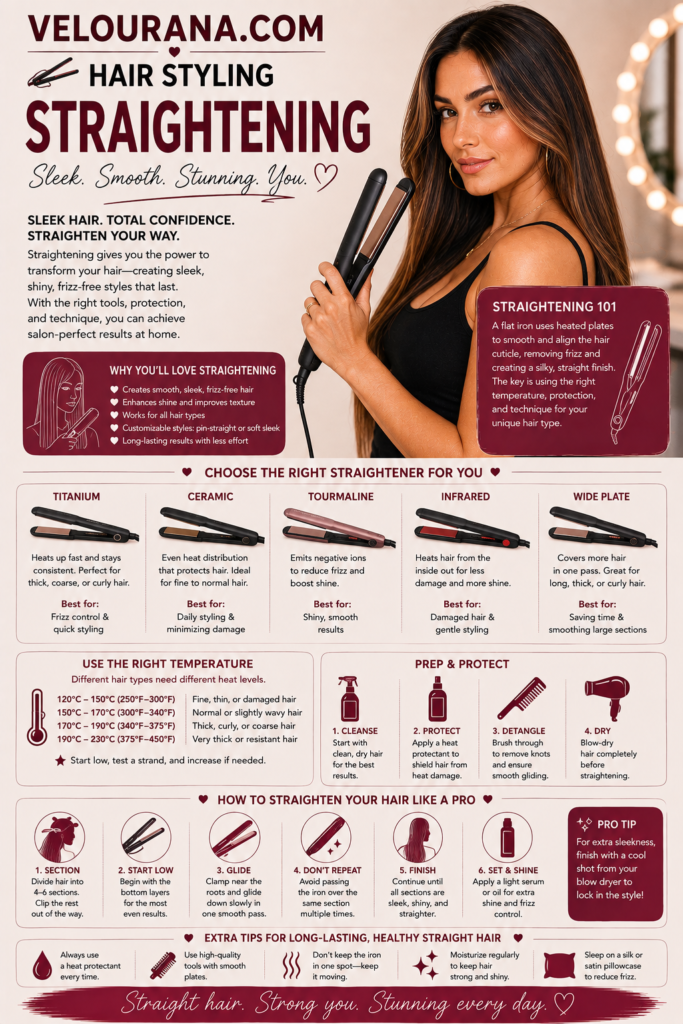
CATEGORY: Straightening
Straight hair can look deceptively simple. When a finished style falls smoothly from the roots, reflects light evenly and moves cleanly around the shoulders, it can appear as though very little styling was required. In reality, successful straightening depends on a series of decisions about preparation, sectioning, heat, direction and finishing.
The objective is not necessarily to make every strand as flat as possible.
Beautiful straightened hair can retain volume at the roots. Layers can remain visible. Face-framing pieces can sweep naturally rather than hanging rigidly beside the face. The ends can fall straight, curve inward or move slightly outward depending on the haircut. Even an exceptionally sleek finish benefits from enough flexibility to move naturally.
Straightening is therefore better understood as controlled reshaping.
Different starting textures require different amounts of transformation. Naturally straight hair may need little more than refinement. Wavy hair can be smoothed while retaining some body. Curly and coily textures may require a more substantial preparation process before the final straightening stage. Fine hair can respond quickly but lose volume easily, while dense hair usually benefits from more careful sectioning.
Hair condition matters as much as natural texture.
Long ends may have years more exposure than new growth. Color-treated or lightened sections may respond differently from untreated hair. A technique that works beautifully on one part of the head may be unnecessarily intensive on another.
The straightening tool itself is only one element.
The foundation created before direct heat can determine how many passes are required afterward. The way the roots are directed determines whether the finished hair appears sleek or flat. Section size influences whether the tool works efficiently. The direction of the final movement determines how the ends and layers behave.
When these details are considered together, straightening becomes more than removing waves or curls.
It becomes a way of creating a deliberate silhouette.
Straightening Begins Before the Straightener Is Switched On
The quality of the starting foundation has a major influence on the amount of work required from a straightening tool.
Hair that is tangled, unevenly dried or already heavily coated with styling products can be more difficult to divide and control. Sections may separate unpredictably, and the tool may need to revisit areas that were not styled consistently the first time.
Preparation should therefore make the hair manageable.
Detangling helps sections remain organized. Appropriate hair care and styling products can support the desired finish without overwhelming the hair. Heat protection should be used according to the instructions of the chosen product and the requirements of the styling tools involved.
The hair should also be in the condition required by the particular straightening device. Conventional flat irons are generally intended for dry hair, while specialized wet-to-dry or air-straightening devices operate differently. The manufacturer's directions should always determine how a specific appliance is used.
This distinction matters because tools that produce a similar visual result can work through very different mechanisms.
Preparation should match the mechanism.
For someone who blow-dries before straightening, the blow-dry can perform much of the initial organization. Directional airflow and controlled brush work can smooth the hair sufficiently that the straightener becomes a finishing tool rather than the only tool responsible for transformation.
This is especially useful for naturally wavy, curly or coily hair.
The smoother the foundation, the less correction may be required later.
That does not mean the blow-dry needs to produce absolute perfection.
It simply needs to move the hair intelligently toward the final result.
Sectioning Determines Whether Straightening Is Efficient or Repetitive
Large sections can make straightening appear faster.
In practice, they often create more work.
When too much hair is placed between straightening plates, the outer strands may receive strong contact while the interior remains less affected. The section emerges partially smooth, so it is passed through the tool again.
The problem is not necessarily insufficient heat.
It may simply be excessive section size.
Dividing the hair into manageable sections allows the tool to interact with the strands more consistently. This makes each pass more meaningful.
Dense hair benefits particularly from this approach.
The lower layers can be separated and styled first. Middle sections follow. The visible upper layers and face-framing pieces can then receive the attention required for the final finish.
This organization also prevents completed hair from becoming mixed with unfinished sections.
That sounds like a minor convenience, but it can reduce accidental repetition significantly.
Fine hair may require fewer sections, but the same principle applies. If a section is already straight and polished, there is no reason for it to be repeatedly caught in neighboring passes.
Good sectioning creates a map.
The stylist knows what has been completed, what still needs work and which areas deserve additional shaping.
Straightening becomes systematic rather than repetitive.
Smooth Hair and Flat Hair Are Not the Same Thing
One of the most common misconceptions about straightening is that maximum smoothness requires maximum flatness.
It does not.
Hair can be sleek through the surface while retaining space at the roots.
This distinction can completely change the finished hairstyle.
If every section is pulled firmly downward from the scalp, the roots are encouraged to lie close to the head. That may be exactly right for an ultra-flat aesthetic, but it is not necessary for every straight style.
When more natural volume is desired, the roots can retain some elevation while the tool concentrates on smoothing the lengths.
This is especially useful for fine hair.
A perfectly straight finish combined with completely compressed roots can make fine hair appear less abundant. Preserving a small amount of lift creates a fuller silhouette without sacrificing polish.
Dense hair can benefit for another reason. Natural volume can make sleek hair look luxurious. Eliminating all of that body may be unnecessary when the objective is simply controlled straightness.
The haircut should influence the decision.
A blunt bob can look beautiful with relatively sleek roots and a strong perimeter.
Long layered hair may benefit from more crown lift so that the upper sections do not disappear into the lengths.
Face-framing pieces may need a little elevation to prevent them from hanging directly against the cheeks.
Straightening should therefore create the amount of smoothness appropriate to the style rather than automatically pursuing the flattest possible result.
The Straightener Should Travel With Purpose
A controlled pass is more useful than several uncertain ones.
The section should be manageable enough for the tool to work consistently, and the movement should remain smooth rather than repeatedly stopping and restarting.
The speed of the pass depends on the tool, the hair and the intended result. The manufacturer's guidance should be respected, particularly regarding temperature and operation.
What matters stylistically is that the movement has a clear purpose.
If the objective is sleekness, the section can be guided smoothly in the desired direction.
If the ends need curvature, the movement can gradually change near the bottom.
If a face-framing section needs to sweep backward, the direction can shift accordingly.
The straightener does not need to travel through every section in exactly the same vertical line.
This is where straightening becomes hairstyling.
The tool can influence direction as well as texture.
Once the section has reached the intended smoothness and shape, it can be left alone.
Another pass should solve a visible problem, not simply repeat a successful action.
Fine Hair Usually Needs Less Straightening Than It Appears To
Fine hair often responds quickly to heat styling.
If the natural texture is straight or lightly wavy, a controlled blow-dry may already produce most of the desired smoothness. The straightener can then be reserved for the areas that need additional polish.
This selective approach helps preserve volume.
Fine hair can become visually flat when every section is repeatedly straightened from the roots. The result may be smooth but lack movement.
Instead, the roots can retain some natural lift.
The tool can concentrate on irregular bends through the lengths, the visible upper sections and the ends.
Product weight also deserves attention.
A heat protectant should be used appropriately, but several rich smoothing products layered together can make fine hair feel heavier. If the style depends on movement, the preparation should support that movement.
The finished hair should still separate naturally.
Layers should remain visible.
The ends should not look compressed into a rigid line unless that is specifically the intended aesthetic.
Fine straightened hair often looks most polished when the technique appears almost invisible.
The viewer notices shine, movement and a clean silhouette rather than the fact that every strand has been intensely heat styled.
Thick Hair Needs Better Sectioning Rather Than Automatic Maximum Temperature
Dense hair creates a different challenge because there is simply more hair to organize.
Trying to compensate by using oversized sections can lead to inconsistent results. The visible surface becomes smooth while the interior remains textured, encouraging repeated passes.
Smaller working sections usually solve the problem more effectively.
This does not mean every section needs to be extremely thin. It means the amount of hair should be appropriate for the tool and the density.
A smooth blow-dry can also make a substantial difference.
If thick wavy or curly hair has already been stretched and organized, the straightener can refine the result rather than performing the entire transformation alone.
Dense hair can also retain some natural root volume.
A sleek finish does not require removing all physical fullness. In fact, controlled density can make straightened hair appear particularly rich.
The visible upper layers deserve the most cosmetic attention because they define the surface of the hairstyle.
Internal sections still need enough styling to integrate with the finish, but they may not require the same degree of perfection as the front and top.
This hierarchy makes the process more efficient.
The objective is a cohesive hairstyle, not identical treatment of every strand.
Wavy Hair Can Be Straightened Without Losing All Its Natural Body
Wavy hair often sits relatively close to a straightened finish before styling even begins.
The transformation may involve smoothing irregular bends and creating a more consistent direction rather than completely rebuilding the texture.
A blow-dry can accomplish much of this.
Once the hair is dry and organized, the straightener can focus on the areas where the wave remains stronger or less predictable.
Some natural body can remain at the roots.
This prevents the finished hair from looking excessively compressed.
The ends can then be shaped according to the haircut.
A blunt cut may benefit from a clean straight perimeter.
Layers may look better with a slight bend.
Face-framing sections can sweep backward rather than being forced directly downward.
The result remains straight, but it does not have to look artificially rigid.
For someone who regularly alternates between natural waves and straightened hair, this softer interpretation can also make the transformation feel more connected to the natural texture.
The hair is polished rather than erased.
Curly Hair Benefits From Dividing the Transformation Into Stages
Curly hair requires a greater change in shape when the goal is a straight finish.
Trying to make one tool perform the entire transformation can make the process unnecessarily difficult.
A controlled preparation stage can first elongate and organize the texture. Depending on the styling routine and tools being used, blow-drying may create a smoother foundation before the straightener is introduced.
The flat iron can then refine.
This division of work is useful because the direct-contact tool is no longer being asked to correct every bend from the original curl pattern.
Sectioning becomes especially important.
Curly hair can be dense even when individual strands are fine. Working through manageable sections allows the roots and interior hair to receive consistent attention.
The final degree of straightness should also be chosen deliberately.
Some people prefer an extremely sleek finish.
Others prefer a straight blowout with more body.
These are different aesthetics.
The second does not require every trace of natural volume to disappear.
The roots can remain fuller while the lengths become smooth.
The result can look straight while still retaining the abundance associated with the original texture.
Coily Hair Requires Precision Rather Than Aggressive Repetition
Coily hair can undergo a substantial transformation during straightening, making preparation and organization particularly important.
The natural texture should not be treated as a problem that must be overcome through repeated passes.
A better strategy is to move progressively toward the desired finish.
The hair is prepared appropriately.
The texture is organized into manageable sections.
If a stretching or blow-drying stage is part of the routine, it creates a more controlled foundation.
The straightener then performs the final refinement.
The exact process should suit the hair, its condition and the tools involved.
A section that does not become smooth after an appropriate pass should prompt evaluation rather than automatic repetition.
Perhaps the section is too large.
Perhaps the preparation was insufficient.
Perhaps the temperature setting or tool is not appropriate for the particular hair.
Technique should be examined before simply repeating heat.
The finished style can also retain volume.
Straightened coily hair does not need to become completely flat to look polished.
A fuller straight finish can be striking because it combines smooth lengths with natural density.
The objective should be chosen before styling so that the technique supports the desired silhouette.
The Roots Need Different Treatment From the Ends
A single strand of long hair does not have a uniform history.
The newest growth near the scalp may have existed for only a few months. The ends may have been exposed to years of washing, brushing, friction, environmental conditions, coloring and heat styling.
Treating the entire strand identically ignores that difference.
The roots may need more attention because natural texture is strongest there.
The ends may respond almost immediately.
If a resistant upper section needs another adjustment, the tool does not automatically need to repeat the same amount of work through already-smooth ends.
This becomes particularly important with long hair.
Every complete root-to-tip pass exposes the ends again.
A more precise approach targets the area that actually needs refinement.
The same principle applies to color-treated hair.
Highlighted or lightened ends may behave differently from newer growth. The styling routine should respond to the present condition of each area rather than following a rigid pattern.
Straightening is more controlled when the stylist recognizes that roots, middle lengths and ends have different needs.
Straight Ends, Curved Ends and Soft Ends Create Different Styles
The direction of the ends determines much of the personality of straightened hair.
Perfectly straight ends create a strong, contemporary finish. They work particularly well with blunt cuts and hairstyles where precision is part of the design.
A slight inward curve creates softness.
This can make a bob appear rounded and polished or give long hair a more flowing finish.
Outward movement creates another character entirely. A small flick through selected layers can make the haircut appear lighter and more playful.
Long layered hair can combine these directions.
The lower sections may remain relatively straight while shorter face-framing pieces sweep outward.
The straightener can create these shapes through changes in direction during the final part of the pass.
The movement does not need to become dramatic.
A subtle bend can be enough.
This is important because repeatedly working the ends in an attempt to create a perfect curve can make the styling process unnecessarily intensive.
The end should be shaped once effectively and then allowed to settle.
Face-Framing Sections Should Be Styled for the Face, Not the Rest of the Hair
The front pieces often need a different technique from the back.
A face-framing layer is designed to interact with the features. Pulling it straight downward may make it smooth, but it can remove the movement that makes the haircut flattering.
Instead, the section can be directed according to its intended fall.
Curtain bangs can sweep outward.
Long front layers can travel backward.
A side fringe can retain enough curvature to sit naturally.
These movements can still belong within a straight hairstyle.
Straight does not mean every strand must point in the same direction.
The shorter length of front pieces also means they may respond more quickly to styling.
They should not automatically receive the same number of passes or amount of manipulation as much longer sections.
Once the desired movement appears, the front is finished.
Because these sections are highly visible, small corrections can transform the entire hairstyle.
This makes them an ideal area for precise rather than excessive styling.
Bobs and Lobs Need Shape as Much as Smoothness
Straightening a bob is not simply a matter of making every strand straight.
The perimeter is a major part of the haircut.
A blunt bob can be styled into an extremely sleek geometric shape, but it can also be softened with a slight inward bend. A long bob can retain more root volume and movement through the front.
The ends should be consistent enough for the perimeter to look deliberate.
One section turning strongly inward while another turns outward unintentionally can disrupt the shape.
The straightener can therefore be used to establish both smoothness and direction.
The crown may need a little lift.
The sides can remain controlled.
The ends can complete the silhouette.
A bob often needs fewer dramatic styling movements than long layered hair because the haircut itself provides such a strong shape.
Precision matters more than complexity.
Long Layered Hair Should Not Be Straightened Into One Flat Sheet
Layers create dimension by placing different lengths throughout the hairstyle.
If every section is straightened tightly downward and compressed against the neighboring hair, those differences can become difficult to see.
A better approach preserves some separation.
The crown can retain lift.
Shorter layers can be directed slightly away from the longest hair.
Face-framing pieces can sweep backward.
The longest sections can remain smooth and relatively straight.
This creates a straight hairstyle that still reveals the architecture of the cut.
Fine layered hair can appear fuller because the sections occupy slightly different spaces.
Dense layered hair can look more organized because the volume is distributed rather than compressed into one shape.
The straightener becomes a tool for defining the haircut rather than erasing it.
Color-Treated and Lightened Hair Need a Responsive Routine
Chemical processing can change the way hair reacts to heat.
The important consideration is not simply whether the hair has been colored.
It is how it behaves now.
If the ends have become more fragile-feeling, if certain sections straighten much more quickly than others, or if the hair has become increasingly dry or difficult to manage, the styling routine should respond.
A technique that worked before repeated lightening may no longer be appropriate unchanged.
The same is true as hair grows.
Older processed ends and newer growth can behave differently.
The straightener should follow those differences.
A section that smooths quickly can be left alone.
An area that needs more attention can receive it without automatically subjecting the entire length to identical repetition.
This responsive approach makes more sense than treating every styling session as a fixed formula.
Second-Day Straight Hair Rarely Needs Complete Re-Straightening
Straightened hair usually changes gradually overnight.
A bend may appear on one side.
The roots may recover some natural texture.
The front may lose its direction.
The ends may remain almost perfectly smooth.
This does not mean the entire hairstyle needs to be straightened again.
Selective refreshing can preserve the original work.
If only one section has changed, only that section needs attention.
If the roots need refinement while the lengths remain straight, the styling can focus on the upper area.
If the front has lost its sweep, the front can be reshaped.
The remainder can stay untouched.
This approach also allows the hairstyle to become softer over time.
Freshly straightened hair may look extremely polished on the first day. By the second day, it can gain more natural movement while retaining most of its smoothness.
That evolution can be attractive.
There is no requirement to return the hair to its exact first-hour appearance every morning.
Straightened Hair Can Become the Foundation for Other Hairstyles
A straightening session does not need to produce only one look.
Smooth lengths can become the foundation for several hairstyles over the following days.
A high ponytail can emphasize the clean texture.
A low ponytail can create a sleek, understated finish.
A half-up hairstyle can preserve movement through the lower lengths.
A bun can use the smooth foundation to create a polished silhouette.
Braids can introduce heatless movement into straightened hair, creating waves when they are later released.
Large rollers can add broad curvature without requiring another complete session with a direct-contact tool.
This versatility extends the value of the original styling work.
Instead of repeatedly restoring the exact same straight finish, the hair can move naturally into different styles.
That makes straightening part of a larger styling wardrobe rather than an isolated result.
The Best Straightened Hair Still Looks Like Hair
Perfect smoothness can be visually impressive, but the most sophisticated straight styles often preserve qualities that keep the hair alive.
The roots have enough space to avoid looking compressed unless complete flatness is intentionally part of the aesthetic.
The lengths reflect light but still move.
Layers remain visible.
The front interacts naturally with the face.
The ends complete the haircut.
The hair can swing when the wearer moves rather than remaining fixed in one rigid position.
Achieving this result depends less on repeatedly passing a straightener through every section and more on understanding what each area needs.
Preparation creates the foundation.
Sectioning creates control.
Appropriate heat creates transformation.
Direction creates shape.
Restraint preserves movement.
The tool is important, but the decisions around it determine the quality of the hairstyle.
Fine hair may need only selective refinement.
Dense hair may need systematic sectioning.
Wavy hair can preserve some natural body.
Curly and coily textures can be transformed progressively rather than aggressively.
Long hair can receive different treatment at the roots and ends.
Processed hair can be styled according to its current condition.
Bobs can use straightening to emphasize their perimeter.
Layered cuts can remain dimensional instead of being flattened into uniformity.
And second-day hair can be refreshed selectively rather than completely rebuilt.
Straightening is therefore not simply the removal of texture.
It is the creation of controlled direction.
The hair becomes smoother because the strands are organized.
It becomes polished because the surface is refined.
It becomes flattering because the roots, layers, front and ends are shaped according to the haircut.
When those elements work together, the finished result can be sleek without being severe, smooth without being lifeless and straight without losing the movement that makes hair beautiful.
That is the difference between merely flattening hair and genuinely styling it straight.
The End
Velourana.
 Discover More From Our Family of Websites
 ZodiacBearing (Astrology, Tarot, Numerology, Angel Numbers & Spiritual Guidance)
 Velourana (Beauty, Makeup, Hair Care, Skincare & Beauty Tips)
 HavenBearing (Home, Living, Organization, Décor & Everyday Inspiration)
 PawBearing (Pet Care, Dog Breeds, Animal Health, Training & Pet Products)
 PsyCatherine (Notes From the Journal of a Psychologist on Real Life)

