
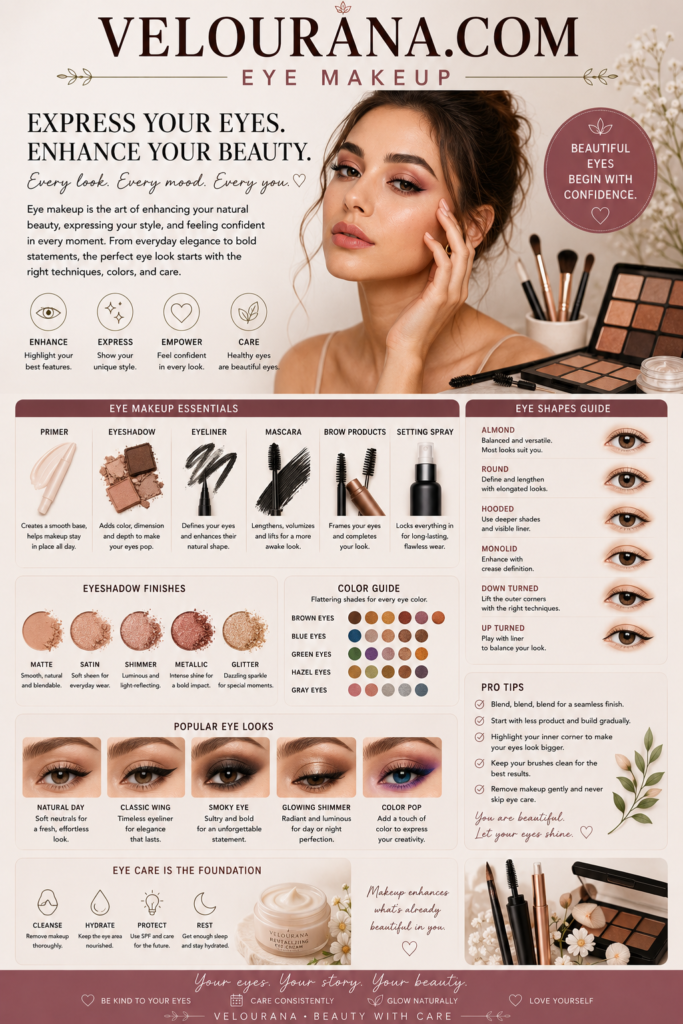
CATEGORY: Glitter Eyeshadow
Glitter eyeshadow is one of the few forms of eye makeup that changes continuously after it has been applied. Matte pigment is read primarily through color and depth. Satin adds a controlled sheen. Metallic shadow reflects more strongly, but glitter introduces another dimension entirely: individual particles catch light at different moments as the eyelid moves, creating an effect that is never completely static.
This movement is what gives glitter eyeshadow its particular visual power. A relatively simple eye can become dramatic without requiring elaborate contouring because the texture itself creates interest. Gold glitter can bring warmth and luminosity to neutral makeup. Silver can produce a cooler, sharper effect. Rose, bronze, copper, violet and jewel-toned particles can transform the lid into a focal surface that responds to every change in angle and illumination.
Yet glitter is not simply shimmer in a more intense form. The scale, density and behavior of the reflective particles alter the way the product should be applied and the way the eye should be designed around it. Fine glitter can appear almost seamless and sophisticated, while larger particles create greater texture and a more editorial finish. Some formulas suspend the glitter within a creamy or gel base. Others rely on loose particles that need an appropriate cosmetic adhesive or base to remain where intended.
Because glitter eyeshadow is used around a particularly delicate area, beauty and safety must remain inseparable. Only products specifically intended and labeled for use around the eyes should be applied there. Decorative craft glitter, body glitter not approved for the eye area and improvised reflective materials do not belong on the eyelids simply because they resemble cosmetic glitter.
When the product is appropriate and the placement is intentional, glitter eyeshadow can be one of the most sophisticated ways to use light in makeup.
What Makes Glitter Different From Shimmer and Metallic Shadow
The distinction between glitter, shimmer and metallic eyeshadow is largely about the way reflective material is distributed and perceived.
Shimmer usually contains very fine reflective particles dispersed throughout pigment. From conversational distance, the surface often appears luminous rather than visibly particulate. The light seems to wash across the eyelid.
Metallic shadow creates a denser reflective surface. The particles are usually packed closely enough that the lid can resemble polished metal, foil or liquid pigment. Reflection becomes more continuous.
Glitter remains more visibly fragmented. Individual reflective points can often be distinguished, especially in formulas containing larger particles. Instead of producing one smooth field of light, glitter creates multiple flashes.
This difference becomes especially noticeable when the eye moves. A metallic lid may brighten broadly as it turns toward illumination, while glitter produces numerous separate points of reflection.
The size of the particles influences the effect dramatically.
Micro-glitter can create an almost sparkling veil over another shadow. Larger cosmetic glitter produces stronger texture and more obvious flashes. Multidimensional glitter may contain particles that reflect different colors depending on angle.
Some formulas combine these categories. A metallic shadow may contain visible glitter particles. A shimmer may have enough sparkle to appear almost glittery. Cosmetic terminology is not perfectly standardized, so the product's actual appearance and intended use matter more than the label alone.
The useful distinction is visual. Shimmer creates glow, metallic creates a reflective surface and glitter creates points of light.
Why Glitter Needs a Different Approach to Placement
Reflective texture attracts attention wherever it is placed.
This makes glitter eyeshadow extremely effective but less forgiving of random distribution. A small amount concentrated in the center of the lid can draw attention there immediately. The same glitter spread broadly above the crease changes the entire shape of the eye because the reflective area becomes much larger.
Placement therefore functions almost like lighting design.
The center of the mobile lid is one of the most common positions because it catches light naturally as the eye moves. Glitter placed there can make the lid appear more dimensional, particularly when surrounded by matte or satin shadow.
The inner portion of the eye creates a brighter effect. A restrained glitter accent near the inner lid can illuminate makeup without turning the entire eye into a reflective surface.
The outer lid produces a less conventional result. Dark glitter concentrated toward the outer eye can create a dramatic, smoky effect rather than conventional brightness.
Glitter can also be extended through the crease or above it in editorial looks, although this changes the relationship between reflection and natural eye structure. The product becomes more obviously decorative and less connected to conventional lid placement.
The key is deciding where the light should appear strongest.
Fine Glitter and the Sophistication of Controlled Sparkle
Fine glitter can be unexpectedly subtle.
When the particles are small and applied in a thin layer, the eyelid may not appear overtly glittery in ordinary lighting. Instead, small points of light emerge only when the head moves or stronger illumination reaches the eye.
This makes fine glitter particularly useful when someone wants evening glamour without a visibly textured surface.
Neutral shades work beautifully in this context.
Champagne glitter can sit over beige or taupe shadow and create delicate luminosity. Bronze glitter can intensify warm neutral makeup without changing its color story dramatically. Soft rose glitter can introduce a romantic quality while remaining relatively understated.
The sophistication comes from restraint.
Rather than covering every visible part of the eye, the glitter becomes an accent inside a larger matte or satin composition.
A softly sculpted neutral lid with one concentrated reflective area can appear more dimensional than an eye completely covered with sparkle.
Larger Glitter and Editorial Texture
Larger particles behave differently because texture becomes visible even before the light catches them.
This can create an intentionally dramatic surface.
Instead of blending seamlessly into the eye, the glitter announces itself as material. The eyelid becomes decorated rather than merely illuminated.
Such finishes are particularly suited to editorial, festival-inspired or highly expressive makeup where the texture itself is part of the aesthetic.
The rest of the eye can remain restrained to preserve clarity. A clean complexion, defined lashes and one strongly glittered lid may produce greater visual impact than combining the glitter with several other intense textures.
Dark bases can make larger glitter appear even more dramatic because the reflective particles emerge from a field of shadow.
Black, charcoal, navy or deep plum beneath silver, blue or multicolored glitter can create a night-sky effect with extraordinary contrast.
Lighter bases produce a different result. Gold or champagne glitter over cream or beige can feel brighter and more glamorous rather than mysterious.
Glitter Over Matte Shadow
One of the most effective ways to make glitter visible is to place it beside matte texture.
Matte eyeshadow absorbs light. Glitter reflects it. The contrast between the two makes both surfaces more pronounced.
A matte brown crease surrounding gold glitter creates an immediate distinction between depth and luminosity. Charcoal matte shadow around silver glitter intensifies the cool drama. Burgundy matte beneath rose or copper glitter creates warmth with considerable visual complexity.
This relationship also helps control the glitter.
Rather than allowing reflection to occupy the entire eye, matte shadow establishes the architecture while glitter becomes the focal surface.
The eye can therefore remain sculpted even when the reflective finish is intense.
This is especially useful for evening makeup because strong glitter does not need to replace traditional dimension. It can sit inside it.
Glitter Over Metallic Shadow
Glitter layered over metallic eyeshadow creates a much richer reflective surface.
The metallic base provides continuous shine while glitter adds separate flashes above it.
Gold glitter over bronze metallic shadow produces layered warmth. Silver glitter over pewter creates a cooler, more dimensional finish. Multicolored glitter over blackened metallic shadow can produce dramatic color shifts as the light changes.
The effect can become intense very quickly because both layers are reflective.
For this reason, surrounding areas often benefit from simpler textures. A matte crease or clean brow area can prevent the eye from becoming visually overloaded.
Layering also changes the depth of the glitter. The reflective particles no longer sit directly against skin but against another luminous field, making the entire surface appear denser.
Neutral Glitter and Everyday Wearability
Glitter eyeshadow is often associated with evening makeup, but neutral glitter can be surprisingly wearable.
The key is scale and density.
A small amount of champagne, taupe, bronze or soft gold glitter pressed only onto the center of the lid can create movement without overwhelming the face.
The surrounding makeup can remain minimal.
Soft mascara, natural brows and a restrained complexion allow the glitter to feel like an intentional highlight rather than a dramatic statement.
Neutral glitter also benefits from tonal integration. When the reflective particles belong to the same general color family as the base shadow, the effect appears more seamless.
Bronze glitter over warm brown creates harmony. Champagne over beige creates brightness. Taupe glitter over cool neutral shadow produces a quieter, more sophisticated sparkle.
The eye remains recognizable as neutral makeup, but the texture gives it additional life.
Color Glitter and the Transformation of the Eye
Colored glitter introduces another layer of visual complexity because reflection and hue operate simultaneously.
Blue glitter can shift between navy, cobalt and turquoise depending on the base beneath it. Violet can appear soft and romantic over mauve or dramatic over black. Green becomes jewel-like over deep forest or earthy over bronze.
Red, copper and burgundy glitter create warmth, particularly when surrounded by similarly rich matte shadows.
Multichrome and iridescent glitters can shift between several colors depending on angle, making the eyelid appear different under changing light.
These finishes can become the entire point of the makeup.
When the glitter itself contains complex color, elaborate surrounding shadow may be unnecessary.
A simple dark or neutral base can provide enough structure for the reflective pigments to reveal their shifts clearly.
Glitter and the Center-Lid Spotlight
The center-lid placement is particularly effective because it exploits the natural curvature of the eye.
Light reaches the most prominent part of the lid differently as the eye opens and closes. Glitter placed there produces movement even when the rest of the makeup remains matte.
A deep smoky eye can be transformed by a narrow area of gold, silver or bronze glitter pressed into the center.
The darkest pigment remains near the inner and outer lid, while the reflective center creates dimensional contrast.
This technique can make a relatively dark eye feel less flat without removing its intensity.
It also works with color.
A plum smoky eye can carry rose-gold glitter through the center. Navy can be illuminated with silver or blue. Olive can become more luminous with antique gold.
The glitter does not need to cover the full lid to create a strong visual effect.
Glitter as an Inner-Lid Accent
Placing glitter toward the inner lid creates a brighter, more open impression.
Instead of treating the inner corner as a tiny point of highlight, the reflective area can extend slightly across the mobile lid.
Champagne and pale gold are traditional choices, but colored glitter can produce more unusual results.
Lilac or icy blue can create a cool, ethereal effect. Pale green can introduce freshness. Rose can soften darker surrounding shadow.
The important factor is the relationship between the brightness of the glitter and the depth elsewhere.
A luminous inner lid beside a dark outer corner produces a strong gradient that guides the eye outward.
Smoky Glitter Eyes
Glitter does not need to look delicate or festive.
Against deep smoky shadow, it can become dramatic and almost nocturnal.
Black, charcoal, espresso, navy and plum create excellent bases because their depth allows reflective particles to stand out.
The glitter can remain concentrated close to the lashes, spread across the entire mobile lid or appear only through the center.
Dark glitter itself can also be used.
Black glitter creates texture without introducing obvious brightness. Deep navy and burgundy glitter add flashes of color that appear only in movement.
This type of eye depends heavily on contrast between shadow and reflection.
The darker the surrounding base, the more intensely even a small amount of glitter can appear.
Glitter With Winged Eyeliner
Crisp eyeliner and glitter create a compelling contrast between geometry and texture.
The glitter provides movement and irregular reflection, while the wing creates a stable directional line.
Black winged liner over gold, bronze or champagne glitter produces classic glamour. Colored liner can create more unusual relationships.
The timing of application matters because the liner needs a sufficiently stable surface to remain clean.
If glitter particles are too large or uneven beneath the line, achieving a smooth edge can become more difficult.
One solution is to preserve a narrow area near the lash line for liner while concentrating the glitter slightly above it.
This keeps the geometric edge visually clear.
Glitter and Lower-Lash Placement
Glitter beneath the lower lashes can be beautiful when used with restraint.
A small amount concentrated close to the lashes can echo the upper lid and create continuity.
This placement becomes more dramatic because reflected particles are closer to the cheek area and may be more noticeable.
The cosmetic product must still be intended for eye-area use.
Loose particles should be controlled carefully to reduce migration.
Colored glitter beneath otherwise neutral upper-lid makeup can also become an interesting focal point.
A thin line of blue, green or violet sparkle introduces color without covering the entire eye.
The Importance of an Appropriate Base
Glitter often requires greater adhesion than conventional powder shadow.
Some pressed glitter formulas contain their own binding medium. Cream and liquid glitter shadows may set directly on the lid.
Loose cosmetic glitter generally needs an eye-safe adhesive or base specifically intended for that use.
The purpose is not only longevity.
A secure base helps keep the reflective particles where they were placed instead of allowing them to travel unpredictably across the face.
The base should be applied in a controlled layer rather than excessively thick.
Too much product can cause movement, while too little may not provide sufficient hold.
The glitter is usually pressed rather than aggressively swept across the surface.
Pressing preserves density and reduces unnecessary dispersion.
Managing Fallout Without Overworking the Eye
Fallout is one of the practical challenges of glitter eyeshadow.
Loose particles can move onto the cheeks, lashes or surrounding skin during application.
The solution is not aggressive rubbing.
Working with small amounts and pressing the product carefully can reduce unnecessary movement.
Some people prefer completing eye makeup before complexion products when using substantial glitter because any stray particles can then be removed before foundation or concealer is applied.
Others prefer using controlled pressed or liquid glitter formulas that create less fallout.
The exact method depends on product type.
What matters is avoiding unnecessary manipulation close to the eye.
Glitter on Hooded Eyes
Hooded eyelids can wear glitter beautifully, but visibility changes according to placement.
If the glitter is applied only to the mobile lid, much of it may disappear when the eye is open.
Extending the reflective area slightly above the natural fold can allow the texture to remain visible during normal expression.
Long-wearing formulas may also be useful because areas of the eyelid can touch and encourage transfer.
The eye should be assessed open rather than only closed during application.
This ensures that the glitter is placed where it will actually be seen.
Glitter on Textured and Mature Eyelids
Glitter is sometimes presented as unsuitable for textured or mature eyelids, but such absolute rules are unnecessarily restrictive.
The effect depends on particle size, placement and personal preference.
Fine glitter or softly reflective particles can create elegant luminosity without producing an excessively textured surface.
Larger particles make texture more obvious, which may be desirable in an editorial look or less desirable in understated makeup.
Concentrating glitter on a smaller area of the lid can provide light without covering every natural fold.
The question is not whether glitter is allowed but what type of glitter supports the desired finish.
Glitter and Eye Color
Glitter can influence the apparent intensity of the iris because reflective colors sit so close to it.
Bronze and copper can bring warmth around many eye colors. Gold creates richness. Silver introduces cool contrast.
Green, blue and purple glitter can either echo tones already visible in the iris or create deliberate contrast.
There is no need to follow rigid color-matching rules.
A shade does not need to correspond directly with eye color to be beautiful.
The broader composition matters more.
Daylight and Evening Light
Glitter can look dramatically different according to illumination.
In soft daylight, fine particles may appear delicate and scattered.
Under artificial evening lighting, the same glitter can flash much more strongly.
Direct photography can intensify reflection further.
This variability is one of the reasons glitter eyeshadow feels dynamic.
The wearer may see a relatively subtle eye in one environment and a much more dramatic one in another.
Choosing density according to the anticipated lighting can therefore influence the final effect.
Removing Glitter Without Excessive Friction
Removal requires patience because glitter particles can remain on the skin even after surrounding pigment has dissolved.
An appropriate eye-makeup remover can help loosen the base holding the particles.
Pressing the remover gently against the closed lid before wiping can reduce the need for repeated rubbing.
Loose particles should be lifted carefully rather than dragged around the eye.
The objective is to remove both pigment and reflective material without unnecessarily irritating delicate skin.
Products should also be removed completely before sleep, especially when glitter or adhesive bases have been used.
Why Glitter Works Best When It Has a Purpose
Glitter can easily dominate eye makeup because reflection attracts attention automatically.
The strongest looks therefore give it a clear role.
Sometimes it is the central feature. Sometimes it is only a small point of light. Sometimes it creates contrast against smoke, while at other times it becomes part of a soft neutral composition.
The amount of glitter should follow that role.
Adding more simply because the product is beautiful can reduce the clarity of the design.
A tiny reflective accent can sometimes create more sophistication than a completely glittered lid.
At other times, complete coverage is exactly what the look requires.
The distinction is intention.
The Continuing Appeal of Glitter Eyeshadow
Glitter eyeshadow endures because it offers something conventional pigment cannot fully reproduce: visible movement through light.
The eye changes every time the lid moves.
A flash appears, disappears and appears again from another angle.
That instability is part of the beauty.
Glitter can be glamorous, delicate, dramatic, futuristic, romantic or rebellious depending on color, particle size and placement.
It can transform neutral makeup without changing its underlying color story or become the most obvious element on the face.
When chosen carefully and used with products intended for the eye area, glitter becomes more than decoration.
It becomes a way of sculpting the eye with reflected light.
THE END VELOURANA
 Discover More From Our Family of Websites
 ZodiacBearing (Astrology, Tarot, Numerology, Angel Numbers & Spiritual Guidance)
 Velourana (Beauty, Makeup, Hair Care, Skincare & Beauty Tips)
 HavenBearing (Home, Living, Organization, Décor & Everyday Inspiration)
 PawBearing (Pet Care, Dog Breeds, Animal Health, Training & Pet Products)
 PsyCatherine (Notes From the Journal of a Psychologist on Real Life)

